


Today’s deals include refurbished MacBook Air, starting at $999, refurbished 80GB iPod Video, new App Store freebies and many more.
Details and these and other bargains can be found on the CoM Daily Deals page.

Today’s deals include refurbished MacBook Air, starting at $999, refurbished 80GB iPod Video, new App Store freebies and many more.
Details and these and other bargains can be found on the CoM Daily Deals page.

One of the biggest drags of the iPhone – its battery — may one day be supplemented with a wireless charging system that recharges the device in your pocket or bag when you walk in the room.
At the TED Global conference in Oxford on Thursday, Eric Giler, CEO of Witricity, demonstrated an iPhone being recharged wirelessly by his company’s new system.
“You’d never have to worry about plugging these things in again,” he said.
Giler explained the system to the BBC (see the video above). He says the technology could be on the market within 18 months.
Witricity’s wireless charging system is based on the physics of “electromagnetic resonance,†the same principle that makes a wine glass shatter when an opera singer hits the right note.
But instead of sound energy, Witricity’s system transports power over electromagnetic waves. The system has two parts: A transmitter unit, plugged into a wall outlet, which uses a vibrating coil to create a resonant magnetic field. In the target gadget, a matching coil tuned to the same frequency transforms electromagnetic vibrations into juice for the device.
The system works without any physical contact. Other wireless charging systems, like Palm’s Touchstone, require contact between the gadget and the charging base.
The system is claimed to be safe, and will charge gadgets and devices within range, including bigger electronics like flat-screen TVs. Giler demonstrated a TV running on wireless power that is commercially-available.
Giler also showed the system recharging a T-Mobile G1 phone, which had all the components packed inside. The iPhone had to be fitted with a special sled.
“They don’t make it easy at Apple to get inside their phones so we put a little sleeve on the back,” he said.

Malcolm Gladwell is a very sharp guy, on a whole lot of topics (heck, he liked my book!). One of the most enjoyable reads of the past month is his point-by-point thrashing of Chris Anderson’s book Free in the New Yorker, which basically established that, all protests to the contrary, charging money is a better business than giving things away for free.
But in the course of this deconstruction, Malcolm made a pretty big arithmetic error that made it sound like Apple was on the verge of making the content it sells for its devices more important than the hardware itself:
“And there’s plenty of other information out there that has chosen to run in the opposite direction from Free. The Times gives away its content on its Web site. But the Wall Street Journal has found that more than a million subscribers are quite happy to pay for the privilege of reading online. Broadcast television—the original practitioner of Free—is struggling. But premium cable, with its stiff monthly charges for specialty content, is doing just fine. Apple may soon make more money selling iPhone downloads (ideas) than it does from the iPhone itself (stuff). The company could one day give away the iPhone to boost downloads; it could give away the downloads to boost iPhone sales; or it could continue to do what it does now, and charge for both.”
Actually, Apple is really, really far away from making more money selling iPhone downloads than from the iPhone itself. Let’s take the most recent data we have.
Today’s deals include a synthetic leather iPod case for $4, new App Store freebies, Maxtor’s OneTouch 1TB Firewire/USB hard drive and many more.
Details of these and other Daily Deals can be found on the CoM Daily Deals page.
Today’s deals include a refurbished Apple iPod touch for $159, App Store price drops, Fuji digital camera bundle and many more.
Details of these and more Daily Deals can be found on the CoM Daily Deals page.
Today’s deals include a back-to-school sale on Macs, refurbished unibody MacBooks starting at $949, refurbished MacBook Pros and many more.
Details on these deals and more can be found on the CoM Daily Deals page.
Today’s deals include a Samsung Netbook that can be hacked to run OS X, a 2TB external HD for a nice price, and a Philips 42-inch LCD HDTV for $850. And many more!
Welcome to Macintosh, the feature length documentary that explores the many ways Apple, Inc. has changed the world, jumped from the international, independent film festival circuit to pay-per-view cable TV Wednesday.
The film, which relies on notable personalities associated in one way or another with Apple, such as Andy Hertzfeld, co-creator of the original Macintosh, and long-time Mac evangelist Guy Kawasaki, tells the inside story of what makes Apple different and will now be available to over 20 million subscribers to the Comcast cable network in both the Pay-Per-View section and the “Movie” section of Comcast’s On Demand service.
“The goal was to make a film that you can show to anyone, even someone that has never used a computer, and have them understand why so many people love Macintosh,” says Josh Rizzo, Co-Director. “Availability to all US Comcast customers goes a long way toward completing that goal.”
If you’ve seen it, you know Welcome to Macintosh is really a love song to Apple and though the film is in no way authorized, sponsored or otherwise approved by the company, it’s a good bet there will be cheering in Cupertino once the ancillary sales begin to roll in from people who come to Apple through having seen the film.
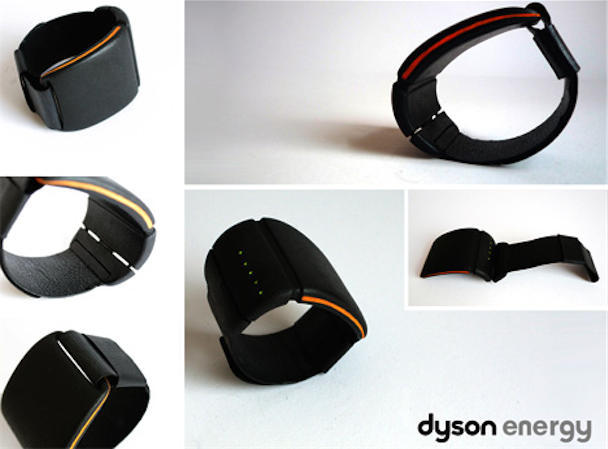
Are you tired of walking, running or otherwise moving to eek a bit of electricity from the numerous gadgets converting kinetic energy into power for your iPhone?
Get ready for extra talk time for just being alive. The Dyson Energy Bracelet converts the temperature difference between your body and the surrounding environment into enough electricity to talk a few more minutes on your favorite Apple communications device.
The bracelet includes a mini USB connection which Apple and other cell phone makers earlier this week approved as a universal standard (at least in Europe) for recharging mobile phones, starting in 2010. A price and distribution date have yet to be announced. More information is available at Yanko Design.
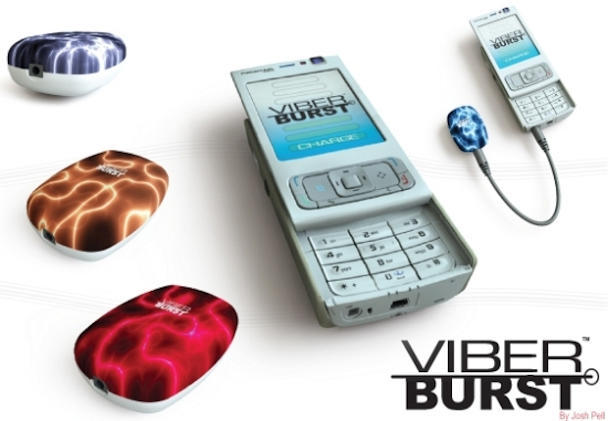
Unlike the Viber Burst kinetic device we talked about recently, the Dyson bracelet employs the thermoelectric effect to convert body temperature into electricity. Although the thermoelectric effect is commonly used in temperature sensors, it can also be used to generate power. (Here’s a fuller explanation of the science behind the gadget.)
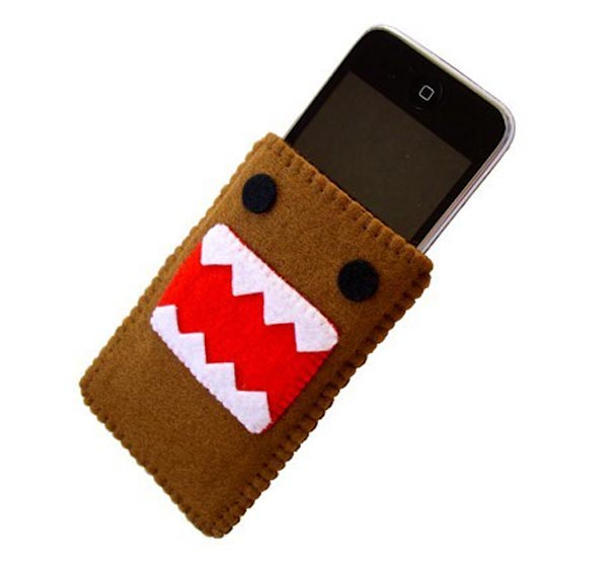
If you’re looking for a “green” way to protect your new iPhone, felted cases appear the latest fad for eco-conscious Apple fans. The latest example: the Domo Kun iPhone case. The felt case, designed for the iPhone, iPod Touch and iPod Classic, is emblazoned with Domo Jun, the monster serving as a Japanese TV mascot.
The felt monster measures 4.7-inch x 3.1-inch, but the Etsy artist announced Tuesday the hand-made item was sold-out, just a day after putting the iPhone/iPod holder on the site. A similar fate met another iPhone case, a felt version of an old-style rotary phone.


