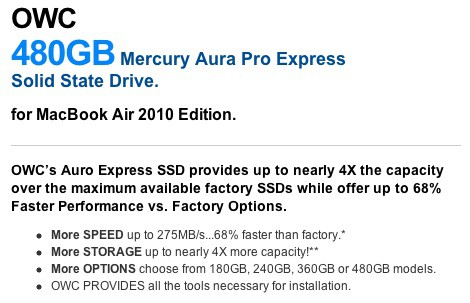
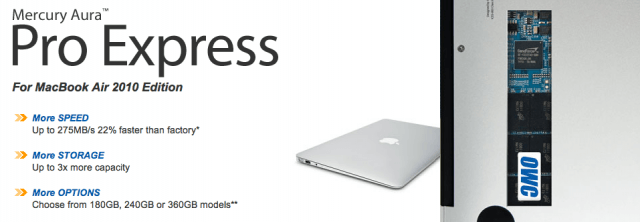
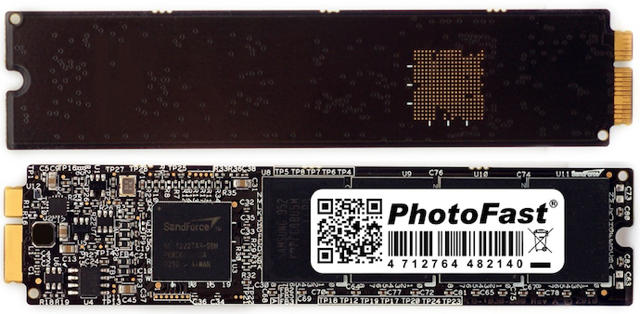
Other World Computing has just announced its latest Mercury Aura Pro Express solid-state drive designed for the latest generation of MacBook Airs. Boasting a whopping 480GB of storage, the upgrade offers nearly 4x more capacity than currently available from factory available SSDs, and is an incredible 68% faster.
As you’d expect from an SSD, however, especially one designed for the latest MacBook Air, these babies come at one heck of a price. The 480GB upgrade will set you back a staggering $1,579.99, but you’re not going to find this kind of storage for Apple’s ultra portable notebook anywhere else.
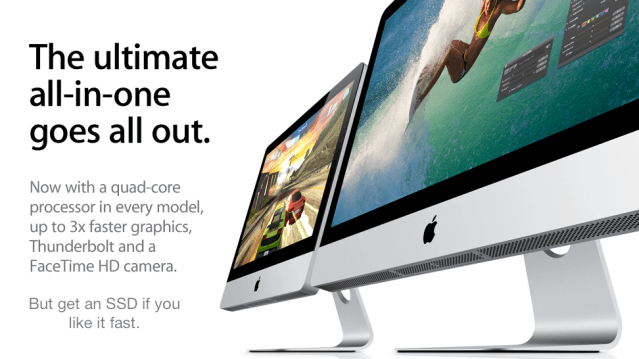
Apple’s new family of iMacs launched today, featuring Intel’s latest Core i5 and i7 processors, 4GB of RAM, and 3x faster graphics; all the ingredients needed to bake a super speedy all-in-one. However, there’s one thing missing from Apple’s lineup of four ‘ready-made’ iMacs, and that’s a solid-state drive. Without one your shiny new iMac might not be as fast as you expected it to be.
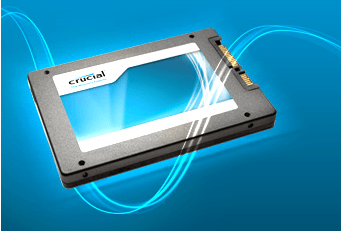
Crucial has just launched its new M4 lineup of 2.5-inch solid-state drives, which are the successors to the RealSSD C300 range, and boast faster read and write speeds. The M4 uses 25nm technology NAND flash created by its parent company Micron, and is available in 64GB, 128GB, 256GB and 512GB models.
Crucial claim the new M4 SSDs reach read speeds of up to 415MBps – a 17% increase over its predecessor – while write speeds are up 20% with speeds of up to 260MBps.
As with all SSDs, however, this technology doesn’t come cheap. The 64GB M4 will cost you $130, which rises to $250 for the 128GB, $500 for the 256GB and $1000 for the 512GB. All can be purchased directly from Crucial and include a three-year warranty.
While the M4s are pretty pricey, solid-state drives are a great way of improving the speed of your Mac. Traditional hard drives are famous for being the bottleneck in modern-day Macs, and since the release of the incredibly nippy second-generation MacBook Air, many users have realized the difference an SSD can make and have adopted the new technology. Recent tests have proven that MacBook Pros equipped with SSD drives are significantly faster than those with traditional HDDs.
I live on this long, steep hill that some days just feels so infinite and Sisyphean that I fear I might be the character of some inexplicably forgotten short story by Jorge Luis Borges. On particularly hot summer days, I’ll sometimes muse to myself, halfway up this interminable hill, that walking really is for suckers, and I should just lop off these wimpy locomotive appendages and treat myself to some of those robo-legs I’ve had my eye on for so long.
Apple doesn’t make robot-legs, unfortunately. What they do make are MacBooks that come with SSD drives… and to me, investing in one was pretty much the direct equivalent of having my computer’s old weak, broken legs cut off and some rocket-powered karate kickers transplanted in their place. You simply will not believe how fast computing can be with an SSD, or how slow your current “fast” computing experience is without one.
Need more proof than my say so? MacWorld tested a few MacBook Pros — a couple with SSDs, a couple identically specced without — and found notable speed improvements.
AnandTech is reporting that Apple has appeared to have made some changes to the MacBook Air released in October 2010. The Macbook Air refresh last fall included some welcome surprises for Apple fans — a new 11.6″ form factor, an external case redesign, faster graphics, and larger SSD drives. All of this came at a lower price. The most interesting part of the refresh was the new SSD drives. Apple didn’t use regular 2.5″ or 1.8″ SSDs and instead introduced a whole new type of SSD form factor called mSATA SSDs a.k.a. blade SSDs.
This is welcome: OS X 10.7 Lion adds support for the TRIM command. The addition of this deep little function will mostly be of interest to new MacBook Air owners, as it’s essential to the long-term performance of an SSD drive.
The new MacBook Pros expected later this week will boot off solid-state drives, claims Boy Genius Report, citing unnamed sources.
In addition:
The new MacBook Pros will feature larger glass trackpads. It’s hard to imagine how this is possible, but they’ve been growing with each successive machine, so maybe so.
The lower-end models will have 8GB-16GB SSDs for Mac OS X, and will also come equipped with a regular hard drive. This will offer the benefits of SSDs — instant on and super fast performance — while also providing lots of room for power users’ files (video and Photoshop).
The higher-end models will be SSD only, just like Apple’s new MacBook Air line.
The new machines will be up to a half-pound lighter than curent models. Again, hard to imagine how this is possible given that Liquidmetal rumors are unlikely.
The report also note there will be five different SKUs, jibing with previous rumor reports.
Apple’s product release cycle can seem mysterious if you’re new to the fold, but old hands know roughly when to expect the next refresh of each of Apple’s product lines. So when the Three Guys and a Podcast blogs say that new iMacs should be due in March, they aren’t really saying anything that MacRumors’ Buyer’s Guide couldn’t tell you.
More interesting than the new Macs in March revelation is some of the other predictions Three Guys and a Podcast have put together: they expect that solid state drives will be coming to all Macs starting this year, loading the OS on one drive while pairing them with larger traditional HDDs for storage. The end result should be much, much speedier Macs all around (trust me on this one: my 27-inch top-of-the-line iMac has collected dust ever since I got my 11-inch MacBook Air).
Additionally, we should see Intel’s new Sandy Bridge processors in this year’s Macs, as well as improved (but not Retina Display) resolutions in the 21.5-inch and 27-inch iMacs, thanks to Apple’s ongoing investments in display technology. A modest refresh for right now, but just wait until the next refresh, when Apple tackles the iMac line with more radical redesigns in mind. I can’t wait.
Feeling pinched for space in your new MacBook Air? I know I certainly am, even (or, perhaps, especially) with a 500GB USB hard drive perpetually tethered to my 11-incher.
I’m interested, then, in OWC’s recently unveiled Mercury Auro Pro Express Kits, which are compatible with both the late 2010 11-inch and 13-inch MacBook Pros. They are available in three sizes: a $499.99 180GB dSSD, a $579.99 240GB SSD, and a $1,179.99 360GB SSD… all of which are not only bigger than Apple’s in-house drives, but faster as well.
Much as I’d like a bigger SSD in my MacBook Air, at those prices, I’m tempted to wait until they come down a bit… but that might not be an option. Apple has already shut down one company selling MacBook Air SSD upgrade kits, and it’s likely they’ll do the same here, so if you’re going to get one, better scrape that $500 together fast.
Although it pays off in compactness, the MacBook Air’s locked down, proprietary construction makes it one of the least self-serviceable or upgradeable computers out there. Heck, you can’t even upgrade the RAM: it’s soldered onto the motherboard.
If you’re brave enough to crack open your Air, about the only thing that will actually prove replaceable to most mortals will be the Toshiba SSD drives, which is what prompted Taiwanese company Photofast to start selling 256GB SSD modules that offered a 30% boost to your Air’s read and write speeds.
Unfortunately, it looks like Photofast’s MacBook Air SSD business has been shut down by Apple, who apparently threatened the company’s >a jref=”https://www.9to5mac.com/38937/apple-makes-photofast-stop-sales-of-speedy-256-gb-macbook-air-ssds?utm_source=feedburner&utm_medium=feed&utm_campaign=Feed:+9To5Mac-MacAllDay+(9+to+5+Mac+-+Apple+Intelligence)”>standing as a member of Apple’s own MFi program, which allows them to make officially licensed Apple accessories.
It’s sucky, especially if you wanted to double your 11-inch Air’s for cheap (as I did), but in all honesty, my butter fingers are probably better off not cracking open my Air’s guts. Apple’s probably done me a favor here.