Mobile menu toggle

Search results for: Apple One

Mac Billboards and ebOY-style Street Scenes

By

post-272-image-05ef13bb4fb6f79c63774a8586bdf498-jpg

Talking of Apple billboards, MacBillboard.com is a site devoted to — Mac billboards.

The site, based in Holland, has six pages of billboard photos submitted by snappers from all over the world, like the one above of a billboard in Los Angeles by Mark Adamson.

Better, the site also has a series of ebOY-style pixelart desktop pictures, showing incredibly detailed Amsterdam street scenes full of iPod billboards and office workers sitting at Macs. Here’s the index page with each image at several different resolutions.

Airport Express pixelart desktop

There’s an Apple garage sale, an iPod factory, and an Apple retail store with a line of little pixely Macheads waiting to get in. Here’s a detail:
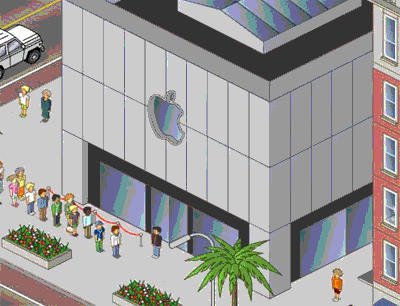
IFO pixelart Apple store

You can also get an Apple mini store desktop — modelled after Apple’s container-sized mini shops — which has lots of space around the edges designed to be populated with the site’s custom icons, like these I-heart-iPod icons.
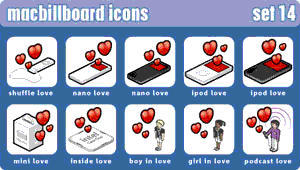
I heart iPod icons

It’s all free, so have at it.

Cult of Mac Paperback — Call for Submissions

By

post-261-image-fb99e5e383c93cd5a5a1ddbd6b234a55-jpg

I’m in the process of updating my Cult of Mac book for a paperback edition, to be published in the fall.

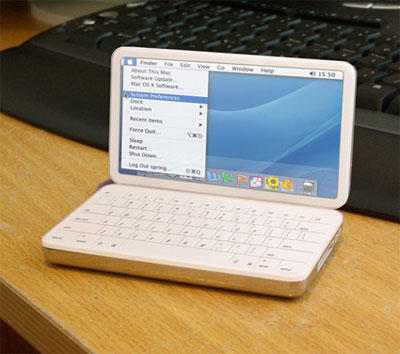
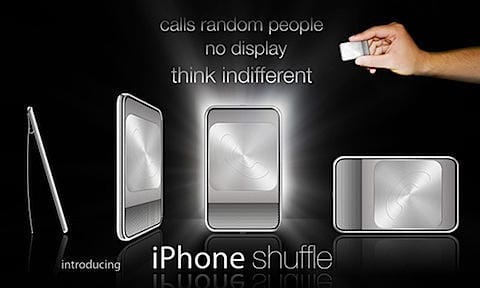
Some of the graphics are looking a bit dated, epecially the mockups of future Apple products, like those submitted to Engadget’s recent WWJD competition.

Trouble is, I’m having a hard time tracking down mockup makers. So I’m putting out the call.

If anyone has high-resolution, print-ready mockups, and they’d like them included in a new edition of the book , please contact me at mockups -AT- cultofmac -DOT- com.

Photo courtesy of Engadget.

Windows on a Mac

By

post-257-image-409fdcec98235744fa7a60c075e2fed3-jpg

Slashdot commentator on Windows on a Mac:

“We’ve figured out how to put an inferior OS on more expensive hardware! That way, we can have both the frustrations of Windows and pay out of the ass for Mac. Everybody wins!”

And here’s Joy of Tech’s take. Click the pic for the entire cartoon.

It reminds me of my experience of installing Linux on a Mac a few years ago — which was, “great, now what?”

Another Slashdot poster has a good point about Windows-running Macs being attractive to businesses — they won’t:

“First, dual boot is a myth, it is damn annoying and so counterproductive. Most people dont realise that until they actually experiment it, it’s hype now, but all Linux users know it’s a pain, and I know from experience that a dual boot Windows/Linux means one thing… Windows 90% of the time. Vmware and others solutions are the way to go for people who need Windows professionaly for a given application, I can’t wait for a Mac OS X version. Second, some people try to makes us believe that companies will buy Apple PC to their employees now that they can run Windows, yeah right, serious manager will buy more expensive hardware, plus a Windows licence, so that their employees can have an Apple design and the joy of using Mac OS X out of the office… “

Reviews

By

cult_logo_featured_image_missing_default1920x1080

Cult of iPod

Reviews of Cult of Mac

Does DRM Really Suck the Life of Batteries? — CNet Test Flawed

By

cult_logo_featured_image_missing_default1920x1080

An experiment by CNet to see whether copy-protected music files sucked the life out of player’s batteries is interesting but flawed.

According to CNet, DRM copy-protected music can decrease battery life by up to 25 percent thanks to the processing overhead necessary to play them.

But as one commentator on the story points out, the test compared protected WMA files with unprotected MP3 files. It should have compared protected-WMA to unprotected WMA, or Apple’s FairPlay AAC versus unprotected AAC.

Here’s the Censored Pics of Torched MacBook Power Connector

By

post-249-image-b9d8437b4e1afbe6bf1e87c539d94234-jpg

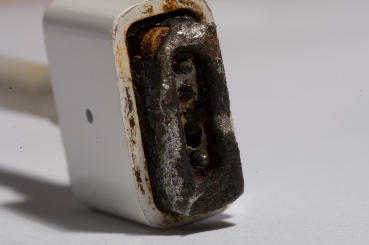
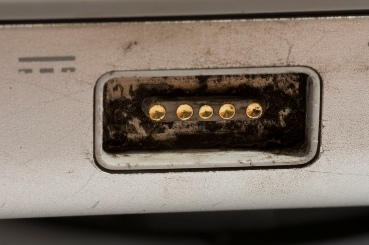
The Dutch MacNed website has copies of the controversial pictures of a magsafe power connector that were removed from Flickr on Thursday at the request of Apple.

The magnetic MagSafe power connector allegedly burned up. Its owner, Rogier Mulder, posted some pictures to Flickr, which immediately caught the attention of Apple. He was asked to remove the pictures while the company investigates. He writes on Flickr:

“Apple support responded very well (thanks Klaas) and fast. Before I called our local Apple support line, the dutch engineers were already contacted by their US collegues (who saw the pics) to inquire if I already called in. I’m getting a new Macbook asap and I will return my current one.”

magsafe002.jpg

magsafe.jpg

FreeiPods.com Sold Private Data — Despite Promising Not To

By

cult_logo_featured_image_missing_default1920x1080

FreeiPods.com, the wildly popular marketing scheme that offers free iPods for trying out various subscription offers, sold the data it gathered on 7.2 million Americans to an email advertising firm, according to a story at Wired News by my colleague Ryan Singel.

(New York Attorney General Eliot Spitzer) announced Monday that e-mail marketing giant Datran Media had agreed to a $1.1 million fine for knowingly buying marketing lists from companies with privacy policies that promised not to sell or transfer the lists to a third party.

… Datran’s biggest purchase, according to the text of the settlement (.pdf), was a list of 7.2 million Americans’ names, e-mail addresses, home phone numbers and street addresses from Gratis Internet, a company best known for promising free iPods, televisions and DVDs to users willing to sign up for promotions offered by partners such as Citibank, Blockbuster and BMG’s music club.

The sites inspired dozens of “Is there really such a thing as a free iPod?” stories in the press (including one by Wired News), and internet forums were packed with pleas for information on how to acquire a free version of Apple Computer’s signature fetish item. The freebie required a registrant to sign up five others into the program, and eventually the legalized pyramid scheme reached its inevitable saturation point.

While many did indeed get a free iPod, all ended up with inboxes full of marketing pitches, which began showing up within hours of registering.

Gratis lied to me for the story I wrote originally about the company (also linked above), which did wonders for their early credibility, and then lied again for a follow-up story I wrote about it’s privacy practices that was prompted by the avalanche of spam its customers mysteriously received.

In addition, Gratis Internet was a member of Truste, which provides a “privacy seal” to companies it says have a trusted privacy policy.

When asked by Wired News in 2004 how third-party spammers got hold of Gratis members’ e-mail addresses, Truste said it could not find a problem with Gratis’ practices.

“The results of our investigation indicate that Gratis Internet did not violate their privacy policy,” Truste investigator Alexander Yap wrote in an October 2004 e-mail. “Truste did, however, work with them to strengthen and clarify their privacy statement.”

Several months later, Truste revoked Gratis’ seal of approval, then quickly reinstated it, then pulled it again, but declined to state publicly its reasons.

In the wake of this week’s settlement, Truste’s spokeswoman did not return repeated phone calls, and executive director Fran Maier did not respond to e-mailed questions about why Truste never discovered the alleged sale or informed the public that Gratis was not adhering to its privacy policy.

The Steve Jobs Soundboard

By

Steve Jobs Soundboard

Now you can create your very own Steve Jobs keynote, thanks to a soundboard with 50 of the great man’s utterings.

Made by a Japanese website, the soundboard includes gems like:

“But there is one more thing.”

“We think video is the wrong place.”

“Do you have an iPod?”

“It scrolls like butter.”

“We have this rotating Apple sign on the top, which is popular in Tokyo.”

Unfortunately, the site is slow and may be having server problems. It doesn’t appear to be loading the entire soundboard. I get only 6 phrases, including a very tinny and disappointing, “Hi, I’m Steve.”

Get Real Audiophile Sound From an iPod

By

post-3-image-315b232f8ac77d51207a1f39a4fd1cc6-jpg

It is possible to get audiophile quality sound out of an iPod, but probably not from Apple’s iPod Hi-Fi boombox, says technologist Tim Bray.

“I gather that on stage today, Mr. Jobs freely flung about the word ‘audiophile’ while pitching the new iPod Hi-Fi. Well, I’m one of those: wrote for the mags, have gear from obscure British manufacturers, turn off a fridge thirty feet away to listen. I’ll look forward to giving the Hi-Fi a listen. It seems fantastically dubious that something 43 cm wide, with a listed bass floor of 53Hz (the bottom string on a bass is 42Hz), weighing 6.6kg, and costing $349, could actually produce ‘audiophile’ sound.”

Bray, Sun’s Director of Web Technologies, suggests instead plugging in a good pair of in-ear canalphones. Bray recommends Etymotics or Shure. I have a pair of Xtrememac FS1, which have heartier bass than the Shure or Etymotic. But Bray says most important of all…

… get your music off CDs and use lossless compression. The D/A in an iPod is really not bad at all; if you send all of the music through it and play it through first-class transducers, you’ll be happy.

Infoworld Agrees: OS X “Threats” Overblown

By

cult_logo_featured_image_missing_default1920x1080

It’s nice for once not to be utterly alone in my opinions.

Earlier this week I wrote the recent security “threats” to OS X are overblown in a column entitled Mac Attacks a Load of Crap.

Most people disagreed. John Dvorak, for example, says malware is “good news for Mac users because now security holes will be fixed early, and users will learn to become aware of these things. It’s a little bit like getting the mumps. You do not want to get this ailment as an adult.”

But veteran tech reporter Tom Yager at Infoworld, who’s as sober and levelheaded as they come, says the panic is much ado about nothing. He writes:

“… rather than marking the first viruses to infiltrate the Mac OS X fortress, as many press reports claimed, the vulnerabilities are among many potential security risks that Apple continuously and proactively tracks. Furthermore, the “critical” label affixed to the viruses by security vendors are alarmist, inciting a code-red threat level for potential security risks that Mac users can avoid through commonsense precautions.

A media feeding frenzy has erupted over the OS X Leap.A worm and the Safari browser filesystem metadata proof-of-concept exploit. It is a nonstory that has been given legs by virus software vendors that get their names in the papers by branding as extremely critical malware that’s been harmless to date — the very same vendors that then admit that one check box’s worth of tilting the balance between convenience and safety is all that’s required.”