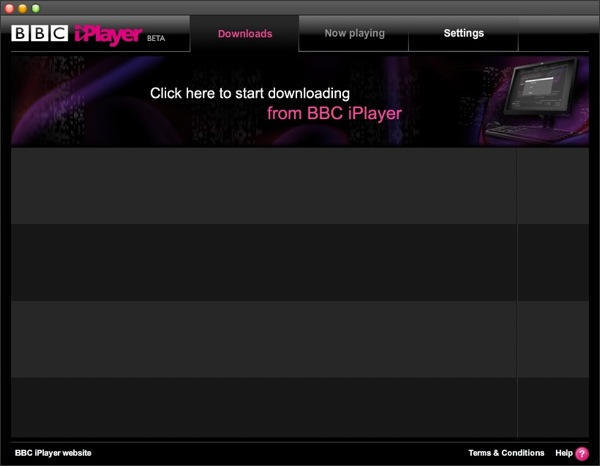
At long last, there’s a desktop app for UK Mac users to download digital copies of BBC TV shows.
The launch of the Mac beta comes many months after its Windows rival. It also comes with a self-congratulatory news story at news.bbc.
And it’s also a bit of a mess.
Lots of people, myself included, have spent long hapless hours this evening, trying to find any way to download the app in the first place. I hunted high and low and found nothing. I signed up as a Labs user. I clicked randomly on some stuff. Hmmm. Finally a friend sent me this link, which took me to a Download option.
It’s an Adobe Air app, so installation is fairly straightforward from that point. Even so, with the app installed, I still can’t find a single show available as a download. And that’s after trying in three different browsers. Hence the disappointingly empty screenshot above.
But hey, let’s not moan. It’s great to have the app at all, and UK Mac users will be delighted to have it around. Thank you lovely Auntie Nerds!
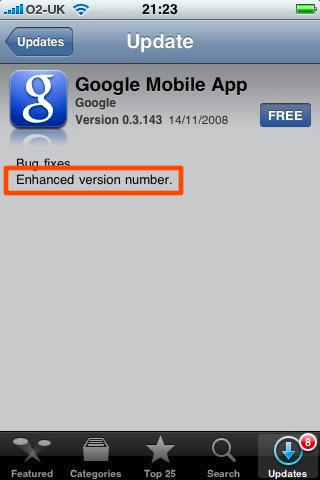
Only Google treats us as well as this. Other software developers insist on adding functionality to their updates; only Google gives us the benefit of enhanced version numbers. These people really care about us. It brings a tear to my eye, it really does.
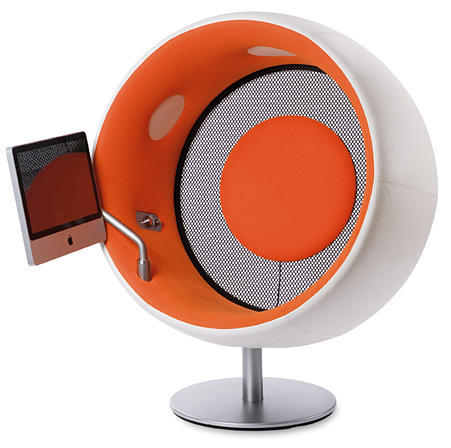
Philippe Starck, one of the most famous and prolific designers alive, has made these monumental iPod speakers.
Called Zikmu and designed for Parrot, these sleek, wireless “couture” speakers stand 2.5 feet tall with a docking station for an iPod or iPhone on top. Audio can also be streamed from a PC or Mac via Wi-Fi or Bluetooth, and the speakers emit sound from both sides.
They’ll be in available in spring 2009 and cost $1,500.
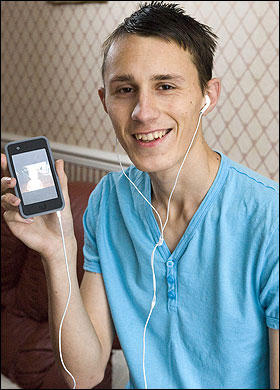
If British tab The Sun is to be believed, 18-year-old Gavin Brooke stayed awake listening to an iPod as surgeons removed a brain tumor.
The teen had a tumor in a tricky place that surgeons didn’t want to damage, so the boy had to stay awake during surgery.
Brooke was given an anesthetic to numb the pain, but the head surgeon let him hook up his iPod Touch to give him something to do.
What was on the playlist?
The first tune Brook played on his iPod was “Apologize” by Timbaland Featuring One Republic, the rest were garage and R’n’B tracks that kept him occupied during the six-hour surgery. The iPod was plugged into the operating theater’s sound system and the volume was low enough so that Brooke could carry on conversation with the surgeons.
The tumor was removed and Brooke has since recovered.
Photo: Cishore/FlickrApple’s withdraw from Macworld Expo marks “the beginning of a shift in leadership roles,” Piper Jaffray’s Gene Munster told investors Wednesday.
The decision by CEO Steve Jobs to bypass a keynote speech in favor of marketing head Phil Schiller, sends “a clear message that a leadership shift is underway,” Munster wrote in a note.
This isn’t the first time onlookers have attempted to read Apple’s intentions through trade show speaker selection. In October, the inclusion of Schiller and Tim Cook prompted questions of a potential exit by Jobs.
The Apple Expo in Paris became the latest victim of Cupertino’s decision to scale back its participation in industry trade shows. The French show announced Wednesday next year’s show was cancelled.
Attendance at the 25 year-old Paris event had dwindled to 30,000 this year from a high of 90,000. Apple CEO Steve Jobs had skipped the event since 2004, when he underwent surgery for Pancreatic cancer. The trade show suffered another black eye in 2007, when Apple was unable to show the iPhone.
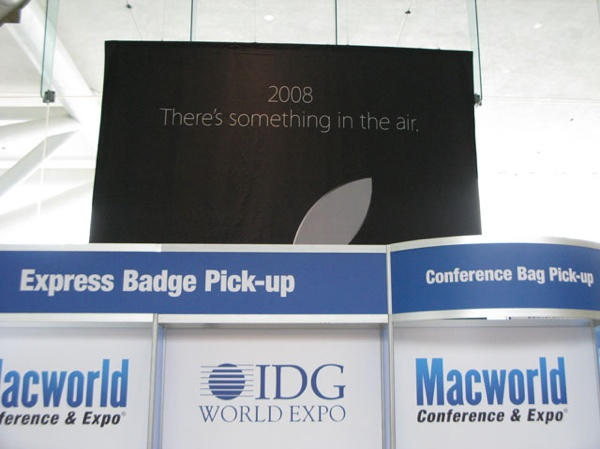
Tuesday Apple announced San Francisco-based Macworld Expo 2009 would be its last and that Jobs would not be keynote speaker. The company explained the move, saying trade shows had become ‘a very minor part’ of customer outreach.
Recent weeks have seen renewed discussion about the security vulnerabilities of Macs and the OS X operating system, though, as usual, it is primarily PC interests who say, “your day of reckoning is gonna come” and Mac interests who say, “Apple computers are the safest computers under the sun.”
Meanwhile, Apple released a security update on Tuesday that quashed 21 security bugs, news of which was taken by those on both sides of the debate as evidence their argument is right.
What better time, then, for Norton/Symantec to release Internet Security 4 for Mac and Internet Security for Mac Dual Protection, designed for those running Boot Camp or other Windows virtualization software on the Mac. Both products integrate all-new firewall and antivirus protection with tools to help protect against the increasing instance of identity theft.
I spent some time this week going over the UI and program features with Symantec’s Mac Product Manager, Mike Romo, and I was impressed with the granularity built in to the software’s control features and pleased to see Symantec has paid attention to creating a UI that says the designers have seen and used Macs themselves.
While automatically blocking attempted exploits using different protocols, Norton Internet Security for Mac’s firewall now also offers application control, which allows users to manage the applications that are connecting to the Internet, protecting Macs from spyware. New location awareness controls let users specify different connection settings for different networks to which a computer may be connected. The software is also integrated with Symantec’s DeepSight Threat Management System, an evolving database of known bad actors. Firewall rules are automatically updated at least once a day to protect against the latest attacking IP addresses.
This is powerful software that should appeal to rabidly security-conscious Mac users – especially the growing cadre of multiple-user businesses, schools and enterprise customers who have adopted the OS X platform – who will be happy with its degree of configurability as well as the extensive live monitoring and event logging it makes possible. Those who want to “set it and forget it” can also feel secure from phishing, malware or hacking threats they believe are lurking out there for the Mac.
Available now for the US from the Symantec online store and through various retail outlets, Norton Internet Security 4 for Mac is US$79.99, which includes a one-year subscription to Symantec protection updates. The suggested retail price for Norton Internet Security for Mac Dual Protection is US$89.99, which also includes a one-year subscription to Symantec protection updates.
“Apple is sending a message to the entire community–professionals, hobbyists, media, Mac User Groups, and even IDG themselves–that they care nothing for the community who supported them through thick and thin,” she declares.
And so: “If you’re attending the Macworld Expo keynote on Tuesday, Jan. 6, you can send a message to Apple by remaining silent during the 2009 keynote. While Phil Schiller is on the stage, let there be no applause, no whistling… just utter and complete silence.”
What do you think of Lesa’s plan? Will you join her in silent protest? If you do, and Apple DOES finally unveil that updated Newton-Pippin-Tablet-iPhone crossover that everyone’s been going on about for so long, how will you manage to contain yourself?
I can’t help thinking that Lesa’s just shooting herself in the foot here. By announcing that it will quit Macworld, Apple has already made clear that it doesn’t care what Macworld attendees think. It’s going to do its own thing, regardless.
(Photo used under Creative Commons license: thanks kradlum.)
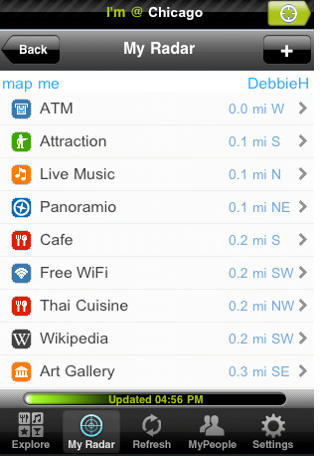
You yourself might not be an actual superhero, but with Earthcomber, a free GPS-leveraging search/mapping/social networking app for iPhone and iPod Touch, you can have “superhuman awareness,” according to developer Jim Brady.
Preloaded with a comprehensive database of restaurants, movie listings, events, historical sites, local information and more, the app lets users tag their interests – for example, Greek cuisine, historic buildings, hot chai tea, or free WiFi access. They can also add their own items, and invite friends so they can find them as well.
Earthcomber then scans an area for any matches, using the iPhone’s GPS. Any place that has anything of interest is announced by an optional chime.
Earthcomber is different, according to Brady, because it utilizes multiple technologies so the user doesn’t have to jump from one application to the next to accomplish related tasks. “That’s the whole point,” Brady said. “We don’t have to turn off our eyes to start up our ears, and we sure don’t have to fill out a search box for our brains to work. Earthcomber uses mobile technology as a powerful extension of our natural abilities, so that we can be constantly aware of what’s right around us.”
Earthcomber won Nokia’s 2008 Mobile Rules! competition for “Best Infotainment” application. The company provides USA service today and plans international coverage with a coming update.
Retina-X released the unsubtly named Mobile Spy software for iPhone on Wednesday, a product the company says “will reveal the truth for any company or family using Apple smartphones.”
Mobile Spy operates in stealth mode, invisible to the iPhone user, but permits parents or employers who install it to silently monitor incoming and outgoing text messages (SMS) and call information of children or employees – even if activity logs are erased. The software starts when the phone is booted up, records all call and SMS activity and uploads the data in real time to Retina-X servers, which may be accessed from anywhere on the Internet.
The company says it is working on adding spy awareness to email activity in a future release.
Because the software runs in the background, sending and receiving data across the network while other software is in use, Mobile Spy violates Apple’s iPhone SDK, so you won’t find it on the app store, but it is available on the Retina-X website.
Priced at $100 annually, $70 semi-annually or $50 quarterly, it is compatible with iPhone 3G only.
This holiday season you may want to beware of parents, bosses and spouses bearing iPhone gifts.
One of the most depressing scenes in the already depressing “Sex and the City” movie is the one where Carrie Bradshaw gets left at the altar.
The groom, aka Big, hasn’t shown up. In a scene where all the stars especially look like they need a good night’s sleep and more calming carbs in their diets, Samantha holds an iPhone, set off against a fire-engine red dress.
Ahh, remember back when? When rumor sites didn’t exist? Where second-guessing the next Stevenote meant walking in the rain to your nearest User Group meeting, and having a heated discussion with your friends Gary, Bob and Bob about what future Macs might be like?
(And how you and Bob would disagree, and at the end of the evening neither of you had given way on the argument, so you said to Bob: “I’ll write you a letter to spell out exactly what I mean,” and Bob said: “Hey even better, you can send me a message on my new FAX MACHINE!”, and you felt completely out-manouvered?)
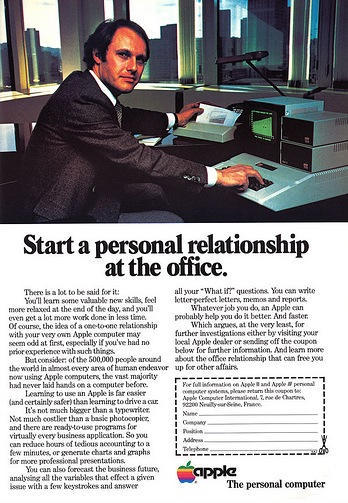
Ballistickcoffeeboy has a Flickr photostream stuffed to the brim with vintage Mac stuff. Adverts, screenshots, product pics, photos of his own kit, you name it. Go dive in and wallow for a bit.
(Photo of “Start a personal relationship at the office” used under Creative Commons license, thanks to ballistikcoffeeboy.)
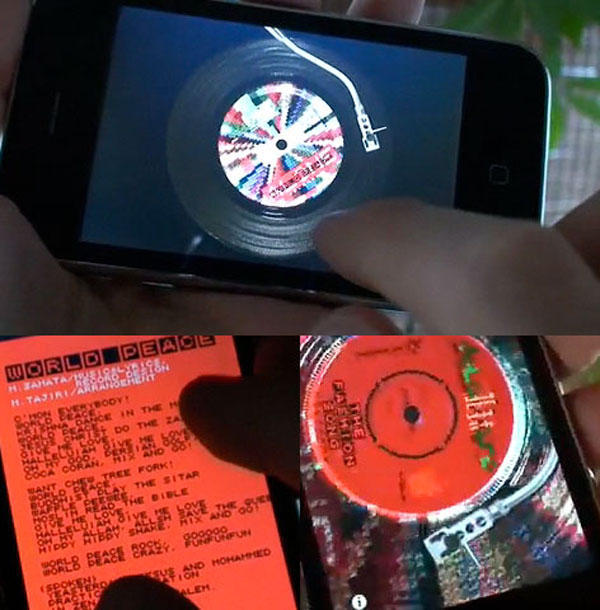
A little bit old school, a little bit new school: the Record 001 app lets you work the image of a vinyl record with your fingers in a shout out to turntable days.
Digital DJs can backspin, pause and scratch like they would on a real record on an iPhone or iPod touch screen.
Record 001 has mixed reviews so far — the first release comes with just two oddball tracks “World Peace” and “The Fashion Song” — calling it a quirky demo app but not regretting the $1.99 price tag.
See if you don’t get a smile out of the video, though.
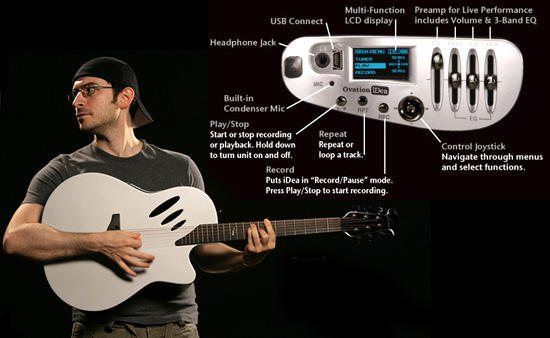
In a nod to Apple, the world’s first MP3 recording guitar is a sleek, all-white number called iDea.
You can record riffs as you play, along with vocals on a built-in condenser microphone or use the built-in MP3 player to add backing tracks. It holds up to 100 minutes of music.
A USB port lets you transfer your music to a Mac or PC. The iDea comes with pre-loaded tracks, plus six lessons and an amp. The whole shebang is controlled from the top side of the guitar, no word on whether there’s a left-handed version, too.
Tech-strummers Ovation created the guitar, it comes with a $600 price tag.
If you love the idea but are more of a Mac-loving DIYer, you may want to check out this hack Brian Green made by adding two iPod Touch devices to his guitar, calling it the iTouch guitar.
Apple must end its exclusive iPhone sales agreement with France Telecom, a government agency ruled Wednesday. The 2007 deal created a “serious and immediate” threat to broader competition, according to France’s competition regulator.
The order could allow the No. 3 French carrier Bouygues Telecom SA to begin selling iPhones soon. For its part, Orange announced it would appeal the measure. The carrier said the decision puts France in a “radically different situation” than Germany, the U.S., Britain and Spain, where Apple has exclusive distribution deals.
The French Competition Council, which took up the Bouygues claim in September, said Apple’s five-year agreement with Orange was “clearly excessive.”
“Steampunk lies at the intersection of science and romance,” says one of its foremost practitioners, Jake Von Slatt. “It embraces technology but demands technology return the favor.”
We came across Von Slatt while checking in with our friend Bob Eckstein, whose recently completed project, The History of the Snowman is now out in the world after six years of grueling research.
One of Eckstein’s next projects is producing a graphic novel out of a nautical explorer’s diary from 1850. A full-immersion writer, Eckstein has gotten himself in the mood for the work by transforming his office space into a 19th century Captain’s Quarters. He refitted his computers and office equipment into old ship instruments to lend verité to his efforts, and secured vintage trappings to serve up authenticity to his muse.
Hence, my introduction to Steampunk.
Click on pics in the gallery below and follow after the jump for more of the story.
Treo-maker Palm has unveiled the Palm Software Store, the latest company to take a page from Apple’s successful iPhone Apps Store.
The new store allows Palm device owners to purchase and download either Windows Mobile or Palm applications directly to handsets. Palm users were required to download applications to a computer first and then transfer the software.
Apple said trade shows, such as Macworld Expo, are a “very minor part” of how the company reaches customers. Instead 3.5 million Apple fans stream into Apple stores each week.
Macworld had been used as a platform to interact with developers and a way to talk to the press. However, Apple has created its own developer conferences and spread product announcement throughout the year to guarantee almost continuous press attention.
“So why pay IDG and be subject to its event requirements,” asked Apple analyst Avi Greengart of Current Analysis. “This will definitely weaken Macworld going forward.”
There may be a silver lining in Apple’s announcement it won’t attend future Macworld Expo trade shows. Despite the downgrades and talk of CEO succession planning, one analyst says Apple can only benefit from Tuesday’s decision.
“I see this as a major boon for investors, rather than a bust,” independent Apple analyst Andy Zaky said in an e-mail to Cult of Mac.
Only traders wishing to manipulate Apple stock through rumors and speculation could be hurt, according to Zaky.
Since 2007, Macworld events have seen “massive selling in Apple’s stock,” he said. In fact, every Apple media event has resulted in a drop in stock prices.
Was 2008 the last Macworld appearance for Apple CEO Steve Jobs?
Despite Apple’s attempt to convince investors otherwise, Oppenheimer & Co. told clients new questions about CEO Steve Jobs’ health made the Cupertino, Calif. company a risky long-term bet.
The investment house downgraded Apple’s stock to “perform” from “outperform” following Tuesday’s announcement Jobs would not appear as keynote speaker at the Macworld 2009 tradeshow – the last year Apple would attend the annual event.
“Whatever the reason, the unexpected announcement has underscored the greatest risk to Apple’s long-term success — its dependence on Jobs’ health and its apparent lack of a succession plan,” analyst Yair Reiner wrote investors.
Every time I say this, some people start getting all shirty and saying: “Yes it is! Steve matters!”
After my Don’t Panic post yesterday, there were similar comments, like this one: “Yeah, actually Steve Jobs health is our business. He made Apple, he revived Apple and he brought Apple to it’s current massive success. Steve Jobs IS Apple. Without him the company has a far smaller chance of survival.”
I completely disagree with this line of thinking, and here’s why:
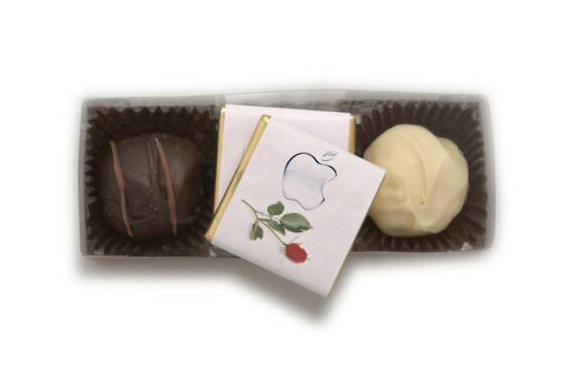
Eating just one Belgian truffle can make you “significantly more likely” to desire a Mac than your more self-controlled neighbor, according to a study due to be published in the Journal of Consumer Research.
Professors Juliano Laran (University of Miami) and Chris Janiszewski (University of Florida) conducted a two part study in which one group of participants was given a chocolate truffle, while the other group was required to abstain. In part one of the study, the researchers found, not surprisingly, the group of truffle eaters was more likely than their pleasure-restricted peers to to unleash a “what the hell” syndrome, and revealed a desire for additional treats such as pizza, ice cream and potato chips, while their abstaining counterparts found it easier to resist temptation.
Part two of the study again had people eat or resist a chocolate truffle and asked them to indicate how much they desired several products that are symbols of status [for example] an Apple computer… “People who ate the truffle desired the status products significantly more than those who had to resist the truffle,” write Laran and Janiszewski.
The answer to Apple’s flat Mac sales, then, would appear to be free truffles for every visitor to an Apple Retail Store. Someone get an advance abstract of Behavioral Consistency and Inconsistency in the Resolution of Goal Conflict to Cupertino, stat!
Not literally, mind. From the delightful Peter Serafinowicz Show Christmas Special, uploaded to YouTube this evening. The demonstration of the comma is amazing, but you wouldn’t believe what it takes to make a semi-colon.