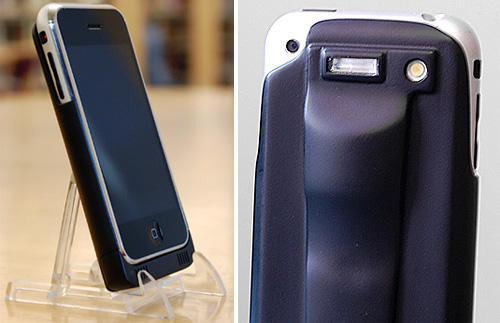
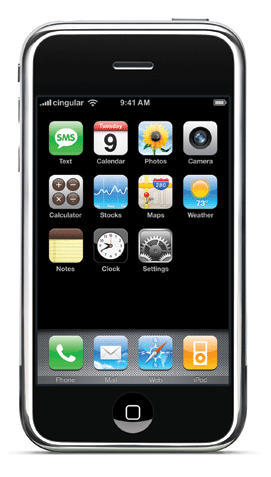
A promise to “unleash the true power of your iPhone” might not be the best marketing slogan for Snapture Flash, a xenon flash accessory with red-eye reduction for Apple’s mobile device. As snappy as it sounds, the slogan also calls attention to what is roundly regarded as the iPhone’s weakest attribute, its 2.1 megapixel, fixed focal length still camera.
The flash’s sleeve-like case is powered by the phone itself, which SnaptureLabs estimates will give you 1000 flashes on a single charge. As a bonus, the sleeve also provides amplification for the iPhone’s on-board speaker.
The downside here is that the flash is only a prototype and the accompanying Snapture camera software (which itself provides some interesting creative mods and controls for the iPhone’s camera), requires a jailbroken phone to avail yourself of its charms.
It will be interesting to see whether Snapture Labs can strike a deal to get it’s patent-pending flash technology to market before Apple comes out with a new version of the iPhone with some sort of flash built-in.
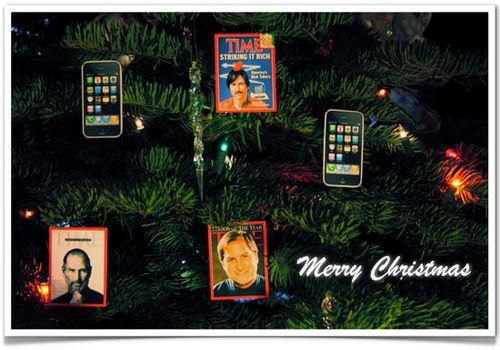
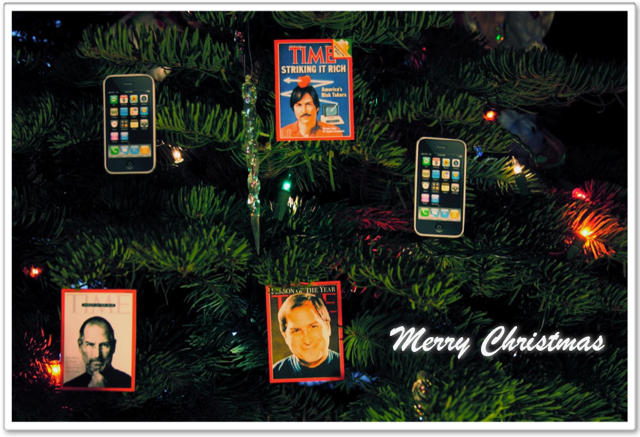
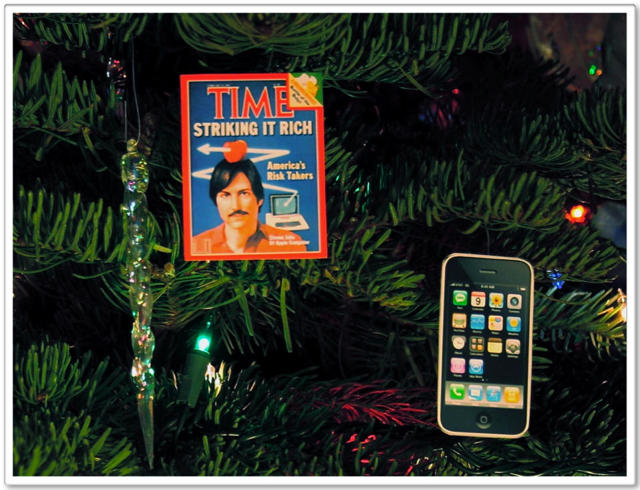
The kind Apple fanatics at iPhone Savior have done the great public service of creating Apple and Steve Jobs-themed Christmas eCard templates and posted them over at Flickr for anyone who still has a few last minute greetings to get out.
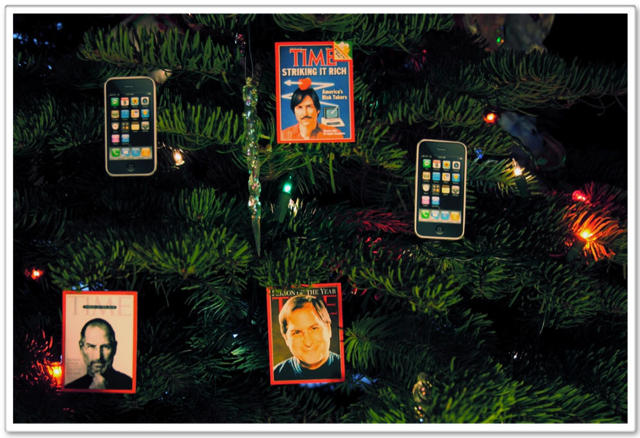
You can use a pre-made card like the one above, or choose from two styles of hi-res blank cards and add your own graphical text message to express your holiday sentiments and your love for all things Apple in the same vehicle.
As they put it over at iPhone Savior, “Sincerely wishing everyone an iPhone 3G for Christmas and some sweet dreams of Steve.”
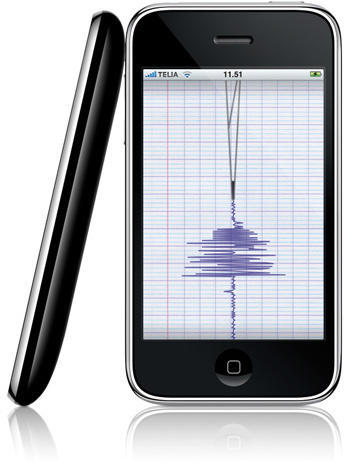
Seismometer is the iPhone app that can not only let you know if you’re in an earthquake (and how bad it is at your personal epicenter), but also records and displays the movement energy of just about anything.
Seismometer uses your iPhone’s built in accelerometer to measure movements in two axes, calculate the resulting energy and draw the results on a rolling scale.
Version 1.1 updates feature noise filtering, expanded frequency settings (20, 40 , 60 and 200hz), and choice of output to logarithmic or linear scale.
99¢ buys you fun for the whole family; no additional premium charged to iPhone users located on major fault lines.
Is there any social dynamic the iPhone cannot be leveraged to transform somehow?
Here’s a six minute video from digitalJournal TV detailing a “social taxi service” that San Francisco-based Avego Shared Transport hopes will one day expand the public transit system by enabling every private vehicle to operate as a public transport vehicle.
This free iPhone app has the potential to dramatically reduce wasted seat capacity in cars, reduce the costs of commuting and expand commuting options for riders and drivers alike. This is definitely not your father’s hitchhiking experience.
Using the iPhone 3G’s GPS capabilities and web services, Avego seeks to enable a cross between carpooling, public transport and eBay, by matching a driver’s wasted seat capacity – those seats which are unoccupied – to passengers, reducing commute costs for all participants. Avego automatically apportions the cost of the commute, providing a financial incentive to commuters frustrated by high gasoline prices.
The company is quick to point out that the arrangements it facilitates clearly fall under “carpooling” laws that exist in nearly every jurisdiction in the US since the oil shock of the 1970s, and financial transactions are carefully limited so that participating drivers only recover the expenses associated with providing transport and do not cross the line into making them commericial transport operators.
For the nitty gritty on how Avego works, see the further information page on Avego’s website, but definitely take time to watch the video here and marvel at yet one more example of how Apple technology is changing the ways people interact with each other and with the world around them.
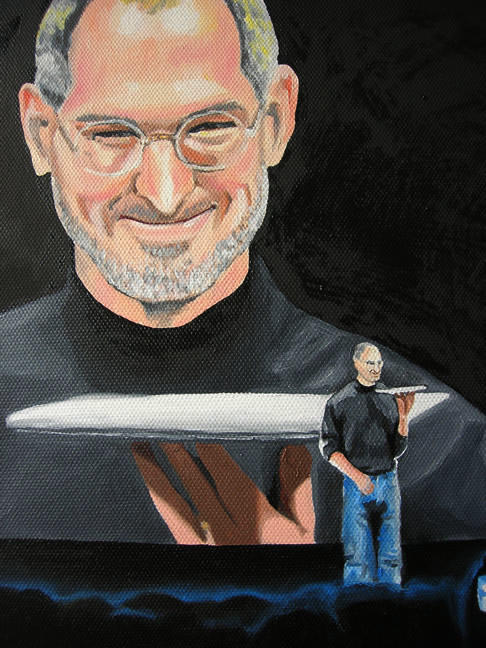
In the wake of Apple pulling out of Macworld — and the prospect that Steve Jobs may leave the company — many are wondering if Apple will survive without him.
The answer is yes, Apple will definitely survive without Steve Jobs. It may even thrive.
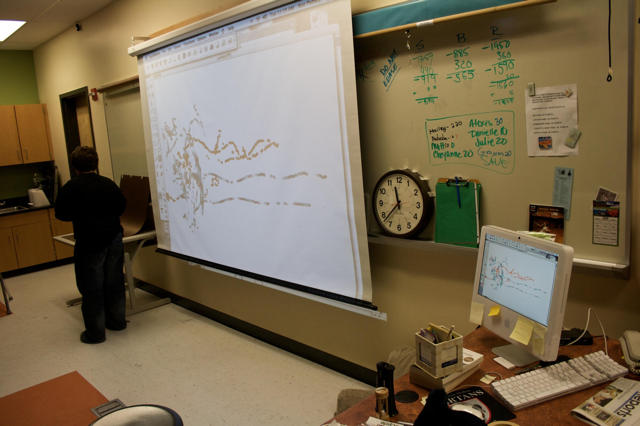
I’m very interested in Wiimote projects for the Mac for two reasons. One is that the guy who came up with the idea (Johnny Lee) is an alumnus of my university. I’m so into his work that I even went to his thesis defense. The other is that my mom is a sixth grade teacher, and I helped her convince the technology department at my old middle school to buy two Wiimotes for her to use with the projector and iMac in her classroom.
Setting up the Wiimotes with the whiteboard is a snap, especially with the Wiimote Whiteboard program for the Mac. The only problems we’ve had are making the IR light pen and finding something simple for the kids to do.
In a quick demonstration last week, using a DVD player remote control since the IR light pen I made ran out of batteries, I set the kids up drawing in Appleworks. This was fun, and the ENTIRE class immediately jumped out of their seats and lined up at the chance to draw themselves. This was certainly one of the most excited and engaged audiences I’ve ever presented to.
Even so, Appleworks isn’t a really great program to be using for this type of thing. It’s obviously not designed for a pen interface, and it can’t use the Wiimote’s multitouch capabilities. This is why I was so excited to see Adrien Mondot’s effort to hook up eMotion to the Wiimote set up:
The video shows all kinds of wonders that sixth graders would lose their minds over. Drawing is cool enough, but I think we’d have to resuscitate some of them once we got them moving letters around, using multiple pens, affecting particles and giving them 3D graphics.
I’m going to try to make some little kids pass out after winter break. Have you tried the Wiimote whiteboard project?
Last week I asked Cult readers for their nominations for new Mac app of the year. Things, 1Password and Dropbox seemed to be the consensus choices, all of them excellent new software products.
It got me thinking, though: how has my computing behavior changed during the last 12 months? What new software am I using that I wasn’t using last Christmas, and why?
I’m a shy and retiring Englishman, so tooting my own horn doesn’t come naturally, but my brash American wife insist I post this: USA Today named Inside Steve’s Brain, my book about Steve Jobs, one of the best business titles published in 2008.
Says USA Today:
“Offers insightful nuggets on Steve Jobs, who helped create personal computers and digital music while moonlighting as a modern-day Walt Disney at animation studio Pixar.”
A good Apple t shirt is hard to find. You want to be unique, to be different. You want your shirt to be like your Birkenstocks and Uggs before they were cool. Some companies will mail these things out to you for free if you beg them enough (my friend got a Digikey shirt after a week of calling), but for Apple you’ve got to go out and get them from third party vendors. These are for the long time Mac users, and the nerds who want to look good.
This shirt lurks in its awesome. Most would think that it’s just another “power button” shirt. Those in the know recognize it from other places. There’s also a bandana for the truly serious.
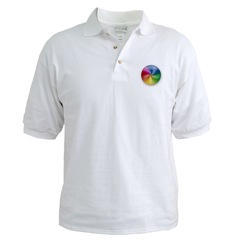
Mac t shirts are all well and good, but when it really comes down to it, you probably don’t want to wear them to work. You want something with a little more sophistication, even if you’re locked in the server closet all day. The Spinning Beach Ball of Death polo shirt is the way to go for casual Fridays.
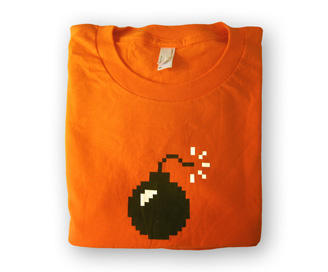
Insanely Great Tees could easily fill this entire list, but I’m just going to include two of their shirts. The Bomb is definitely a must-have for me, as I can’t remember how many times I saw that little popup window. It’s ingrained in my mind. This shirt says “Yes, I was around before OS X”, “Yes, this is a metaphor for my coolness” and “No, I don’t belong in airports”.
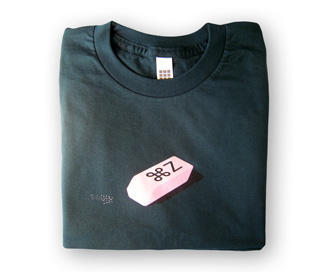
The second Insanely Great Tees shirt is also one of my favorites. The Campground Command symbol is a subtle nod towards your Mac side, but the general concept is there for Windows and Linux users as well. This shirt was even featured in the nerd-shirt gold mine of a television show The IT Crowd.
Finally, a parody of the most sold t shirt ever. There’s too much Mac nerdiness going on here to even try to get into it all.
For those of you looking beyond this list, I recommend that you click around the sites that these shirts are from. Blue Collar Distro and Insanely Great Tees have a great selection of Mac and otherwise geeky shirts. I recognize that there are lots of great Mac shirts on Cafepress, but I tried to steer clear of them because of some issues with quality they’ve been known to have. There are also lots of great expo and out of stock shirts to be had, but that’s no good for your wardrobe is it?
British-Sri Lankan rapper Maya “M.I.A.” Arulpragasm’s last album, Kala, was made on a Mac.
Her second album, called an “international block party” by Rolling Stone, Kala is full of ear-wormy music that includes samples of Pink Floyd, gun shots, digeridoo riffs, cash register ca-chings and kids on backing vocals. (Give a listen to “Mango Pickle”.)
She traveled with producer Dave Taylor to India, Australia, Jamaica and Trinidad to record it.
Although news satirists The Onion target Apple with a certain frequency, pull back the curtain and staffers are Apple users.
When asked by the Guardian to name their favorite piece of technology, both Onion staffers Will Graham (executive producer/director) and Julie Smith (general manager) said the iPhone.
The rest of the tech Q&A reads like a love letter to Apple, a few excerpts:
Mac or PC?
Will: our whole Onion organization is very fervently pro Mac, despite doing jokes about them. For creative people there is no comparison.
Do you think the iPhone will be obsolete in 10 years’ time?
Julie: Yes, I do. They’ll probably have the iPhone 36G by then.
What’s the most expensive piece of technology you’ve ever owned?
Julie: My Macbook Pro.
Will: I remember there was a thing my dad gave me as a Christmas gift that I thought was really cool, about eight or nine years ago –œ the Mac Talk…
What piece of technology would you most like to own?
Julie: I guess a robot. Or another iPhone.
Apple’s iPhone now has 23 percent of the smartphone market, trimming RIM’s lead and showing signs of strong consumer demand even five months after the launch of the 3G, a new survey indicates.
The iPhone’s share of the smartphone market has more than doubled since June, when ChangeWave found the Apple handset held 11 percent of smartphone sales.
Although RIM’s BlackBerry remains leader, with 41 percent of the market between September to December, the Ontario company slipped by 1 percent.
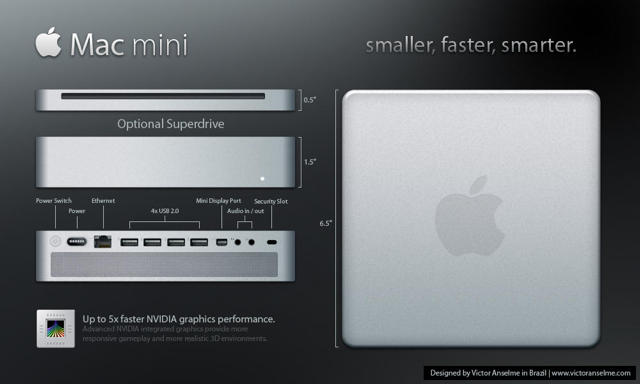
Brazilian designer and Apple fan Victor Anselme has a few ideas about how the Mac mini might evolve into a useful and desirable product.
From his description, helpfully translated by Google from the original Portuguese, as amended by your humble correspondent:
The case would be done in mostly aluminum; the largest piece would be the top along with the four sides. The bottom is black plastic similar to the back of the iMac, with a lever here to open the case, enabling easy upgrades to memory or the hard drive.
Air circulation is much higher now and is pretty much like the MacBook Pro, and this Mac Mini now comes with internal speakers.
In keeping with configuration of new Apple products the Mac mini will no longer support FireWire (note: say it isn’t so, Victor!) and the new Mini Display Port is used for output of digital audio and video.
iPhoneSavior reported on Anselme’s concept the other day, noting it appears inspired by a recent Mac Rumors report showing evidence that a refreshed Mac Mini would be based on the NVIDIA MCP79 chipset.
Along with rumors of an iPhone Nano, detailed below, talk of a refreshed Mac mini and iMac, as well as a 32GB iPhone 3G dominate pre-Macworld chatter leading up to the actual event kickoff on January 5.
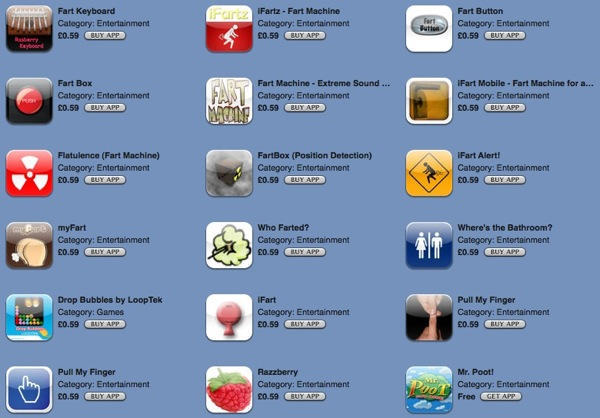
57 Varieties of Fart-oriented applications are approval worthy in the eyes of the inscrutable AppStore gatekeepers. But iBoobs, a demo of which can be seen above, apparently violates a threshold of taste beyond which Apple is unwilling to go.
It’s nice to know there is a standard one must meet as an app developer, though, personally, it seems to me iBoobs at least uses the accelerometer to somewhat realistic effect.
What would an impending Apple-oriented convention be without some rumor-mongering to pique the interest of the faithful and get tongues a wagging? Ahead of Macworld 2009, slated for January 5 – 9 at San Francisco’s Moscone Center, one of the more persistent rumors has involved the supposed announcement of a smaller form-factor iPhone, dubbed the iPhone Nano.
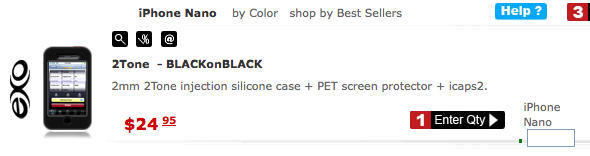
TUAW reported an interesting escalation of the iPhone Nano rumor Monday, showing evidence of an iPhone Nano case being marketed by XSKN, a company that began selling iPhone 3G cases in mid-May of 2008, almost 2 months prior to Apple’s release of the phone. In early September, XSKN was showing off new 4th Generation iPod nano cases, prior to the Let’s Rock event where they were officially unveiled.
As you can see from the screen shot I captured tonight from the XSKN website, the company is taking orders for cases for a product called iPhone Nano.
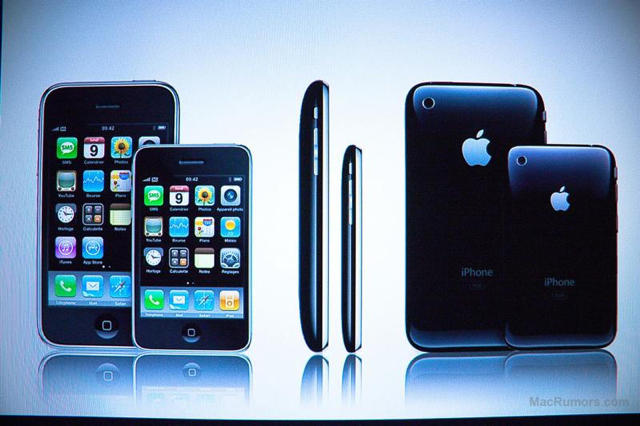
If that’s not enough to whet your whistle, how about the photo, below, which someone submitted late Monday on the down-low to MacRumors.
Wonder if Phil Schiller will use the traditional “one more thing” phrase on this item or if perhaps Apple has something else up its sleeve.
In the hustle bustle of modern urban life, especially during holiday seasons fraught with travel delays, white-knuckle driving on treacherous roads, crowded shopping districts (though maybe not so much that, this year) and kids on vacation underfoot, a little bit of peace and tranquility can seem like the greatest of gifts.
Now you can give such a gift to yourself, a friend or loved one, with Freeverse’s Tranquility app for iPhone and iPod touch.
For just $1.99, drift off to sleep or catch a few peaceful moments during a stressful day. With a beautiful visual interface and new audio tweaks in the recently updated version 1.3 (requires iPhone 2.2 firmware), you can choose from a full 60 minute relaxation and meditation track, or from other themes such as Flowing Water, Ocean Waves, Desert Wind, Gentle Rain or Thunderstorms, even Pink Noise – an enhanced form of white noise.
Tranquility is the other side of Freeverse, the award-winning app developer responsible for Moto Chaser, Burning Monkey Casino and Big Bang Sudoku, among many others. Available now in the AppStore.
Writing Monday for the eWeek blog, AppleWatch, Joe Wilcox gave the iPhone a D in telephony and a C for battery life, saying he simply could not recommend the device as a phone. Despite singing the praises of Apple’s mobile platform he gave it an overall grade of B- and seemed mighty pleased to announce that everyone in his family has rejected the iPhone in favor of an iPod Touch + some other cell phone.
I find Wilcox’s assessment curious and wonder how many of the other 8 – 10 million iPhone owners feel their device is so disappointing from the telephony and usability standpoints that they’d actually prefer to carry two devices around instead of one. Follow me after the jump to learn what Wilcox thinks is so bad about iPhone and where my own assessment takes me in response.
The iPhone app formerly known as Exposure has just been updated to version 1.5 and now has a new name: Darkslide.
Developer Fraser Speirs explains what it’s all about on his blog. For the uninitiated, the app is an iPhone-friendly environment for your Flickr account. It lets you keep track of your photos, your contacts’ photos, and check what images have been taken near your current location (which comes in extremely handy when you’re at a tourist attraction and you want to try and shoot something a bit different).
The big new feature in Exposure – sorry – Darkside 1.5 is, in Fraser’s own words, “Upload, upload, upload”. So, it does uploads now.
(I’ve not been able to test it yet, because my App Store is refusing to acknowledge that Exposure has been updated to anything other than Exposure. I expect it’ll all update itself in a few hours.)
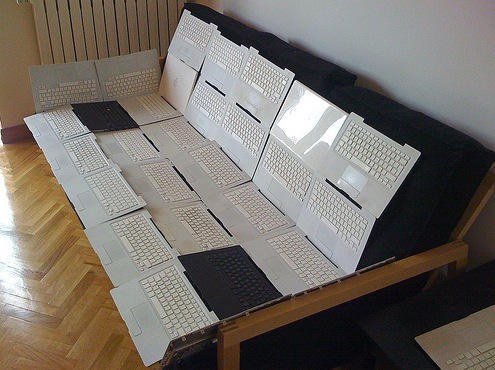
I did ask je@n what the story was behind it, but je@n didn’t reply. I expect je@n’s very busy. Thanks anyway, je@n, for letting us re-use your Creative Commons licensed photo. Of a sofa. Covered with MacBook keyboards.
Although some are questioning how long Steve Jobs will continue to lead Apple, the Cupertino chief executive ranks No. 2 in a list of most-like company leaders.
Jobs had a 90 percent approval rating by participants in the first-ever survey by review site Glassdoor. Jobs garnered 290 reviews, far above the 50 needed to qualify.
Art Levinson, CEO of biotech firm Genentech, was ranked No. 1 most-liked boss with 93 percent approval.
Jobs beat Eric Schmidt, CEO of Internet Google, who had 88 percent approval.
Office Depot CEO Steve Odland ranked as the least-liked CEO, obtaining just 4 percent approval from reviewers.
Add Garmin to the list of companies announcing plans to introduce Android-based handsets in 2009. Garmin said its nuvifone will link GPS features with Google Maps.
The handset is expected to be the first in a series from Garmin, according to the company’s head of Asia Pacific marketing, Tony An.
An said while the nuvifone will launch this Spring, a number of others based on Android will appear during the second half of 2009. The Garmin phones will be produced by another company, reports said Monday.
Friday, Samsung said it would launch its first Android phone in the U.S. sometime between April and June of 2009. Development of the handset has been accelerated to meet the “specific needs of local carriers,” an unnamed Samsung official told the South Korean ET News.
Palm, the down-on-its-luck Treo maker, announced Monday $100 million in new funding amid talk it will unveil new products at the January CES trade show.
In addition to the $100 million lifeline, the deal allows Palm to sell shares worth $49 million — or a 31 percent premium before April 1.
The much-needed funding comes as Palm reportedly has just two years before cash is depleted and the company is set to unveil a new handset and a smartphone operating system.
‘Tis the Season of Giving and for a site such as MacHeist, where you can get bundled amazements year-round, giving really means giving. This Christmas, sign up for a MacHeist account and come to the MacHeist Giving Tree on Christmas to see what free gifts are under the tree just for you.
Refer your friends and get additional gifts with your name on them.
Prolific Baroque composer Johann Sebastian Bach has made it into the digital age with a dedicated iPod.
The Bach Pod from Passionato packs 175 hours pre-loaded on an Apple 80 GB iPod classic. Recordings are from the opus collection Hnssler Edition Bachakademier released in 2000 on 172 CDs that was favorably reviewed but was later discontinued as a set. The Bach Pod costs about $700.
There’s still enough memory left over, 63GB, to add a few things and it also comes with three back-up DVDs as insurance against hiccups.
While some hardcore classic music fans will want to pick and choose who interprets the maestro — you can check out download samples here — it would make a great gift.