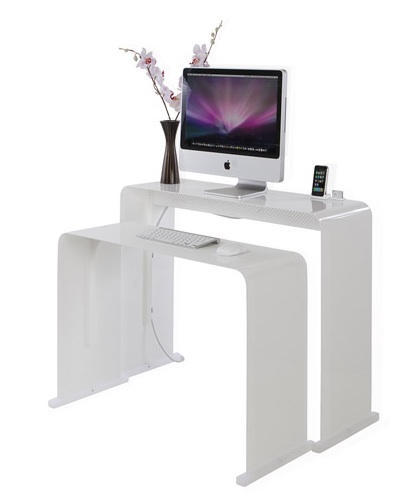
They call it the “OneLessDesk”. They say it will be “the last desk you’ll ever own”. It’s … quite a desk.
Sleek. Silvery. (Unless you buy the white version.) Made out of solid steel, strong enough to hold two 24 inch flat panels side-by-side, cut from raw sheet metal with lasers, baby.
“Built”, they say, “like an American tank.”
And a steal at just $649. I’ll have two. I’m going to melt them down. I could do with a tank.
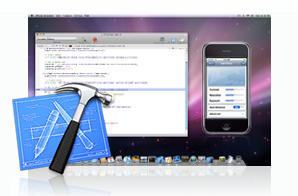
Steve Jobs and Steve Wozniak became fabulously wealthy using minimal resources beyond their own time and talent, working out of Job’s garage. Today, Jobs and the company he and Wozniak founded are making similar rags-to-riches stories possible with the iTunes AppStore and applications created by third party developers for Apple’s iPhone.
Steve Demeter, developer of a popular $5 iPhone game, Trism, announced he made $250,000 in profit in just two months, according to a story by Gadget Lab blogger Brian Chen. If his profits continue at their current rate, Demeter will earn $3 million by July 2009.
Demeter by no means tried to reinvent the wheel. Trism is basically a version of Bejeweled that uses the iPhone’s accelerometer to good advantage, giving the game what Demeter believes are the fundamental requirements for success at iPhone app development: unique gameplay and high replay value. He also designed support for an online leaderboard that creates community and says applications with great content sell themselves, something the developer of another popular game, Tap Tap Revenge, agrees with.
Bart Decrem was one of only four people who originally worked on Tap Tap Revenge, a free application that hit a milestone of 1,000,000 downloads just two weeks after its launch. Decrem’s company recently began inserting advertisements in the game, and it also has plans to release a premium version that will cost money in addition to the free app. He says iPhone development is “reminiscent of the early days of the web in terms of the amount of green fields and opportunity,” according to Chen. “You really don’t need a huge amount of capital. You need attention to detail and product, and that’s going to keep increasing.”
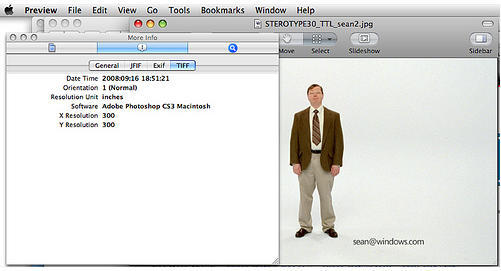
Flickr user LuisDS discovered metadata on the creative copy of the “stereotyped PC user” and other photos appearing on Microsoft’s “I’m a PC” website that reveal they were produced using Macs running Adobe Creative Suite 3.
Microsoft code monkeys scrubbed the identifying information from the website stills overnight.
Author and Mac guru Adam Engst has just released the third edition of Take Control of Buying a Mac, in which he talks about what’s new and what hasn’t changed about buying a Mac since the Intel transition. The book reviews why hard drive size isn’t important, but RAM is, and why an iMac may be your best choice. Laptop or desktop? Which laptop? Engst delivers answers to these questions and more in the 98 page book.
The book features a chart of Apple’s model launches over the last 5 years to help predict when new Macs will appear and worksheets help you match your needs and budget to the right model Mac. Engst explains when readers can purchase to get the most bang for their buck, compares different venues for where to shop, gives advice and step-by-step instructions for transferring files from an old Mac to the shiny new one, and offers thoughts about how to get the most out of the Mac that’s being replaced. The book costs $10 and is available at Take Control Books.
I was intrigued when I read my colleague Johnny Evans’ post about 7digital and its 4 million DRM-free tracks available in 320k MP3 quality, so I went to the site to pick up a copy of the classic Harry Nilsson album, The Point, which I’ve been wanting to buy.
I found the site easy enough to navigate, with a pleasant balance between text and graphics that seemed a refreshing change from iTunes’s hevavily-graphics-oriented interface. I located The Point quickly, listened to a couple of preview tracks and thought, hey, why not? Signing up for an account was even relatively painless and straightforward, and when it came time to give my address, I put in that of a friend who lives in London, which is when the deal started heading south. See how after the jump.
But, really, they say very little. Instead of finding these adverts a refreshing antidote to the brash and somewhat tiresome arrogance of Apple’s ads, they just come across as a feeble and overly defensive response, like a weedy geek whimpering “stop picking on me, dammit!” Microsoft should have blazed on to the scene, proving its worth and reasoning why it’s better than Apple, or at least hammered home its point with a little humor.
Instead, we get dry, by-the-numbers, designed-by-committee adverts that are borderline nauseating. Little more than a self-congratulatory pat on the back, they tell us what we already know: lots of people use PCs, and PCs can be used for diverse things. Thrilling. They don’t say lives can be made better by using PCs, nor do they provide any compelling reason whatsoever to check out Microsoft’s output over the competition. (Possible exception: beard lovers.) They’re also dull, unimaginative and unoriginal, riffing weakly off of Apple’s ideas, rather than Microsoft coming up with its own. While that might make them very relevant to Microsoft, that doesn’t make them good adverts.
Apple’s gains on Microsoft haven’t been down to advertising—in fact, one might argue that Apple’s advertisements actually put many people off the brand. Instead, they’ve been down to user experience, and rallying against complacency. Until Microsoft can offer similarly persuasive arguments, I can’t see its adverts convincing anyone to stick with ‘PC’, let alone switch to it.
For years, Microsoft and others have attempted without much success to shake Apple’s tight grip on the digital music scene. From subscription services to the Zune, companies have searched for the winning alternative to the iTunes, iPod bundle. Analysts now believe Finland’s Nokia may have a good shot of chipping away at Apple’s dominance.
More than 80 percent of people would pay for Nokia’s ‘Comes with Music’ service – particularly when it feels like they are getting tunes for free. Nokia says it will launch the handsets Oct. 17 in Britain.
Strategy Analytics said cost and selection trump brand – even ones so tightly woven as Apple, iPod and iTunes.
“Nokia Comes With Music effectively bundles a year’s subscription of music downloads (PC and mobile) into the price of a handset,” analyst Pitesh Patel told Cult of Mac.
Patel said Nokia – the largest handset maker – could overwhelm Apple’s iPhone.
“Nokia’s strong distribution and handset marketshare means that it currently sells more music playing devices than Apple,” the Strategy Analytics wireless analyst said.
However, we are not likely to see a head-to-head battle between the two companies in the United States. Nokia instead will challenge the iPhone in Europe and Asia – areas where Apple’s name awareness gives way to the handset maker.
The key point in this dust-up is that digital music fans care little about the name on their music player.
“It turns out that brand is irrelevant,” said Patel.
Much is made of the Apple ‘halo’ which helps sell products based just on brand. However, brand consultants Interbrand Thursday put a value on the halo: $13.7 billion.
Although Microsoft again beat Apple in most valuable brand ($59 billion), the Cupertino, Calif. company had a 24 percent jump in brand value — second only to Internet giant Google.
Apple’s position rose to 24th place compared to 33rd in 2007, according to the ranking of global brands.
“The latest iPods, iPhone and MacBook Air strike the perfect balance between coolness and mass appeal,” Interbrand said in its report.
The consultancy cites Steve Jobs coming aboard as CEO as another reason for the brand’s rise in value.
Software giant Microsoft may have reasons to look over its shoulder. Although its brand value is steady, its ratings are falling.
The Redmond, Wash. company ranked in third place this year, down from its second-place showing in 2007. Rival Google, on the other hand, turned in the largest gain in brand value, leaping from to 10th position from 20th last year.
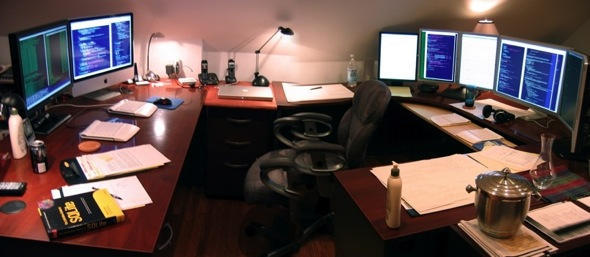
Admit it: you’ve always wanted an office like this, haven’t you? Your dual-monitor setup looks a bit pathetic now, doesn’t it?
This is the massive eight-monitor workspace of Mitch Haile, and when we saw it on Flickr we knew we had to share it. You can see the original pics of his iMac and his Mac Pro, as well as many more photos of his office space. But why on earth does he need so many monitors? We asked him. Over to you, Mitch:
“I am working at a stealth mode start-up in San Jose, where I used to live. I commute from Boston. Part-time I do some consulting and oversee back-end software architecture for a new DVD cataloging service, www.take11.com.
“The iMac is for email and mundane tasks like bug triage,
documentation, etc–stuff that doesn’t require 6 monitors.
The MacBook Pro is obviously for travel. Both of these machines have 4GB of RAM each.
“The six monitors are connected to the Mac Pro. Main apps are X11, Eclipse, Terminal, BBedit, gvim, VMware. The Linux box next to the Mac Pro also is a VMware-oriented system and I run xterms and another Eclipse application on that box, using X11 forwarding to display it on the Mac. NFS all over the place. The Mac Pro has about 4TB of storage, the Linux box 1TB.
“The main reason for the 6 monitors is to see multiple debuggers concurrently. The 95” or so of width is about
the physical maximum I can take in at once; it’s not really
enough room but I don’t want to kill my neck.
“The boxes in the closet are more testing infrastructure. More RAM, more VMware on the towers. The small shuttles were cheap (about $200 each) and perform small little tasks that are important but need isolation from the rest of the environment.
“I have been running multi-monitors for about 9 years now. I think I upgraded to 4 monitors in 2004; as LCDs have gotten cheaper, it’s been more practical. Three 21″ CRTs would
kill a desk, but 6 LCDs weighs a lot less.”
Thanks to Mitch for the guided tour and permission to re-use the pics. Image smushing was done with DoubleTake.
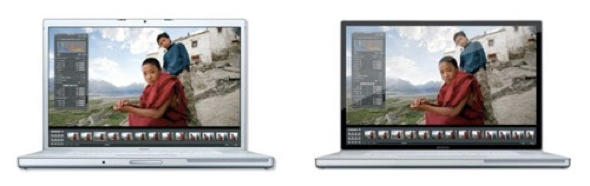
Erroneous MacBook Pro Mock-Up Courtesy Ars Technica
This has been a gangbuster summer for Apple. First came the iPhone 3G announcement in June, alongside OS X iPhone 2.0 with the AppStore, Mobile Me, and HD video in iTunes, then came a new round of incremental but strong new iPods, and amazing news about a major uptick in Mac sales during a down economy. In spite of some software issues, Apple is coming out with huge new gains in multiple markets and is healthier than just about any other tech company.
And yet, unless Apple rolls out rumored new Macs next Tuesday, all of that will start to look suspect. To find out why, click through!
The more I watch Microsoft's new ad for Windows, the more I like it.
The more I watch Microsoft’s new ad for Windows, the more I like it.
The ad, which debuted on Thursday night, successfully counters the idea promoted by Apple that PCs are bumbling buffoons personified by prematurely middle-aged businessmen.
Instead, the ad convincingly portrays the PC as part of global culture, unpretentious and down-to-earth.
The ad starts with a John Hodgman-alike Microsoft engineer, who proudly declares: “I’m a PC, and I am not alone.” It then swings through Europe, Africa, America and back again, showing people of all nations declaring simply one after the other: “I’m a PC.”
It ends with author Deepak Chopra, who says: “We are all a PC, inseparably one.”
Watch it carefully. The people and locations of the ad clearly reflect Bill Gates’ concerns about the world: disease, poverty, education and opportunity. Bill Gates makes a appearance (a welcome one. I admire him giving away his money), and there’s quite a few people from developing countries in this ad: something I’ve never seen in Apple’s marketing.
They’re real people, with accents and bad teeth (like me). I find it a refreshing antidote to the fake youthfulness of Apple’s iPod silhouettes and the insufferable, elitist hipster who personifies the Mac on TV.
I like Microsoft’s new ad because it portrays the PC through the very ordinary people that use these machines every day — and some extraordinary ones. It’s the opposite of Apple’s phony lifestyle advertising. It’s refreshingly egalitarian. It’s like “The Wire” versus “Law and Order.” Plus, there’s no sign of Jerry Seinfeld.
If you enjoy running a Windows game alongside your usual Mac applications, you aren’t alone. New numbers indicate U.S. sales of virtualization software is up 50 percent this year.
The sales increase would be even greater than the 41 percent jump in Mac hardware sales Apple recently reported.
Between $15 million and $20 million of Mac virtualization software has been sold so far in 2008, according to NPD Group analyst Michael Redmond.
Redmond, talking to Computerworld, credited Apple’s move to Intel processors for “encouraging more users to experiment with virtualization.”
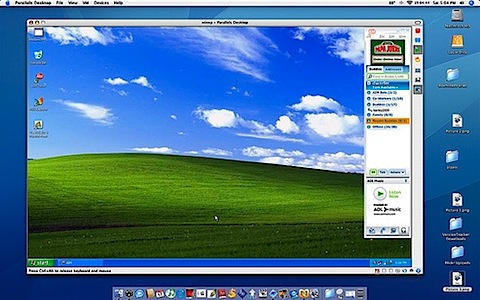
Differing from Apple’s Boot Camp, which lets Mac users reboot into a Windows environment, virtualization software permits Intel Apple’s to run Windows applications within OSX. The most frequent uses of Mac virtualization is to play a Windows game that has yet to be released for the Apple platform or for developers to test software designed for Windows users.
Parallels Desktop and VMWare Fusion are the two leading virtualization software packages for the Mac. Parallels, introduced in 2006, has sold a million copies while Fusion (now Fusion 2) sold a quarter million copies since coming on the Mac VM scene in 2007.
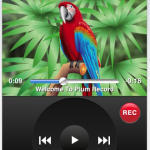
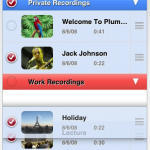
Plumb Amazing’s Record app for iPhone turns the device into a nifty little field recorder for capturing interviews, lectures, songs, bird calls, meetings, car sounds (to play for Clik and Clak on Car Talk), reminders, ideas, your child’s first words, street musicians, podcasts, science notes, observations, the list is limited only by your imagination.
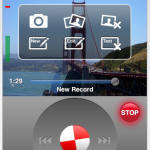
Sounds in Plum Record can be tagged with photos, and text, multiple tags can be added at different locations in a sound file like bookmarks, allowing you to jump to different sections of the sound file instantly.
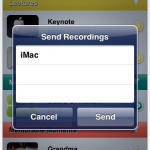
Plumb Amazing also offers a free server for uploading files, or you can transfer them directly to your Mac or other disk server.
Available now in the AppStore for a measly $5, many AppStore reviews of this software are glowing, though several complain about bugginess that prevents transferring files to Macs running Tiger.
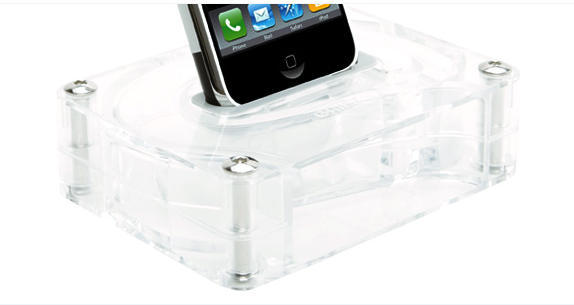
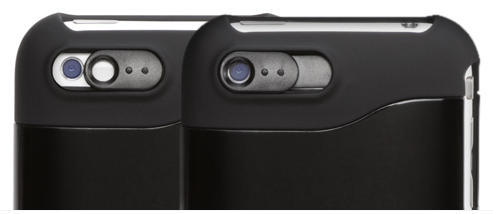
Griffin Technologies unveiled two iPhone accessories worth investigating at Apple Expo Paris on Wednesday: AirCurve is an acoustic amplifier that requires no power to amplify the iPhone’s built-in speaker, and Clarifi has a lens for taking close-up photographs built in to its protective polycarbonate iPhone case.
AirCurve borrows design elements from Bose “wave technology” to turn your iPhone into a no-power-drain alarm clock on your nightstand, or a mini sound system that never needs batteries or adapters, according to Griffin. An internal coiled waveguide collects sound from the iPhone’s built-in speaker, amplifies it, and projects it into the room. Designed with a pass-through slot that allows you to charge and sync your iPhone with a dock cable (available separately), AirCurve’s see-through translucent body lets you appreciate the acoustic curves inside that do all the work. Look for the AirCurve selling soon for $20 at major American electronics retailers.
Clarifi is similar to dozens of other protective polycarbonate iPhone cases on the market but is distinguished by the built-in lens that trurns the iPhone’s 2 megapixel camera into something more than just a snapshot device with focus set to ∞. Without Clarifi, iPhone requires about 18 inches to focus properly. Slide Clarifi’s lens into place and, according to the product specs, you can move in to 4 inches for crisp, detailed macrophotography. The case has cutaways for access to the power switch, headphone jack, volume controls, and dock connector. Clarifi will sell for $35 at major electronic retailers beginning in October and is compatible with iPhone 3G only.
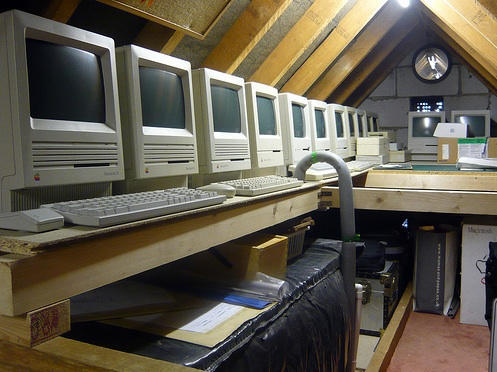
By day, Damian Ward operates Macs for a printing company in darkest Buckinghamshire, a county just to the north west of London. He’s been doing this for 15 years or so.
By night, Damian hunts for batches of unwanted, unloved old Macs. He hunts down 512k machines, Classics, SEs and SE30s, and early iMacs. He takes them in — from colleagues, friends, Freecycle, eBay, junk sales, anywhere — and tinkers with them. He has quite an impressive collection.
“You bring them home and you think they’ll be beyond repair, and that you’ll only be able to use them for parts,” he says.
“Then you discover they’re working fine, and then you can’t get rid of them can you? You have to keep them.” That’s right. You have to.
Microsoft’s $300 million Vista ad campaign has ditched comedian Jerry Seinfeld in favor of a John Hodgman-alike Microsoft engineer who says: “Hello, I’m a PC, and I’ve been made into a stereotype.”
Microsoft on Thursday is set to air several new ads, according to the New York Times, including one starring a lookalike of the bumbling but lovable PC character in Apple’s Get a Mac ads, played by Daily Show correspondent and author John Hodgman.
The Times says the ad is an “audacious embrace” of Apple’s Windows-baiting, and typical of MS’s new agency, Crispin Porter & Bogusky, which has a history of turning negative perceptions into advertising counterstrikes.
Apple has been “using a lot of their money to de-position our brand and tell people what we stand for,” Microsoft brand marketer David Webster told the Times. “They’ve made a caricature out of the PC.”
Other ads in the series will include musician Pharrell Williams, actress Eva Longoria and author Deepak Chopra, the Times says.
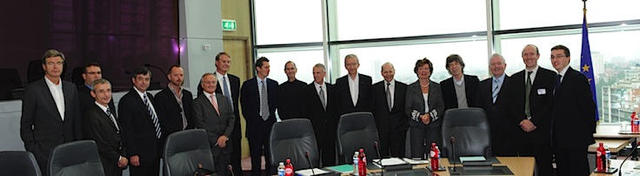
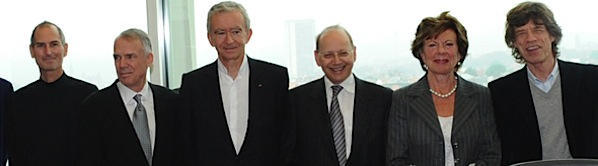
Jobs met with Sir Mick at an online commerce roundtable to discuss “opportunities and barriers” to online retailing in Europe, the EC says. Other bigwigs included EC competition commissioner Neelie Kroes and the heads of LVMH, Alcatel, eBAy, Fiat and EMI, and others.
The business leaders met on Wednesday.
Jobs may be in Europe to attend Apple Expo in Paris, which just opened, although Apple doesn’t have a booth at the show.
The annual Apple Expo trade show is the biggest Apple-oriented show in Europe. Until 2003, Jobs has delivered a keynote speech there. But as Apple has expanded its chain of stores around the world, it has been pulling out of more and more conferences: Macworld in New York, NAB in Las Vegas and Apple Expo in France.
“Apple is participating in fewer trade shows every year, because often there are better ways for us to reach our customers,” an Apple spokesman told Macworld.
Apple increased its share of notebook computers sold in North America during the second quarter to 10.6 percent, moving it into fourth spot and posting the largest jump among top computer makers, researchers said Wednesday.
The numbers compare to the 6.6 percent market share registered during the same three-month period in 2007, according to DisplaySearch. The four-point jump is the largest of the top five PC makers. Dell led the market with 21.9 percent of North American notebook sales.
After the jump, read how the Apple ‘halo’ effect is boosting business interest in Mac notebooks.
Macenstein has a beauty of a post, explaining precisely how to remove Apple’s own apps from sight on your iPhone.
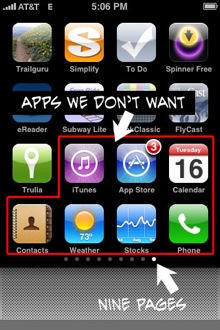
If you’ve ever wondered how many screenfuls of apps the iPhone will let you store, the answer is nine – or a total of 148 apps. But it turns out that there’s a secret, hidden, 10th screen.
So if Calculator, Clock or Contacts drive you crazy and you want to be rid of them, all you have to do is get yourself nine screen loads of apps, and be sure that the 8th and 9th screens are full to the brim. Then get the icons wiggling and start shuffling from screen eight to screen nine. Boom!, as Steve would say.
The apps aren’t actually deleted, just removed from sight. And even then, they will re-appear after you restart the phone or sync it.
Full details are at Macenstein. And if you read it and think: “Why would I spend so much time doing that?”, then you and I both have great minds.
Every high school and junior high student in the Ballinger school district near San Angelo has been given a brand new MacBook. Lucky them.
Let’s assume that most of these youngsters have not owned a Mac before. What advice should we give them? What tips would make their computing life a happy one?
Here’s my list, which in some respects is similar to Alex Payne’s, linked above:
don’t let your Mac automatically log you in. Pick a good system password and make sure you have to enter it to gain access
back your stuff up. If your computer is going to die, the chances are good that it’ll die the day before you have to hand in that important assignment
don’t overload your Applications folder with stuff you don’t need
use a text editor to write. Only use a word processor for final formatting, if it’s necessary; even then, TextEdit or Bean are just fine for most of the basics
learn about properly quitting apps (not just closing their windows); about using disk images and installing software from them; about grabbing screenshots with Command+Shift+3 and Command+Shift+4; about Expose and Spaces and Quick Look
Just a few tips off the top of my head. If you were in that school hall while those MacBooks were handed out, what advice would you have been giving the kids?
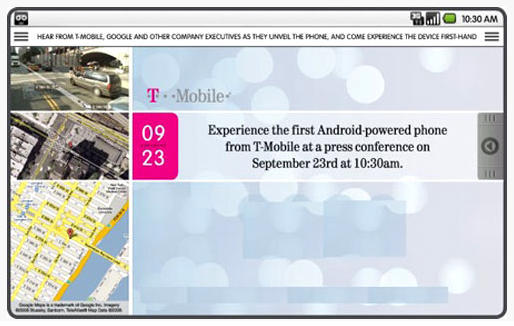
Emulating Apple’s propensity for using media “events” to unveil new technology, T-Mobile sent an “invitation” to technology press Tuesday, encouraging attendance at a New York City event on September 23rd that will mark the debut of Google’s Android smartphone and the software it’s powered by.
The event sets up the first public challenge to Apple’s domination of the touch-screen smartphone market, with the thoroughly-leaked and publicly previewed phone, once known as the HTC Dream but now called the G1. Reportedly tricked-out with features including a slide-out display that exposes a full keyboard, as well as a BlackBerry-like trackball, the phone has been rumored to be the launch device for T-Mobile’s nationwide 3G network and may also boast GPS navigation, a tilt sensor and Wi-Fi connectivity.
We hope that Wi-Fi rumor proves true if the G1 hopes to go toe-to-toe with iPhone.
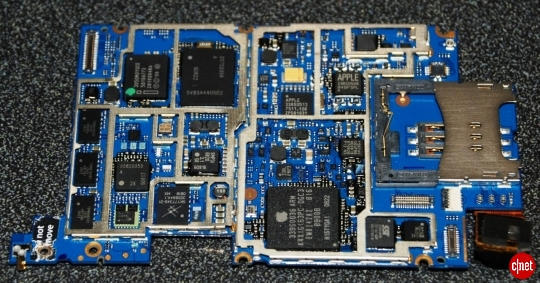
The LinkedIn profile of a senior manager on Apple’s chip architecture team appears to confirm Apple is developing its own ARM processors for the next generation of iPhone, according to a report in the New York Times.
While current iPhones feature a Samsung chipset according to many analysts, Apple was rumored to have acquired chipmaker PA Semiconductor in April for $300 million to engineer custom low-power chips to meet the specific needs of iPhone and iPod design. Wei-han Lien, a member of the PA Semi team who came to Apple in the deal, lists his current project as “Manage ARM CPU architecture team for iPhone” on his profile at the popular social networking site, an indication Apple will soon quit outsourcing iPhone processors.
By developing its own ARM configuration, Apple could create a processor with support for software accelerators or a graphics engine, according to former AMD chief technical officer Fred Weber. In addition, disposing of an outside chip supplier would allow Apple to maintain tighter controls on who knows what about its future products.
As one might expect, Apple declined to comment on matters related to PA Semi, which it operates as a subsidiary.
The market for Apple’s iPhone may turn out to be less than half the size once expected in Japan, according to a report in the Wall Street Journal. With worldwide sales of the 3G model approaching 6 million units since its July 11 launch, and at least one analyst predicting total 2008 sales to reach 7 – 8 million units, Japanese consumers may snap up fewer than half a million out of a previously predicted 1 million, writes Journal reporter Yukari Iwatani Kane.
“The iPhone is a difficult phone to use for the Japanese market because there are so many features it doesn’t have,” says Eimei Yokota, an analyst with MM Research. More than 10 domestic handset manufacturers compete for a slice of Japan’s cellphone market, one of the world’s largest with annual sales of 50 million phones. Nokia Corp., the industry leader in global shipments, has less than 1% share in Japan. Instead, Sharp Corp. leads the Japanese market, with about 25% of shipments. Models currently sold by Japanese cellphone makers typically contain a high-end color display, digital TV-viewing capability, satellite navigation service, music player and digital camera. Many models also include chips that let owners use their phones as debit cards or train passes.
While Softbank, Apple’s cellular phone partner in Japan with 19.5 million wireless subscribers, says the iPhone continues to be popular, Yokota, the MM Research analyst, says one small but must-have feature often cited as a deficiency in the iPhone is the lack of “emoji,” clip art that can be inserted in sentences to jazz up emails.
Takuro Hiraoka, an analyst for GfK Marketing Services Japan Ltd., says the problem could be a lack of education. “Japanese users don’t know what to do with an iPhone,” he said. “Sales could grow if Apple provides specific examples of how it can be used.”
Apple computer sales in the U.S. rose 38 percent during the second quarter, more than triple that of top PC maker Hewlett-Packard, researchers said Tuesday.
Gartner said U.S. Apple PC shipments rose 38.1 percent during the second quarter, compared to the same period in 2007. The Cupertino, Calif. company shipped nearly 1.4 million PCs in the U.S., up from 1 million units during the second quarter of 2007, Gartner said.
Read more about Apple’s jump in marketshare after this jump.