Attempting to survive a post-Apple environment, Macworld Expo may pull up stakes and move after 2010, general manager of the tradeshow indicated in an interview published online Thursday.
“IDG is absolutely open to considering other venues and pricing structures after the 2010 Expo,” according to an Ars Technica interview with Paul Kent, Macworld Expo vice president and general manager.
Kent suggested the show will likely remain in the San Francisco Bay Area due to the dense number of tech companies. However, the Expo leader left open the possibility of moving from San Francisco’s Moscone Center after next year.
Of all the surprises to come out of the CES show this year, Palm’s revival as a serious player in the handheld device market is perhaps the biggest of all.
Most people – myself included – had long since consigned Palm to the dustbin, confident that it would never re-invent itself out of the hole it had fallen into, out-manouevred and out-featured by rival devices.
Not so.
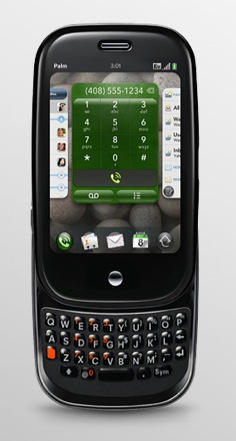
The initial reports coming from CES are that the Palm Pre is an excellent device and offers the iPhone some proper competition.
And at least some of that success might be because the team at Palm has a few former Apple employees on board.
“How Apple centric is the new Palm team? Well, Chris McKillop is director of Software at Palm … One of the PR people at Palm did PR at Apple. Jonathan Rubinstein, who runs the Palm Pre team and led off the announcement, was a key person in development of the iPod and lots of people followed him from Apple to Palm.”
Partly because my first ever PDA was a Palm, and I was a happy Palm user for many years. I don’t want to see the company fail. And partly because any serious competition for Apple is a good thing – anything that gets people umming and ahhing over whether they should buy an iPhone or a Pre will make Steve Jobs sit up and start paying attention when people ask for simple, basic stuff like copy/paste and syncable text notes.
UPDATE: I’ve just noticed that this post is very similar to another post by my esteemed Cult colleague Mr Mortensen not four hours previously. My apologies for the repetition. At least we can be sure that two great minds here think alike. I’m not having a good week, am I?
Shake with fear, GarageBand developers! Cower before us on your knees, Steve Jobs! Bow down and acknowledge how cool we are, Phil Schiller!
For we are Microsoft, and we make Songsmith, and now NOTHING CAN STOP US.
(What you DIDN’T know is that the above video is NOT an advert for Songsmith, but in fact a cleverly disguised ad for another new Microsoft product called Adsmith. With Adsmith, you think up the coolest, most amazing idea for an advert, for any kind of product, and Adsmith automatically generates a high definition video, using just your thoughts as a starting point! That’s right, you don’t even have to sing or talk to it, it just READS YOUR MIND.)
((What you DIDN’T DIDN’T know is that Apple spies have been operating within the Microsoft marketing team for some years now. Their job is not so much espionage but sabotage – they are not there to discover Microsoft’s secrets (Steve Jobs isn’t really interested in them), but to ensure that as many Microsoft adverts as possible contain video footage of a MacBook Pro.))
My other blog has gone Apple this week as we close in on the launch of our book Wired to Care. I’ve just gone live on the Empath-o-Meter with a poll to rate how widespread empathy is at Apple. By empathy, I mean the ability of people inside the company to understand the needs of the folks out in the world that they’re trying to serve. As a Macophile, I obviously feel very well-served by Apple, but I have trouble knowing whether it’s because the folks inside the company really get where I’m coming from — or just that Steve Jobs has an amazing intuition for what’s going to connect with people like me.
Check it out — I’m anxious to see your votes and your comments!
I have a guilty secret to confess: I’ve been secretly hoping that one of the zillions of so-called “iPhone killers” might prove to be. After all, if the rest of the mobile industry continues to crank it crummy wannabes like the BlackBerry Storm or the Samsung Instinct, Apple will have far less incentive to actually take their own product to all-new heights of greatness. Apple makes awesome stuff, but they make even more awesome stuff when threatened.
And so it was that I was very heartened by the announcement of the Palm Pre at the Consumer Electronic Show. If you haven’t had a chance to read up on the phone, I highly recommend that you do. It’s small, relatively sleek, has a nice keyboard, and it’s got the best UI for a mobile phone that I’ve seen outside the iPhone. And for some tasks (app-switching, most notably), it’s already better.
Now, have no fear, I have absolutely no intention of buying a Pre. The music syncing looks suspect, there’s no video support of any kind for the version set to launch this year, and I don’t need a full keyboard to be happy. All that, and it’s going to be Sprint-exclusive, and I travel enough that a GSM phone is pretty much a necessity for me.
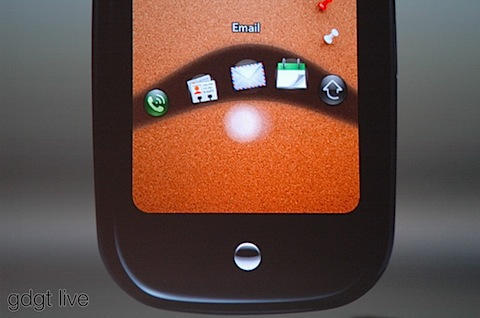
I am excited that the Pre is good enough to actually make Apple work hard, particularly on the software front. The Palm Web OS has a clear point of view, an attractive look, and some genuinely innovative features, such as the gesture bar and the very cool “wave” application launcher shown above. The Pre cribs a lot from the iPhone — not to mention OS X’s Expose feature — but it brings these ideas together in a way that even Apple hasn’t yet.
And the good news is that now Apple has a reason to go beyond the interface created for OS X iPhone 1.0. I wouldn’t be even slightly shocked if we see an Expose for iPhone update in firmware 3.0, or even before. And Apple needs to get more serious about rolling out the multitasking Push API it promised last July.
Kudos to Jon Rubinstein and Palm for pulling off a far better phone than I thought them capable of. It’s the first serious mobile platform that’s even coming close to besting the iPhone (sorry, Android), and it’s clearly going to have a life beyond its initial release. And hey — it’s got cut, copy, and paste!
Apple is ditching MacWorld to instead exhibit at CES next year instead, according to one source.
The source, citing “friends who work at Apple,” insisted the company is ditching MacWorld because it will “go large” at CES, which typically runs concurrently with MacWorld in early January.
The International Consumer Electronics Show, or CES, is the big annual gathering ot the consumer electronics industry. Held in Las Vegas over several days, it attracts more than 2,700 companies from all over the world, including technology giants like Microsoft, Sony and Nintendo.
Apple has never had a presence at the show, exhibiting at MacWorld instead. In 2007, Steve Jobs managed to eclipse CES by unveiling the iPhone at MacWorld, but typically the technology press prefers CES, which has more companies and therefore more news.
If Apple were to be a presence at CES — with Steve Jobs possibly giving a keynote speech — it would no longer have to compete with CES for press attention.
In addition, Apple is now more of a consumer electronics company now than a computer company, making CES a much better fit than MacWorld, the source said.
The source insisted his information was solid, not just speculation.
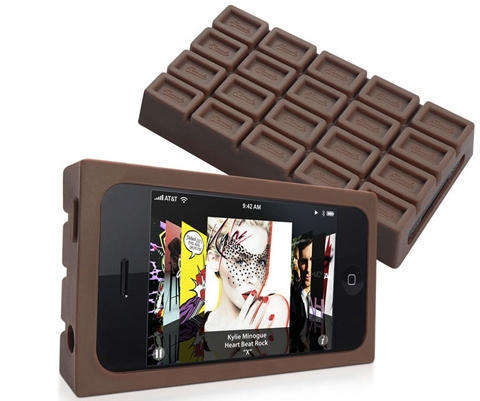
Sold in a package made to look like a candy bar, this brown silicone case wraps your iPhone 3G in yummy goodness, though it does bloat the sleek line of the device.
The fatten-up might make a high-tech phone look slightly tired, though it does bring to mind Wired co-founder-cum-chocolatier Louis Rossetto.
Say you lose your iPod or iPhone and some good Samaritan finds it, but there’s no way for them to get it back to you because there’s no contact info on it.
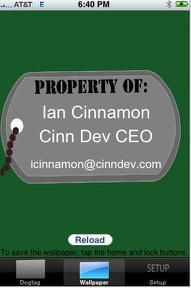
If you’ve got an iPod Touch or iPhone, enter an $0.99 USD app called DogTag, which adds an ID icon and allows you to put the contact info of your choice.
Even If you’ve got a passcode, the info is still accessible as a DogTag wallpaper. The brainchild of Ian Cinnamon, who has been programming since age seven, the app was released a few days ago, and so far the handful of reviews are mostly positive.
For older iPods, one quick way is to name your device with an email address (my iPod nano and older pods support the “@”). This way, if the iPod is plugged in, your contact info pops up on the desktop and in iTunes.
You can also add your info to “contacts” or “notes” on iPods, too so they don’t have to plug it in to go looking for you. (Although if they really dig, the name information you assign will come up, too, in the settings>about screen).
I hit on naming mine with an email address after spending a frustrating 20 minutes at the gym trying to convince the guy at lost and found that yes, the iPod containing, among other things, just the contralto part of “Lacrimosa” and three cover versions of “Mah Na Ma Na” was, in fact, mine.
Have you devised a good way to ID your iPod or iPhone? Any luck with getting it back?
Sharing is caring, let us know in the comments.
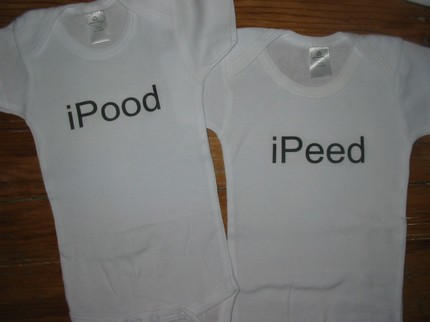
The concept does sum up a lot of iLife for infants, but the trouble with these iPooed and iPeed onesies is that once your baby soils the Apple-inspired jumpsuit, you’ll have to change them out of it.
About $16 for a set of two on Etsy. They come in a range of colors (white, pink, blue and green) and sizes to fit babies up to 34 pounds.
Photo: Cishore/FlickrWhile CEO Steve Jobs received his traditional $1 annual salary for 2009, three top execs each received $100,000 raises, Apple told federal regulators Wednesday.
Apple chief operating officer Tim Cook, finance head Peter Oppenheimer, and Mac hardware senior vice president Bob Mansfield had their paychecks boosted, as well as their stock portfolios.
Cook, often mentioned as a possible replacement for Jobs, will earn $800,00 per year. Oppenheimer, Apple’s Chief financial officer, will make $700,000 per year, while hardware chief Mansfield will make $600,000.
Macworld announced its 10 Best of Show picks for 2009 Wednesday afternoon, reinforcing the uninspired pall Apple’s looming withdrawal has cast over this year’s entire event.
From the hundreds of thousands of feet of floorspace taken up by Conference exhibitors at San Francisco’s Moscone Center, Macworld editors’ only significant hardware find was the Windows Home Media Server from HP.
My purpose here is not to pick apart each official choice, or even to come up with my personal alternative Best of Show picks – though give me another couple of days to walk the Expo floor and I might. I aim only to point out that when your top hardware pick at a trade show dedicated to Apple and Macintosh-oriented computing is a device that requires a Windows-based PC for initial installation, it’s cause for a little existential self-reflection.
Macworld did ferret out one item at the show that looks quite promising in my view – a Bluetooth Web Cam from ecamm network. To be available by spring 2009 at an MSRP of $150, the ecamm BT-1 streams 640×480 H.264 video and 48 kHz AAC stereo audio from up to 30 feet away from a paired Mac.
Your Mac has a built-in web cam you say? Well, with the BT-1 and its mini flexible tripod, you get the freedom to adjust the position, pan, and tilt of your web cam imagery. It’s also mountable on any standard camera tripod to give you further flexibility in filming. You and the editors of Macworld seem to have forgotten that old slogan Apple rode to the success from which it now abandons the Macworld Conference and Expo:
Among the underwhelming upgrades to iWork Apple announced Tuesday, I thought the ones made to Keynote seemed at least interesting. Call me crazy, but I’m rather fond of Apple’s presentation software and given the ubiquity of Powerpoint used in the business world, I’m always impressed when someone shows up with a Keynote presentation instead. It just tells me the person cares, you know?
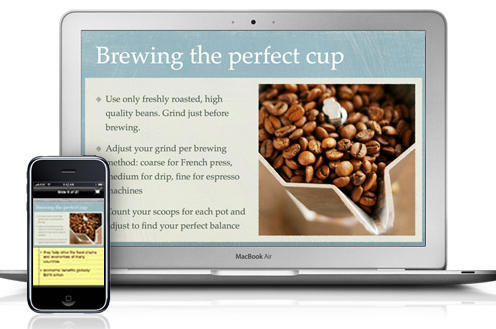
Helpfully, Apple itself has created Keynote Remote, an app for the company’s mobile devices that lets you control your Keynote slide presentation on your computer from your iPod touch or iPhone.
Swipe to advance or return to the previous slide. In portrait mode, see your presenter notes on your iPod touch or iPhone. In landscape mode, preview your next slide. Keynote Remote works with your Wi-Fi network, so you can control slide playback from anywhere in the room.
Great stuff, really. But, uh, you’ll need to drop another 99¢ in order to make it happen, even after you’ve bought the copy of iWork 09 needed to use the mobile app. Amazing.
Evidence, if it were needed, that even writers of the Best Mac E-zine Of All Time need to stop for a sit down every now and again.
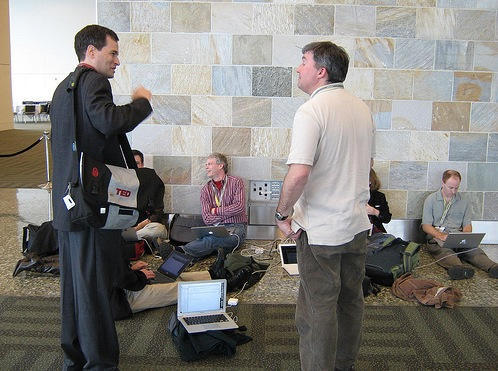
Here, thanks to the CC-licensed photostream of TidBITS writer Glenn Fleishman, we can see the TidBITters relaxing between frantic article-writing. It’s funny that even the awesome TidBITS team ends up crouching on the floor, huddled up by the power sockets just like the rest of us.
But wait, who’s this walking past – possibly also on the hunt for an empty power outlet? Why, it’s none other than equally great Mac writers David Pogue and Jason Snell. Pogue, Engst and Snell all together in one image: congrats! You’ve collected the full set!
An Australian pilot program using the iPod touch as a classroom tool has some high school students doing more homework, others puzzling over the device.
Though the small program — eight 14-year-olds — using iPod touches is far from giving a scientific answer of how they might change learning, a few interesting things have cropped up.
One: Louise Duncan, the teacher who started the program at Shepparton High in Victoria, found that some of the kids had trouble using them.
“We assume that 14-year-olds are really technologically savvy, but they’re often not,” she told Perth newspaper Western Australia Today.
Students use the hand-held media players to search the internet, download music, do quizzes, research and submit assignments and work with students in Singapore.
Duncan found that students in the test program were more willing to come to school, did more homework and used their iPods more than laptops or desktop computers.
The iPods are on loan from Apple and run on the Study Wiz platform; the test is part of a global mobile learning project.
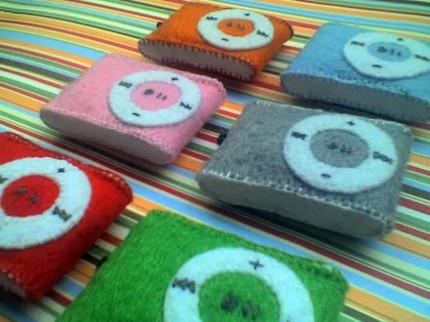
You could add this hand sewn iPod Shuffle in felt to your iPhone, a key chain, or otherwise adorn yourself with it, making the cuddly gadget just a bit more useful than the felt version of Apple’s phone that can’t be used even as a dog toy.
Cuter than cute, the 1″ x 1.5″ plush iPods are the handiwork of a woman in the Philippines with, as you might imagine, a declared love of kawaii stuffed toys.
iPod Shuffle charms come in blue, gray, pink, orange, red and green (specify your color pick in advance) at just $4 a pop on Etsy.
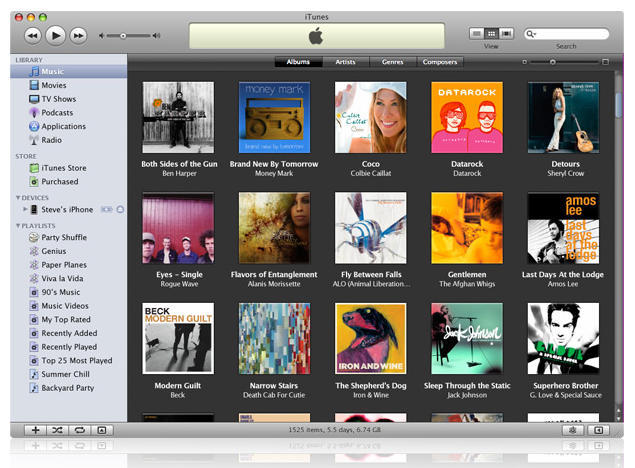
Lost in the verbiage over Apple’s decision to expand the number of DRM-free songs on iTunes was a fee some are calling Apple’s ‘music tax’ potentially worth $1.8 billion to Cupertino.
iTunes users will need to pay $0.30 per track ($0.60 per video and 30 percent of the price of an album) to use Apple’s one-click conversion to DRM-free listening pleasure. While offering copy-protection free iTunes songs is viewed as a ‘win’ for consumers, it may also further enrich Apple’s coffers.
Erick Schonfeld of TechCrunch estimates Apple would earn $1.8 billion if each of the 9 billion iTunes sales were converted to non-DRM.
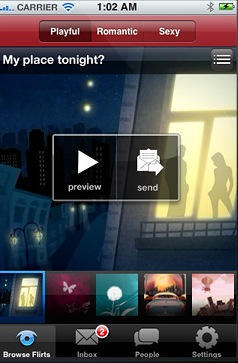
Among the more interesting things I’ve come across so far at Macworld is an innovative calling application from Freedom Voice, called Newber. Somewhat similar, but with a couple of key differences to Grand Central, Newber lets you route every phone call made to you though a single number and, using GPS location awareness, lets you take the call on any phone that happens to be nearby.
If you’re in the office at your desk, Newber will send calls to your work phone. At home it can ring the house phone. On the road Newber will ring your iPhone, the phone extension in your hotel room, even the payphone at the gas station in the middle of nowhere where you’re getting a flat fixed – if that’s where you want it to ring. Your callers have one number for you and you can receive their calls anywhere.
I saw the app in a demo at a press event on Monday night and spoke further yesterday with David Gerzof, president of Bigfish Communications, the PR firm representing Newber, about the difficulty Freedom Voice has had getting the Newber app approved for distribution in the AppStore. “Newber was submitted in October and Apple authorized the product manager to contact them by phone, which he does every day,” Gerzof told me. “They haven’t said it will be approved or that it won’t be approved, in fact we can’t see from our activity logs where they have even begun testing it. It’s very frustrating.”
As a result, despite having already put several hundred thousand dollars into developing the platform for iPhone, Gerzof and Newber aren’t putting all their eggs in Apple’s basket. A Demo application for Blackberry is already operating and the company is also working on one for Android. “We love Apple and began work first with the iPhone SDK because we wanted it to be the launch platform, but if they aren’t interested, we have to move forward with the others,” Gerzof says.
Hackers Tuesday forced MacRumors to halt its live-blogging coverage of Apple marketing exec Phil Schiller’s keynote speech at Macworld Expo. The hack hit MacRumorsLive.com, a domain created for commenting on the annual San Francisco, Calif. Mac-focused tradeshow.
Interspersed with live updates about news of iPhoto upgrades were offensive messages, including one declaring Apple CEO “Steve Jobs just died.”
In a statement posted about an hour after Macworld Expo opening, the site’s founder Arnold Kim apologized to readers for the attack.
Although Apple marketing head Phil Schiller announced a 17-inch MacBook Pro and more DRM-free music from iTunes, one analyst believes what wasn’t said is what counts most.
Gene Munster, the Piper Jaffray analyst and Mac-watcher, wrote Tuesday that the lack of many fireworks during Schiller’s talk signaled “Steve Jobs remains primary spokesman and active leader” for Apple.
The question of how active Jobs will be as CEO while he undergoes therapy for a “hormone imbalance” was raised Tuesday when brokerage firm Oppenheimer & Co. wondered if Jobs could fully perform as head of Apple.
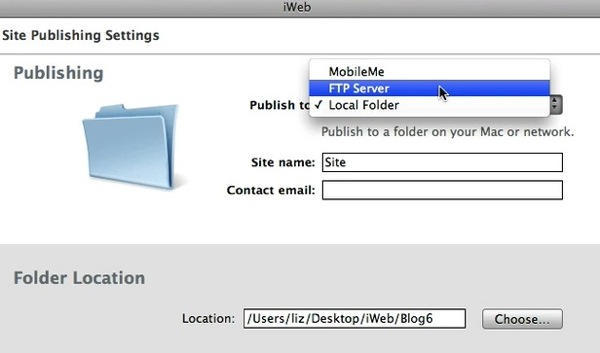
There are is two one great new features in iWeb 09 that went unannounced in yesterday’s keynote, both of which transforms it, in my opinion, from a waste of disk space into a potentially useful tool.
The two changesare is:
→ iWeb can now handle multiple web sites simultaneously; you simply flick from one to another in the sidebar
→ iWeb now lets you publish to any (S)FTP server, rather than tying you in to Mobile Me or restricting you to publishing to a local folder
There have been a few instances in recent years when I’ve briefly toyed with the idea of using iWeb for basic web projects, only to reject it seconds later because of these two this flaws. With iLife 09 installed, I’m going to revisit those projects and think again.
Today’s was the first MacWorld keynote I’ve missed in three years, and I have to say, I really didn’t miss anything. But then again, it was quite clear Apple was making a half-hearted showing as it was, revealing none of the products people are most excited about <cough>Mac mini</cough> and announcing several products that are either predictable, uninspiring, or just plain obnoxious toward consumers. Is anyone excited about variable iTunes song pricing who doesn’t work for a record label? Anyone? Or how about the “Indiana Jones” effect for iMovie 09 so you can have a fake plane fly over a fake globe to represent travel? This was worth gathering the world’s technology media?
It’s probably for the best that Steve Jobs didn’t show.
But all of the above was apparent to anyone watching. What was left implicit, though it was communicated loud and clear, is the fact that Apple now has to put its money where its mouth is, having dismissed MacWorld’s trade show atmosphere, and put together some truly special product launch events very quickly. The biggest advantage to not making the first Tuesday of January the holy grail of Apple announcements is that Apple can announce products when they’re ready and as it suits them, instead of forcing stuff to be ready ahead of time for MacWorld (and to beat out the CES news cycle). In other words, Apple should let the rest of the month pass, and then make a major hardware introduction on every Tuesday in February, culminating in a press event on the last Tuesday of the month to unveil the much-anticipated new Mac mini (and with the 32-gig iPhone coming somewhere beforehand).
At the end of the day, Apple is probably logically right that MacWorld doesn’t make sense for them anymore. I think it’s ungrateful, given how much the enthusiast community saved Apple during the mid-’90s, but it probably is the right thing from a business standpoint. But it also feels like they deliberately left a lot out of today’s announcements, as if to emphasize their rejection of the trade show model. It just felt cheap, you know?
The media and the public trickled onto the Macworld exhibit floor in the wake of Phil Schiller’s Keynote speech Tuesday in San Francisco with a collective yawn, casting a sad and listless pall over Apple’s final year at the seminal trade show dedicated to Mac and Macintosh innovation. Gone was the excitement generated in recent years by the introduction of revolutionary new products such as iPod and iPhone. Gone was the sense that Steve Jobs contagious’ enthusiasm and obsessive secrecy could somehow reward us with ever more new, beautiful, elegantly designed products that would change our relationship to technology and with each other.
Instead, Schiller left the Apple community pondering battery life and notebook aftermarket resale values, wondering how a little face paint and eye shadow applied to iWork and iLife is going to drive increasing revenue to One Infinite Loop between the end of Macworld on Thursday and the next Cupertino Town Hall event sometime later this year.
One the surface of things, a mood that I might liken to one in a household where the divorce has been agreed to but not yet finalized, is curiously appropriate to the uncertain economic horizon each and every one of the hundreds of Macworld exhibitors – as well as, of course, the show’s anchor tenant – is facing.
Sure it would have been exhilarating for Phil Schiller to have whipped out a thoroughbred upgrade to the Mac mini today, or a revamped Apple TV that might challenge the assumptions of what an interface between the office and the living room could look like. But I talked to several long time Mac addicts on the floor this afternoon, who confided they were relieved not to be tempted by any groundbreaking hardware innovations from Apple – because big ticket expenditures of every stripe are on hold until further notice.
In its way, then, Apple proved it still has the pulse of its audience well in hand – why offer revolutionary new products that would require hundreds or thousands of dollars in new investment (not to mention the huge investment in manufacturing required to roll out new hardware) when the company can let its legions of loyal consumers who have already bought Macs and iMacs over the years try on new software outfits at $50 – $80 a pop? Lean times may be coming for everyone but by golly you can spend your downtime learning how to play guitar with John Fogarty and marvel at the face recognition amazements of new iPhoto software.
Some of the busier booths on the exhibit floor this afternoon were ones hawking accessory items costing well under $100. Big gear manufacturers with shiny new products costing in the hundreds and thousands of dollars, not so much. And the reps of a couple of those exhibitors told me some of the newest stuff they have at the show are just prototypes, with no big production commitments coming into place until the economy and consumer spending shows signs of taking an upturn.
Compared to recent years, Day 1 attendance was significantly lower, something I could tell in the sparse lines at the concession stands and in the reliability of the WiFi connections available throughout the hall. But fewer people were here today because Steve Jobs was not here today. Tomorrow, when you’d expect the attendees interested in Macworld regardless of Steve Jobs’ presence, we’ll get a better idea of just how deflated the Mac community is over Apple’s final Macworld appearance and a sense of how much air has gone out of what was until pretty recently a high-flying market for computer technology.
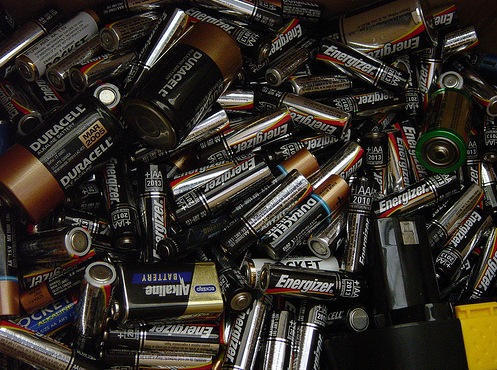
For me, the most interesting part of that keynote was the stuff about batteries. I think it’s safe to predict that similar long-life, non-replacable custom batteries will be appearing in the smaller Apple notebook computers in coming months.
Apple’s gone to great lengths to push this battery idea. Witness the expensively-produced video on the MacBook Pro page, that spends a lot of time explaining why it had to be this way. This shows that Apple expected some backlash.
The negative feelings on this issue runs deeper, though, thanks to a problem that’s industry-wide, not just confined to Infinite Loop.