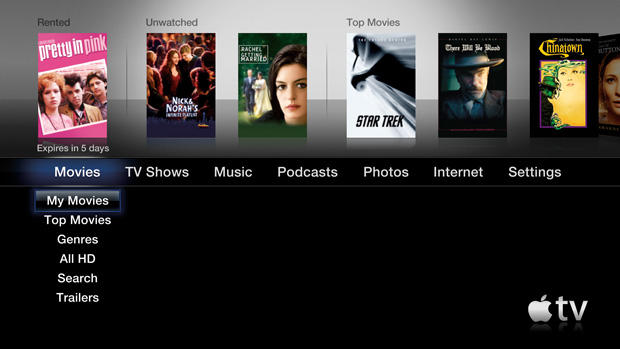
Apple has filed a patent for a wireless “remote wand” with the idea of adding it to future versions of Apple TV. The wand would give users with control over a cursor on the Apple TV screen, sort of like a mouse controls a cursor on a computer. The wand would also give Apple TV three-dimensional controls similar to those offered by Nintendo’s Wii controller.
According to Apple Insider, unlike the current 5-button remote on the current version of Apple TV, the wand can control a number of functions and can be used to zoom, as a keyboard application, an image application, an illustration application and a media application.
Probably the coolest thing about the pointless perspex carry-all is the iPod with its Chanel logo on the video screen — apparently Lagerfeld considered it more important than a cell phone.
A tiny authentication chip in the headset with on-cord control shipped with the just-released iPod shuffle is raising concerns among some that Apple will extort licensing fees from third-party headset manufacturers who wish to make headsets compatible with Apple’s new music playing devices.
First reported Friday in a review of the new shuffle at iLounge, the authentication chip was then derided by the Electronic Frontier Foundation as Apple’s attempt to invoke the Digital Millennium Copyright Act not to stop piracy, but to impede competition and innovation.
Saturday night, Boing Boing Gadgets posted pictures of the curious chip, along with a thoughtful piece pondering whether Apple’s engineering really amounts to DRM: “For all we know, it could be something the FCC made them put in so that it doesn’t interfere with whalesong.”
The EFF raises a great point, actually, wondering why more reviewers have not seized on Apple’s proliferating instances of hardware DRM: “If it were Microsoft demanding that computer peripherals all include Microsoft “authentication chips” in order to work with Windows (or Toyota or Ford doing the same for replacement parts), … reviewers would be screaming about it.”
In the final analysis, however, if Apple is in fact, as Boing Boing put it, “attempting to eat the headphone industry whole,” the company will lose. Consumers have the last vote and to the extent it may seem Apple products are stifling competition, raising prices and limiting choice, Apple’s tiny devices will go unsold.
There are already many many alternative music players on the market for consumers to choose from – some of the best even made by Apple itself – making the new shuffle a stillborn product if consumers perceive an inability to use it as they see fit.
Playfish, one of the largest and fastest growing social games developers, announced Saturday the availability of its popular title, “Who Has the Biggest Brain?” for iPhone and iPod Touch. Who Has The Biggest Brain? features Facebook Connect and enables friends to play together anytime, anywhere.
Playfish is behind 5 of the 10 most currently popular social games played on Facebook, according to the company’s marketing material, and claims more than 60 million registered players currently play its games on the Internet’s fastest growing social networking platform. The company says more than 15 million people have played Who Has The Biggest Brain? on Facebook since launching in late 2007.
“We believe iPhone and iPod touch represent the next generation of entertainment platforms,” says Kristian Segerstrale, CEO of Playfish.
With 12 mini games, 27 brain types and a variety of unlockable achievements, Who Has the Biggest Brain? enables players to compete with their real-life friends and experience the more social and connected game play that Segerstrale describes as part of the company’s mission.
By creating games for people to play together using social networks and platforms such as Facebook, MySpace, Bebo, Yahoo!, iPhone and iPod touch, Playfish aims to transform video game play from an isolated, solitary obsession to one in which people enjoy greater social and connected experiences.
Who Has the Biggest Brain? is available now for $4.99 in the iTunes AppStore.
The key to success for some of the best young filmmakers in America may be the unique partnership their school district has with Apple.
Students from Birdville (TX) ISD’s Media Technology program have distinguished themselves by having 5 films chosen for the student showcase at The South by Southwest Film Festival, which began Friday in Austin, TX.
Five films from students in a single school district is a record for the nation’s preeminent art, film and music festival and the program’s director credits the district’s relationship with Apple for her students’ success.
“Apple has made it possible for our students to be certified in Final Cut Studio while still in high school,” says Karen Seimears, the program’s director. “The University of Texas offers this to their students, and it costs almost $2000. Our students can earn it for free! What’s amazing is that we’re giving kids the tools they need while they’re still in high school to be absolutely employable. And not just that, but when they go into college, to be at the head of their class.”
Apple began providing individual laptops for each student in the Birdville program two years ago and the district is home to the nation’s only Apple Authorized Training Center for high school students.
Perhaps you know about Steampunk, the geek sub-culture movement that marries devotion to the aesthetics of Victorian romance with a commitment to the use of modern technology.
The vast majority of Steampunk practitioners work in the PC realm, though there are impressive examples of Apple gear transformed.
None moreso, perhaps, than the eye-Pod Victrola from Doctor Grymm. A custom mod of an Apple iPod Nano 1st Gen, the design is inspired by Mary Shelley’s Frankenstein.
The “eye-Pod” can be worn on the wrist via the leather cuff, or placed on it’s custom Victrola base.
Full functionality of the iPod remains intact and a hidden USB cord retracts from the base to either a wall charger or a computer. Hidden pressure plates send a strobing “static charge” into the quartz crystals on either side of the magnified veiwing portal, and music plays through the Victrola horn or though a portable personal hearing apparatus (in progress).
Here’s an iPhone app you might find coming in handy someday. Best of all, Have2P is a free iPhone app that finds restrooms in your area thanks to your device’s nifty GPS locator.
Useful features include info on whether the restroom is for customers only, if it has a changing table and even reviews on how clean it is. Users can edit restroom info, submit restroom reviews and add restrooms to the database.
The latest update to Have2P even claims to have an “urgency detector” that senses when you and the phone are shaking and automatically starts a new search for nearby relief.
CBS and MobilTV announced a grand experiment in WiFi broadcasting this week with the release of March Madness on Demand (link opens iTunes), a $5 application for iPhone and iPod Touch that will theoretically allow users with a good WiFi connection to see live streamed TV broadcasts of the NCAA Basketball Tournament begining March 19th.
CBS will stream every game of the tournament up to and including the Finals on April 6th, in addition to providing video highlights on demand. Users without WiFi access will be able to access live audio of games in progress over AT&Ts 3G and Edge networks.
Every year at this time, it becomes a popular sport to estimate the supposed billions of dollars in lost productivity American businesses suffer as a result of workers’ preoccupation with what some call the most exciting spectacle in sports.
How about you, dear Cult readers? Are you willing to throw $5 on the table to see if CBS can follow through on its promise to live stream the excitement?
Let us know how you think this is going to play out in comments below.
Liu says he got interest pretty high up the Apple corporate ladder from that video, but “Microsoft actually took my music video video very seriously, and we decided to collaborate on a viral video for Microsoft Office for Mac.
The video was supposed to debut at Macworld this year, but delays intervened and it is finally being released today.
Liu told Cult of Mac he had hundreds of windows open at times in PPT, Excel, and Word during the making of the video. “Honestly, it didn’t crash, and didn’t slow down. Not like anyone else in the world would try and animate ASCII in MSWord, but … ”
He explained his motivation for the project, saying, “I think Apple users should know that MSOffice doesn’t have to be “un-fun” like ILife ’09 makes it out to be.”
“I’m a huge Mac fanatic, and I wanted to make Microsoft seem less corporate-y with this ad campaign. Microsoft gets thrown under the boss (sic) a lot.”
For what it’s worth, Liu said he was bored and curious, and he tried doing this with iWork ’09 but it wasn’t holding up as well. “I do have to hand it to MSFT for making a pretty stable program, with good creative features (if you know how to use them).”
Steve Wozniak has a slight fracture in his foot but has vowed to press on with the Dancing With the Stars competition.
“I didn’t want to worry anyone unduly.” Wozniak mentioned on his blog this morning. He had been feeling pain in his foot and after having an X-Ray and an MRI it was revealed that he has a foot fracture.
Karina Smirnoff, his professional dance partner accompanied “The Woz” to Cedars-Sinai hospital, worried that she had lost her partner, but Wozniak was given a removable cast and the okay to dance as long as he is very careful and wears the cast faithfully when not rehearsing or performing.
In an e-mail to his Facebook Support Group, Wozniak said he told his doctors he is determined to continue with Dancing With The Stars because he “loves being part of such a good and important thing.”
A program providing MacBooks for students in Maine plans to increase its scope by leasing 100,000 computers from Apple at a cost of about $25 million per year.
Maine started its first-in-the-nation program by distributing more than 30,000 computers to each seventh- and eighth-grader in all of the state’s state public schools in 2002 and 2003.
Now, all 120 of Maine’s high schools, along with 241 middle schools, will have new laptops under the same program. The cost runs about $242 per computer per year.
Maine governor JohnBaldacci believes the laptop computer program can go beyond the classroom, becoming ” a powerful tool for the entire family.”
“Every night when students in seventh through 12th grade bring those computers home, they’ll connect the whole family to new opportunities and new resources,” Baldacci said. The computers would come with software to connect to the state’s CareerCenters, he added.
In 2007, a study released by the Maine Education Policy Research Institute (.pdf) indicated that student writing scores improved after laptops were introduced.
Apple is indeed having a special event, as widely rumored, March 17. But it won’t be hardware, it will be a preview of the next iteration of iPhone software. The company distributed invitations to select press outlets Thursday, saying the event at Apple’s Cupertino headquarters will also feature a new version of the iPhone SDK.
Presumably, the new software will get into general release by June/July, which is becoming the time of year we can expect new iPhone hardware as well.
Stay tuned for more as news and rumors and mock-ups and spy shots develop.
The full-time techie and self-described “part-time jackass” at drunken tech took a look inside a new single quad-core Mac Pro to find two mystery ports named “Big Frank” and “Little Frank.”
DT writes: “I haven’t seen an Easter egg, hardware or software, on an Apple product in a LONG time. I have no idea what the “Big Frank” non-socket or “Little Frank” actual-socket is. My only speculation is that the single quad-core board is the “Little Frank” and that the dual quad-core board is “Big Frank.” I’ll speculate some more and say that maybe the connector is for the equipment testing hardware. ”
Take a step back in time and see how the writers at Saturday Night Live during the 2005 season weren’t too far off in imagining the iPod shuffle released Wednesday by Apple.
Apple introduced an all-new redesigned iPod Shuffle Wednesday, touting it as the first music player that talks to you.
Except that it’s not the first music player that talks to you. Does anyone remember the Nanocromatic iPods introduced just last summer?
Those iPod nanos also featured the “Voice Over” function being touted as Wednesday’s big new improvement to the shuffle, which now sports 4GB of storage (up from 2GB). Apple’s smallest music player now features playlist support, however and syncs with iTunes through an included USB cable which connects to the shuffle’s audio jack.
The new shuffle also comes with earbuds featuring on-cord remote control.
The new design is rectangular rather than square, comes in Silver or Black and costs, as did previous models, $79. Apple is making these things smaller all the time, with the new shuffle being smaller than a house key and not much thicker.
It’s probably a good thing the shuffle’s Voice Over function, which supports 14 languages, is accessed manually, to tell users the name of the artist and song playing or run through the playlists available on the device. On the iPod nano introduced last summer, the Voice Over feature was an on-or-off setting and quickly grew tiresome when it would kick in at the mere changing of the device’s orientation from vertical to horizontal.
More user control is good; thank you, Apple.
UPDATE: this piece has been edited to more accurately reflect the new shuffle’s capacity. Thanks to readers who pointed out the error in the original report.
I grew up with 1980s home-computer gaming: Atari, Commodore, Spectrum, Amstrad. In the UK, we had, comparatively speaking, no money (yuppies aside), and, rather than being lucky enough to follow our disk-happy American chums, had to make do with cassettes. Inevitably, with tapes being cheap, publishers soon realised that affordable games were very saleable games, regardless of quality. Eventually, the number of £1.99 and £2.99 games being churned out was astonishing, as was the ever-diminishing amount of time it would take full-price releases to show up on budget labels.
Towards the end of the 1980s, it got to the point where almost no-one bought full-price games in the UK, because everyone would just wait for a price-drop. Watching apps on the App Store brings back these memories, and so perhaps it was inevitable that the other bastion of 1980s software—the compilation—would at some point make its way to the App Store.
On March 9, the 5 Fingers Games Bundle appeared, mashing together BurnBall, Chopper, Up There, Sneezies and Blackbeard’s Assault. Time will tell if this process works in the present day. It certainly has the potential to give exposure to poor-selling but quality games. However, compilations were the other thing that broke 1980s gaming in the UK, since almost every half-decent game ended up on a compilation eventually. I’m hoping people will continue to buy and support indie devs, rather than wait for a now seemingly inevitable price-drop or compilation entry that will ultimately lead to cheaper entry points and fewer development resources.
The opening spread of a large iPhone gaming feature in Retro Gamer 61.
In the UK at least, the balance is starting to tip regarding iPod touch and iPhone games. Edge magazine interviewed Greg Joswiak (Apple VP for iPod/iPhone product marketing) recently, but, more importantly, gave Rolando a double-page spread in the magazine.
Edge is notorious for being one of the few British magazines that actually understands how a rating system should work, and avoids placating publishers, instead scoring games as they deserve. Rolando got a ‘7’, which in Edge’s book is pretty good, especially when you consider games are rated against all the competition. (The general conclusion was the game is good when compared to anything, but a current standout on the platform.)
More astonishing, though, is the current issue of Retro Gamer. This magazine concentrates solely on classic gaming, interviewing the likes of Eugene Jarvis, Toru Iwatani and Yu Suzuki, seeing how old games came to be. This month, ten pages of the magazine are given over to iPhone, exploring how the system is becoming a favourite for indie devs who have a fascination with classic gaming.
The point is that when newsstand mags—and especially niche publications like Retro Gamer—start covering iPhone gaming in this manner, it’s surely knocking on the door of mainstream. That said, such coverage can still prove controversial, and there was a barrage of complaints regarding ‘legitimacy’ on Retro Gamer’s forum—some centring around the relevance of Apple’s device in a retro magazine, but many arguing that it’s not a de-facto gaming platform at all. Long-time readers of Cult of Mac will know that this was a view that I once held, something I intended to address in a feature on this site sometime over the next couple of weeks.
Ego is an aptly-named iPhone app that lets you check web statistics that matter to you, on the go. Because you’re, as the tag-line says, important.
Through hooks into Feedburner, Mint and Twitter, the current version supports statistics on the number of visits to any number of your websites (including daily, hourly and monthly numbers), feed subscription totals and changes, and how many people are following you on Twitter.
Support for Google Analytics is planned in a coming update.
Just $1.99 keeps you up-to-date on your web relevance any time, any where.
Sentiment seems about 8:1 against young German artist Darakas’ vision for the Apple touchscreen netbook rumored to be headed to market in the 2nd half of this year.
We asked Cult of Mac readers to step up up with their own renderings and so far we’ve got a sleek looking tablet idea from reader Bobbertson, above, and another from reader Sean, below.
Sean imagines a device containing a 7″ Multi-touch glass screen with a black frame and chrome bezel around the screen. Something more like an enlarged iPod Touch rather than a ‘tablet’, which usually contains a larger screen.
It would have a 1.6GHz Intel Atom Processor, 512MB – 1GB of RAM, 64GB flash memory, bluetooth, WiFi, and a cut down version of OS X Leopard or ‘Snow Leopard’ to fit the device.
Speculation that Apple is poised to release a touchscreen netbook remains persistent as winter snows, with dozens of outlets reporting again today that unnamed “sources” in Taiwan and China “confirm” the new product will be released as early as the 2nd half of this year.
So what the heck, as long as we’re talking about something that may or may not come to pass, why not talk about what it may or may not look like?
16 year-old German artist Darakas, who also goes by the name Jesse, gets the conversation started with this 3D modeling rendition of his vision for the Apple MacTouch.
Until the badly lit spy photos start showing up, we think this is a pretty good jumping off point. Have you finished your Apple netbook mock-up, or see any others out there? Let us know in comments and we’ll feature them here.
Evil Panda says: See me inside Tweetie. I like Tweetie. Apple, stop being stupid, or Evil Panda will get you.
UPDATE: All’s now well in the land of Tweetie. Apple relented and, in double-quick time, posted Tweetie 1.3 to the App Store today. However, this episode highlights that if you’re going to censor things, you really have to censor the ‘right’ ones, and also have some consistently enforced guidelines to work towards. And so Evil Panda is sated for now, but he’s still watching, Apple.
I recently moaned about the App Store on my blog, Revert to Saved, when the South Park app rejection debacle highlighted Apple’s inconsistency regarding application approval. (Short version: South Park app gets rejected for “potentially offensive” content, despite entire South Park episiodes being for sale on iTunes and therefore watchable on an iPhone.)
Today, however, things took a turn for the crazy. Tweetie, an iPhone Twitter client—in fact, the very best and top-selling iPhone Twitter client—just got its latest update rejected. The reason is so staggeringly bonkers that I’m hoping it’s an early April Fool jape. Apple rejected it, according to the developer, because there was an offensive word in the Twitter trends list, which Tweetie provides access to. No, really.
This is so astonishingly stupid that I am still reeling that Apple could be so dumb. Are apps now supposed to police the entire internet? Does Safari filter out rude words? Is Apple suddenly going to wrench Tweetie and every other Twitter client from the App Store? For that matter, maybe Apple should remove the likes of WriteRoom, because, hey, I can write the word “fuck” in it, and I might offend myself.
Sort out your App Store approval process, Apple, because you’re looking stupider by the second. And while competition is currently non-existent, it certainly won’t be that way for long.
If you were, like one of our readers, too busy watching “Chuck” last night or you live outside the U.S., you can still vote for Woz on Dancing with the Stars. Polls are open until noon EST.
Check out his moves to the aptly-chosen “You Ain’t Seen Nothing Yet” then go to the ABC website, register and you’ll be able to cast all 13 of your votes (yes, the hack Woz predicted works) as I did this morning from Milan.
“My wife needs medical care; and we don’t have health insurance,” he explains on the website he just put up, where he is selling quite a collection of Apple memorabilia, including posters, brochures, cards, stickers, manuals, annual Apple fact books, t-shirts, even a vintage Apple ProMouse that was Steve Jobs’ gift to attendees at the Macworld New York keynote address in 2000.
“Don’t be intimidated by the prices!” Saldanah writes on the portal page. “Most items have some bargaining room built-in, and we’ll do quantity discounts too, so find what you want and let’s talk. You might be suprised!”
That’s a good thing, too, because — for example — he’s got eleven t-shirts from various Apple Store grand openings priced at $200 each.
These economic times are difficult for so many people and one never wishes on anyone the need to sell things near and dear to them in order to raise funds for medical bills. We wish Saldanah and his wife the best.