Apple said it was “saddened and upset” by a recent spate of suicides at Foxconn, a China-based electronics manufacturer believed to be making Apple’s upcoming next-generation iPhone. The Cupertino, Calif. consumer electronics designer also announced it would launch an independent evaluation of the plant where 10 workers have committed suicide in the past year.
Earlier this month, a call for investigations was spurred by the death of another worker.
The iPad launches officially in Japan on May 28, but like lots of countries around the world, jet setters and government members already have them before local stores do.
Apple’s new device hasn’t been declared street legal by Japan’s communication authorities yet so, much like in Israel whose iPad “ban” got supermodel Bar Rafaeli into trouble, until it’s been officially cleared for use, elites who have them must pretend not to use them.
Case in point: Japan’s telecoms minister, Kazuhiro Haraguchi, “borrowed” an iPad from Marc Benioff, customer service exec at Salesforce.com, while visiting the US in May. Haraguchi however, clarified via Twitter that “I’m not illegally using the iPad in Japan.”
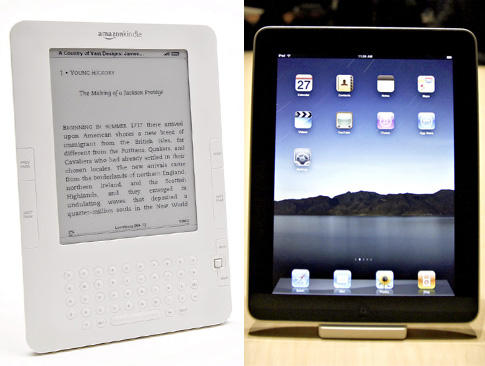
Speaking Tuesday at Amazon’s annual shareholder meeting, CEO Jeff Bezos said that a color version of the Kindle e-reader is “still a long way out.”
According to Bezos, adding color to the Kindle’s e-ink display, while possible in the lab, is simply “not ready for prime-time production.”
Don’t think for a second, though, that Amazon intends to let the iPad run away with the e-book market without a fight.
Bezos appears to have been very specifically saying that a color e-ink Kindle wouldn’t be out soon, but his wording leaves the possibility of an iPad-like Amazon tablet wide open. Trying to beat Apple at the tablet hardware game is probably folly, but there’s got to be a lot of temptation in the Amazon offices to give it a try.
There’s a growing number of analysts and pundits who believe that netbooks will increasingly become irrelevant to most customers as tablets This latest Retrevo poll seems to support that opinion.
The Retrevo poll’s sample size was over 1,000 individuals of different genders, ages, incomes and location who considered buying a netbook last year. The question asked was: “Did you hold off on buyinga netbook after the iPad was announced in January?”
The results are quite good for iPad. 40% waited to buy a netbook until after Apple announced the iPad, while 30% didn’t wait at all. The remaining 30%? They all abandoned their netbook plans and went with iPad instead.
Wired has released a version of their magazine for the iPad. The new version costs $4.99 and is available from iTunes. Ironically, the video used to demonstrate the iPad version, can’t be viewed on an iPad due to its use of Adobe Flash.
The iPad version was released ahead of the scheduled June premiere by publisher Condé Nast. “Wired Magazine will be digital from now on, designed from the start as a compelling interactive experience, in parallel with our print edition,” editor-in-chief Chris Anderson told readers. Earlier this year, Anderson called the iPad a “game changer.”
In the on-again-off-again Apple/Flash affair many people feel caught in the fray. McCann creative Mat Bisher, perhaps tired of being caught up in this tug- of-war, used his Flash-built site to send a strong message: “STEVE JOBS HATES YOU.”
Bisher employed a Flash sniffer to send this message, sniffers detect whether users are on Flash-enabled devices. Try to view Bisher’s “Save Apple” site from an iPhone or iPad you’ll be greeted by Steve Jobs flipping you the bird with a freakishly long middle digit.
Bisher hit on the idea out of frustration: “I, like many agency creatives, have designed my site using Flash, and as we all know, Apple’s iPads and iPhones are not Flash supported thanks to Mr. Jobs.
Apple’s been under the scrutiny of the U.S. Department of Justice in two anti-trust investigations over the last couple of months: the first in response to complaints by Adobe that Apple wouldn’t allow Flash on iPhone OS, the second in relation to the forthcoming iAd network.
Steve Jobs can’t be happy about either of these investigations, so the prospect of a third must have him massaging his temple as if someone just fired an invisible BB into it: the New York Times claims that the DoJ is launching yet another anti-trust investigation against Apple, focusing on the iTunes hegemony over the digital music market.
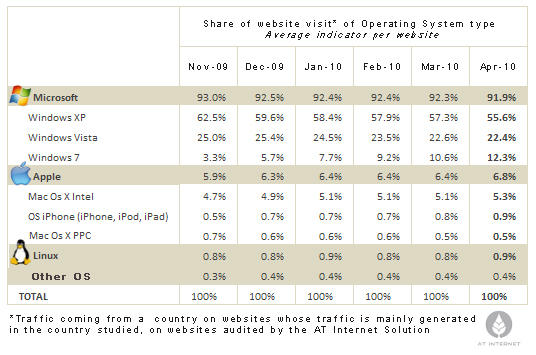
Apple’s slice of the web browsing pie sits restlessly at around ten percent, in the States when you take all of its platforms into account and is growing every day. It doesn’t quite have the same breadth of pie wedge in Europe, but as this chart from AT Internet auditing the visitors of their monitored websites makes clear, Apple’s operating systems are gobbling up more and more pageviews every day.
According to AT Internet, Apple’s marketshare is now sitting at around 6.8% in Europe, having grown 2.3 points since last November. iPhone OS is consuming about 1% of all European website views. Meanwhile, Microsoft’s own marketshare has gone down over the same period… with websites visited by Windows Mobile and Android devices are so insignificant that they can be comfortably lumped into “Other OS” category.
Valve Software has just announced that their revolutionary shooter Half-Life 2 will be coming to Steam for Mac later today… and to promote it, they’ve released this incredible Half-Life 2 themed riff on Apple’s own seminal “1984” advertisement, with City 17 resistant fighter Alyx flinging the series’ iconic crowbar through the televised face of the Big-Brother-like Walter Breen.
Absolutely brilliant. As for Half-Life 2, the Steam release marks the first time that the game has been playable under OS X for the last six years. At this point, the game is a little long-in-the-tooth, and Valve has released much better games like Portal and Left 4 Dead II since then, this is a great opportunity to play a classic.
Price is still unknown, although the PC version costs $20 on Steam, so unless Valve offers Half-Life 2 at a discount, that’s probably what you can expect to pay.
Yesterday’s release of Google’s Chrome 5 internet browser made it even more viable a Safari replacement than ever (if you can get over the design niggles, that is), but if a rather sly hint from Daring Fireball’s John Gruber is anything to go by, Apple may attempt to match Chrome and Firefox’s most interesting feature — extensions support — with Safari 5.
Quoth Gruber:
The other big thing that’s missing [in Safari] (compared to both Chrome and Firefox) is a proper extension API. If only Apple had an imminent developer conference where they could unveil such a thing.
This is a big weakness of Safari compared to many other modern browsers , and the ability to easily tweak the Safari experience according to user preference would certainly win Apple’s browser some converts.
The question is: are browser extensions anathema to Apple’s own design ethos, which tries to perfect the user experience through tight-fisted control? As great as Firefox and Chrome extensions are — I simply can’t work with a browser that doesn’t support them anymore — things can get quite ugly and confusing, design-wise, with a lot of extensions installed. Apple can’t be too happy about that prospect.
Still, at the end of the day, the option of extensions coming to Safari is a win for everyone. My only hope is that Apple will crib some other ideas from Chrome while they are at it: Chrome’s effortless merging of the search field and address field is so brilliant that it makes any other interpretation seem amateurish in comparison.
Apple’s upcoming 2010 Worldwide Developer Conference, starting June 7 in San Francisco, is a bit like celebrating Christmas Day after already knowing what will be under the tree. Yes, CEO Steve Jobs will deliver a keynote address, but otherwise, there is “little room for surprise,” a prominent Apple analyst said Wednesday.
With talk of the upcoming next-generation iPhone splashed across blogs and television newscasts like some messy Hollywood divorce, all that’s left for Apple to do is fill in the details. The handset will likely have a front-facing camera useful for video conferencing, longer battery life and thinner design, Piper Jaffray’s Gene Munster told investors. Munster calls the WWDC a “non-event” for Apple stock.
Former Apple retail employees have filed a class action suit in California over rest breaks and poor treatment.
The lawsuit was filed on behalf of all people employed in non-exempt (hourly paid) “Genius” positions in San Francisco County Superior Court on September 15, 2009. A website gives more details on the suit.
“Apple has enjoyed an advantage over its competition and imposes a resultant disadvantage on its “Genius” employees by failing to authorize, permit and provide statutorily mandated rest breaks as required by law.”
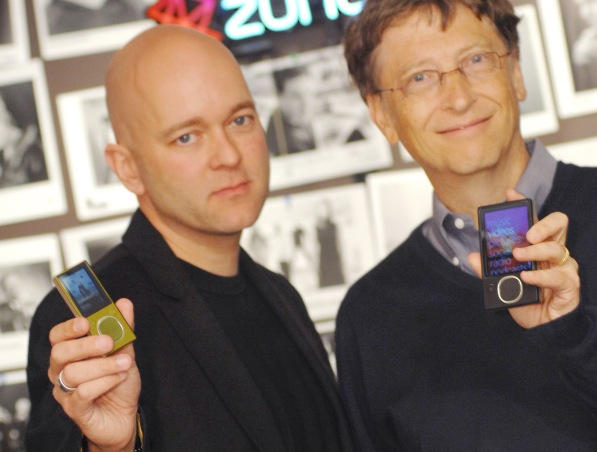
Microsoft's James J Allard (seen here with Bill Gates) is leaving the company, largely because of failed attempts to match Apple's iPod, iPhone and iPad.
Two of Microsoft’s highest-profile executives are leaving, and Apple’s running rings around the company is partly seen as the reason.
Robbie Bach and James J Allard, leaders of Microsoft’s Entertainment & Devices Division, are both leaving and will not be replaced. It is Microsoft’s biggest management shakeup in years. The restructuring will put CEO Steve Ballmer in direct charge of Microsoft’s consumer-focused mobile businesses, which are getting a kicking from Google, Nintendo and especially Apple. This transition is reminiscent ofwhen Bill Gates left Microsoft, which signified a turning point for the company’s leadership and direction.
In fact, Venture Beat’s Dean Takahashi, who wrote a pair of books about the Entertainment & Devices Division (Opening the Xbox and The Xbox 360 Uncloaked), says the inability to compete with Apple is behind the shakeup:
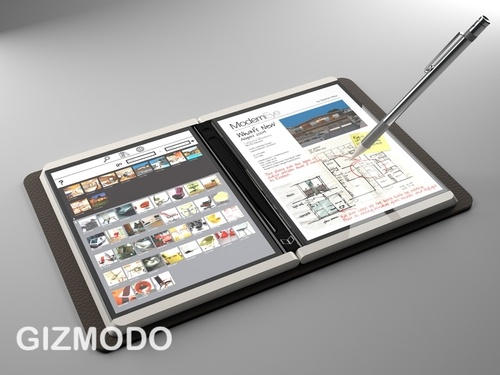
Allard’s last project at Microsoft was Courier, which Ballmer canceled earlier this year. It was viewed as an attempt to take on the Apple iPad. While Bach’s division is profitable now, it may be remembered for its inability to take on Apple in the increasingly critical mobile business. And that may explain why, any day now, Apple’s market capitalization is going to become bigger than Microsoft’s.
UPDATE: Horace Dediu has a good guess why Bach was fired: he lost Hewlett Packard when the company bought Palm. “Bach lost a key account; in fact, he could be responsible for having lost the biggest account that Microsoft ever had. Ballmer is a sales guy and he knows the importance of these relationships. A customer like HP must be managed carefully and their strategy must be steered to fit with yours. If HP felt they needed to go somewhere else for their mobile OS, it’s a slap in the face, but if they buy the asset and IP and internalize a competing platform, then that is a dagger to the heart for Ballmer.”
Google has graduated its spiffy Chrome browser for Mac from beta to stable release. It’s a major milestone for the browser, and an indication Google is taking the Mac platform seriously. For a while, it looked that Chrome for Mac was an afterthought.
Today, I’m happy to announce that Google Chrome for Mac is being promoted out of beta to our stable channel. We believe that it provides not only the stability, performance and polish that every Mac user expects, but also a seamless native Mac application experience that Mac users will feel instantly at home with.
I’m a big fan of Chrome, even though it’s a memory hog with multiple tabs open. It’s fast and there’s a big and growing gallery of more than 4,500 extensions.
We start off with two MacBooks for under $1,000: a 2.26GHz MacBook Core 2 Duo for $799 and a 2.26GHz Unibody MacBook Pro, starting at $929. Also on tap is a price cut on the 16GB iPhone 3Gs from Walmart.
Along the way, we also check out Apple’s back-to-school sale, new software for the iPhone and iPad and other Mac-related items. Details on these and many more bargains are available at CoM’s “Daily Deals” page right after the jump.
Another worker at China’s Foxconn Technology Group has died. While few details were released by the state-run Xinhua News Agency, the incident is the 10th death in the past year at the electronics maker. Ironically, the death followed an announcement Monday by Foxconn disputing reports of a sweatshop atmosphere.
“We are certainly not running a sweatshop. We are confident we’ll be able to stabilize the situation soon,” the AP quotes Foxconn Chairman Terry Gou.
Microsoft is expected to overhaul its entertainment and devices group as the desktop software giant finds itself out-muscled in a bruising battle between Apple and Google. The division – responsible for the Windows Phone, Zune and Xbox – will likely lose its chief technology officer, reports say.
Although the division made $1.67 billion in sales for the first quarter of this year, Microsoft is being outmaneuvered as technology increasingly goes mobile. J. Allard, the division’s chief experience officer and chief technology officer, is expected to leave the company in the wake of Microsoft’s decision to kill his dual-screen Courier tablet.
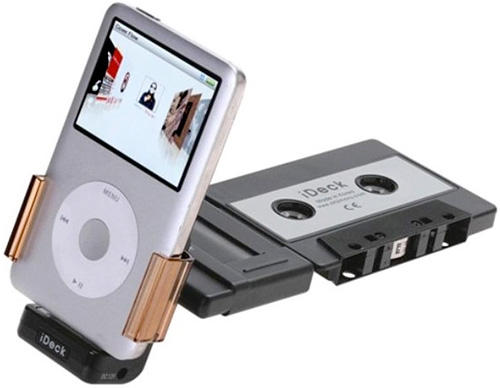
For years, I’ve been resiting the urge to upgrade my deck and instead pumping my iPod or iPhone audios to my antediluvian car stereo with a cheap $2 cassette deck adapter. For guys like me, then — individuals who own cars worth less than their phones, and are proud of the fact — the iDeck iPod Car Cassette Adapter seems ideal: it turns your existing cassette deck into a permanent in-auto iPod dock.
I’d be typing “SOLD” here except for that last remaining sticking point, the price: the iDeck costs $39.99 through Amazon. Heck, for that price, a cheapskate like me might as well buy a new car. One with floorboards!
Outdoor furniture designers must be feeling the fruit this season: here’s another Apple- inspired al fresco lounger.
In darker rattan than yesterday’s version spotted in Norway, this one’s also got a little more abstract shape and looks less cribbed from the Cupertino company logo.
Mac collector Mark Johnson spied this one in a Liverpool Costco where the price tag is about $2,100 (£1,500 circa).
Can the apple fall too far from the tree or would you buy this for your backyard?
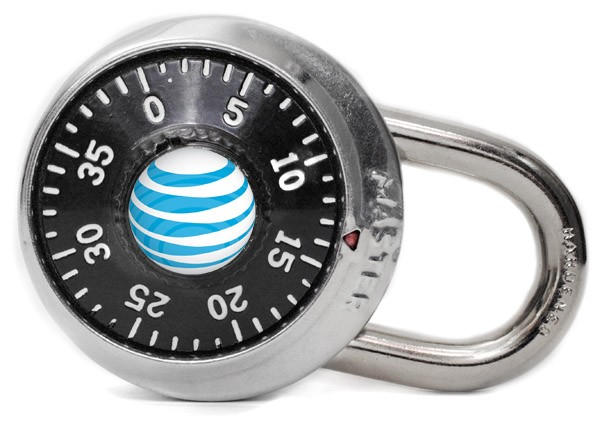
Although AT&T leaders have responded with bravado to questions of how Verizon might upset the carrier’s exclusive iPhone apple cart, Wall Street apparently isn’t so care-free. AT&T could lose up to 40 percent of iPhone subscribers when Verizon starts selling the handset, one analyst warned Monday.
Up to 6 million of AT&T’s 15 million iPhone customers could leave for Verizon, Davenport & Co. analyst F. Drake Johnstone told investors. Attempts to bar the door – such as hiking the early termination fee for smart phone owners from $175 to $325 – is the first signal “AT&T is clearly worried that it will lose customers once a competing carrier such as Verizon begins carrying the iPhone,” Johnstone said.
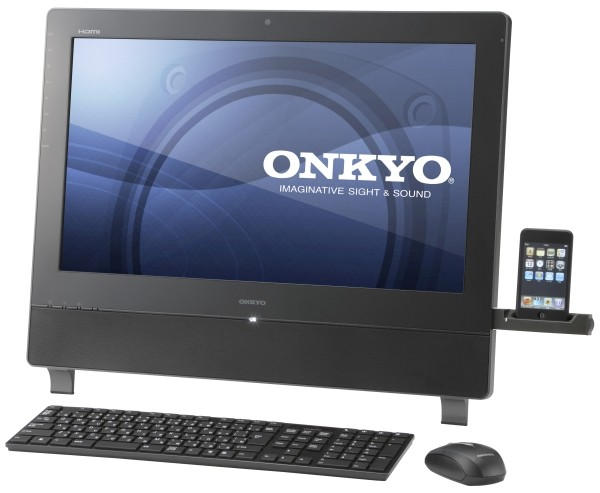
It’s hard to describe Onkyo’s latest PC as anything besides a little bit daft. The E713 is an all-in-one Windows 7 PC (with all the hideous matte gray plastics aesthetics of such) which prominently boasts a slide-out, built-in iPod dock that has been sillily mis-designed so it’s mouth just isn’t quite wide enough to slide an iPhone in. What?
Otherwise, it’s not a bad looking machine, featuring a Core i5 processor, 4GB of RAM, a digital TV tuner, Blu-Ray drive, 1TB hard drive and a 23-inch 1920 x 1080 LCD for just $1100… but the obvious bone-headedness of designing a computer with a built-in iPod dock that can’t dock with Apple’s most popular product is just the sort of casual ineptitude that keeps us all on Macs to begin with.
Capcom’s fantastic series of lawyerly anime adventure titles, the Ace Attorney series, have been delighting gamers on Nintendo’s handhelds since 2001… and now the first game, Phoenix Wright: Ace Attorney is available to download through iTunes.
The iPhone version of Phoenix Wright is basically a direct port of the Nintendo DS version, with the lower half of the iPhone screen standing in for the DS’ lower display. Otherwise, though, the two games are identical, and as a long-time fan of the series, this is an easy game to recommend if you like quirk, tongue-in-cheek gravitas and cheeky mysteries to solve.
You can buy Phoenix Wright: Ace Attorney on the App Store now for just $4.99.
Apple apparently has gotten the message over repeated reports of iPad shortages. The Cupertino, Calif. company may double production for its tablet device to 2.5 million units per month by September, up from 1 million to 1.5 million expected for next month, one analyst said Tuesday.
In a note to investors, Sterne Agee analyst Vija Rakesh writes checks with memory suppliers indicates Apple is preparing for a wider international launch and the upcoming back-to-school markets.
Panic, the company that makes awesome applications like Coda and Unison, got a little surprise in the mail yesterday – a Faux Apple Design Award, sent in by an extremely appreciative user of their best-known product, Transmit.
It’s that time of year again! Apple’s throwing a bone (or, alternatively, trying to lock-in) green undergrads heading to college for the first time with their annual “Back to School” program, which nets eligible students a free 8GB iPod Touch (or $199 off any other iPod).
If you want to qualify, you have to buy a new Mac and iPod simultaneously at the Apple Education Store, an Apple retail store or authorized campus store. The discount is in the form of a rebate, so you’ll need to wait ninety days to get your $199 back.
As usual, it’s a pretty sweet deal that is available to any educator, students of higher-education or parents shopping for their college-bound sproglings. If you think you’re eligible and are looking to buy a new Mac, this is a great time to pick it up and get yourself a free iPod in the process.