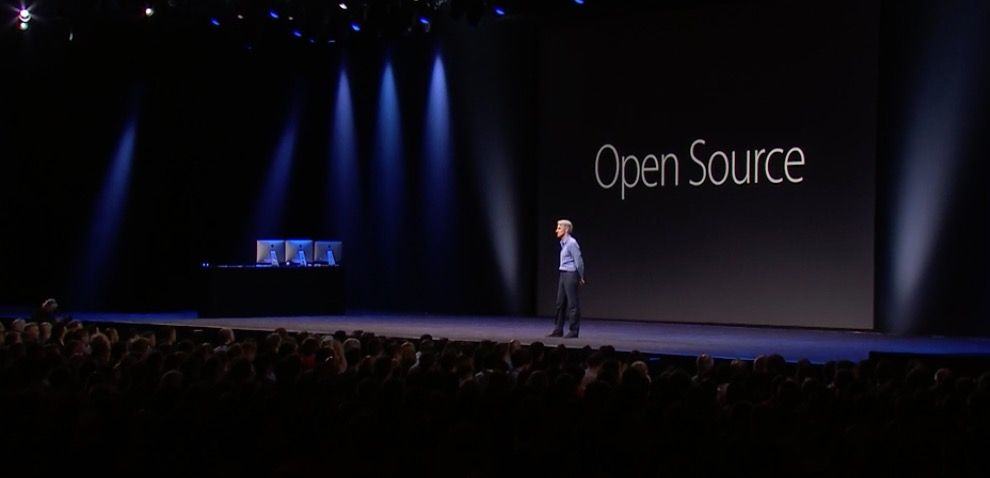
Apple’s culture of secrecy was responsible for the departure of Chris Lattner, the company’s former head of developer tools and the creator of programming language Swift, claims a new report.
Lattner recently left Apple for Tesla — with friends putting the move down to the ongoing conflict between wanting to create open-source tools and Apple’s tendency to not want to publicly discuss anything.
“He always felt constrained at Apple in terms of what he could discuss publicly — resorting to off-the-record chats, surprise presentations, and the like,” a colleague told Business Insider. “Similarly, I know he was constrained in recruiting and other areas. Eventually I know that can really wear people down.”
Apple’s culture of secrecy was established by Steve Jobs upon his return to Apple in the late 1990s.
Before this, Apple was — believe it or not — a company known for leaking information to the press. Jobs immediately shut this down, doing his best to track down employees illicitly leaking information and instituting one of the most counterintuitive PR departments around, with the goal of controlling the Apple narrative.
This strategy worked well, and Apple’s position and reputation meant that most employees would happily take the vow of silence to get the kind of reimbursement Apple offered — and to work on some of tech’s most exciting products.
Is the age of secrecy coming to an end?
In the past couple of years, there has been less contentment with all the secrecy, and Apple has compromised a bit. In 2015, Apple’s entire networking team reportedly quit the company when Apple asked them to build a bulletproof network, but wouldn’t allow them to collaborate with others outside the company doing similar work.
Apple later joined the Open Compute Project, despite having previously refused to do so.
As Apple has ramped up its AI research in an effort to compete with companies like Facebook and Google, it has struggled to recruit top students due to its obsessive levels of secrecy. With that in mind, Apple recently took the previously unimaginable step of allowing its researchers to publish academic papers on their work.
Update: Lattner sent out a tweet this morning denying that his leaving had anything to do with Apple’s secrecy. “My decision has nothing to do with "openness," he wrote. “The "friend" cited is either fabricated or speculating.”
My decision has nothing to do with "openness". The "friend" cited is either fabricated or speculating. Folk just want to make look bad.
— Chris Lattner (@clattner_llvm) January 13, 2017

Luke Dormehl is a U.K.-based journalist and author, with a background working in documentary film for Channel 4 and the BBC. He is the author of The Apple Revolution and The Formula: How Algorithms Solve All Our Problems … and Create More, both published by Penguin/Random House. His tech writing has also appeared in Wired, Fast Company, Techmeme and other publications.

2 responses to “Apple’s obsessive secrecy may have driven out Swift’s creator”
Apple seems to be in a perceived slump. It has happened before, and they have been able to work their way out of it. It’s not like they are not producing some excellent products. I think there is a consumer fatigue, as Apple moves away from producing professional products and focuses on its core consumer business.
In the past, every couple of years it seemed, they would launch some new exciting product. There has not been anything all that exciting for years. It seems though, they have had some missteps in recent history. I think not making products that resonate with professionals is a mistake. I realize they probably sell thousands of iPads for every Mac Pro they sell, but these halo products validate the products below them. From a brand perspective Corvettes make the Malibu more applealing.
I point out the proceeding as I believe that changes in personnel is at the heart of the issue. The a packaging guy was put in charge of user experience on iOS and it has become less useable, and had lost its lead over Android under his direction. Their industrial design now far outweighs form, there is such a thing as thin enough. Personally, I would rather have better battery life than a product that is stunningly thin.
They also seem to launch products then move on to the next thing. With the exception of iDevices (which in fairness is the majority of their business) none of their products are class leading. Apple TV, Siri, and iCloud are all substandard products compared with their competitors. This is a problem when you want to grow your services business, and it has historically relied on a compelling ecosystem. If Apple is unable to retain talent for whatever reason, Google and Amazon will be happy to welcome them into their fold and continue making inroads.
Read following article to understand how a single mother was able to generate $89,844/year in her extra time on her laptop or computer without selling anything>>>FL-Y.COM/3m1b