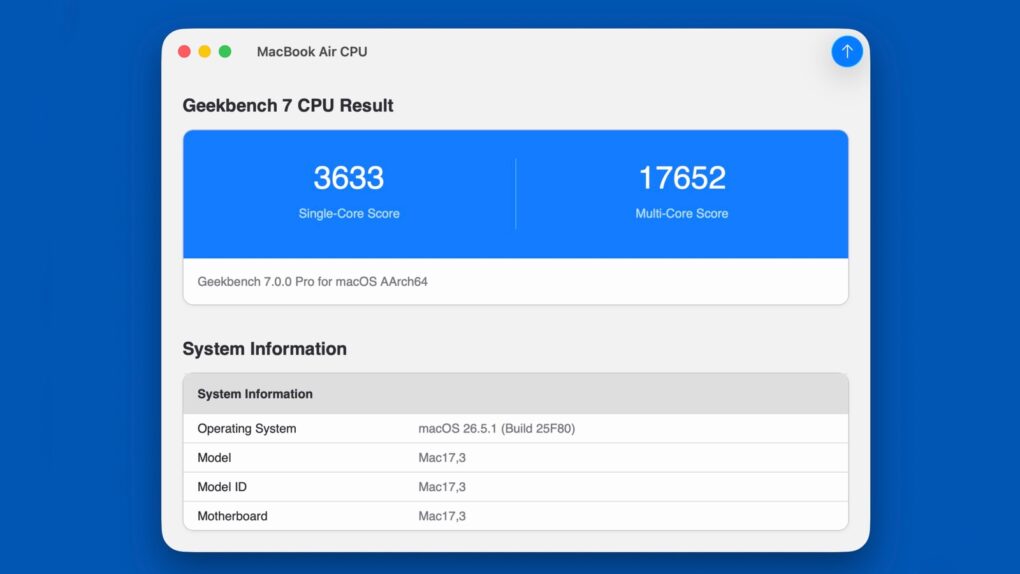
Primate Labs released Geekbench 7, the first major update to its widely used cross-platform benchmarking suite in three years. The new version introduces redesigned CPU and GPU workloads intended to better reflect how modern applications use today’s hardware, with a greater emphasis on handling video and playing games.
Because the latest version uses a new scoring system, benchmark scores made with the new app can’t be compared with one made with Geekbench 6. So every device needs to be retested.
Geekbench 7 arrives with improved benchmarking tests
Primate Labs created Geekbench to address a widespread complaint about benchmarking applications at the time: that they were unrealistic.
“Geekbench tests reflect how people use their devices. Instead of just crunching digits of pi for an hour or doing 80 different versions of the same task, Geekbench’s tests measure tasks like how quickly a device can load an example website, render a PDF, add filters to photos, and process HDR,” explained the developer.
Over the years, Primate Labs has kept improving its tests, periodically bringing out new generations. Previously, the last was Geekbench 6 in 2023.
And now Thursday brought Geekbench 7. According to the developer, it adds benchmarking tests for:
- Sharing your screen in video conferencing
- Watching videos with auto-generated captions
- Simulating game physics
Geekbench 7 is more than a new app version
Don’t mistake the change from Geekbench 6 to Geekbench 7 as simply a new version of the app. Because Primate Labs just introduced an entirely new scoring system, the results from Geekbench 7 are not directly comparable with Geekbench 6.
Geekbench 7 scores replace Geekbench 6 scores going forward, and users will need to rerun benchmarks with the new version of the app to make meaningful comparisons between devices.
Also, just having Geekbench 6 on your computer won’t automatically install the Geekbench 7 app. It must be installed separately. And the new app doesn’t replace the old one.
CPU and GPU testing
As with previous releases, Geekbench 7’s CPU test generates separate single-core and multi-core scores for benchmarking general performance. But there are improvements here, too.
“A redesigned multi-core benchmark only runs tests multi-threaded when real applications do, so your scores reflect how software actually uses your device,” noted Primate Labs.
The GPU test clocks your iPhone’s, Mac’s or iPad’s potential for gaming, image processing and video editing.
“New to Geekbench 7 is a focus on Machine Learning, with tests that measure real-time face tracking and image upscaling,” said the developer.
Compare your Mac, iPhone and more to Android, Windows, etc.
Over the years, one of Geekbench greatest strengths is that it delivers a consistent benchmarking experience across virtually every major computing platform. The software is available for iOS, macOS, iPadOS, Windows, Linux and Android, allowing users to compare performance between Apple, Intel, AMD, Qualcomm and other processors.
That broad cross-platform support has made Geekbench one of the industry’s most widely used benchmarks for evaluating everything from smartphones and tablets to laptops and desktop PCs.
Geekbench 7 for all five platforms is available now via the Primate Labs website.

Ed Hardy has been writing full-time about tech for 26 years, and using it for much longer than that. His intro to Apple was a Macintosh SE/30 (which he still has), but now he uses a 13-inch iPad Pro as his primary computer.
That’s because he’s a “tablet first” type of guy. Rather than use a Macbook, he connects a keyboard case to the iPad. And instead of a desktop Mac, he connects his tablet to a 27-inch display and full-size keyboard. (So don’t try to tell him that everyone has to use a Mac to be productive.)
Before coming to Cult of Mac, Ed wrote for NotebookReview, TabletPCReview and Brighthand, as well as other sites.