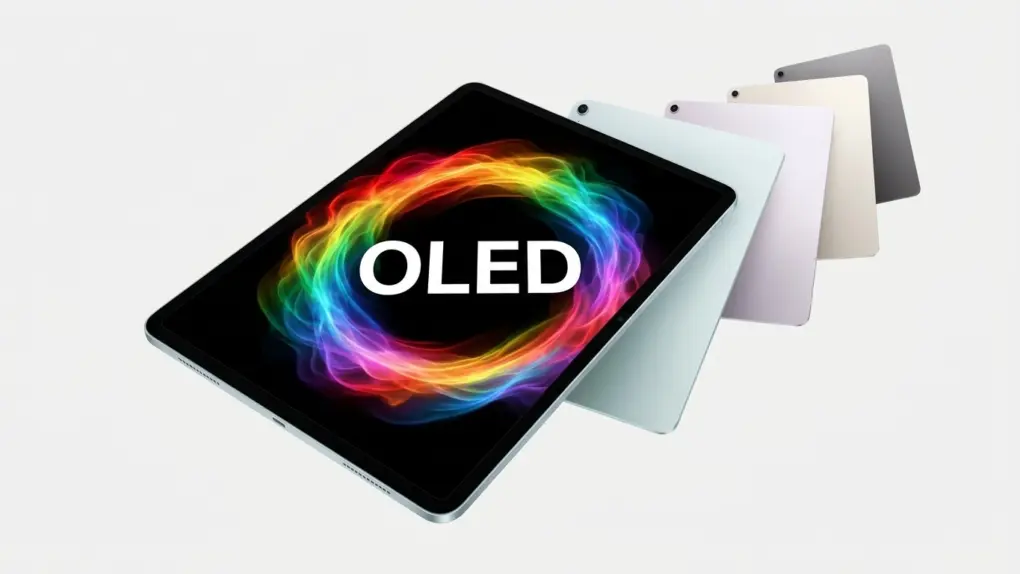
Excited about the new OLED iPad mini, but want something larger? Apple’s first iPad Air with an OLED display remains on schedule to arrive in the first half of 2027, according to a new supply-chain report.
The upgrade is expected to bring richer colors and deeper blacks to Apple’s midrange tablet though it supposedly won’t be ale to match the high-end OLED display technology found in the iPad Pro.
Expect an OLED iPad Air in 2027
In an OLED display, each pixel produces its own light and can switch off completely when displaying black. In contrast, LCD screens rely on separate backlights to illuminate the entire display, making it much more difficult to reproduce true blacks. Another result is stronger colors and better contrast.
Apple is gradually bringing OLED to more products across its lineup, replacing LCD panels as the technology becomes more affordable to manufacture. The iPhone made the transition long ago, while the iPad Pro and Apple Watch also use OLED screens. The OLED trend reached the iPad mini just this month.
A long series of leaks points to the iPad Air as next on the list. A report from DigiTimes published on Tuesday offers another indication that an OLED version of the mid-range tablet is moving toward production.
Samsung Display is expected to supply most of the panels, although Chinese display maker BOE is reportedly hoping to win a portion of Apple’s business.
Cult of Mac reported in April that Samsung Display planned to begin mass-producing OLED panels for the tablet around January 2027. Apple was expected to introduce the updated iPad Air sometime in the first or second quarter of the year.
The latest DigiTimes report reinforces that timeline, suggesting Apple’s plans haven’t slipped.
Both iPad Air sizes expected to get OLED
The display upgrade is expected to cover both the 11-inch and 13-inch iPad Air models. Apple currently sells both sizes with LCD screens.
However, don’t expect the new displays to match the technology in the iPad Pro. Apple reportedly plans to use a single-stack OLED panel with a low-temperature polycrystalline silicon (LTPS) backplane. The iPad Pro instead uses a more sophisticated tandem OLED design with two light-emitting layers.
That difference should help Apple keep manufacturing costs down and avoid a substantial price increase. But it also means the iPad Air will likely remain limited to a 60Hz refresh rate rather than gaining the iPad Pro’s 120Hz ProMotion technology.
Other improvements
The current version of the iPad Air runs on an M4 processor. An upgrade to the M5 seems likely for this mid-range model, especially now that the M6 is appearing in new Macs.
Whether Apple will bring the iPad mini’s new Acoustic Display to the Air is anyone’s guess. This tech has audio output coming from behind the screen, eliminating the need for speaker holes.
What OLED will do to the 2027 iPad Air price is currently unknown. Especially with RAMageddon driving up Apple’s memory costs. The current 11-inch version starts at $749, while the 13-inch model costs $949.

Ed Hardy has been writing full-time about tech for 26 years, and using it for much longer than that. His intro to Apple was a Macintosh SE/30 (which he still has), but now he uses a 13-inch iPad Pro as his primary computer.
That’s because he’s a “tablet first” type of guy. Rather than use a Macbook, he connects a keyboard case to the iPad. And instead of a desktop Mac, he connects his tablet to a 27-inch display and full-size keyboard. (So don’t try to tell him that everyone has to use a Mac to be productive.)
Before coming to Cult of Mac, Ed wrote for NotebookReview, TabletPCReview and Brighthand, as well as other sites.