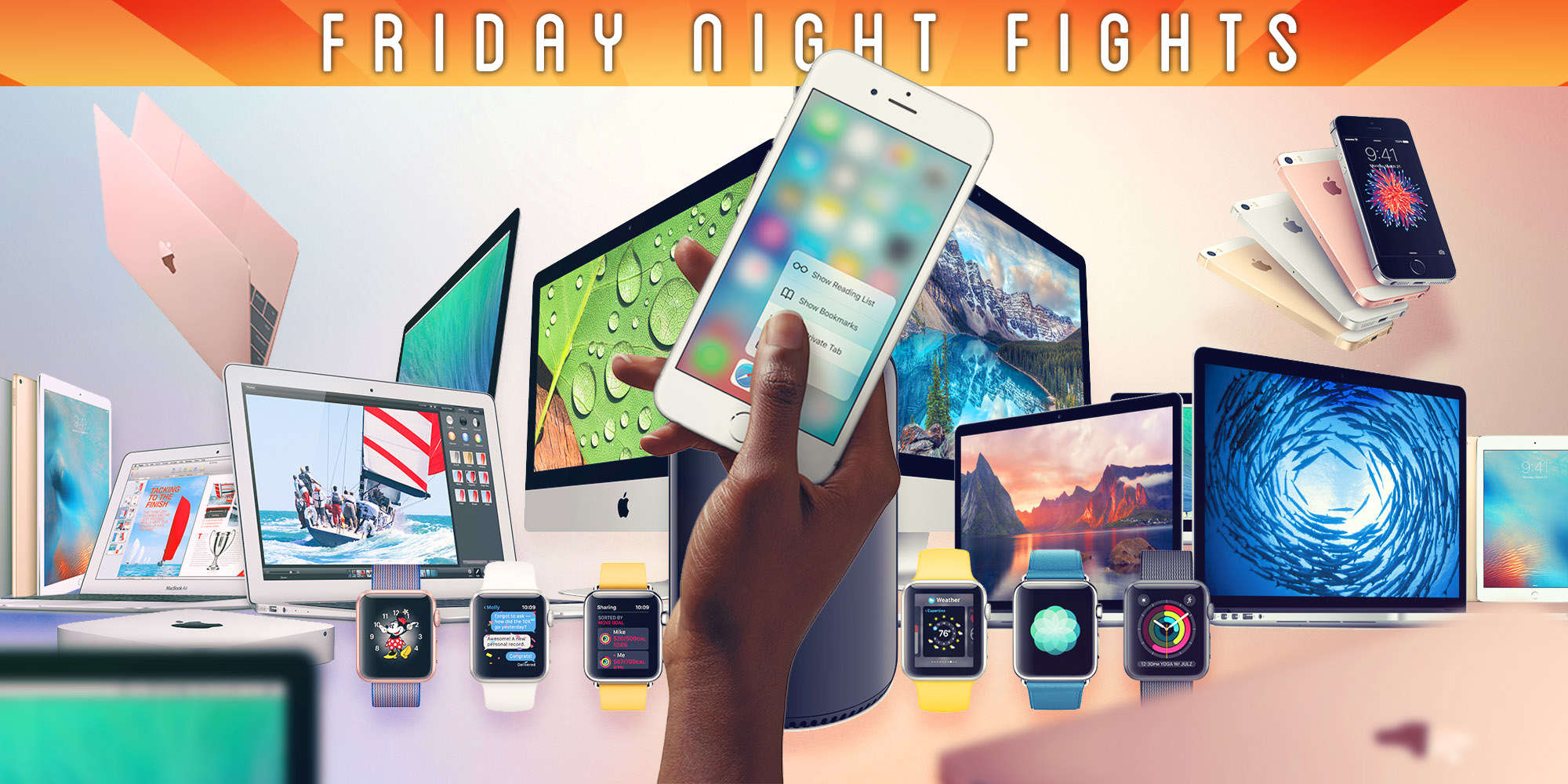
Apple’s product portfolio has expanded quickly since Tim Cook replaced Steve Jobs as CEO, what with the launch of larger iPhones, Apple Watch and the 12-inch Retina MacBook. But are things getting out of hand?
 Some fans might argue Apple has too much on its plate, and that other products — particularly its software — are suffering as a result. Others might argue that Apple needs everything in its current lineup — and more! — to keep up with the competition.
So, who’s right? Join us in this week’s Friday Night Fight as we exchange insults and virtual blows over whether Apple desperately needs to streamline its product lineup.
 Luke Dormehl: I’ve been writing “Today in Apple history” posts for Cult of Mac for a while now. One of the things I like so much about researching and writing those posts is that it reminds me of products or marketing strategies I haven’t thought about in ages.
This week, I wrote about the colorful iBook laptop, which Steve Jobs introduced early on in his run as Apple CEO. It really reminded me just how simple Apple’s product line was when Jobs took over — and what a horrible, convoluted mess it had been before then.
Under Jobs, Apple had Macs aimed at pro-level customers and regular customers, MacBooks aimed at pros and regular folks, one iPhone, one iPad and a handful of other devices. None of them stepped on the metaphorical toes of another Apple product.
Sure, there was a bit of product cannibalization — but Apple was great at clearly defined product lines, and its machines were so beautifully thought-through that people didn’t care too much about the “one size fits all” mentality.
Today it’s different. We have the iPad mini, iPad Air and iPad Pro. There’s the 4-inch iPhone SE, the 4.7-inch model, the 5.5-inch “Plus” and, if you believe the rumors, an iPhone 7 Pro model for photographers.
The MacBook Air, while still a laptop I very much like, seems to be an extraneous part of the product lineup. It no longer makes sense even in terms of its name, compared to the MacBook.
That’s without talking about the fact that Apple is now making wearables and, reportedly, an Apple Car is on the horizon.
I’m not saying Apple should go back to making computers and nothing more, but I don’t think I’m alone in worrying that a quality-control issue arises when the company is making so many different products. Apple also risks losing the simplicity that made its products so accessible. Am I crazy to be thinking like this?
 Killian Bell: I’m not sure you’re crazy (probably), but I do think you’re worrying about this too much. I definitely don’t think Apple’s product portfolio has become too saturated or too confusing. With the exception of the MacBook Air — which needs to die now, and surely will soon — and maybe the iPad Air, everything deserves its place in the lineup.
If you look at rival companies that do have too many products, such as Samsung, you find a lot of overlaps. The South Korean company offers a whole host of smartphones in so many variations that it’s hard to choose which one to buy — even if you’re dead-set on a particular screen size. You don’t really have this problem with Apple.
If you want your smartphone to be small and affordable, you choose the iPhone SE. If you want it to be average-size and packing the latest specifications, you choose the iPhone 6s. If you want it to be so big you have to buy pants with massive pockets just to accommodate it, you choose the iPhone 6s Plus.
Without these three models, iPhone demand would be even weaker, and Apple would find it immensely more difficult to compete with rival Android devices.
When you look at the Mac lineup, each machine has its own strengths and weaknesses, and you choose the one that fits your requirements. There’s no confusion, because they’re all so different. You can’t be stuck between a Mac mini and a Mac Pro, or a MacBook and a MacBook Pro, because they are all clearly focused on meeting different needs.
I will admit that the iPad family is a little confusing. I don’t understand why we have an iPad Air and an iPad Pro, both with 9.7-inch displays. But I still don’t think Apple’s existing portfolio is as cluttered as you suggest. And I certainly don’t believe there is a quality-control issue.
Luke: Don’t get me wrong: I don’t want Apple not to introduce new products because it’s got enough already. I’m really excited about the possibility of a 5K Thunderbolt display with a built-in GPU, for example. I just think the company has lost some of its focus on creating great devices that “just work.” Instead, Apple is following the Samsung mantra of throwing a bunch of new products out there to hit every target demographic, as if it’s responding to marketing research notes.
I think some of this comes down to Tim Cook. He has been a great CEO at Apple in many, many ways. He’s more of a “peacetime leader” to Steve Jobs’ “wartime leader,” in the sense that Jobs always seemed most in his element when his back was against the wall and he was fighting against giants.
Cook, on the other hand, is doing a good job of making Apple into a benevolent “force for good” while it’s on top of the world. But he also has an (understandable, given his background) operations approach to things: He’s not got the Henry Ford “you can have any color car you want so long as it’s black” mentality that Jobs did.
With Steve Jobs, you felt that there only needed to be a few options available because Apple had worked out exactly what users needed. Arrogant? Perhaps. Accurate? Judging from past success, I’d say so.
But this focus on simplicity at Apple seems to be vanishing. It’s not just the hardware, either: It’s the naming of the new products, the marketing campaigns, the software design. A lot of things feel cluttered and increasingly tiered. Let’s say Apple does come out with a new iPhone Pro aimed at photographers, for example: Do you not think a portion of the audience is going to be upset that they’re forced to choose between a smaller handset size (a lot of people, particularly women, don’t want a “phablet”) and a top-quality camera?
Killian: Yes, I do think iPhone fans will be upset if there’s a third “Pro” model this fall. But I don’t think we can really argue over that until it happens. I still believe it won’t; a recent leak from the ever-reliable Evan Blass revealed Apple’s internal code names for its next-generation devices, and there were only two — for iPhone 7 and iPhone 7 Plus.
I will admit Apple’s naming conventions are becoming confusing. They do need to be simplified. But I don’t think its software could get any simpler, with the exception of watchOS, which is still very much in its infancy and will obviously get better over time.
Let’s turn this around, then. What do you think Apple could do today to make its product portfolio simpler? What do you think should be cut, and why?
Luke: I’m not going to run through every product that Apple makes and argue the various merits and demerits of each one, but I think the focus on pushing out new updates for iOS and macOS each year, plus refreshes of all its major product lines with new versions available to bolster them, is taking its toll.
Let’s not forget that this is the same company that, during Jobs’ reign, had to choose to delay one of the big OS X launches because iOS was consuming too many resources internally. As for hardware, I like the Steve Jobs approach of having two products in each category, either aimed at pros and regular consumers or, in the case of iPhones, people who want either small or large smartphones.
Get rid of the MacBook Air. Get rid of the iPad Air. I could make a good case for eliminating the iPhone Plus, too. But this is about a lot more than just the current line of products; it’s a philosophy toward products. As Steve Jobs once noted, the thing he was most proud of was saying “no” to things while at Apple. Simplicity isn’t always easy to quantify, but for a long time it was a real differentiator.
Your turn: Is it time to streamline the Apple product lineup?
But let’s turn this over to readers. Do you think Apple could stand to streamline its products? If so, which should Apple make the difficult decision to abandon? Or is Killian right when he says that identifying new niches to target is the best way for Apple to succeed in a world saturated with smartphones and tablets? Leave your comments below. And have a good weekend.
Friday Night Fights is a series of weekly death matches between two no-mercy brawlers who will fight to the death — or at least agree to disagree — about which is better: Apple or Google, iOS or Android?

Killian Bell is a freelance writer based in the U.K. He has an interest in all things tech and also covers Android over at CultofAndroid.com. You can follow him on Twitter via @killianbell.

11 responses to “Should Apple streamline its product lineup? [Friday Night Fights]”
YES!
The 9.7 in screen is their most popular screen size for iPads.
They typically have at least 2 generations of iPads and iPhones to cater to a larger demographic, because it helps drive sales in countries and to the education market, where they simply can’t afford Apple’s top of the line models.
The MacBook Airs could get removed, but the MacBook needs to be better, it doesn’t even have an i5 or i7 processor, it lacks I/O ports, so I think the MacBook should have more to it, and they should drop the price a little, then they can possibly get rid of the MacBook Airs. Apple does need to have lower priced models that are still powerful enough to run the baseline apps because Apple does want to get into the education markets.
Apple is losing the education market to Chromebooks
I currently make approximately 6-8 thousand dollars /every month with my online job. So if you are ready to work easy online work for several hours every day from comfort of your home and get decent profit for doing it… Try this job SELF99.COM
Keeping two older generations as it helps to drive sales in countries who caanot afford the top tier? I live in such a country, South Africa. Generally, if you cannot afford the top tier you cannot afford any tier. People would rather buy the top tier from a much cheaper competing product that has all the features, than buying an older Apple product with a shorter lifespan and limited features. It’s doing Apple’s brand more harm to keep them, than the few extra dollars they get from them.
No, they need to update their current lineup already.
YES!
Here’s what to keep:
12″ Macbook
21″ and 27″ iMac
10″ and 13″ iPad Pro
Mac Pro
iPad Mini
4th Gen Apple TV.
Here’s what to get rid of:
4.7″ iPhone
11″ Macbook Air
Mac Mini
iPad Air
iPod Touch
all old generation products.
Here’s what to change:
iPhone SE to 4.2″ screen
iPhone # Plus to iPhone LE at 5.5″
Macbook Air to 14″
Macbook Pro to 16″
no more wifi-only iPads.
Here’s what to introduce:
Mac Mini^3 (based on Mac Pro design)
30″ display with built in GPU
I’m not going to argue about the exact sizes, but I agree in principle that just two to three sizes per product, and no “old” models, may work very well for Apple. And just call products by their screen sizes:
(i)Mac 22″
(i)Mac 26″
Mac (Pro) + 30″
MacBook 12″
MacBook (Pro) 14″
MacBook (Pro) 16″
iPad 12″
iPad 10″
iPad 8″
iPhone 6″
iPhone 4.5″
Watch 45mm
Watch 40mm
I’m a bit of a minimalist and perfectionist, so the current Apple does not bode as well with me as the previous one. I’m also a huge believer in not asking your customers what they want, but rather understanding what they need (another Henry Ford idea used by Steve Jobs). Even in my own company I’ve watched how our offerings got more and more convoluted as each year we offered more options to meet the requests of our customers, until we got to the point where roll out had become extremely slow and maintenance exhorbitantly high, not to mention the army of support required. I was given the opportunity to find a fix, and you’ve guessed it, I reduced the offerings. It was an extremely difficult process – everybody was used to and insisted on the large variety of offerings, even calling it our differentiator. Eventually, we got there. Our offering reduced to a tenth it was before. Our support was quartered. Our website simplified and reduced to the very basics. Our sales team retrained. Our marketing team refocused. The result was astonishing – we doubled our sales, trippled our following and almost halved our cost. Most important, it’s a mindset that must change. More is NOT better. Better is better. And with focus, you get better. Oh how I miss that at Apple. Without going into detail, some of their design decisions really appear rushed. Some of their software have the same bugs even three releases later, and even though it’s been reported. Some of their business decisions tend to be really short-lived, maybe becauase they’re too rushed or thin. Apple has lost focus, their offerings are too wide, but not deep enough as it used to be. Sure the can introduce new categories, but not with a million offerings in each. Sometimes just one is enough!
I would say at it current form, get rid of the Mac Pro, or make it a “real” Mac Pro, with components that users can upgrade on their own. Three years without updating it can’t be considered a Pro machine
what i find very interesting is every article for like a year is saying “Apple will/should dump the Air.” Yet, when i look around, what I see everybody having is the Air and the Macbook Pro. Not the regular macbook. I go to lots of coffee shops, i’m in libraries where people go to beat the heat and i never see the regular macbook. It’s all ipads, other tablets, pros, air’s and other pcs. So for me it seems silly to dump the laptop that people are buying.