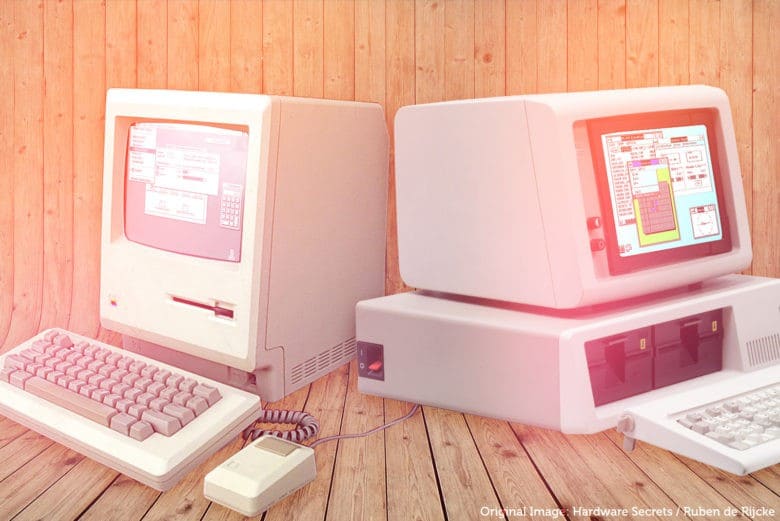
 August 14, 1991: As Apple and Microsoft head to court to battle each other, the tide begins to turn against Cupertino and its claims that Windows unlawfully copies the look and feel of Mac OS. A judge’s ruling calls into question the basic tenet of Apple’s copyright lawsuit against Microsoft over Windows 2.03.
The case concerns whether key elements of Apple’s operating system are original enough for copyright protection. The decision turns out to be a major blow against Apple — and the start of the company’s 1990s decline.
Windows 2.03 pits Apple vs. Microsoft
Released in 1987, Windows 2.03 triggered the Apple-Microsoft legal battles of the early 1990s. The pivotal update added Mac-style icons and overlapping windows to Microsoft’s operating system. While earlier versions of Windows looked comically primitive next to the Mac’s OS, Windows 2.03 closed the gap — and Apple took notice.
Apple’s lawsuit against Microsoft also mentioned Hewlett-Packard, whose NewWave technology worked with Windows. Apple sought a massive $5.5 billion in damages, the equivalent of nearly $13 billion in today’s money.
Right from the beginning, things weren’t as clear-cut as they might have seemed. Although both Apple’s Lisa and Mac graphical user interfaces debuted before the first version of Windows shipped, Microsoft had been working on its operating system before then. To make matters even murkier, work done at legendary Silicon Valley research center Xerox PARC inspired both companies.
Apple’s lousy deal with Microsoft
Furthermore, Apple CEO John Sculley signed a terribly lopsided deal with Microsoft co-founder Bill Gates on November 21, 1985. Sculley licensed technology from the Mac’s “visual displays” to Microsoft so the company could build its own operating system — as long as Microsoft agreed to continue developing for Mac. This included a two-year exclusivity window with Microsoft Excel.
In 1988, Apple sued Microsoft as Windows evolved to resemble the Mac operating system more closely. Apple’s suit identified 189 different user interface elements that it argued Microsoft used illegally. Unfortunately for Apple, the judge ruled that the agreement between the two companies covered 179 of those elements.
That left just 10 elements that Apple could argue were its own work. The August 14, 1991, court ruling by U.S. District Judge Vaughn R. Walker began to chip away at those, establishing that Apple’s UI elements were not original enough to warrant copyright protection.
“Upon reviewing the authorities cited by defendants, the court has concluded that in determining whether an individual element, completely divorced from its setting in a copyrighted work, is ‘unprotectable’ (i.e., not entitled to copyright protection) there is apparently no principled means of distinguishing the traditional doctrines of merger, functionality, and scenes a faire from defendants’ unoriginality of component elements theory,” the ruling said. “If a plaintiff directly copied … expressive elements of his work from preexisting works, he has no right to preclude others from using those same ‘unoriginal’ elements.”
From bad to worse for Apple
Ultimately, the situation was resolved two years later on August 24, 1993, when the court dismissed Apple’s case. The company appealed, but the court’s decision was upheld. Microsoft went on to release Windows 3.0, 3.1 and — most devastatingly — Windows 95.
While Apple struggled, Microsoft went from strength to strength. It was a bad time to be an Apple fan, and an even worse time to be an Apple investor. And then some guy named Steve Jobs rejoined Apple in 1997, and the whole thing started to turn around.
Were you an Apple fan during the legal battles of the 1990s? Leave your memories of that tumultuous era below.

Luke Dormehl is a U.K.-based journalist and author, with a background working in documentary film for Channel 4 and the BBC. He is the author of The Apple Revolution and The Formula: How Algorithms Solve All Our Problems … and Create More, both published by Penguin/Random House. His tech writing has also appeared in Wired, Fast Company, Techmeme and other publications.


2 responses to “Today in Apple history: Tide turns against Apple in war with Microsoft”
I was an Apple fan at the time, but I wasn’t much of a technology person until the late 90s, so I didn’t notice what was going on in the late 80s and early 90s. I started to take an interest in tech when Apple bought NeXT. The acquisition of NeXT was in a lot of ways, a reverse acquisition since it was NeXT technology that became Mac OS X. I never was a Microsoft hater over all this BS, but I do resent how they ripped off a lot of Apple’s early work in GUI. Starting with Windows 95, they made improvements that separated them from Apple’s UI, so by that time, Apple’s argument was very weak. There’s no use in continuing to debate whether or not Microsoft ripped off Apple. Now, it’s just a question of which company best serves its customers. I think that company is Apple. Their ecosystem works better for me. I like how there’s a seamless flow between macOS, iOS and watchOS.
Good write-up, but this statement was of:
“The case concerns whether key elements of Apple’s operating system are original enough for copyright protection.”
It really wasn’t about whether the elements were original enough but, as you later discussed, whether the license that Apple granted to Microsoft covered them! It was a major error, and one that hurt Apple greatly. It fit Bill Gates’s approach, though.
However, as we’ve seen, even without licenses, companies still seem to be able to rip off each other with few or minor consequences and even build huge markets around their copies– e.g., Samsung’s 143-page engineering document outlining in glorious detail how it was copying the iPhone’s features and changing its phone to match it. The hugely favorable initial verdict has been progressively whittled down — and mocked as pertaining to a small number of purportedly obvious features! Apple should have been granted a massive portion of Samsung’s smartphone revenues and ongoing royalties– and quickly enjoined from selling its copycat phones. Instead, the case took years and is still ongoing!