iTunes LP: The First Digital Album Good Enough to Criticize
1:15 am, September 10th, 2009, Pete Mortensen
Alan Kay, the computing visionary who first envisioned the Dynabook computer concept, worked at Xerox PARC and helped make the original Mac amazing, is one of my favorite technology philosophers. Simply put, he had a way of turning a phrase when discussing the progress of technology that could bring clarity to a muddled topic.
Of all his quotes, my favorite is also one of his most casual. He said that the Macintosh was “the first personal computer good enough to criticize.” In his mind, everything else had been so crummy that to begin listing faults would pretty much convince you that PCs shouldn’t exist at all. Ever since, the mark of an emerging technology’s arrival is the point at which it becomes good enough to begin figuring out what’s wrong with it.
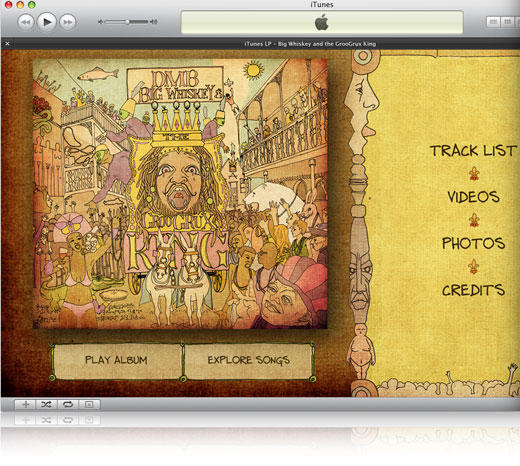
And of all of Apple’s announcements this morning, only the digital album format iTunes LP (also known as Cocktail) qualifies as a major improvement to a nascent technology. Simply put, though Apple long ago figured out how to sell music as digital downloads, it’s taken until now for them or anyone else to get in the ballpark of how to make those downloads feel anywhere near as special as a physical CD or LP.
Having played around with it for a bit (and watched several more demos of albums I haven’t picked up), it’s quite clear that Apple’s made a huge leap forward. And in so doing, it has made it abundantly clear how far they have to go.

Here are five steps Apple could take to make iTunes LP a competitor with your vinyl collection:
1. Get It Off My Computer and On My Devices
The nice animation, visuals, video, and lyric displays offered for the first round of iTunes LP are nice and all, but I don’t actually spend a lot of time focusing on my music when playing it back off of a computer. iTunes is a background task most of the time, and even this immersive experience won’t change that — and it’s kind of weird to “page” through liner notes with mouse clicks. The entire look and feel is dramatically more suited to the iPhone or, dare I say it, a tablet computer. If Apple brings multitouch into the equation, maybe the format will restore some of the emotional connection to the tangible object of music in some way. For now, this is some nice animation I’ll never look at again.
2. Offer Lossless Audio Files
At this point, the only people who are under the impression that limiting the supply of legitimate digital music actual limits the piracy of music work for record companies, yet it’s nearly impossible to buy truly CD-quality (or better) digital audio from major recording artists online. Apple should use the opportunity presented by iTunes LP to significantly up the quality of its audio to make the music itself sound more special.
3. Make it Simple for Artists to Use
Do you know how many iTunes LP titles are available today, the first day of launch? Six. A 43-year-old Bob Dylan record you should already own, a greatest-hits collection from the Doors, American Beauty by the Grateful Dead, the new Norah Jones, the new Dave Matthews Band, and actor Tyrese Gibson’s way-autotuned comic book mash-up MAYHEM! Something for everyone, eh? If that somehow isn’t enough music for you, Apple is offering five (5!) additional albums for pre-order.
Yeah.
Clearly, the format is too complex for artists and labels to get behind yet. If you have the budget of Dave Matthews or Bob Dylan, you can have people make it for you, but if you’re pretty much every other artist, taking advantage of the format will take some (or a lot) or doing. If Apple wants this to become a de facto standard for digital albums, it needs to make this a blindingly easy process for artists to participate in — as easy as submitting your record to iTunes for sale. I don’t know exactly what that looks like, but it’s a clear key to success.
—-
Again, iTunes LP is a fascinating effort. But it’s only good enough to criticize. The next year will be Apple’s opportunity to get it right or watch this concept go the way of the enhanced CD.
Posted by Pete Mortensen in Apple, Top stories, iTunes | Comment on this article
If you enjoyed this article:
Subscribe via RSS or email, or follow us on Facebook and Twitter


Hi! I’m having problem syncing my iPod touch with genius mixes, I don’t know what to do or what am I doing wrong. I hope u can help me. Thanx
Alberto Duarte, on September 10th, 2009 at 2:00 am
I agree 100%. LP’s should be lossless!
tim, on September 10th, 2009 at 7:11 am
> 2. Offer Lossless Audio Files
Meh. 256Mb AAC is as good or better than 320Mb MP3 which is as good or better than the human ear can actually comprehend, while still saving quite a bit of storage space.
Lossless feeds a geek’s self image, and a greed for storage that’s not rational. Nicolas Negroponte long ago suggested that the best way to advance the Internet was not necessarily to build out capacity but to do more with capacity we have: same principle here.
I’d rather keep my 256Mb files and find something new and interesting to do with the excess capacity than just eat it up with the same old thing for no particular reason.
Darcy McGee, on September 10th, 2009 at 8:24 am
Hey, sorry, didn’t you say 5 (five) things? I only see three. Is there another page I’m not seeing a link to? If so, just completely forget this.
Michael, on September 10th, 2009 at 11:17 am
@Darcy McGee
Meh to you, Darcy – I think you mean 256kb/s AAC and 320kb/s MP3.
If you’re going to pontificate, do so with some basic knowledge!
James, on September 10th, 2009 at 11:34 am
problem with lossless and putting it on devices is space. unless you have an ipod classic with a decent sized hard drive, you’re not going to get a lot of content on your device. as darcy said above, 256mb aac is good enough for me, and i expect for most people, especially on headphones or a car stereo.
firesign3000, on September 10th, 2009 at 11:42 am
“Clearly, the format is too complex for artists and labels to get behind yet.”
HTML+CSS is too complex?
“Previously referred to under the Cocktail codename, Apple’s new initiative delivers a single .ite file along with standard purchased album tracks or the movie file. The iTunes Extra file is actually a bundle, which is directory of files masquerading as a single file. Inside the bundle are navigation pages built using web-standards including HTML pages, Javascript code and CSS presentation, along with content folders containing regular PNG graphics, AAC audio and H.264 video files.”
http://www.appleinsider.com/articles/09/09/09/apple_rivals_dvd_with_new_itunes_extras_for_movies_and_albums.html
wha, on September 10th, 2009 at 2:52 pm
1. True, but as you say, if it doesn’t disseminate through the Apple product line it would be a great surprise. Apple have started at the root of the iTunes experience, as a lot more people have iTunes on their PC or Mac than have in an iPhone or AppleTV. I would imagine that the HTML and CSS would require significant work on the iPod front.
2. They certainly good, though at a much increased bandwidth cost to themselves, that will be appreciated by a minority of listeners. 256kpbs AAC is more than adequate for most of their customers; audiophiles are still buying CDs, and represent a fractions of the market.
PS. This paragraph as written makes no sense.
3. I think you are way off base here. When the interface is composed of mere HTML and CSS there is little Apple could do to make it simpler, unless you are suggesting they provide their own templates, which would dilute the very premise of the originality of artwork. Any band that has a website should be capable of creating an iTunes LP, and any band that does not, but is equipped with content should have no more than a couple of days of a web designer’s time to pay for. It’s very easy. What would be a more interesting proposition would be be for Apple to release the iTunes LP spec as a standard delivery model for digital music.
Adam, on September 10th, 2009 at 4:39 pm
@Wha; I agree with what you are saying, but the way you said it just scared away every artist thinking this might be a cool thing to try.
@Adam: thank you for clarified what Wha managed to make complicated. And yes the first sentence in point two was painful to read.
I’m glad Apple is at least trying to bring back the magic of what it meant to throw a new album and ingest all the goodies included in the jacket.
kbuck, on September 10th, 2009 at 6:58 pm
Most of my CDs are ripped lossless into iTunes then stored away.
If there was a tablet device sized like let’s say a DVD case I would happily buy digital albums in lossless format and enjoy artwork and infos in an acceptable size.
An enhanced version of the Apple ‘Remote’ app would do the trick.
merk, on September 11th, 2009 at 6:48 am
Totally agree about the lossless thing. The lack of lossless audio is what stops me buying much stuff on iTunes.
Matt, on September 11th, 2009 at 7:30 am
Sorry Pete, but that was not “a greatest-hits collection from the Doors”.
“The Doors” was their first album they released which launched them to stardom,
it’s to their credit the songs on the album ended up as great hits.
Dave, on September 12th, 2009 at 5:53 pm
I tore apart the iTunes LP file and wrote about it on my blog. I think you guys will like it, I don’t see any reason these couldn’t be on my iPhone besides some time to work the right UI into the iPod app. http://jwr.cc/x/3
Jay Robinson, on September 12th, 2009 at 7:30 pm
I like itunes LP and The Doors will be my first buy, what I am wondering about in itunes 9 is the home sharing feature for up to five computers, would this feature work just on a home network or across the internet, if it works on the internet would this not encourage users to setup linked groups of users to copy and paste each others music and media just like P2P ?
Poppa, on September 13th, 2009 at 3:20 pm
How’d you find the 5 pre-orders? I tried to do a search to see what other LP format items are available, but didn’t get anywhere? Did I miss some glaringly obvious link on the iTunes store intereface?
ndurantz, on September 14th, 2009 at 4:44 pm
darcy, just because YOU can’t tell the difference between lossy and lossless doesn’t mean that others can’t tell the difference. 320 kb/s is not “as good or better than the human ear can actually comprehend,” as you claim. with clean amplification and sensitive drivers one can easily tell the difference between lossy and lossless. of course, some masterings of music over the years are in such shape that it doesn’t really matter what bitrate you listen to it at. try listening to lossless Led Zeppelin on vinyl. then, compare it with 192 kb/s .m4a — very little difference. however, listen to an album that was mastered mercifully and painstakingly and you CAN tell the difference. it’s a moot point, really, because i’d be extremely happy if iTunes offered 320 kb/s files. that is good enough for most listeners, even the ones with stereos costing upwards of $5,000 like me. NO form of digital music will ever sound better than my classic analog records from the ’60s and ’70s because it is theoretically impossible for something to sound better than it was ever intended to.
justinbarbier, on September 16th, 2009 at 11:10 pm