Apple may be planning to use Liquidmetal for a new iPhone antenna, says the co-inventor of the sci-fi metal alloy.
Interviewed exclusively by CultofMac.com, Dr. Atakan Peker says Liquidmetal might be a good material for building a next-generation antenna to replace the problematic part in the iPhone 4.
“Let me state that this is very exciting for me,” he said. “I made the first and original alloy formulations… I am a big Mac fan and greatly admire Apple as a company. I have been using Mac exclusively my whole life, both at work and home. It is a pleasant surprise for me to see both get together.” As Apple explores innovative materials, it could also be working towards an apple folding phone with a cutting-edge Liquidmetal hinge. Learn more about it here.
As Apple explores innovative materials, it could also be working towards an apple folding phone with a cutting-edge Liquidmetal hinge. Learn more about it here.
Liquidmetal is already used to build the antenna for the Verizon USB727 wireless modem, which got great reviews for its reception.

Apple, of course, has weathered a lot of negative PR for the external antenna in the iPhone 4, which loses signal when the handset is held in a certain way (along with every other smartphone). Apple is issuing free rubber Bumpers to iPhone 4 customers worried about the issue.
Last week, Apple signed an exclusive agreement to license Liquidmetal Technologies‘ IP for consumer electronic products.
Peker co-invented Liquidmetal alloys in 1993 with engineering professor Bill Johnson when he was a graduate student at the California Institute of Technology.
Peker subsequently went on to become VP of research at Liquidmetal Technologies, a Caltech spinoff set up to commercialize the technology. He spent 13 years at the company. Peker is now Director of Advanced Materials at Washington State University.
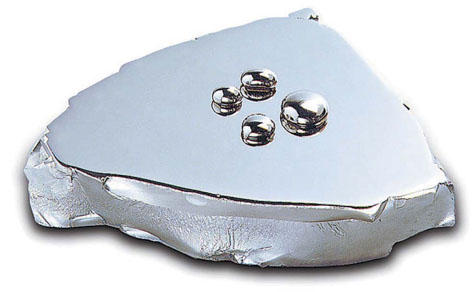
Liquidmetal is the commercial name of a series of exotic alloys developed at Caltech. The alloys have an atomic structure that is more like glass than metal, and are commonly known as “bulk metallic glasses.”
Bulk metallic glasses are super strong, scratch-proof, corrosion resistant, extremely flexible and very light. They can be cast into very complex shapes, like plastic, or blow-molded like glass. They are used for, among other things, golf clubs, tennis rackets, skis, and the cases of high-end cell phones.
Apple’s plans for Liquidmetal is unknown. Surprisingly, the company is very secretive about it. Apple didn’t respond to a request for comment, and neither did Liquidmetal.
Peker said he had no direct knowledge of Apple’s plans. Apple is already using Liquidmetal in at least one product, he said (a Magic Trackpad if you can guess what it is) and is likely to expand. Liquidmetal Technologies has invested heavily in die-casting technology. Apple is likely to use the alloy as a structural component in mobile products like the iPhone, iPad or iPod.
First order of business is an iPhone case that incorporates a new antenna. The alloy case could be structural as well as functional. In other words, a Liquidmetal case could also function as a big antenna. And because different mixtures of metal can produce alloys with different characteristics, Apple could blend an alloy that is optimized for receiving radio signals.
“You can build casings with functional characteristics, and the alloy’s properties as an antenna can be optimized,” Peker said.
Apple could also make cases with very complex and unusual shapes, Peker added. The cases would be literally seamless.
“This is a highly flexible material,” he said. “Apple could do some very creative cases.”
Because Liquidmetal casting is extremely precise, Apple may be able to microstructure the surface. It could imprint non-slip patterns, or even a hologram. Apple already laser-etches logos and serial numbers onto its current products. In future it might be able to create things like holographic logos that can’t be scratched or rubbed off.
Liquidmetal doesn’t fatigue or crimp like other metals when twisted or bent. Future applications might be one-piece hinges for laptop lids, or even an iPhone that folds up like a wallet. The design firm Ideo has already imagined a fold-up Liquidmetal cellphone.
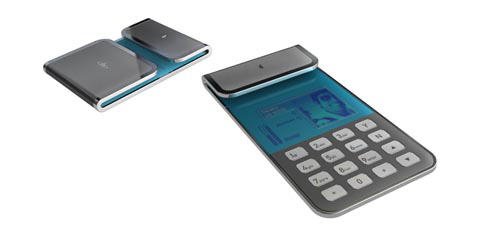
Liquidmetals has had a checkered business history. After a lot of early promise, the company has struggled recently. In the mid-2000s, it licensed its technology to companies like Motorola, Samsung and SanDisk but it hasn’t seen much action in consumer electronics for several years. The problem, Peker said, is that the company didn’t have the resources to develop the technology.
“Apple is best positioned to take advantage of that,” he said. “They could come up with some very creative uses that no one can predict right now.”
Apple’s head designer, Jony Ive, is famous for his fascination with raw materials and new manufacturing techniques. In the late 1990s, he borrowed technology from the candy industry to make the transparent plastic of the first fruity iMac. More recently, he has pioneered advanced milling techniques to hew MacBooks out of solid aluminum blocks. In fact, the last dozen years of Apple’s design history is marked by Ive’s experiments with materials like plastic, glass and aluminum.
To take advantage of Liquidmetal alloys, Apple would need to pioneer a new manufacturing infrastructure, which requires a lot of capital and risk.
“I have been working with it since 1993,” said Peker. “Even after all these years and all the research, we still don’t know enough about this material.”
“It is hard to predict what will come, when you leave such a technology to the imagination and creativity of Apple product development and innovation,” he added. “I won’t be surprised with some very interesting products in the future.”

Leander Kahney is the editor and publisher of Cult of Mac. Leander is a longtime technology reporter and the author of six acclaimed books about Apple, including two New York Times bestsellers: Jony Ive: The Genius Behind Apple’s Greatest Products and Inside Steve’s Brain, a biography of Steve Jobs.
Leander has written for Wired magazine, Scientific American, The Guardian, The Observer, The San Francisco Chronicle, MacWeek and many other publications.