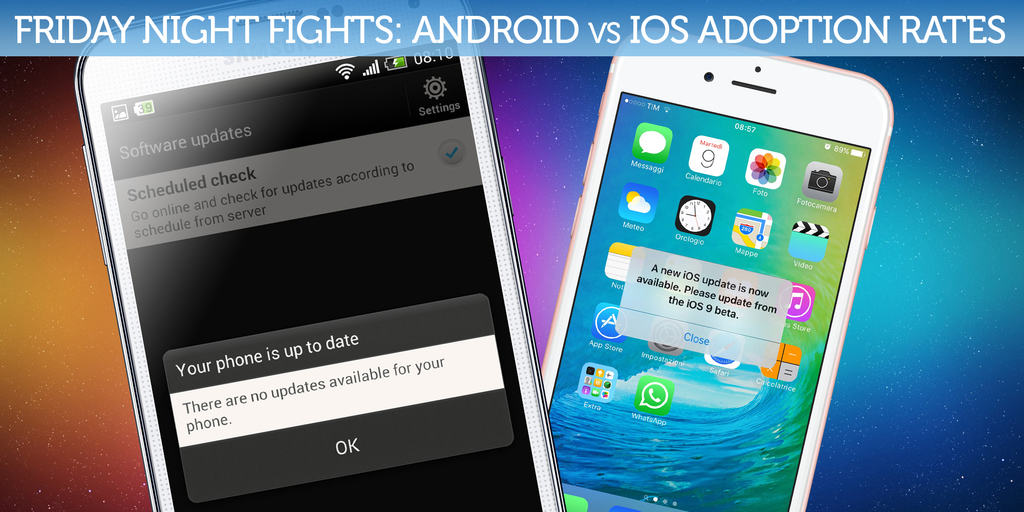
iOS 9 has been out for two days, and it’s already running on more than 20 percent of compatible devices, according to the latest data. In comparison, Google’s latest Android release, version 5.1 Lollipop, is running on just 5.1 percent of devices ten months after it made its public debut.
 These figures highlight the staggering difference between updates on Android and iOS. But is it fair to compare adoption figures between these two platforms, and do users really care?
Join us in this week’s Friday Night Fight between Cult of Android and Cult of Mac as we battle it out over this very topic!
 Luke Dormehl (Writer, Cult of Mac): Happy Friday Night Fight, Killian!
This week was a big one for both Apple and its users. We saw the launch of iOS 9 which, according to live data from Mixpanel, is already at more than 20 percent adoption. iOS 8 adoption, meanwhile, finally topped out at 87 percent.
That’s slightly down from what iOS 7 achieved for a number of reasons, but it still amounts to almost 9 out of every 10 eligible users upgrading to what was then Apple’s latest mobile OS. That’s a phenomenal achievement, which says a lot about Apple users and how engaged they are with their platform.
When I was writing about this earlier in the week, I pointed out how much astonishingly better it is than Android’s dismal record for getting users to upgrade. The company’s most recent Android version, Lollipop, has 21 percent adoption. That means that, possibly by the end of today, iOS 9 will have managed in three days what it took Android the best part of a year to do.
That’s pathetic — and it’s indicative of some of the bigger problems Android faces. My question is, is it fair to compare these figures, and what — barring Fandroids packing in their Samsung handsets and joining us over here at Team Apple — would it take to change things?
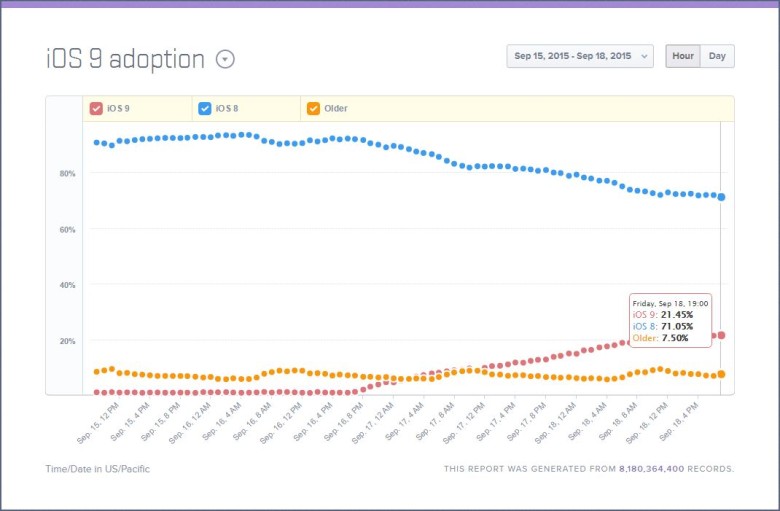
Photo: Mixpanel
 Killian Bell (Writer, Cult of Android): It’s great that iOS 9 is already off to a promising start — and that Apple can boast about its iOS adoption figures every year. It’s one of the clear advantages iOS has over Android, and I don’t see Google’s OS ever being able to match it.
Having said that, I don’t think it’s fair to compare iOS adoption figures with those of Android.
Android is open-source, so Google lets almost anyone use it and adapt it for their own devices. Most people see that as a good thing. But without full control over the OS, it’s impossible for Google to ensure that Android users get the latest updates as soon as they’re available.
It’s not that Android users have the option to update to the latest software as soon as it rolls out and simply choose not to; in some cases, it can take manufacturers a year to make the latest Android updates available to their customers.
The other important thing to remember is that unlike Apple, Google’s hardware partners don’t just release one or two smartphones every year. Motorola has a number of devices in its lineup — as does LG, Sony, HTC, and all the others. I won’t even get started on how many Samsung churns out within a 12-month period.
It’s simply not feasible to update all of these devices as soon as the latest Android update is out. The software has to be optimized for each one, and that’s a process that takes time. These companies cannot build operating systems for 20 devices in just a few months. And if they did, those operating systems would be terrible.
While Android’s adoption figures may seem “pathetic,” then, I think it’s silly to suggest they could ever match those of iOS. It’s just not possible with the way things are, and it would be exactly the same situation for iOS if Tim Cook went crazy and made that open-source.
Maybe Google could do something to improve the situation slightly — perhaps introducing a rule that forces hardware makers to update all the devices they’ve released in the last 12 months within 6 months of an update’s release.
But that would be too difficult to enforce, and it would likely upset a lot of partners, so it’s not going to happen.
Luke: It may not be “fair” to compare, but there’s a lot that’s not fair — like the major security lapses Android devices suffer because of this fragmentation. Stagefright was a great recent example of this. Google knew about it for three months before even the best Android devices started getting the necessary improvements to stop their users’ data from being compromised.
It may be a tough thing to fix, but this is one of the fundamental problems with the Android system. With dozens of partners, Google can’t control bugs because of the total lack of uniformity. We’ve talked Android security before and it doesn’t seem to get any better.
Compare that to iOS and, while there certainly have been bugs discovered in the system, Apple always solves them as quickly as possible. It’s not good enough, and it’s tough to work out what Google could do differently. A rule like the one you suggest would be a good idea, but it still means response time is significantly slower than iOS — if such a rule was possible to implement to begin with.
The other thing I’d be interested to see, and I don’t know if you can get figures for this, but what percentage of eligible Android users upgrade given the chance? It’s one thing to say that Android users don’t have the ability to upgrade because of the lack of available updates. But do Fandroids upgrade if they have the opportunity? Because just about every study shows how much more engaged users are with iOS: from spending more money on it to spending longer within apps. The fact that Apple gets so many people to upgrade isn’t just about the fact that it pushes out its software updates so quickly; it’s that iOS users care enough to upgrade.
Photo: Killian Bell/Cult of Mac
Killian: There’s no excuse for Stagefright and other vulnerabilities like it, but Google and several of its partners — including LG and Samsung — have already vowed to improve security with monthly patches for all devices. This means that as soon as a major flaw is discovered, it can be eliminated much more quickly. So it’s not like Google or anyone else is ignoring the security concerns.
The other thing I should note about those security updates is that carriers will be making them available to customers much faster than regular Android updates, which can be in testing for months before they’re finally approved and made available to customers. This is another hold up, and another reason why Android’s adoption figures aren’t as good.
Yes, I do think most Android users upgrade when they can. Suggesting they don’t because they don’t “care enough” is just clutching at straws to support your argument, I think.
Sure, there will be a certain percentage that don’t — maybe because they don’t know how to — but that’s going to be the case on every platform, including iOS. I’m pretty sure my granddad is still running iOS 7 on his iPad because he doesn’t like the idea of having to learn new features.
Luke: I won’t ask at what stage the Bell family went from upstanding Apple-using citizens to no-good Android lovers.
I’m not “grasping at straws” to support my argument. Check out this ComScore study, for instance, which lays out clearly that iPhone owners are so-called “power users” who are much more likely to engage in all major content categories than Android owners. It follows, at least to me, that more engaged users would also be much more likely to upgrade to the latest mobile OS. I’m not just saying this to get some yucks laughing at Android users; I’m pointing out that a) Apple’s ability to get people to upgrade isn’t something we should take for granted and b) it’s not clear that Google could emulate the model if they wanted to.
Ultimately, it would be great to see Android pull it together and find a way to lessen the Android fragmentation problem (wasn’t it Tim Cook who called it a “toxic hell stew”?), but I just don’t see it happening. It would great to see some proactive steps on their part though. I like that 12-month rule you suggested… even if it is hard to imagine it being implemented.
I can pretty much guarantee that, one year from now, we’ll be talking about iOS 10, while Android adoption won’t have substantially changed from what it is today.
Killian: How dare you bring my family into this. I’ll have you know I’m the only Android user in the house, but that doesn’t mean they love me any less. (I don’t think.)
I don’t care about any ComScore study. There are huge differences between Android and iOS that make those things inaccurate. For instance, Android caters to everyone — including those who only want to spend $100 on a smartphone to do email — and they don’t need other apps.
Plus I think many Android users would argue that Google’s platform is better suited to “power users” than iOS is. A platform that prevents you from swapping default apps, downloading and managing files, customizing your interface to suit your needs, and more isn’t exactly ideal for power users.
No, Google couldn’t emulate Apple’s model for reasons I’ve already mentioned, and as I’ve already stated, Android will never catch up with iOS when it comes to adoption figures. At no point have I tried to convince you otherwise. But I don’t think Google, any of its partners, or many Android users really care about that.
Yes, you have to wait ages to get updates if you don’t buy a Nexus device with pure Android. But every Android fan knows that, and yet they continue to buy into the platform anyway.
Today’s debate was about whether it’s fair to compare adoption rates, and I think I’ve provided good reasons why it isn’t. But that’s enough from us — let’s turn this one over to the readers now and see what they make of it.
Is it fair to compare the adoption figures or Android and iOS? And does anyone really care?
Friday Night Fights is a series of weekly death matches between two no-mercy brawlers who will fight to the death — or at least agree to disagree — about which is better: Apple or Google, iOS or Android?

Killian Bell is a freelance writer based in the U.K. He has an interest in all things tech and also covers Android over at CultofAndroid.com. You can follow him on Twitter via @killianbell.

15 responses to “Android vs. iOS: Do adoption figures mean anything?”
So is Lolipop at 5.1 pct “Google’s latest Android release, version 5.1
Lollipop, is running on
just 5.1 percent of devices ten months after it made its public debut.”
or at 21 pct “The company’s most recent Android version, Lollipop, has
21 percent adoption”
The Lollipop name covers Android 5.0 and up. If you count them all, adoption is at 21 percent. However, in my intro, I was talking specifically about the latest version, Android 5.1, which is at 5.1 percent.
Laugh Out Loud that is horrible.
Aside from the security concerns already noted, which users will care about, I think the another group that cares about adoption rates is developers. One nice thing about being an iOS developer is that when Apple announces new features and APIs (Split screen multitasking, Touch ID, various extensions in iOS 8, etc.), it is worthwhile to immediately start implementing those features for users to create better experiences. That’s because within a month or so of release, the majority of users will be on that latest iOS version and have access to those features.
With fragmentation like Android’s, it seems like it would be a more complicated decision of when / if to code new feature functionality. And if it takes a year to get still a relatively small percentage of users compatible with the newest features (right when the next version’s new features are rolling out), it may never seem “worth it” to support the latest OS bells and whistles. Android has a cool compatibility library that bridges some new OS features back to older versions of the OS, but it has limits to what it can support.
As a developer, having massive adoption makes it easy and worthwhile to implement new functionality (and we love being able to use the latest APIs, etc.). As a user, it’s nice to have such widespread and immediate developer support of new features in your favorite apps. So I think fast adoption is a virtuous cycle of better experience for both developers and users.
Stated by Killian” “Yes, I do think most Android users upgrade when they can. Suggesting they don’t because they don’t “care enough” is just clutching at straws to support your argument, I think.”
Actually, a combination of different statistics support this conclusion. If the support tor the claim that the majority of Android users “don’t care enough” or are less engaged, hinged SOLELY on OS update rates, I would agree with your statement. That is not enough evidence to make that conclusion.
However, statistics have shown repeatedly (from every source imaginable, not just comscore. Many independent businesses report back on browsing rates, page counts, number of visit, click conversion, avg total purchase, avg purchase rate etc etc ) that iOS users, browse the internet more, window shop more, buy more, buy at a higher avg total price when shopping, buy apps more, use apps more… and the list goes on. Every single statistic definitely shows a far more engaged iOS user than Android user. Taken collectively (most statistics are more telling when compared to others), the evidence is overwhelmingly clear. Android only wins in terms of shipment (but that doesnt necessarily mean sales. And as pointed by the person quoted, Android is open source so their shipping numbers includes any device with android.), from a statistical standpoint.
To “not care” is to be blind to the market. As others have noted, this is why retailers, content makers, and in general any developer will work on iOS first, and Android second. That is where the market is, that is where the money is. Period. ALL data points to this. Separately, money aside, its also easier, as others have noted for Developers
Great in-depth response. Thank you.
It also isn’t fair that Shamesung copies EVEYTHING‼️‼️‼️
While this is an important advantage to Apple more so from the compatibility side to me, I don’t really care about this. Care more that Apple’s opening up another 3 stores today. I view each store Apple opens as a dagger to the Android camp.
Even more so, when I’m hearing Samsung’s laying off upwards of 11,000. Another 3 stores may ensure yet another round of layoffs.
So, while the advantage of the hardware and software control is nice, the competitors bleeding out slowly as more more Apple stores open is even better news to me.
Microsoft has more Windows OEMs and more different number of devices with billion combinations of hardware/software (desktops, laptops, tablets..) than Android has, yet every single device running Windows OS (vista, 7, 8, 8.1, 10) get each month security updates.
Do you know what Google could do….work with their partners hand in hand to come out with updates at the same time or close to when google releases it. Apple talks at WWDC about the new features coming out in the fall each year so that developers can get their apps ready for release when it comes out…why should it be any different for the partners of Google. Google should tell their hardware partners in advance what they are working on and give them beta’s to start writing and testing their custom implementations of the OS so it’s ready when it gets released. Even if this is done behind closed doors and not in the eye of the public this would immediately help get Android users the upgrades they need/want in a reasonable amount of time. The rule above should be another things they do by forcing a hard deadline to implement the new OS to all devices released within a time frame. Apple does this all the time with apps and developers. Just treat hardware makers like developers of apps and boom problem solved.
Ummmmmm. Google DOES. Its just manufactures usually don’t ship it in time or something else happens. They get the source and responsibility to make it how they want and publish it around 6-4 months before the official release.. Thats why there the nexus line. So people don’t need to go through the manufacture and can just get a IOS like update experience.
The ironic thing is is that theres usually a ASOSP port on devices that don’t have it before the manufacture finishes its update. Its BS. But there is the nexus line like i stated earlier.
Apple has to update 20 iOS devices this year
Android’s partners have no more excuses, they have to update their devices
A better article would be how many bugs and broken features are still in iOS, and new to iOS 9. For example, select/cut/copy/paste is still broken in Safari. It’s been that way since iOS7!
And here’s a new abomination. The new iPad Podcast app in iOS 9 no longer allows you to view video podcasts in fullscreen. What you now see is a small window for video and two huge white borders, top and bottom. There’s no way to fill the screen.
UN FREAKIN BELIEVABLE!!
Allow me to show you a fantastic ways to earn a lot of extra dollars by finishing basic% tasks from your house for few short hours a day — See more info by visiting >MY_DISQUS_PROFILE
The thing is, each “new” release of Android is rarely that much better than the one before it. And, like is pointed out in the article, there are so many “versions” of it because every carrier is in charge of its release, rather than Google. If Google was in charge of the releases instead of the carriers, it might be different.
BTW, I’m a Galaxy Note 3 user who is waiting on a new 6s Plus. Time to jump back to iOS for the time being. In two years when I can upgrade again, I’ll look at Android again and see if I’ll jump back again. Who knows.