Blogger Runs into Trouble with New York Transit Authorities Over iPhone App

Picture 3

New York’s Metropolitan Transit Authority wants to derail an independent iPhone app that publishes train schedules for violation of copyright.

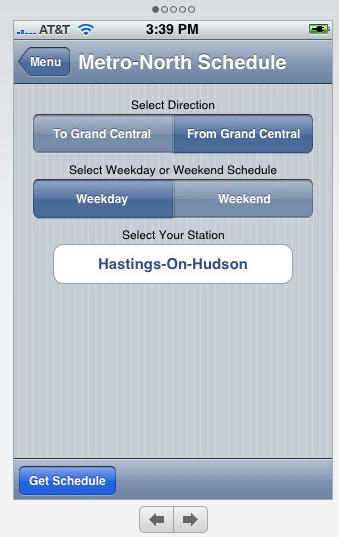
Called Station Stops, the $2.99 app available on iTunes, is the work of commuter Chris Schoenfeld, who also writes the blog of the same name.

The app provides the timetable of the Metro-North Railroad for regularly-scheduled trains departing and arriving from Grand Central Station.

The MTA provides its schedules to Google Transit, but doesn’t release the data publicly.

To build his app, Schoenfeld did it the old way — by entering data manually from the published public schedule.

Schoenfeld, who has often been critical of MTA service, got a nastygram from MTA lawyers ordering him to stop presenting himself as an official service — and pay licensing fees for the schedules.

The MTA reckons the developer owes them a share of profits from the app, back pay the licensing fees. And a $5,000 non-refundable fee.

Schoenfeld’s not interested in ponying up. His sensible David versus ham-fisted Goliath story received a lot of sympathetic local news coverage — but that didn’t stop the MTA from asking Apple to take down the app on Aug. 14.

DON'T MISS
Apple Returns Disputed Transport App to iTunes

As of this writing, Station Stops is still for sale.

As one station stops blog reader, Karen Cavanaugh commented:
“I always use Station Stops to check the train schedule when I visit my daughter in Hoboken, NJ. I never think of it as an “OFFICIAL” website. I’ve been to the official website and it’s awkward.”

Via Stamford Advocate, Greater Greater Washington

About the author

nicole_martinelli

Nicole Martinelli is a San Francisco native who has lived in Milan and Florence, Italy. She's written for Wired.com, The New York Times and Newsweek. You can find her on Twitter , Facebook and Google+.

If you're doing something new/cool that's Apple related, email her about it.

(sorry, you need Javascript to see this e-mail address)| Read more posts by .

Posted in iPhone, iPhone 3G, iPhone 3G S, iPod Touch, iTunes, News | Tagged: |

  • Lucas

    seems the crux of this issue is the status of the schedules. are they public or private information. if they are public then the MTA has little grounds to do anything. if they are private, then the app must go unless the gentleman pays up.
    and the only way to get a judgment is in the courts. I suspect that things will go in Mr Schoenfeld’s direction and I actually hope that he consults a lawyer and they get an official statement backing them up. it would help him and several other app developers treated the same way

  • Erin’s Dad

    Ummm… Train Schedules are not PUBLIC information?

    MTA should worry about making the trains run on time, thereby making the schedules ACCURATE!

  • http://lowendmac.com Dan Knight

    From 20 Copyright Facts: “All facts and ideas are in the public domain.”

    http://www.pddoc.com/copyright/copyright_facts.htm

    In other words, you can’t copyright facts. If the MTA can argue that its schedules are not facts, it might have a legal leg to stand on.

    “A compilation of facts is protected by copyright only to the extent that the selection of the material and the arrangement of the material is ORIGINAL.”

    The MTA can copyright a specific arrangement – table, chart, etc. – of its facts, but not the facts themselves.

  • Ronjamin

    Government entities publications are PUBLIC DOMAIN.

    Although they are an “authority”, they are still a quasi-governmental taxing body, and a defacto part of GOVERNMENT.

    GOVERNMENT DOCUMENTS, PRODUCTS, SERVICES are PUBLIC DOMAIN

  • John

    This is something I’ve wondered about a lot. I’ve been thinking of making some iPhone apps related to a narrow field of science. The value would be reproducing various elemental information in a useful way. The only way to obtain that is to copy it from NIST or published papers. Is that copyright violation?

  • Frank Lowney

    A key data point is whether the MTA is a government entity or not. Anything produced by government is in the public domain. After all, it is tax payer funded. Tax payers have already paid for it.

    This isn’t changed by Google or anyone else handing money to government entities. Their payment is unnecessary and cannot be used to claim exclusive use of the information however much they might like to.

    So, what is the governmental status of MTA?

  • John Lockwood

    We have the same problem in the UK, in that similar travel information is prevented from being used in iPhone (or Mac) applications and the ‘official’ bodies have either failed to provide their own applications or made very poor or too expensive alternatives.

    Here in the UK government information is not in the public domain, even though tax payers have paid for its production.

    Things are a little more complex here in the UK in that many train ‘operators’ are commercial companies running under a license, however even the wholly government owned London Underground has clamped down on anyone trying to use their information.

    One of the latest UK Government ideas on how to (further) rob its citizens is to charge a tax for the view from your house. (I kid you not.)

    See http://www.telegraph.co.uk/news/uknews/1502344/Government-to-tax-the-view-from-your-house.html

    By the way I feel that the fact that the author of this New York Transit timetable app is charging for it rather than giving it away free severely weakens his case.

  • cambosis

    Same thing happened in Sydney…
    http://www.zdnet.com.au/news/communications/soa/RailCorp-targets-rogue-iPhone-app/0,130061791,339295241,00.htm

    before the government decided to direct RailCorp to pull their respective heads in!

  • jon joaquin

    From the MTA’s website:

    http://www.mta.info/mta/network.htm

    “A public-benefit corporation chartered by the New York State Legislature in 1965, the MTA is governed by a 17-member Board. Members are nominated by the Governor, with four recommended by New York City’s mayor and one each by the county executives of Nassau, Suffolk, Westchester, Dutchess, Orange, Rockland, and Putnam counties. (Members representing the latter four cast one collective vote.) The board also has six rotating non-voting seats, three held by representatives of the Permanent Citizens Advisory Committee (PCAC), which serves as a voice for users of MTA transit and commuter facilities, and three held by representatives of organized labor. All Board members are confirmed by the New York State Senate.”

    So it seems it all smacks of Government

  • Nathan

    They’re clearly just pissed off they didn’t think of this first.

  • ling

    This looks like “copyfraud.” See this article: http://ssrn.com/abstract=787244
    From the abstract: “Copyfraud is everywhere. False copyright notices appear on modern reprints of Shakespeare’s plays, Beethoven’s piano scores, greeting card versions of Monet’s Water Lilies, and even the U.S. Constitution. Archives claim blanket copyright in everything in their collections. Vendors of microfilmed versions of historical newspapers assert copyright ownership. These false copyright claims, which are often accompanied by threatened litigation for reproducing a work without the owner’s permission, result in users seeking licenses and paying fees to reproduce works that are free for everyone to use. Copyright law itself creates strong incentives for copyfraud. The Copyright Act provides for no civil penalty for falsely claiming ownership of public domain materials. There is also no remedy under the Act for individuals who wrongly refrain from legal copying or who make payment for permission to copy something they are in fact entitled to use for free. While falsely claiming copyright is technically a criminal offense under the Act, prosecutions are extremely rare. These circumstances have produced fraud on an untold scale, with millions of works in the public domain deemed copyrighted, and countless dollars paid out every year in licensing fees to make copies that could be made for free. Copyfraud stifles valid forms of reproduction and undermines free speech….”