At Steve Jobs 30th birthday party, the jazz great Ella Fitzgerald sings him happy birthday. She seems to have no idea who he is.
Part 14 of “My Close Encounters With Steve Jobs,” Macworld founder David Bunnell’s personal history of the Mac.
At Steve Jobs 30th birthday party, the jazz great Ella Fitzgerald sings him happy birthday. She seems to have no idea who he is.
Part 14 of “My Close Encounters With Steve Jobs,” Macworld founder David Bunnell’s personal history of the Mac.
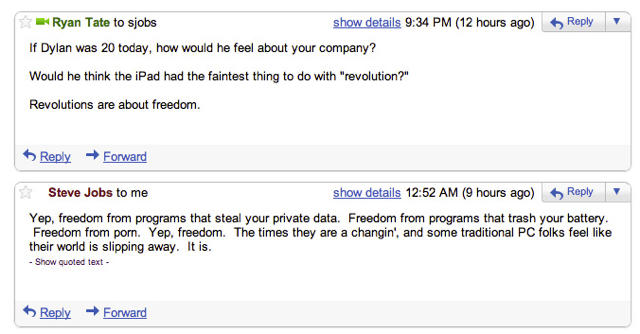
Steve Jobs is at it again — emailing Apple customers with answers to their questions.
This one was sent to CultofMac.com by reader Paul Greenberg, who asked Jobs about a missing MobileMe feature that’s been bugging him for three years: the inability to sync notes via MobileMe.
At a posh dinner party, Steve Jobs eats a plate of raw vegetables with a blonde bombshell sitting on his knee. Instead of going to Macworld and plugging the Mac, he’s too busy partying with Tina the nymphette.
Part 13 of Macworld founder David Bunnell’s personal history of the first Mac: “My Close Encounters With Steve Jobs.”
Steve Jobs is very serious about HTML5 being the future of the web, and in Jobs’ view, H. 264 is an integral part of that formula. Google and Microsoft agree: they’ve committed to MPEG LA’s video codec as the new standard for online video. That puts the three biggest players all in the same corner when it comes to H. 264.
But Opera and Firefox aren’t fans of the standard. Instead, they back a codec called Ogg Theora, which is royalty free and open source, while H. 264 is closed source and only royalty free until 2015. Their fear is that mass adoption of H. 264 will cause MPEG LA to “flip the switch” on royalties five years down the line, leaving companies no choice but to pay exorbitant licensing fees.
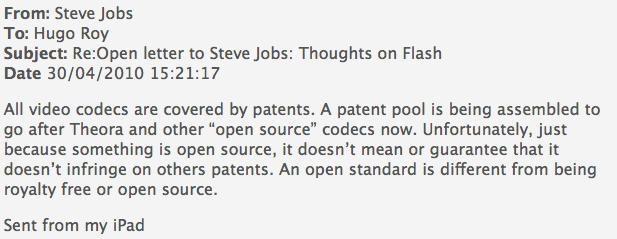
So why isn’t Apple on board with Ogg Theora? Apple fan Hugo Roy wrote Steve Jobs over the weekend, asking him about Apple’s backing of the H. 264 standard. Jobs informative and surprisingly length reply follows:
In part 12 of Macworld founder David Bunnell’s story of the early Mac, Bill Gates is the only developer to actually deliver on his promises of software for the Mac. Microsoft’s Excel literally saves the Mac just when sales drop to nil, but at the same time Gates’ engineers are reverse engineering the GUI for the first version of Windows.
In Part 11 of Macworld founder David Bunnell’s memoirs, Steve Jobs triumphantly introduces the Mac to the world. “It sang to us. It performed mathematical calculations with the blinding speed of a Cray mainframe. It drew beautiful pictures. It communicated with other computers. It bounced rays off satellites and sent a subversive message to the Soviet Union.”
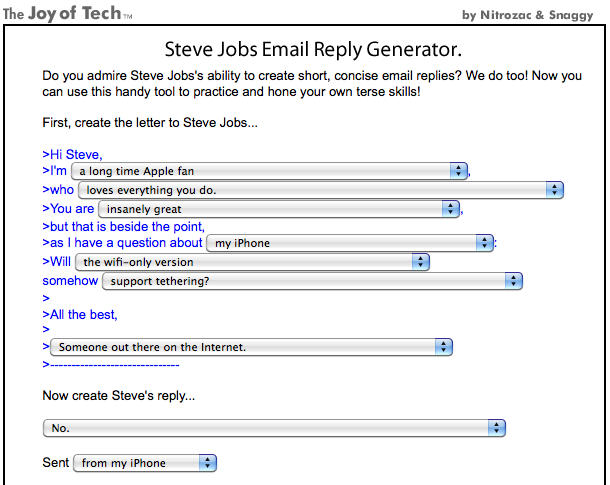
Since contacting Steve has gotten so popular lately, The Joy of Tech has created this handy web based Steve Jobs Email Reply Generator for simplifying the process…
Apple CEO Steve Jobs isn’t exactly known to mince words with his customers or employees, and his characteristic bluntness even extends as far as his conversations with other CEOs.
Take this conversation he had with eerie William Macy lookalike and Nike CEO Mark Parker upon the introduction of the Nike+ product line. Asking Parker for advice on how to run his company, Jobs bluntly replied: “Get rid of the crappy stuff.”
“I expected a little laugh,” Parker said. “But there was a pause and no laugh at the end.”
No, Mark, Jobs is dead serious about excising the crap. Well, except for the Apple TV.
In part 7 of Macworld‘s founder David Bunnell’s memoirs of the Mac, it’s clear that the machine isn’t ready for prime-time. Macworld‘s editor Andrew Fluegalman tells this to Steve Jobs, who reacts in a surprising way.
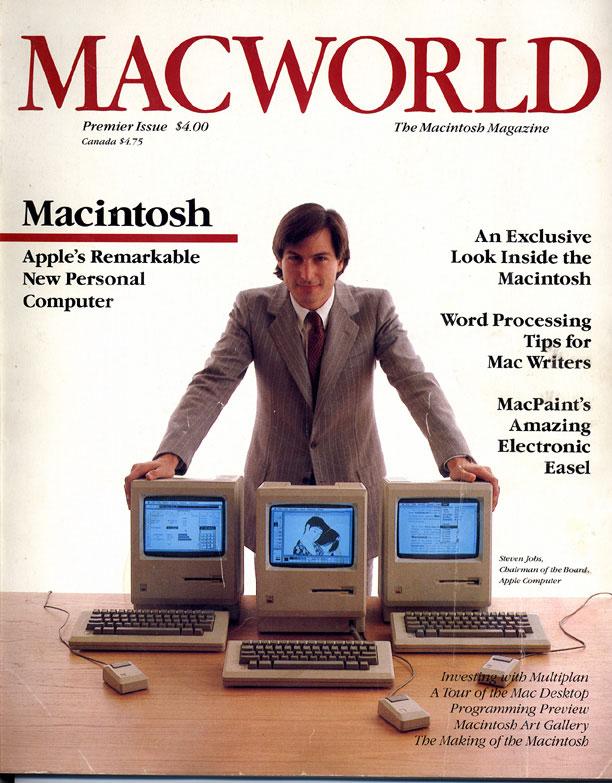
In Part 6 of his memoirs, Macworld founder David Bunnell recalls the magazine’s first cover shoot featuring Steve Jobs, who has a sudden, unexpected change of heart.
“Take a picture of this,” Steve said, holding up his middle finger. We stared in disbelief.
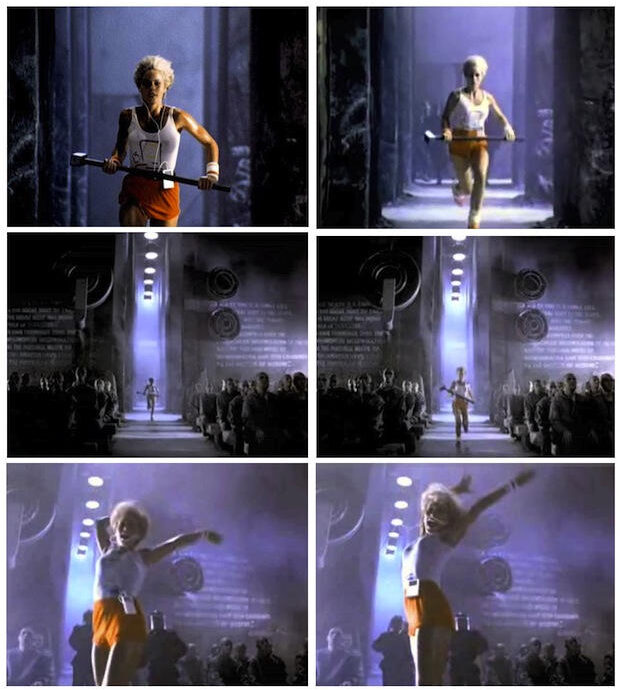
In Part 5 of My Close Encounters With Steve Jobs, Macworld founder David Bunnell describes seeing the 1984 Macintosh ad for the first time.
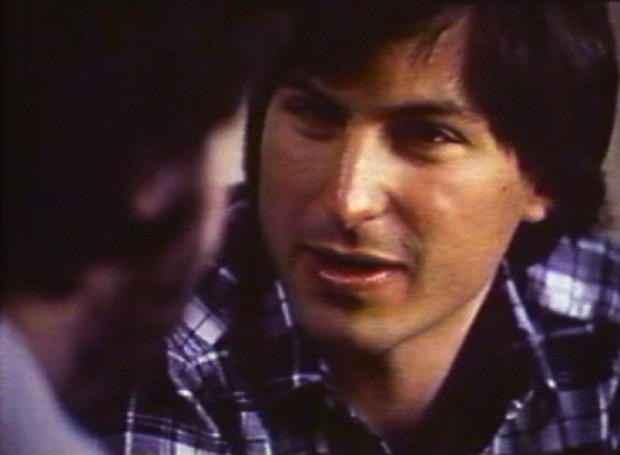
Macworld‘s founder David Bunnell’s first meeting with Steve Jobs is surprisingly genial. This time he gets to meet the REAL Steve Jobs. Plus he has one of the best ideas of his magazine career.
httpv://www.youtube.com/watch?v=0FW-lrMXLBE
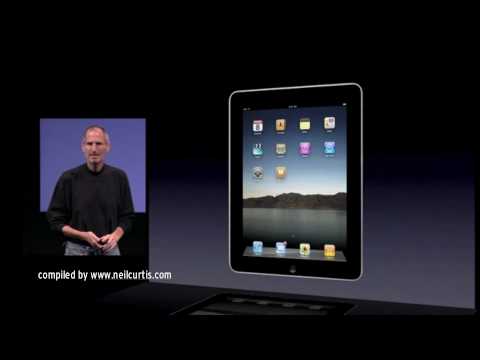
This fierce edit of Steve Jobs’ April keynote by Neil Curtis — father of the 180-sec keynote is, like, um great. (Curtis reminds us that, uh, it’s all in good fun).
Very reassuring for anyone who has, like, uh, spoken in public, or, you know, heh, been interviewed for radio, or, um, so, done a podcast, and um been horrified at all the excess, uh, verbiage? and weird intonations? and half sentences (“We nailed?”) that, so, now, inevitably, you know, clutter up the way you, uh, talk.
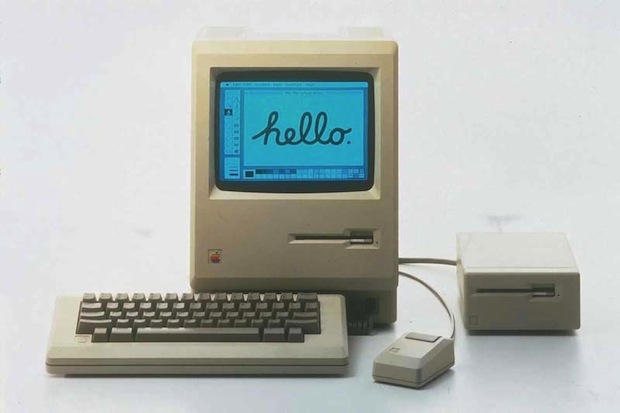
In Part 2 of My Close Encounters with Steve Jobs, Macworld-founder David Bunnell tells of seeing the Mac for the first time, and why Steve Jobs parks in handicapped spaces.
This is the first installment of “My Close Encounters with Steve Jobs,” a fantastic series of stories about the early days of the Mac written by the founder of Macworld magazine, David Bunnell.
Bunnell meets Jobs for the first time. He’s nervous because Jobs is in “an extremely foul mood” says the receptionist, maybe because he had an unsuccessful date with Joan Baez the night before.
Also, Bill Gates tells Bunnell he’s going to buy a Mac for his mother. Gates and his cohorts are so excited about the Mac, they’re all buying up Apple stock (possibly in violation of SEC insider-trading rules).
Want porn on the go? Go buy an Android phone is the advice of none other than Apple founder Steve Jobs.
For the next three weeks we’re going to be publishing a series of posts called “My Close Encounters with Steve Jobs.” Written by David Bunnell, the founder of Macworld magazine, it’s a bunch of great stories about Jobs and the launch of the Mac. It’s a excellent, insightful read with a ton of previously unpublished stories and details. Starting Tuesday — Part 1: Meeting Steve.
It’s Friday and we’re all a little tired. Luckily, a surprisingly vociferous Steve Jobs has been taking to his iPad email client a lot lately to entertain us.
His latest missive? Explaining the rationale behind leaving the 13-inch MacBook Pros behind the Core i3i5 15 and 17-inchers with comparatively wimpy Core 2 Duo processors.
Steve Jobs has sent another of his off-the-cuff customer emails, this time about the not-so-fast chip in the new 13-inch MacBook Pro.
Some observers are complaining that the 13-inch MacBook still sports a rather lowly Core 2 Duo chip, which also powered the previous generation machine. Meanwhile, the 15-inch and 17-inch MacBooks got speedy Intel Core i5 and i7 processors.
One MacRumors reader sent Steve Jobs a note about it, who responded that Apple chose to offer better graphics and battery life rather than an increase in CPU performance.
With typical modesty and restraint, Steve Jobs today downplayed the iPad hype. Pouring cold water on some of the hyperbole pundits have lavished on the device, he said:
“We think this is a profound gamechanger. We think when people look back some number of years from now, they’ll see this as a major event in personal computation devices.”
He was responding to a question about being surprised by the initial reaction. Here’s what he said in full:
Boy, Steve Jobs doesn’t mess around, does he. Not content with his Google throwdown, he’s challenging the entire telecommunications industry with the iPhone’s new Background VoIP.
OPINION: Steve Jobs saved the most important part of his iPhone 4.0 announcement today till last — the new in-app advertising system, called iAds.
The iAds system is important because it allows the App Store to create a completely self-sustaining app economy that is sealed off from the wider Web.
Tech guru Tim O’Reilly says the App Store is already becoming a rival to the web itself. The App Store, he says, is “the first real rival to the Web as today’s dominant consumer application platform.” Consumers will have no need to visit the web on their iPhones and iPads if they get everything they need from apps, which is bad news for companies like Google.
“This is a new phenomenon,” Jobs said about apps at today’s presentation. This is the first time this kind of thing has ever existed. We never had that on the desktop, so search was the only way to find a lot of things.”
The App Store economy is already pretty well developed. There is the app purchase mechanism itself through iTunes, and in-app purchases, which allow consumers to buy stuff from inside apps themselves. But there was a big hole: advertising. Ads are already a big part of the app economy, but clicking on them typically takes consumers out of the app and into the browser, an experience Steve Jobs describes as jolting.
But now Apple has built a sophisticated ad-serving mechaninsm right into the iPhone (and iPad, natch), which will make the App ecosystem like AOL in the early days — a walled garden. And one that has it’s own economy: in-app purchases, and now in-app advertising. There will be no need to go to the wider web anymore — and that cuts out Google.
“What’s happening is that people are spending a lot of time in apps,” Jobs said today. “They’re using apps to get to data on the internet, rather than a generalized search.”
No wonder Apple and Google are at war. Google swooped in a bought AdMob just to keep it out of Apple’s hands (so Apple snapped up Quattro instead). Of course, Google isn’t on the ropes yet. Android is Google’s attempt to keep it relevant in mobile, and so far it’s holding its own against the iPhone.
But if early numbers are any indication, the iPad is going to be an iPhone-sized hit. Combine the iPad, iPhone and iPod touch, and that’s a lot of mobile devices in Apple’s walled garden.
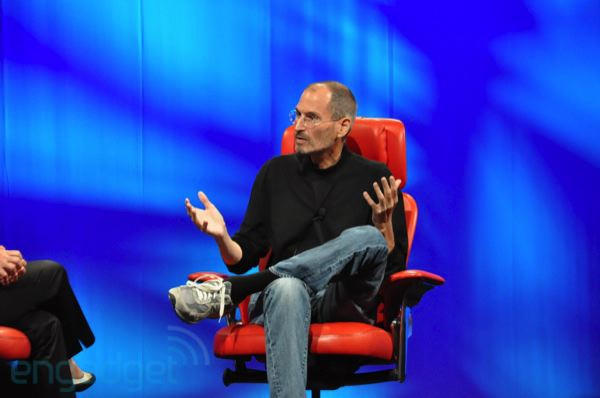
Andrea Nepori, head honcho at Italian-based TheAppleLounge.com, has alerted us to the fact that maybe Steve Jobs doesn’t have anything to wear.
Check out the worn-out pants and forlorn sneakers in the photo of Jobs, left, at Apple’s Stockton Street Palo Alto store in San Francisco on the iPad’s launch day; now sadly note the same fashion choices in the photo on the right, of El Jobso and Google CEO Eric Schmidt kicking back in Palo Alto, taken a week earlier.
So buy an iPad, and maybe Jobs can afford to pop for some new togs. Seriously, before The Gap starts marketing a replica version of his jeans called the iHole. Because we all know where his critics would take that one.
[Thanks to Andrea Nepori for the photo-illustration.]