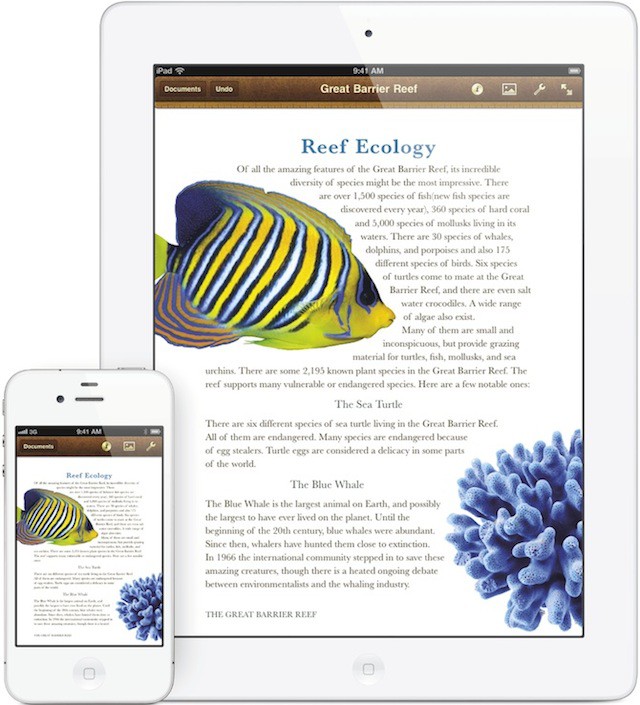
Left: Pastebot, the latest Tapbots app. Right: Weightbot.
Creating an iPhone app is one thing, but making something that stands out in an increasingly deep, expansive crowd is something else entirely. And yet Tapbots have managed just that. Describing their trio of apps as “robots for your iPhone and iPod touch,” Tapbots has managed to infuse the most utilitarian of concepts with genuine personality, and this is largely down to playful and innovative interfaces. We caught up with Paul Haddad (“the programmer”) and Mark Jardine (“the designer”) to find out more about how Tapbots was born, the thinking behind its apps, and what their newest creation, Pastebot, can do for your Apple device.
A laughably fake “iSlate development document” has been “leaked” to PhoneArena, possibly through a drainage shunt trephined through the cranium of some wishful thinking prankster.
The first clue that the document is phony is the fact that, two days later, Apple’s lawyers aren’t Q-tipping the gelatinous remains of PhoneArena’s site owners out from between their toes. But there’s other reasons to be skeptical.
First of all, the document claims that the Tablet will run OS X 10.7, codenamed “Clouded Leopard.” Ha, whatever. Not only is that name ridiculous, but we know that if the Apple Tablet is announced at the end of January that we can expect a launch by no later than June: Apple needs to give App Store developers time to tablet-ready their apps, but they can’t wait so long that the competition has time to catch up. More over, Snow Leopard was just released in August 2009, and the first developer build of its successor is rumored to be released at WWDC in June.
The bottom line: the tablet is going to come out well before the release of the next version of OS X. And it’s probably going to run something closer to the iPhone OS anyway, although I personally expect to see those operating systems as distinct entities begin to converge more drastically with the release of the Tablet.
Apple has a ridiculously good run over the past ten years. But in true Apple fashion, I’m not here to rest on the laurels of the past but to look into the future. So sit back, relax, and take a daring look all the way into the year 2010. Here are the five things that Apple must do to thrive in 2010.
This is likely just a traffic grab, but according to the Quick PWN blog reporting “inside sources”, Apple’s forthcoming tablet will indeed be called the iSlate, but it won’t be a tablet computer: it’ll be an eBook reader, and positioned to go head-to-head with the likes of the Kindle and Nook.
Apple may be preparing to sell up to 45 million iPhones in 2010, according to suppliers. The orders for an upgraded iPhone camera would double those expected for 2009. The news appears to coincide with other reports that Apple may introduce a new iPhone in mid-2010.
“OmniVision Technologies is expected to see CMOS image sensor orders for Apple’s iPhone devices grow to 40-45 million units in 2010,” according to industry sources cited by DigiTimes. The orders for a 5-megapixel sensor may be a response to Verizon’s Droid and Google’s Nexus One handsets which both have more sensitive cameras than the iPhone 3GS’ 3.2 megapixel camera. OmniVision supplied the iPhone 3GS 3.2 megapixel image sensor.
Apple recently complained to Microsoft about its “Laptop Hunter” ad series where pseudo-everyday consumers go on a shopping quest to buy computers on a limited budget.
In what Microsoft Microsoft Chief Operating Officer Kevin Turner called “the greatest single phone call,” Apple lawyers rang up to lament the ads weren’t accurate — since the company shaved prices off Macs, some by as much as $300 hundred dollars, in June.
Microsoft agreed to edit the ads to reflect this.
So what changed in the ad campaign? Not much.
The first edited ad is “Lauren and Sue,” where a mom-and-daughter team are in the market for a computer for under $1,700.
Originally, the ad showed law student Lauren declaring:
“This Mac is $2,000, and that’s before adding anything.”
“Why would you pay twice the price?” asks Lauren’s mom. “I wouldn’t,” says Lauren, who heads to the checkout with a $972 Dell laptop.
In the updated version, the specific price is edited out but Lauren does a drive-by of the Macs, dismissing the MacBook Pro (“this one only has a 250GB hard drive”) before sentencing: “It seems like you’re paying a lot for the brand.”
Microsoft’s Turner told journalists that his company plans to “keep running them and running them and running” the Laptop Hunter ads — and it’s easy to see why. They don’t need specific prices to use the expensive-but-not-really-worth-it Mac argument.
Having now lived with an iPhone 3GS for the better part of three weeks, I remain incredibly impressed with the device. It’s powerful, fast, and running extremely mature software that’s delightfully quirk-free.
That said, it’s also become apparent that if you’re actually interested in using the phone for its intended use (web browsing, e-mail and video), battery life is ridiculously inadequate. In spite of assurances at WWDC, the 3GS only lasts marginally longer than the 3G, and I often need to charge up mid-afternoon to make sure i have decent battery for my train ride home.
Yesterday, things really went out of wack, and I could literally watch my charge diminish by 2 percent per minute when I was doing nothing so much as leaving it on my desk. A restart fixed it, but it was an extreme case of a persistent problem.
I started thinking about all of this thanks to Joel Johnson’s review of the Mophie Juice Pack Air over at BB Gadgets today. I still think having any case would be a downer, but the extra battery power is becoming increasingly necessary to enjoy my long-awaited iPhone in the manner I choose. That said, I can’t really bring myself to by one of those big battery packs that hold four times the charge, or what have you — afraid of losing it.
What’s been your experience? Do you moderate your Flight Control play to preserve your talk time? Or do you sport a bonus battery pack?
By all accounts, the iPhone 3GS launch has been a tremendous success for Apple. Despite launching in a down economy, the new model managed to sell as many units in its first weekend as its predecessor with little sign of slowdown. It’s also been an incredibly smooth launch. Though the iPhone 3G launch was marred by product shortages and buggy software, Apple’s kept a steady supply of hardware in the channel, and iPhone OS 3.0 is quite stable for such a new release.
But as effective as Apple has become in managing all of the aspects of the iPhone that it controls (hardware and first-party software), the launch also reveals the challenges the company faces in its efforts to take advantage of a larger network. AT&T’s signal strength continues to be a subject of much heated debate, and more crucially, Apple’s position as minder of a large software platform with thousands of developers looks increasingly untenable.
I don’t need to go into detail about the numerous cracks in the App Store facade of the last year: the baby shaking app, the unapproved porn, the copyright infringement, the excellent apps inexplicably rejected for arbitrary reasons and the apps that never made it out of the approval process one way or another. What I can say is this: the release of the 3GS has inspired a burst of app submissions the likes of which Apple has never seen before. When the App Store first opened a year ago, it had a flurry of submissions, but a smaller pool of developers. This is the first real “event” period since the iPhone dev community has grown, and the submission pool is not unlike the giant hyperwall of apps that dominated the conversation at this year’s WWDC.
A developer friend tells me that a pre-release version of his app was checked off and approved in a week in the period immediately before the 3GS announcement. The final release, submitted the day of the WWDC keynote on June 8, took nearly four weeks to get through the system, and I’m told that Apple has even notified its developer community that all apps are taking between three and four weeks to vet. That means it takes four times as long to get new products to consumers, four times as long to fix bugs, and four times as long to go from finished work to money-making.
If Apple wants to maintain the dominance of the iPhone and the success of the App Store, it needs to find a more effective way to manage the sheer volume of submissions it’s tackling. Too much crud is making it through, and too much brilliant code is sitting on the shelf. The iPhone is by far the best mobile platform today. Unless Apple learns to treat its developers better on the front end (I hear payment works brilliantly), they won’t be loyal when the next Next Big Thing comes around.
Dan Lyons at a San Francisco book signing in 2007 with tech podcaster Veronica Belmont and Bike Helmet Girl, a recurrent character in the Secret Diary.
Steve Jobs may not be back to work yet, but Fake Steve is.
Fake Steve Jobs (aka Newsweek columnist Dan Lyons) has started blogging again.
Over the weekend, Fake Steve made a series of off-color jokes about Steve Jobs’ recent liver transplant. The posts are classic Fake Steve — sick, tasteless and LOL funny.