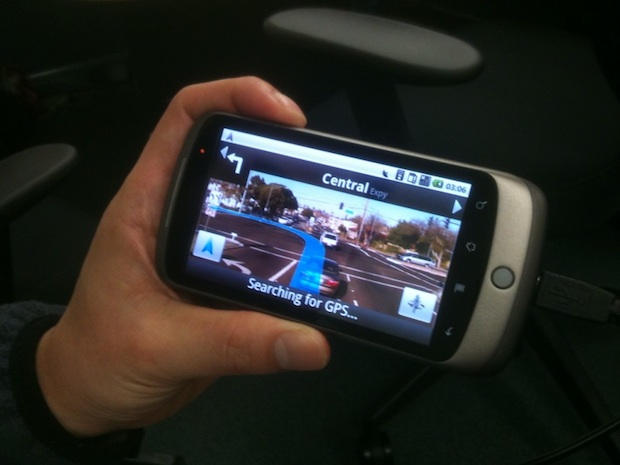
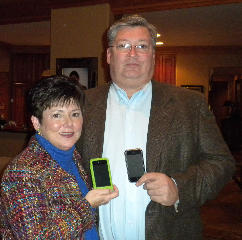
Google's Nexus One smartphone. CC-licensed picture by ekai.
It’s been a month since my review of Google’s “SuperPhone”, the Nexus One. Since that time, we’ve surfed, updated facebook, navigated, called, played endless hands of cribbage and even tried to freeze it to death on a trip to Dayton Ohio. Follow me after the jump to find out does the “SuperPhone” stand the test of time, or is it a phonebooth’d Clark Kent.
Verizon getting the iPhone later this year is no longer a done deal in the mind of one financial analyst. Indeed, Credit Suisse has downgraded the carrier, expecting AT&T could retain an exclusive iPhone contract until at least mid-2011.
The financial firm downgraded its recommendation for Verizon to Neutral, down from Outperform, and shaved its target price to $30 per share, down from $32.
Although Verizon may “eventually” be awarded an iPhone contract as Apple drops its exclusivity in the U.S., “there is much greater probability that AT&T keeps exclusivity for another 12-18 months than investors realize,” Credit Suisse told investors Thursday.
Prevailing wisdom previously was that AT&T’s exclusive contract would end in June of this year and Verizon was the likely beneficiary. However “we no longer think AT&T will lose iPhone exclusivity in mid-2010,” the financial company writes. The delay could benefit Research in Motion’s RIM in the U.S., it said.
The analysis comes a day after reports Verizon and Apple were “still talking” about an iPhone deal. AT&T may have underbid Verizon and other carriers to win the iPad contract. Although the carrier would only say its iPad data plan “pricing speaks for itself,” AT&T beat out Sprint, T-Mobile and others to connect iPad users.
Apple recently came to AT&T’s defense amid questions about the carrier’s 3G network. Apple’s chief operating officer Tim Cook told reporters he had “very high confidence” AT&T can correct problems that have plagued reception.
Apple’s decision to go with AT&T as the sole carrier for the newly-introduced iPad had some wondering about the months of on-again, off-again talks between the Cupertino, Calif. company and Verizon Wireless. Although still talking about a deal, turns out, the CDMA carrier was more interested in snagging a contract for an upcoming iPhone.
“According to sources at Verizon, the company is more interested in the lucrative iPhone contracts,” Fox News reported Wednesday. The carrier says its still interested in supporting the iPad, as well.
It’s mostly been assumed that the iPhone SDK’s omission of terms enabling VoIP over 3G was prompted by Apple bowing not just to AT&T’s bandwidth concerns, but by concerns that 3G VoIP would make calls and minute moot.
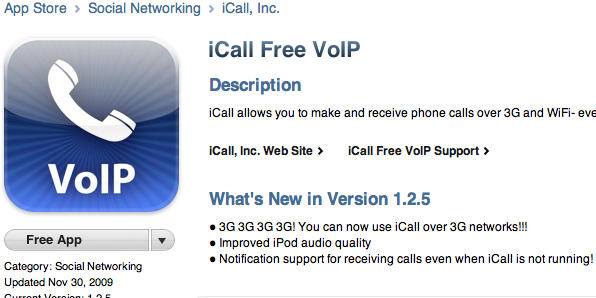
It now looks like that assumption may have been unfair: Apple has just updated the terms of the iPhone SDK to allow VoIP calls over 3G. iCall is the first company to be jubilantly crowing that their free VoIP app has implemented 3G VoIP, but others (hopefully Skype!) should be soon to follow.
That’s not to say that VoIP 3G will work universally — T-Mobile in Germany, to my irritation, doesn’t allow VoIP over 3G — but it’s nice to finally see this functionality hit the iPhone after a couple years wait.
Here in Germany, Media Markt is the Teutonic equivalent of American big box retailers like Best Buy. Considering Amazon.de usually manages to ship the same items overnight for free anywhere in Germany at vastly reduced prices, there’s not much reason to remember the existence of poor old Media Markt, which is what makes it so downright bizarre to me to discover their name plastered all over the gadget feeds in connection with the Apple Tablet.
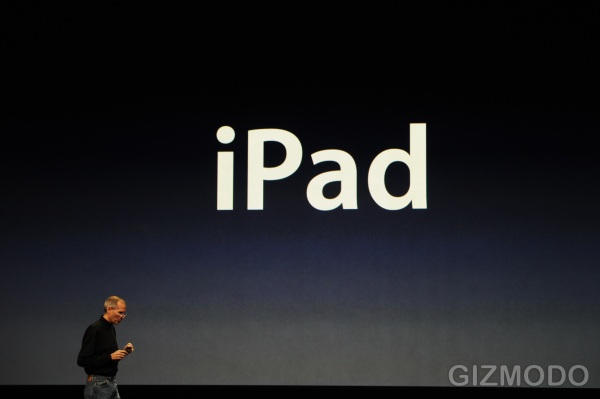
Supposedly, Media Markt accidentally “leaked” the name, price and ship date of the Tablet on their Twitter account. According to the (swiftly deleted) Tweet, the Tablet is called the iPad, it’ll ship on March 1st, 2010 and will cost €499 with a €120/month T-Mobile contract or €899 without one.
Short of the name (I will eat an extremity if Apple is creatively bereft enough to brand the Tablet with the similar to iPod and — in some dialects — identically pronounced moniker, iPad) that all sounds plausible enough… but, uh, no. Media Markt doesn’t know when the Apple Tablet is coming out or what it’s going to cost. I’ve actually seen their employees hooting and hopping around the latest iMacs with all the insight and grace of Hansel and Derek Zoolander. I refuse to believe that whatever administrative assistant they’ve got hammering out updates in the company’s Twitter account knows more about the Apple Tablet than the New York Times.
Google’s Nexus One, the Internet giant’s first entry into the self-branded cell phone arena, costs $174.15 to build, making it just slightly more expensive that its rival from Apple, the iPhone, according to a Monday report. The figure from iSuppli also indicates the build price of the Google handset is just $5 under the subsidized $179 customers pay for the device when agreeing to a two-year T-Mobile contract.
The Nexus One retails for $529 if purchased unlocked and without a carrier’s contract.
The giant Consumer Electronics Show in Las Vegas later this week will be all about tablets, eBook readers and 3D TVs. But of primary interest to Apple followers will be the big gathering of iPhone App developers.
More than 100 iPhone developers and accessory makers will exhibit at the iLounge Developer’s Pavilion, up 150% from numbers announced in July.
Penny and John Alexander claim AT&T is firing them as iPhone users because they are costing the company too much money in roaming charges. The Alexander's home in Alabama isn't directly serviced by an AT&T cell tower.
AT&T is threatening to terminate the accounts of a pair of iPhone users because they’re costing the company too much money.
“AT&T is firing us as iPhone users,” says Penny Alexander, who lives in Dadeville, Alabama, with her husband John.
In late November the Alexanders received a letter from AT&T saying that because they didn’t live in an area directly serviced by AT&T’s network, more than half their calls were being routed through another company’s network. Thanks to roaming charges, the pair are costing AT&T too much money.
“This situation is rare,” the letter said, “but when it happens, our operating costs increase significantly which makes it difficult for us to keep our rates affordable for all other customers.”
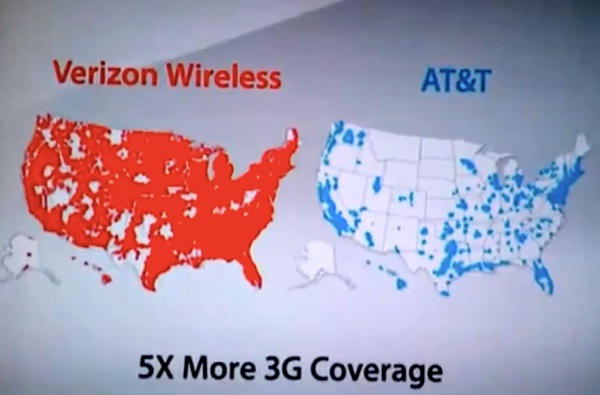
Everyone knows that the one thing holding the iPhone back in the U.S. is AT&T’s poor 3G coverage, right? With a dropped signal, it can transform from one of the world’s most capable mobile computers to a video iPod that plays a pretty mean version of Doom. Everyone knows the problem lies with the network’s inability to handle iPhone data traffic, as iPhones have no such problems in the European market, Japan, and other regions where it has a major foothold — places where the network load is so much not a problem that they enable data tethering from laptops.
Well, everyone knows but the New York Times and the mobile industry analysts — some of whom work for AT&T — they interviewed about the matter. In a dreadful column titled “AT&T Takes the Blame, Even for iPhone’s Faults“, one of the paper’s correspondents in Silicon Valley, Randall Stross, goes so far as to definitively declare that the iPhone’s design “is contributing to performance problems” and that with regard to Verizon, “AT&T has the superior network nationwide.” Oh, for crying out loud.
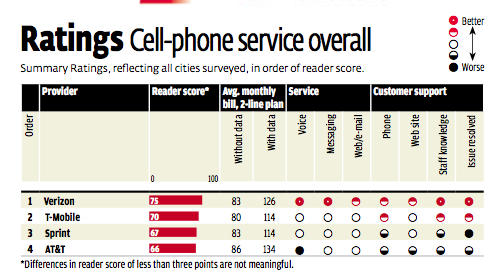
At least it’s now quantifiable: AT&T provides the worst cellphone service in the country, according to a recent customer satisfaction poll.
Consumer Reports hit the streets and asked 50,000 readers across 26 cities to rank cell phone service according to voice service, messaging, internet access and customer support. Verizon came out on top, achieving the top two ranks in customer satisfaction in every category. Then came T-Mobile and Sprint.
AT&T? Dead last. Their highest average rating in any service category was total ambivalence, with most categories rated as poor or terrible.