Number Seven Hundred and Thirty Six on the list of things that really torque me off are people who intentionally and knowingly mislead folks for fun and profit. And to this list of Mortgage Brokers, Right Wing Talk Radio Hosts, and Tobacco Lobbyists, we can now add Roger L. Kay president of Endpoint Technology Associates (aside — people who are ‘president’ of companies employing 50 or less people, are number 977 on the list of things that annoy the crap out of me.)
El Presidente Roger authored a white paper at the behest of Microsoft titled: “What Price Cool” which serves to illuminate us all as to how we all have been paying some imaginary “Hidden Apple Tax” all these years.
Of course, a younger man might shrug this drivel off, yet as I grow older I find my patience for such things eroding. While I’m not quite at the yelling at kids to get off my lawn stage, I am quite crotchety enough to spend my Saturday night debunking this garbage.
Follow me after the jump where we reveal the obviousness with which Le President Kay sold his credibility.
The lucky downloader of the billionth app from iTunes (winner of a MacBook Pro, a 32GB iPod Touch, a $10,000 iTunes Gift Card and a Time Capsule wireless hard drive) is reportedly a 13-year-old who hit the jackpot with a free app called “bump.” Apple reached the billion mark with apps in just nine months.
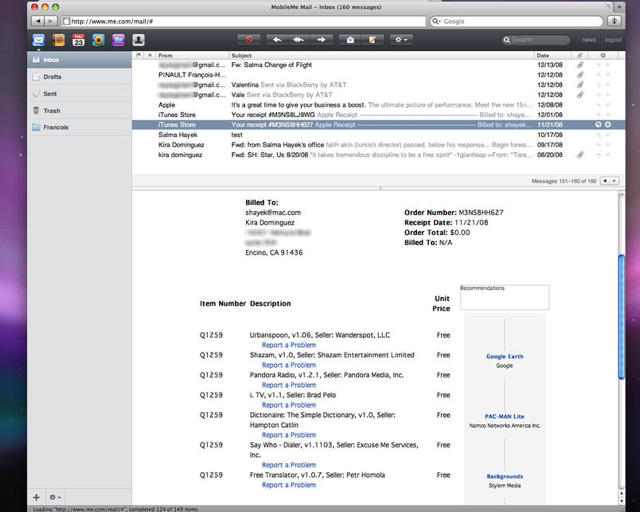
Call it hacking, or just common sense: getting into actress Salma Hayek’s Mobileme account was apparently as easy as knowing her birthday and her favorite starring role.
An anonymous post on imageboard 4chan.org provided MobileMe login details for Hayek:
Go to me.com, forgot password, type [email protected]
Her //snip//
Answer to change password question is: //snip//
Voila : a peek at Hayek’s iPhone apps downloaded from iTunes — including restaurant finder Urbanspoon, Shazam and the Say Who voice recognition dialer — plus emails from uber-magnate husband Francois-Henri Pinault and an invite to America Ferrera’s 25th birthday party.
Wonder if iPhone loving twitterer Ashton Kutcher’s next…
In computer software circles, there’s a lot of discussion about the “10-foot UI,” designed for interactions from across a living room. Now that streaming video has truly come into its own, the space has exploded. Apple’s Front Row is a 10-foot app, as is Boxee.
But if you’re a Mac user, especially a Mac mini owner who keeps it hooked up to an HDTV, there’s only one choice: Plex Media Center, a Mac-only offshoot of the Xbox Media Center software. Basically, Plex pulls all of your content — whether on your hard drive, your network, your Tivo — and blends it with everything on the entire Internet, including Hulu, Pandora, BBC iPlayer, Netflix, and The Daily Show, then wraps it in a stunningly beautiful interface that makes it a snap to navigate all of the world’s video and music with arrow keys are a simple remote control. Better still, it’s an open architecture, and people are adding to it like crazy.
It’s been around as Plex since last July, but many of the best features, like the Netflix plug-in, are recent arriving in the last two weeks. What’s maybe most exciting is that Plex has plug-ins that the original XBMC application lacks. The Mac development community is passionate enough to dramatically improve their offering beyond other versions. Heck, it has its own App Store. And it’s 100 percent free, running on all Intel hardware running Leopard.
This is the media operating system of the future. Now, if they’d just release a companion remote application for iPhone, this thing would really take over the planet.
The Better Business Bureau is warning Facebook users to read the fine print when responding to ads.
A recent BBB press release stated that an estimated $1.3 billion will be spent on social networking advertising this year. The large print on ads featured on social networking sites, like Facebook and Myspace, do not always tell the entire story.
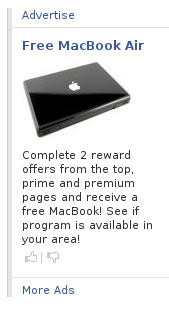
The warning about MacBook Air scams is a hoot:
Also common on Facebook are ads to get a free MacBook Air claiming that the company is seeking laptop testers. The ads lead to an incentive marketing program at https://www.colormyrewards.com/ where participants must sign up for various products and services in order to earn their free laptop.
The Fine Print: Customers must complete two options from each of the three tiers, Top, Prime and Premium before receiving their “free” MacBook. Example offers listed in the Top and Prime tiers include signing up for credit cards or trial offers for subscription services such as for vitamin supplements or DVD rental services. In some cases, the participant will need to pay for shipping, and if they aren’t vigilant about canceling the trial offers they signed up for, they’ll begin being billed every month.
Examples of the Premium offers listed on the Web site that must be met in order to get the MacBook are much more expensive and include paying as much as $1,500 for furniture or purchasing a travel package with a minimum value of $899.00 per person.
BBB Warns: Incentive programs can be extremely costly in the long run and the fine print shows that the customer might have to pay a significant amount of money in order to get their “Free” items. It is also a red flag that Apple does not even make MacBook Air in purple, red, pink, or green. (Emphasis mine.)
And as flickr user 4braham noted (image used with a CC license) the Mac in the scam pic isn’t a MacBook Air. Sheesh!
What gadgets and software applications do you use on a day-to-day basis?
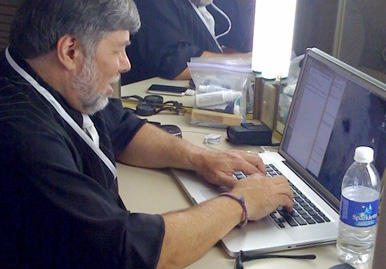
Steve Wozniak: I have such a crowded life and crowded schedule. When people send me a link with a gadget, I’ll look at it and buy it if it looks interesting, but I don’t have time to check out everything I’d like to.
I do have a Nixie Tube watch… The biggest benefit in my life comes from my Segway, which I use everywhere I am. If I’m going to San Antonio, for example, I’ll load it in the car and just go everywhere with it. The other crucial thing is my Verizon wireless card, which I have to have because hotel Wi-Fi is just so unreliable.
What are you using to manage your email?
Steve Wozniak: Eudora….The reason I do is, it has an incredible feature that every single mail client should have.
Any feature in the menu list, any action there, can be added as a button. I changed it so I have a vertical menu bar, so I can have tons and tons of pre-made buttons saved right where I want them up top, and I learn where those place are. You can script actions to the buttons, too, so I can quickly copy messages to my assistants. There are scripts I wrote for joke lists so I can forward a message, remove the brackets and formatting, and make sure all the original attachments are included, to a pre-defined “joke” group. Apple’s Mail app just isn’t scriptable enough to really handle my mail buttons.
Some of the buttons will re-direct mail with quote marks, or not. I’ve got another script that will actually customize a mail forward, like my own version of mail merge. So even if something’s going out to 400 people, I can set it to single out certain people and take away all the forwarding markings, so it looks like I singled out someone to send them mail. Which is, I hope, a nice little moment for them.
If you’ve ever wondered why some developers can’t stand Apple, perhaps Marco Arment can help.
Arment makes useful websites in New York, according to his bio. He’s the lead developer of Tumblr, the Web 2.0 sharing sensation, and creator of the very popular iPhone application Instapaper, which allows users to save web pages on their devices for reading later.
Arment penned a revealing blog post Monday that serves to highlight the frustration even established developers must endure in navigating the uncharted, fickle waters of Apple’s approval process for third-party iPhone and iPod Touch applications.
After submitting an update to Instapaper that included the mobile phone icon shown in the screen capture above, Arment was informed his update could not be accepted because it ran afoul of SDK guidelines that prevent “use [of] the Apple Logo or any other Apple-owned graphic symbol, logo, or icon … except pursuant to an express written trademark license from Apple.”
A friend of Arment’s had designed the icon and offered it to him for use with Instapaper.
Arment concedes the App Store is “an amazing deal for independent developers” but laments the fact that “problems seem so arbitrary, avoidable, and developer-hostile.”
In the end, the frustrated developer must resolve to “make a different icon from scratch that doesn’t contain any depictions of any Apple products,” with Arment asking, “can I use arrows, or does that violate the arrow key on Apple’s keyboards?”
And the bottom line, something with which even Apple is undoubtedly familiar, is that a developer in Arment’s position is forced to resubmit, wait another 7 -14 days, hope to be accepted, and lose a few weeks of the increased sales that the new version will generate, all the while chalking it up to “another annoying cost of doing business on the App Store that [you] can’t do a thing about.”
Thinking further about the new Mac ads — and how if I were considering buying a Mac over a PC they wouldn’t sway me — I came across this post about an accidental switch & bait that turned one PC person, political-science professor Harry Farrell, into a Mac user:
“I was working in my office, when a work-study knocked on my door with a brand new MacBook Pro, which he told me had been sent over from my school’s technology program. I was nonplussed, and told him that he must be wrong, that I hadn’t ordered one etc…
So I finally acquiesced, on the grounds of gift-horses, and the wisdom of not inquiring too closely into the dental conditions thereof, and unpacked it. Two hours later, I was completely hooked –œ more rational and altogether nicer than my Windows box, while much smoother than my Ubuntu installation. I would have wanted to take it home and marry it, if I wasn’t married already. Three hours later, I discovered it had been a mistake, and that it was in fact intended for a colleague with a vaguely similar name… And I had to give it back.”
I get asked a lot why I prefer Macs to PCs. Sometimes it’s from a Windows fan trying to pick a fight, sometimes it’s from a platform agnostic who’s interested why I care enough to choose. But the intent is the same — what makes you so passionate?
And after citing obvious reasons like the elegance of Apple’s hardware and software design or the way everything just works out of the box, I almost inevitably bring up something that seems to dull to get excited about: OS upgrades. Not that they happen, but that it’s always easy for me to know which edition of OS X to buy, and I never feel like Apple is needlessly squeezing pennies out of me by charging more for the features that make it worthwhile to upgrade. Leopard was Leopard. Snow Leopard will be Snow Leopard. Easy.
This is the opposite of the Windows experience, in which there will be seven (!) versions of Windows 7 to choose from, some of which are hopelessly crippled. The worst of these is Windows Starter, designed just for Netbooks.
We all know that the vast majority of personal computers run Windows, with a significant but smaller number using Linux and Mac OS X, and then teeny slices using other operating systems like Solaris and Amiga OS. What might not be so obvious is that Microsoft has become equally dominant in the new Netbook market, with Windows XP or Vista shipping on 95 percent of the tiny lappies compared to just five percent for Linux.
And Microsoft, sitting on top of a dominant market position in netbooks, is quickly formulating a plan to actively screw over their potential customers. In the fall (if they’re lucky) MS will roll out Windows 7, which, from my testing of it, is a lot like Vista without all of the most glaring problems. Alongside Windows 7 will be a version custom-designed for netbooks called “Windows 7 Starter,” which will, I swear to you, only be allowed to run three simultaneous applications and won’t feature the same UI as more expensive flavors of the OS. Those features are present — you’ll just need to pay Microsoft for an upgrade code to access them. So forget about running Word, Firefox, iTunes, and Outlook at the same time if you’re on Windows Starter.
Here’s why this is a brain-dead strategy. The only reason to get a Windows netbook is to run Windows applications. If you’re limited to only three apps at a time, it’s actually saner to use Cloud apps in a Web browser. And if you’re going to do that, it makes more sense to just go with Linux or another alternative. Starter is intended to make people want to buy the nicer versions of Windows 7. I think it’s net effect is more likely to be that people seriously consider alternatives.
And that’s why Apple’s dedication to making OS X available in just normal and server versions is one of the best decisions Steve Jobs has ever made. Apple has ignored the netbook market up until now, but it’s safe to say if Apple did release a netbook, it would be a premium offering at the high-end of the market and run a full version of Mac OS X. That’s just how Apple rolls.
Fewer viruses (the PC has to wear a hazmat suit), facial recognition for iPhoto, stability (no freezing, crashing, error messages) and low maintenance (stability doesn’t depend on security patches, virus scans etc.)
Hmmm. The ads are cute, especially the future one, but I’m not sure if I were really weighing a Mac vs. PC any of these things would convince me to go Mac.