Mobile menu toggle

Search results for: Apple One

Police Launch iPod Registry to Curb Thefts

By

cult_logo_featured_image_missing_default1920x1080

Police in Portsmouth, New Hampshire are setting up an iPod registry to thwart stealing. The registry covers the local high school, where staff and students reported high numbers of Apple snatching.

It works like much like bike registration: students fill out a form with a description and serial number of the device, verified by police staff at registration, and are given a sticker stating the device has been ID’d. The iPod is also photographed and the info is kept on file at the police department.

Police said the program is meant to speed up investigations and perhaps prevent thefts.

Do you think the registration will act as a deterrent?

Image courtesy Portsmouth police dept.

Via Foster’s Daily Democrat

iHouse: Mobile Digs for the Recession

By

post-10517-image-d921ea08f1855af329a90df922546a8b-jpg

Welcome iHome: doors recently opened on a solar-powered, energy efficient prefab house that creators hope has the design cachet of Apple products.

Miles away from the usual trailer park digs, the homes feature v-shaped rooflines, bamboo floors and rooftop decks.

The name’s a hat tip to Apple — much like the iApartment building or the iHotel we’ve written about before.
“We love what it represents,” Kevin Clayton of Clayton Homes told the AP. “We are fans of Apple and all that they have done. But the ‘I’ stands for innovation, inspiration, intelligence and integration.”

The recession-friendly iHouse goes for $100 to $130 a square foot, depending on extras in what’s billed as “a moderately-priced plug and play dwelling” for the eco-conscious.  The ribbon was cut on the iHouse in the US a few days ago at the annual shareholders’ meeting of investor Warren Buffett’s Berkshire-Hathaway Inc. in Omaha, Neb.
Via AP

Cult of Mac Favorite: Star Walk (Mobile App)

By

post-10505-image-7786157389ba34533de3ff342b3622b3-jpg

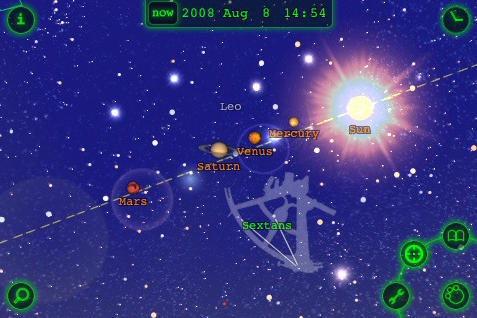
What it is: Star Walk is the official mobile astronomy guide for the International Year of Astronomy (IYA 2009), a $5 app for iPhone and iPod Touch that makes enjoyment of the celestial universe easier and possibly more enjoyable than anything outside a professional telescope.

Vito Technology, developers of the app, recently updated this popular title with improved existing features and several new functions. The new version (1.5) has even more striking graphics, enhanced speed, more images and a greater depth of information than the release version, which has already spent more than 4 months in the Top 25 paid apps of iTunes’ App Store.

Why it’s cool: Star Walk not only gives you a reliable guide to the present night sky based on your current location, it lets you change perspectives to locations thousands of miles away. It can also take you back in time to look at different events (such as eclipses) in the sky on specific dates; view lunar phases and learn about the discovery of constellations’ images and the reason for their shape. Use the super cool ‘infra-red’ night mode for easy outdoor stargazing without adding your device’s bright lighting to the ambient environment.

The new version has been improved with more stars and constellations to look at, with better and more precise images, more reliability and more speed.

The app makes stunning use of the iPhone accelerometer to change your perspective or point of view with just a swipe of the screen and provides zooming capabilities to allow you to travel in to deep space to find out the state of our knowledge of the outer universe.

New Features in the current version include:

♦ constellations on & off setting
♦ sounds on & off setting – but don’t turn them off; they are way cool!
♦ magnitude selection (allows you to show only stars with chosen brightness)
♦ spatio-temporal bookmarks – must admit to still learning about this one
♦ pictures of all constellations (from 10 upgraded to 110)

I’ve been playing with Star Walk for a couple weeks now and it’s definitely become a favorite app to use for stargazing as well as to show off some of my iPhone’s capabilities to friends and curious strangers.

Where to get it: $5 at the App Store.

Woz Joins TechFor Educators.com Board of Directors

By

post-10497-image-c3d313451246a44c44d785f60b77755c-jpg

Steve Wozniak, co-founder of Apple Computers and one of the most recognized engineering geeks in the world, joined the Board of Directors of TechForEducators.com – a Sausalito, CA-based purveyor of goods and services designed to improve the performance of educators – the company announced Wednesday.

“Woz inspired a generation of technologists – including myself,” explained Matt Spergel, President of TechForEducators.com. “The Apple II was an engineering tour de force and an amazing learning tool. We are deeply honored to have Steve contributing his infectious optimism and creativity to our company.”

Wozniak has a strong record of support for children and education, having been a founding sponsor of the Tech Museum of Innovation and the Children’s Discovery Museum of San Jose. He also “adopted” the Los Gatos School District, near Apple’s headquarters in Cupertino, CA, providing students and teachers with hands-on teaching and donations of state-of-the-art technology equipment.

In partnership with the Kids In Need Foundation, TechForEducators.com provides exceptional value to education: for every $1 a customer spends on product at TechForEducators.com, $1.25 worth of free school supplies is also provided to impoverished students. The company carries quality products at competitive prices, all with a money-back guarantee.

“TechForEducators.com represents the best in trying to do good things for our students and teachers,” Wozniak said. “I’m looking forward to the great things they have planned for education.”

MacBook Art Project is a Labor of Love

By

cult_logo_featured_image_missing_default1920x1080

NetBook Fakeout Kyle Buckner's MacBook #2 Kyle Buckner's MacBook
Screen Detail Keyboard Detail Dock Detail 2
Dock Detail 1 A Streaming Dock Kyle Buckner's MacBook #3

Kyle Buckner is a very talented fellow and his primary muse is Apple.

We’ve featured some of Buckner’s work before and he’s also got a spread in the June issue of Mac|Life magazine. He may well be one of the hottest Apple-inspired artists in the US right now.

Buckner sent us photos of his most recent school project, in which he was tasked to create a “Bookart”. Apple obsessed as he is, he was inspired to create a scale model of a MacBook.

Buckner constructed the casing out of wood, routering all the corners and then priming, sanding and painting the pieces white. The hinge system replicates the real Mac’s and is fully constructed out of hand cut MDF wood.

After he painted the pieces, he used a pencil to add the fine details. He drew the screen and full keyboard and penciled in every tiny phillips head screw at its location.

His piece is 3/4 the size of an original MacBook.

We apologize to anyone who got too excited by our earlier post teasing that this might be Apple’s new netbook. It’s a Monday night. It’s not football season.

Does anybody remember laughter?

Help Wired.com Test 3G Network Speeds

By

post-10436-image-ca9879fe37bb8ce009d78095bebafee4-jpg

Following rumors that Apple and Verizon are wooing each other, Wired.com is asking, “Which cellphone network is the best?”

To answer that question, Wired.com is asking for your help testing the speed of U.S. cellphone’ networks.

The test is open to all smartphones on all networks. Simply:

1. Ensure Wi-Fi is turned off and 3G is enabled on your smartphone (not the slower EDGE connection).

2. Load your smartphone’s browser and visit https://inetworktest.com/wired.*

3. The test will run automatically as the page loads. When it’s done loading, tap your carrier (AT&T, Verizon, T-Mobile or Sprint), and your results will appear.

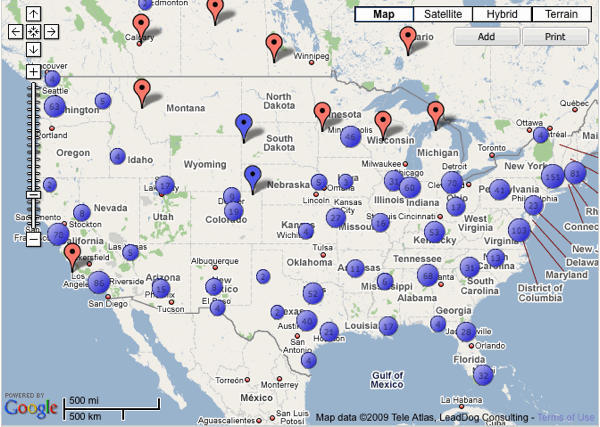
4. Add your details to Wired.com’s results map here: https://www.wired.com/gadgetlab/2009/05/3gstudy

Wired.com’s study follows up on an iPhone-only survey last year, which concluded connection problems were AT&T’s fault, not the iPhone’s.

As Wired.com notes, “A carrier’s network performance is a dealbreaking factor for consumers shopping for a smartphone, whether it’s the iPhone, the HTC G1, or a BlackBerry Storm.”

The test is .

Nine Inch Nailed—more App Store rejection ‘fun’

By

post-10430-image-8c191cc0f07813f364780c77db33f4c4-jpg

UPDATE: Reznor states on Twitter that the app has now been approved—unchanged.

Once again, the App Store is in the news for the wrong reason. We recently covered its bewildering rejection of the South Park app, but things really came to a head with Tweetie, which had an update booted because some App Store approval person found a rude word in that day’s Twitter trends.

Well, Apple’s at it again. Trent Reznor of NIN fame posts that the ‘nin: access’ app has been rejected on the grounds that it enables access to a podcast that has a song with a rude word in. As Reznor notes, using rather colorful language, Apple’s own Mail app lets through emails with rude words, and Safari can be used to access questionable content. But his app, which enables access to a podcast that can be streamed to the app, featuring the song The Downward Spiral, apparently enables access to external content that Apple thinks will warp fragile little minds.

Qwak for Mac: an interview with indie games developer Jamie Woodhouse

By

post-10414-image-7997c766d42eebe6310707b2162914fc-jpg

It warms the cockles when we hear of games coming to the Mac, but a more recent addition is older than most. Qwak, released late last week, has a lengthy pedigree, having first appeared on the BBC Micro way back in 1989. Now, 20 years later, this indie production has made it to Mac OS X, and we tracked down the game’s developer, Jamie Woodhouse, to ask him about the conversion.

The original version of Qwak, running on a BBC Micro home computer.

Cult of Mac: What is Qwak?
Jamie Woodhouse: Qwak is a super-playable, cute, arcade coin-op-style puzzler/platformer. The current version is the fourth incarnation of the game—it was preceded by BBC Micro, Amiga, and Gameboy Advance versions.

The object of Qwak is to make your way through the game’s 70 levels, spread across six visually unique worlds, collecting fruit, gems, and power-ups as you go. On each level, you collect all the golden keys, and then calmly make your way to the exit door! Simple, huh? But look out for baddies (you can throw eggs at them) and raining spikes of death as you go!

You can play alone, or with a friend. In two-player mode, you can co-operate and work as a team, or be more aggressive, throwing eggs at each other, leaving your teammate at the mercy of the baddies. Some levels feature secret areas that require a good portion of problem-solving skills to get to, pulling levers, collecting coloured keys, and opening gates in just the right order.
qwak2
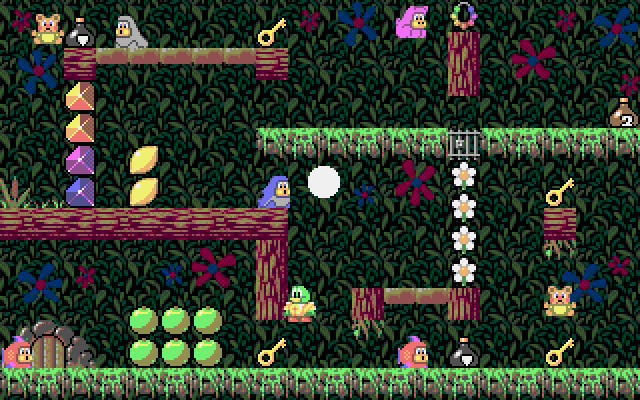
Qwak for the Commodore Amiga ramped up the quality of the graphics and depth in the gameplay.

What inspired the original game, and why did you create it? Why have you regularly ported Qwak to various platforms over the years?
I love making the kind of game that I personally like to play. With Qwak, I guess the combination of skill, puzzles, and problem-solving are what I like. I always thought Qwak was a cool game concept, and something I could improve on and take to the next level. So that’s my excuse for repeatedly making the same game over and over!

Reaction to this latest version of Qwak has been really good. Though most people say it’s not easy, it’s not so hard as to put people off—it’s often described as being ‘challenging’ with ‘one more go’ appeal. In today’s gaming climate, games seem a lot more sedate and easy, and so I guess Qwak’s at the ‘challenging’ end of the spectrum! That’s a good thing though, I hope!

Why did you decide to create a Mac version of Qwak and how did you go about doing so?
Quite a few people asked about a Mac version. I had all the source and assets for the game, so figured it wouldn’t be a big job to port from PC to Mac. It was quite painless in fact—only four weeks from getting my lovely Mac mini to finished product. That was the first time I ever had or used a Mac, and I have to say I’m getting along quite well with Macs so far. So, yeah, in terms of hardware, I just got a Mac mini, and used the official Apple development environment (IDE), Xcode.

qwak3
The Mac OS X conversion is a fast-paced two-player action game.

What are your future plans regarding games? Any plans for an iPhone Qwak?
I’m certainly going to have a play with the iPhone development tools and SDK—they’re already installed on my Mac. Unsure if I’ll do an iPhone version of Qwak, although I am very tempted. I can certainly see myself making more games for the Mac, and will do something for iPhone too, I’m sure.

What advice do you have for anyone considering porting a PC indie game to the Mac?
The main thing, early on, is to make sure you have a network of support. This can be other game developer friends, or game development communities and online forums such as idevgames.com and indiegamer.com. Most people making indie games are quite passionate about that they’re doing and are always happy to give advice. Other than that, dive in and give it a go—the Apple documentation for developers is generally quite good, and the development tools are free.

qwak4
Later levels of Qwak are stacked full of features and foes, and you need quick reactions to survive.

Qwak is available for £12.99 (about $19) from qwak.co.uk; the same site also hosts a free demo that you can download.


Laptop Hunter Parody: Can I Keep the Cash Instead?

By

post-10347-image-f93cf470f4c20ce4faafea24eb1af427-jpg

httpv://www.youtube.com/watch?v=vbJSuduTrPs

To answer Microsoft’s controversial “Laptop Hunter” series, Landline TV parodies the series by sending homeless Frank out to seek a computer. (NB: put your headphones on, some of the language/images are NSFW.)

He loves the Macs (“these are beautiful”), finds the PCs insulting and wants to take the cash instead of getting a PC. Doubt it would ever fly with Apple execs, but it’s a lot more convincing than the latest “Get a Mac” ads.

Via Newton Poetry

WWDC Sells Out in Record Time

By

post-10345-image-faf6f372dbffe51dc58955a4e6bddc08-jpg

Chalk up one more exhibit for the case that Apple and its ecosystem refuse to participate in the global economic meltdown.

WWDC sold out Tuesday, the earliest date on record for which the annual conference devoted to Apple’s development community has reached capacity. Tickets went on sale just a month ago, and were no bargain — even the early-bird special was well over $1,000.

Interest in this year’s event is great for a number of reasons. Developers and presumably the audience at the keynote will get the first public glimpse of OS X 10.6 “Snow Leopard.” The new OS has been in testing with developers for a while now, but many of the expected user interface changes remain under wraps. WWDC may be the first time anyone gets a real look at those.

Even bigger than Snow Leopard, however is the possibility that Apple could unveil a new version of the iPhone, even a touchscreen netbook or tablet. The rumor mill on all of these ideas has been active for months.

And of course there is the ever present shadow of Steve Jobs. Will he make an appearance, even tough he’s not scheduled to return from his sabbatical until the end of June? Could he possibly bear – health permitting – to let someone else introduce a major OS upgrade and potentially game-changing hardware?

The Jobs factor aside, the real takeaway from WWDC’s full house next month is the clear evidence that interest in Apple’s technology remains very strong. The idea that someone could found a career or hit the jackpot on the strength of learning how to develop applications that work with Apple technology seems to be one of the few – and one of the brightest – lights of hope on the economic horizon.