Computing legend and former Apple Fellow Alan Kay has kindly written a detailed note explaining a comment he made at CES, facetiously reported here. Looking for a newsy nugget from Kay’s complex talk, I was trying to make a joke about something profound being revealed at the CES gadget orgy. (“We all thought it was pretty funny too,” said Kay in a separate email).
Kay’s note explains a comment he made about the logical expression NOT BOTH underlying all human thinking.
“What I said was that all human symbol/logical REPRESENTATION systems and all computers past present and future can be made from NOT BOTH,” Kay says.
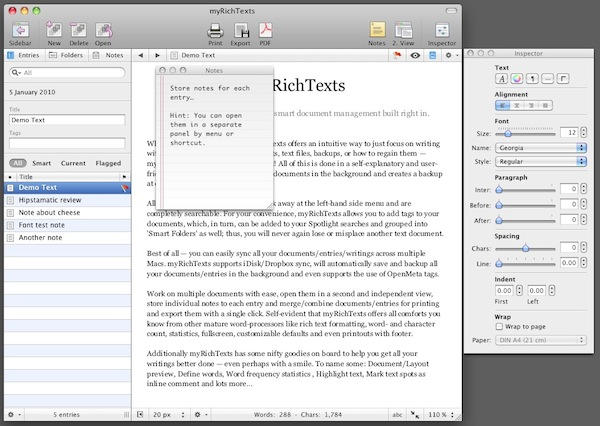
I like electronic notebooks, and I’ve spent a lot of time over the years trying out all the different ones on offer. The latest newcomer is myRichTexts and from what I’ve seen of it so far, I’m quite impressed.
Sometimes you can overdose on all of the iProducts that parade across the screen hoping to capture our attention. Like the iPhone cases made from wood, titanium and everything in between, it can be difficult to find an iProduct that’s original. We wrap up the week with a couple whimsical examples of items that struck our fancy – and maybe yours.
We’ve done iPod docks that double as alarm clocks. Pretty much, you are tempted to hit the ‘snooze’ alarm and go on to the next gadget. But Memorex at least gives its take an intriguing name. Another product that caught our attention is the iBoo Dock for the iPod. The dock and speakers are encased in something akin to a mix of ‘Casper the Friendly Ghost’ and a chocolate drop.
Along the way, we look at other deals, including a 16GB iPod nano for $119 and Airport Extreme router and apps for your iPhone. As always, details on all these and many more bargains can be found after the jump.
If it walks like an App Store and quacks like an App Store, it’ll succeed like an App Store, right? Well, that’s certainly Intel’s hope as it unveils AppUp, a site promoting applications built around the Atom processor for the growing number of netbooks.
The beta version was introduced Thursday, during the first day of CES in Las Vegas. AppUp is a ‘white label’ version of Apple’s App Store, which recently celebrated topping 3 billion downloads for the iPhone and iPod touch. Although Intel introduced AppUp, we’re likely to see customized versions from Dell, Acer, Samsung and other makers of netbooks powered by Intel’s Atom processor.
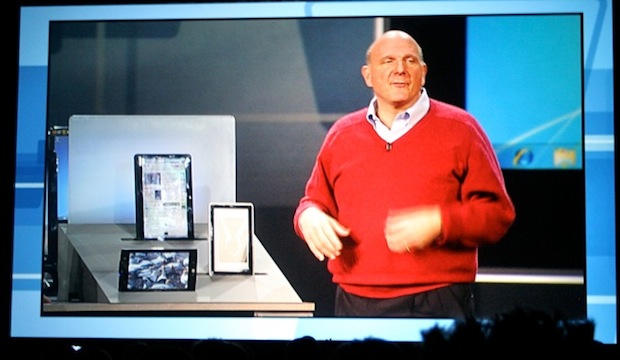
Steve Ballmer at CES 2010 with a prototype tablet from Hewlett-Packard.
Microsoft boss Steve Ballmer offered a very brief glimpse of Hewlett-Packard’s upcoming tablet during his pre-CES keynote on Wednesday night. An appearance by the HP tablet was the most-anticipated part of his keynote because the device will likely go head-to-head with Apple’s upcoming slate, if and when it is released.
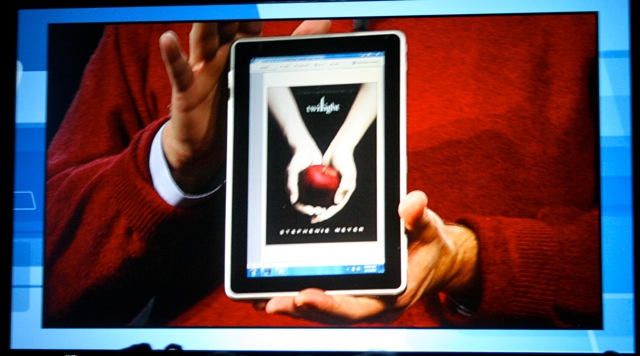
Although it was on stage at the Las Vegas Hilton for only a couple of minutes, the HP Tablet looks thin and polished — hardware wise anyway. Ballmer showed it running Windows 7 and Amazon’s Kindle for the PC software.
“You can flip through pages with your finger,” he said, flipping through pages with his finger. “And you can buy content from Amazon right within the app.”
He then proceeded to show a video running on the tablet, but was briefly frustrated when he couldn’t hit the tiny buttons on screen with his fingers. “Ooops,” he said after trying a couple of times. He eventually got it to play. Microsoft hasn’t yet optimized the tablet’s UI for big chubby fingers.
He didn’t mention the tablet’s name, pricing or ship date. He simply said, “It’s a beautiful little product” and it will be shipping “later this year.”
It appears to have a 10-inch screen and is very thin. It has no visible buttons on the top surface. The HP tablet will be one of the major products from a big-name manufacturer to compete with Apple’s device, which will likely be unveiled at a special media event in San Francisco on January 27.
iHome may have challenged the likes of Bose and Bowers & Wilkins with their iP1, but they haven’t neglected their position as the big boys of the portable-dock space, as evidenced by this trio of updates to their line (no word on pricing yet):
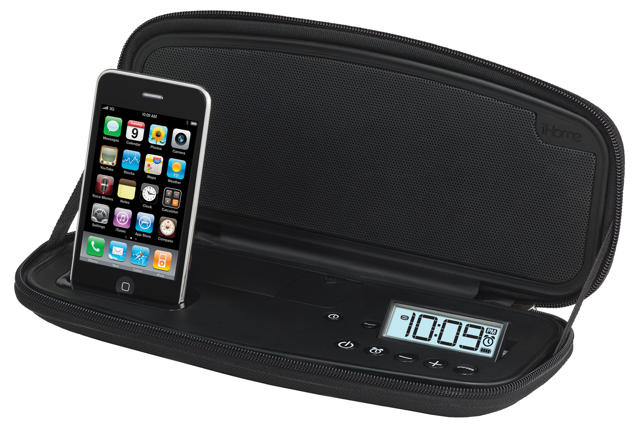
Upper Left: Zipped up, the fabric-covered iP48 alarm dock looks like one of those over-stuffed CD (yeah — remember those?) wallets we used to carry around. Cool feature: the time adjusts automatically just by docking with an iPhone.
Upper Right: An update to the iHM77, iHome says the assegai-like iHM79 speaker set yields improved battery-life and sound. Like their ancestors, the speakers have magnetized bums to keep them together in transit.
Lower Left: The iP1’s Digital Power Station technology trickles down into the high-end, feature-packed iP49 clock-dock. Sound enhancements also include an EQ and neodymium compression drivers (which must mean something to the audiophiles out there). Comes with a remote to control all that tech.
Wired.com reporter Brian Chen demonstrates Microvision's SHOWWX Laser Pico Projector for the TV cameras at CES. The projector is coming to the U.S. in March for about $500. Photo by Dylan Tweney.
LAS VEGAS — Lasers make a big difference for pico projectors, says Microvision, which, coincidentally, is showing off the first laser pico projector made for iPod at CES.
Although pico projectrors are a crowded field, Microvision’s SHOWWX Laser Pico Projector is the first powered by laser, which gives it better color and infinite focus, the company says. Most other pico projectors are powered by LED.
We’ve reached mid-week and the annual gadget nirvana, CES, is set to open in Las Vegas. While you won’t see Google’s “Superphone” or Apple’s much-discussed tablet among today’s list of deals, there are many other chances for striking gold – or platinum, or just a really cool-looking case for your iPhone. We start the day off with a deal on a Curtis iMod iPod player with a 7-inch screen for just $40. Next up: an 80 percent discount on iPod touch cases. We round out the top trio of products with a new batch of freebies from Apple’s App Store, including the NYT crosswords.
For details on these and many other bargains, check out CoM’s “Daily Deals” page after the jump.
Intel’s decision to marry their new mobile Core i5 and i7 CPUs with integrated graphics has reportedly not gone over well with Apple, who are rumored to be demanding custom-designed chips from Intel for an update to their MacBook and MacBook Pro line of notebooks.
But perhaps there’s another solution. Gizmodo noticed that NVIDIA, maker of the MacBook line’s ubiquitous GeForce 9400M GPU, is now teasing a new notebook technology called Optimus that is supposedly capable of achieving the performance of discrete graphics in a notebook while still delivering great battery life.
It’s probably just scalable performance, but if the Optimus tech is as good as NVIDIA is bragging, it would allow Apple to ditch the substandard switchable GPU configuration of current unibody MacBook Pros, which requires a reboot, to a discrete-only solution, like the earliest MacBook Pros and PowerBooks.