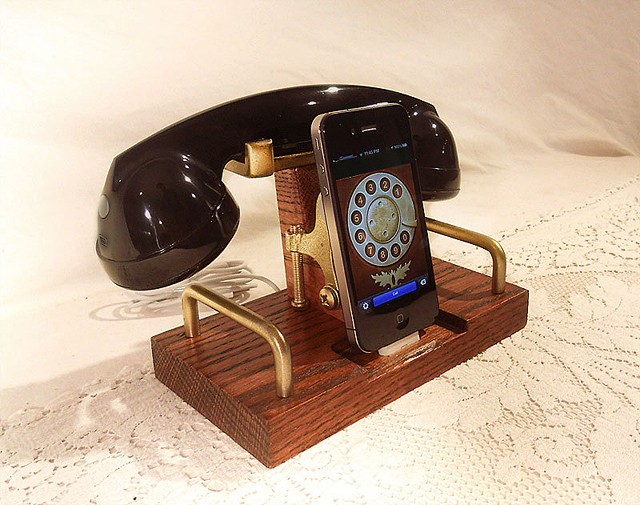
If you love the convenience of your iPhone but miss having a large slab of bakelite on your shoulder while gabbing, your angst is over. This retro-style dock marries a polished oak and brass base, an iPhone dock, and a bluetooth-equipped handset to allow you to experience a century of telecommunications in one fell swoop.
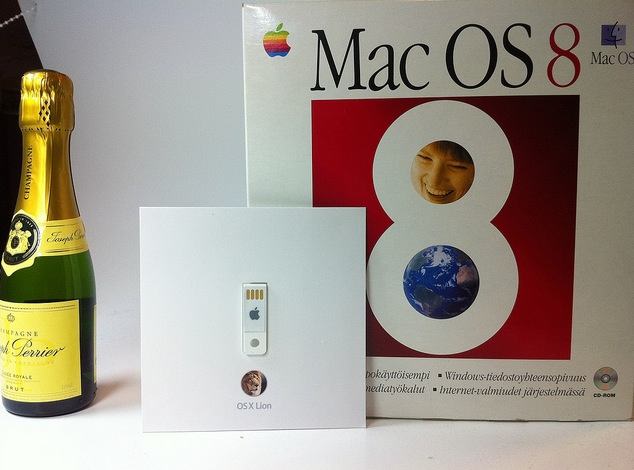
On the right, Mac OS 8 on CD-ROM, packaged in its huge cardboard box. Vintage 1997 stuff. In the centre, today’s diminutive Lion USB stick – which you don’t even have to use if you download direct from the Mac App Store. And on the left, a bottle of champagne, adding suitably classy balance to the whole scene.
If you have a great photo of your smart Apple stuff – retro or modern or both together – and you’d like to share it with your fellow Cult of Mac readers, do send it in: [email protected]
I love the Internet Archive, it’s one of the best online projects there’s ever been.
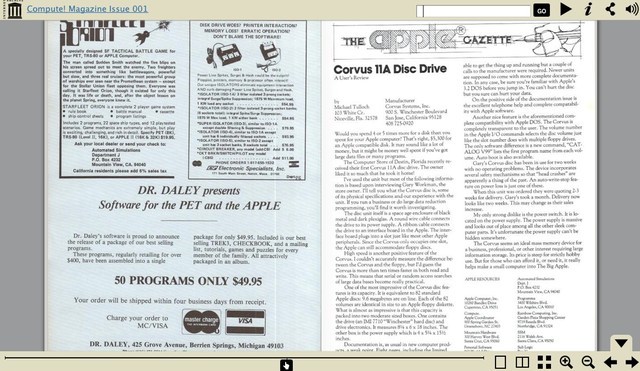
I knew it archived a lot of stuff, but until this week I had no idea that the collection included scanned magazines of old. Jason Scott, of textfiles.com fame, now works for the Archive and wrote a blog post about some of the latest additions – dozens of tech magazines from the dawn of personal computing.
At first glance, you won’t see anything Mac-specific on the list. But you need to delve a little deeper. Remember, in those days Apple was just one of dozens of new arrivals, all of them jostling for position in a brand new consumer market.
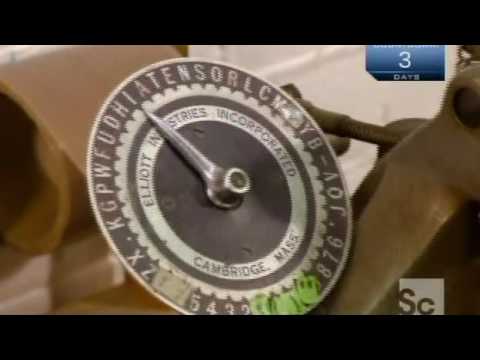
I love this little mini-episode of How It’s Made. It takes an almost antediluvian bit of tech — rolls for automated player pianos — and then shows how two Apple computers almost as ancient help make them.
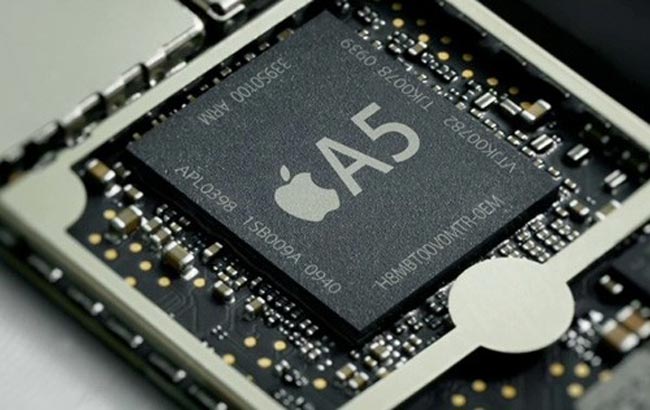
Apple has built the majority of its modern day fortunes upon the back of the low-voltage ARM chipset. Ever since the first iPhone, ARM chips have driven Apple’s biggest and best-selling products. Thanks to the success of iOS, which only runs on ARM, the futures of Apple and ARM are so intertwined that Cupertino now designs its own custom specced ARM chips.
Given how forward thinking Apple is, it probably wouldn’t surprise you to hear that the Mac maker once bought a 43% stake in ARM back in the early 1990s. What probably would surprise, you, though, is that Apple sold that stake at a loss… and that sale saved the company from total bankruptcy.
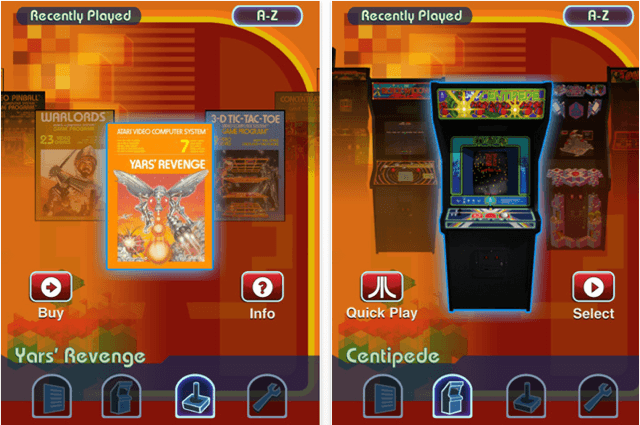
Retro gamers can now enjoy 100 classic Atari titles on their iOS devices thanks to the launch of Atari’s Greatest Hits. The application is a free download that comes bundled with Pong, and through in-app purchases users can download additional game packs at $0.99 each, or the entire collection of 100 games for $14.99.
The collection of classic hits includes 18 Atari arcade games and 92 Atari 2600 games. But the fun doesn’t stop there; the app also boasts head-to-head multiplayer over Bluetooth and original cabinet and box art.
Check out the entire list of games available – and those that support Bluetooth multiplayer – after the break.
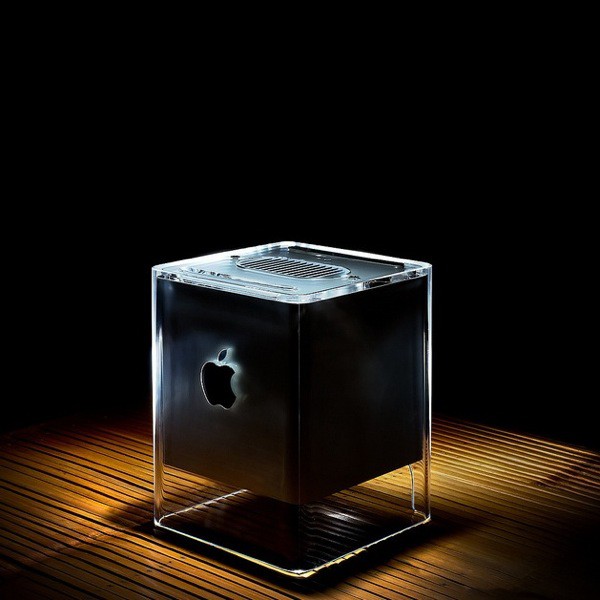
Feast your eyes on this gorgeous combination of old and new, as photographed and (at least in part) brought bang up-to-date by Pedro Moura Pinheiro.
It’s an original Power Mac G4 Cube, circa 2000, but with a few modifications to its insides. The original 450MHz G4 processor and 256MB of RAM have been replaced with dual G4 chips and 1.5GB of RAM. Those changes were made by its original owner, but Pedro wanted to take things a step further when he bought the machine. It’s now zippy enough to run Photoshop CS4 without any trouble.
Pedro says: “The only thing I did was get an Intel 40GB SSD, place it in an external Firewire 400 enclosure, and install Leopard on it – basically, Firewire 400 is much faster than the internal IDE interface, so the speed benefit is greater than trying to install an IDE SSD inside the Cube.”
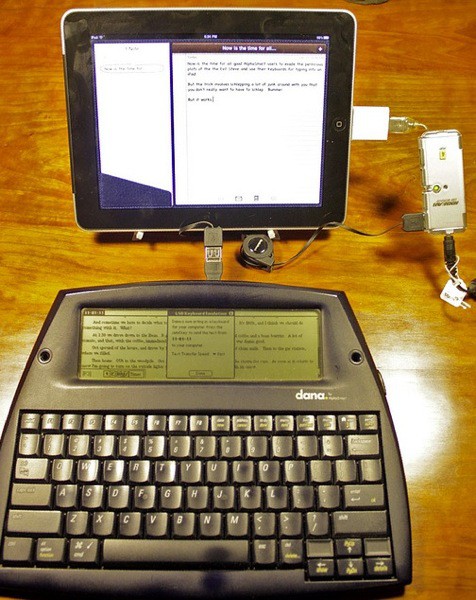
The keyboard you see here is something called an Alphasmart Dana – a somewhat niche tech product, but one much loved by a small band of users (myself included). Some professional writers love it for its weeks-long battery life, instant-on, auto-save, and durable shell.
Smoking Apples has published a lovely post extolling the virtues of an ancient iBook G4, which given a little TLC and a wipe-and-install has been reborn as a perfectly functional household computer.
Valve Software’s transcendent physics and teleportation puzzler Portal already runs sublimely through Steam for Mac… as long as you have a modern MacBook Pro or iMac. But what if Portal wasn’t a modern game, but a classic Macintosh text adventure? This brilliant mock ad re-imagines Portal as a lost game rediscovered through a lost Saturday morning advertisement, complete with an appearance by a badly puppeted GlaDOS. Brilliant… although that green text really looks more at place on an Apple II, don’t you think?
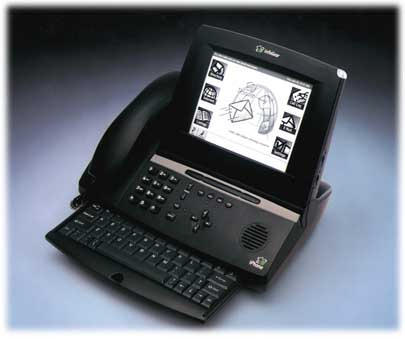
Google’s 2001 retro-search tool has provided endless amusement over the past few weeks. None so much as the image at right, which is the “iPhone 2,” released by InfoTech in mid-1999 and reviewed on StreetTech by Gareth Branwyn.
And yes, it was a comical Internet landline phone, featuring full QWERTY keyboard. Like today’s iPhone 3G, it featured a touchscreen, Internet access, e-mail, and location-based services. Also like today’s iPhone 3G, it improved on significant shortcomings in its predecessor, by adding a better keyboard, higher data speed, and better speaker-phone sound quality.
And, eeriest of all, it had notable areas that needed improving. There was no “Forward” browser button, no “Find” function, and, hilariously, no Cut, Copy, or Paste features. In many ways, it’s exactly like today’s iPhone. Just, you know, totally janky.