Sell it as soon as you can! The longer that Mac sits unused, the lower its price will be when you finally sell it. I’ve personally made that mistake several times, sitting on a used Mac for months (or even years) before finally getting around to listing it. It’s not a pleasant realization that your procrastination lost you hundreds or thousands of dollars.
Shawn Morton has published a very handy howto for converting a classic Mac into a bog roll dispenser, or Apple iWipe. Now that’s time well spent.
One of my co-workers was giving away and old Atari 800XL and Macintosh SE case. He had been planning to do a mini-ITX project, but had never gotten around to it. Always wanting an excuse to tinker with something, I decided to take them off of his hands.
Well, as soon as I saw the Mac SE case, I realized that this one had the most potential. So this weekend, I bought a few things at Home Depot and got started making my Apple-power, wireless, portable toilet paper dispenser — the iWipe.
The whole project took a couple of hours and cost about $15.
Mark Williams, a programmer from Nottingham, UK, had dreams of hitting the big time by designing and selling an iPod case that “isn’t a glorified condom.”
This morning I could hardly contain, cough cough, my excitement as I get the box of samples. I open it up to reveal about a 100 solid perspex cubes containing chinese figurines dressed up as a western bride and groom. WTFF?
You COULD NOT make this stuff up. Its like a sitcom – Carry on manufacturing. Mix up at the depot you say, stickers on the wrong boxes you say. Hmm. I feel sorry for the person who was expecting their kitsch loveliness and instead gets a box of tri-colored vaginas.
Coming soon: the iLoad, a gizmo for loading CDs right onto the iPod. There’s no details except the promise it’s “coming soon” and this:
iLoad copies your CDs onto and iPod or other Digital Music Player, along with all album and track data at a high rate of speed.
The site says the “iLoad” trademark is owned by Wingspan Partners of Campbell, CA, which claims to be also working on a MagLev train between Los Angeles and Las Vegas!
I wonder why anyone would want a CD loader when the computer already does a pretty good job ripping CDs. And where will the track data come from? ITunes goes online to fetch them; will this?
Behold the i-Stones, a pair of stone iPod docking stations.
Sold by Brand Incubator of Japan, the i-Stones come in two models: Wabi and Sabi. They feature USB 2; audio and S-Video out.
Wabi-sabi, according to Wikipedia, “represents a comprehensive Japanese world view or aesthetic.”
It is difficult to explain wabi-sabi in Western terms, but the aesthetic is sometimes described as one of beauty that is imperfect, impermanent, or incomplete. A concept derived from the Buddhist assertion of the first noble truth – Dukkha.
… Many Japanese arts over the past thousand years have been influenced by Zen philosophy, particularly acceptance and contemplation of the imperfection, constant flux, and impermanence of all things. Such arts can exemplify a wabi-sabi aesthetic.
Recognizing the diversity of new distribution channels, the Daytime Emmys are about to announce a new award for video aired on computers, cellphones and video iPods, reports the New York Times.
The National Academy of Television Arts and Sciences, best known for handing out the Daytime Emmy Awards, is expected to announce on Tuesday that it has created an award category to recognize original video content for computers, cellphones and other hand-held devices, like the video iPod and PlayStation Portable.
The category is to have its debut at the academy’s next Sports Emmys presentation, and ultimately be added as a category for other Emmy presentations as well, including those for news and documentary, business and financial reporting and daytime television. The category will not be included in the prime-time Emmy Awards, which are overseen by a sister organization.
It’s the first test by a respected testing lab I’m aware of. All went smoothly and ZDNet was impressed.
Mac OS X looks in amazingly good early form on the x86 platform. As far as power consumption and OS performance are concerned, it can already keep up with Windows XP. Application performance clearly lags behind, though, and still needs to improve.
…
So far, mainly because of performance and price issues, the Apple platform has failed to tempt many Windows users. This could change soon: from the middle of next year, a Mac OS X x86 platform will be available, which will offer more performance to the Windows world.
This is clearly a quick fix in the run-up to Christmas.
Says another iLounge poster:
I love Apple and I love my nano… But it seems this is sort of a lame attempt to admit guilt, well… maybe not guilt, but neglect on their part for not including a case with nanos to begin with. At the same time, no press release / news has been made about now including cases… Sneaky.
Let’s at least five them the benefit of the doubt that they’ll handle this properly and offer something to those who bought nanos already.
Sony’s copy-protected CDs — the ones that secretly install a sneaky Hax0r “root kit” on customers’ PCs — can also install copy-protection software on Macs, according to a Macintouch report:
… I was surprised to find a “Start.app” Mac application in addition to the expected Windows-related files. Running this app brings up a long legal agreement, clicking Continue prompts you for your username/password (uh-oh!), and then promptly exits. Digging around a bit, I find that Start.app actually installs 2 files: PhoenixNub1.kext and PhoenixNub12.kext.
Personally, I’m not a big fan of anyone installing kernel extensions on my Mac. In Sony’s defense, upon closer reading of the EULA, they essentially tell you that they will be installing software.
The Nimzy Vibro Blaster is an unfortunately named “vibrator” that turns any flat object into a speaker.
Developed by Digital Infotech of Singapore, the Nimzy Vibro Blaster transforms audio from an iPod or other gizmo into mechanical vibrations. Placed on a flat surface — wood, stone, glass or plastic — the company claims its “advanced electro acoustic technology” sounds “loud and clear!”
A wonderfully cheery e-mail from the company’s new US marketing operation in Plantation, Florida, proclaimed:
Believe it or not, no more bulky speakers, any flat object can become one…
Owners of IPODs or any other MP3 players can use Vibro Blaster to share their favorite music anytime, anywhere; Business executives can travel with this compact toy to do presentations with audio from laptop. Hence they become more convincing to the audience; bored in hotel room, travelers can enjoy their own music while conducting multiple tasks, most importantly, hear the phone ring!
Once again, Digital Infotech Inc brings more fun to life and work with innovative technology.
Here’s a link to the only product page I could find. Warning: the page makes a horrible racket.
The Camino project has released the first full version of its highly-regarded “Firefox-for-Mac” web browser.
Though still a beta, the Camino 1.0 browser boasts a giant laundry list of improvements and additions, including vastly improved tabs; Spotlight search through bookmarks; and support for Midas, an inline, rich text editor.
Based on the recently-updated 1.5 version of Firefox 1.8 version of the Gecko rendering engine, Camino always had a reputation for speed. I used the previous alpha version but it never really grabbed me. It seemed incomplete compared to Firefox. I shall, however, definitely give the new version a test drive. After all, Camino claims to blend the best of the Mac and Mozilla:
Camino combines the awesome visual and behavioral experience that has been central to the Macintosh philosophy with powerful web-browsing capabilities such as the Mozilla Gecko rendering engine.
Update: Chris Lawson writes: “Camino is no more based on Firefox 1.5 than Netscape 7 is. Both Camino and Firefox use the 1.8 version of the Gecko rendering engine for their core HTML rendering. (At least you didn’t make the mistake of saying it’s based on WebKit, which I’ve also seen out there.)
Author Jackie Huba just bought a PowerBook after 20 years of being a PC user, and she’s so psyched about it, she made a pseudo Switch ad.
As you can see, she’s already a Mac zealot. Welcome to the cult, Jackie!
Jackie is also co-author of Creating Customer Evangelists, a word-of-mouth marketing book, and the Church of the Customer blog, which is “all about word of mouth, customer evangelism and citizen marketers.”
The next version of Motorola’s stylish RAZR phone, the RAZR V3i, will come equipped with Apple’s iTunes software.
The V3i is the second Moto phone to carry iTunes. Like its predecessor, the ROKR (dubbed the CROCKR because of its limitations), it will likely be limited to 100 songs maximum.
If Apple and Motorola are serious about phones as a digital music player, they need to shape up fast. Thanks to a single-chip design, Nokia is able to push today’s high-end Symbian smartphones down into the midrange next year, and features like WiFi are standard across next year’s N series and E series models. More importantly, Nokia is determined to allow users to share their songs and playlists over a personal area network connection using WiFi or Bluetooth – something that Apple is extremely reluctant to do. As the cheeky graphic nicely illustrates.
The French site MacBidouille has detailed step-by-step instructions for souping-up a 12-inch iBook and turning it into a something comparable to the 12-inch PowerBook — at a considerable saving.
It requires disassembing the iBook, swapping out the optical drive and hard drive, and adding Bluetooth and a ton of RAM. It takes a couple of hours, and “this transformation is not a piece of cake,” but:
All parts including the iBook have been purchased for 1,598 euros VAT included. To compare, the same iBook 80GB 5400rpm without the SuperDrive costs : 1,677.99 euros VAT included and the PB 12″ Superdrive 1.2 GB with 80 GB 5400rpm : 2,168 euros VAT included.
Steve Jobs is a money machine. His other company, Pixar, reported profits of $27.4 million on revenues of $45.8 million for the last three months — double Wall Street estimates, according to Reuters.
The windfall was due to strong home video sales of Finding Nemo, as well as lower taxes and “a one-time reduction in expenses.”
In a separate AP report, Jobs said Pixar was “deep in discussions” with Disney, and may strike a partnership by year’s end.
Meanwhile, Pixar has amassed a huge horde of cash, which will likely be used to finance future flicks:
Pixar has said that it would like to own 100 percent of its films in the future. The company has amassed cash of more than $1 billion as it prepares to fully finance its own films.
For the first nine months of the year, Pixar reported net income of $122 million, or 99 cents per share, compared with $86.5 million, or 73 cents per share in the same period last year.
Revenue for the first nine months was $233.5 million compared with $165 million in the same period last year.
Two more TV networks will begin offering primetime shows on demand for a buck a pop, but not through iTunes online store, reports Reuters, because of fears of digital piracy.
“NBC and CBS unveiled separate plans on Monday to make some of their hottest prime-time shows available for viewers to watch at their leisure — without commercials — for 99 cents an episode, throwing open the door to “on-demand” television,” the Reuters report says.
NBC will offer “Law & Order SVU” and “Criminal Intent,” “The Office,” and the cable show “Battlestar Galactica” to viewers with a DirecTV Plus DVR.
Likewise, CBS will offers four hit shows on demand — “CSI,” “NCIS,” “Survivor” and “The Amazing Race” — to Comcast digital cable customers in various cities.
Both platforms are pretty well locked down, with no easy way for owners to get video off the settop boxes and onto file-sharing networks.
In a seperate Reuters report, NBC said it will offer movies and hit shows online only when watertight copy-protection mechanisms are in place.
“We can’t provide them (Google, yahoo and presumably Apple) with content unless they can adequately protect it,” said NBC Universal Chairman Bob Wright.
“Our streets are filled with loads of high quality content for your iPod including movies, television programs, music videos and of course music. All video is encoded in iPod compatible formats (H.264, MP4, M4V) so you do not need to bother with conversion.”
So far, the offerings are fairly thin: a dozen TV shows, half-a-dozen movies (including Pixar’s Finding Nemo — Steve Jobs isn’t going to like that), and a handful of music CDs.
However, there are dozens of music videos. It looks like people who’ve bought Apple’s $2 music videos through iTunes, which are pre-formatted for the iPod, are uploading them to BitTorrent.
Of course, BitTorrent is highly trackable. Use at your own risk, and karma.
At a reunion of the legendary Homebrew Computer Club at the weekend, Apple co-founder Steve Wozniak recalled his hack0r early days with Steve Jobs. Reports CNet:
“… Wozniak related a story about figuring out how he and fellow Apple co-founder Steve Jobs had broken into the digital user group account of John Draper–the inventor of the blue box, a device that allowed its user to make illegal free long-distance calls from any phone.
“We found his resume,” Wozniak remembered, “and we were going to add something about his arrests, but we didn’t.”
Lugz footwear has sent Apple a legal cease-and-desist letter ordering it to pull the new Eminem iPod ad because of “disturbing” similarities to a 2002 Lugz spot called “Arrow,” according to AdWeek.
Larry Schwartz, evp and a principal of New York-based JSSI, which makes Lugz, said in a statement, “If you look at these spots, common sense would tell you that there’s a problem here. The Apple commercial uses the most powerful elements of our campaign, making the ads disturbingly similar. We are prepared to vigorously pursue all legal remedies in order to protect our rights.”
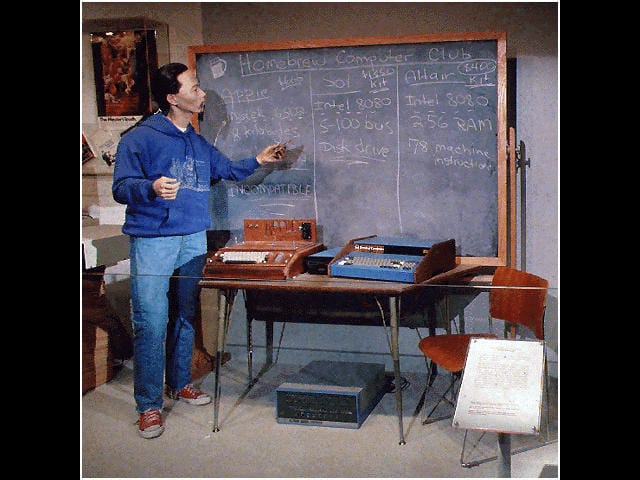
Apple I nerds may be interested in a Homebrew Computer Club retrospective at the Vintage Computer Festival this weekend in Mountain View, California. Apple cofounder Steve Wozniak will be there, as will several other Homebrewers.
“The VCF in conjunction with the DigiBarn Computer Museum is proud to
present a 30th anniversary celebration of the founding of the Homebrew Computer Club, the legendary Silicon Valley institution that helped to launch the era of the personal computer. Bruce Damer of the DigiBarn Computer Museum will moderate this panel of former Homebrew members, including Steve Wozniak, Lee Felsenstein, Allen Baum, Len Shustek, Bob Lash and Michael Holley.
Join the panel as they recount their experiences and gab with the group as we feast on some yummy cake, courtesy of the DigiBarn.”
The Festival is at the Computer History Museum in Mountain View. Doors open 9:30am until 6:00pm; full exhibit is $12 per person per day; $7 per person per day for exhibit and marketplace only. Kids under 17 are free.