Treo-maker Palm has unveiled the Palm Software Store, the latest company to take a page from Apple’s successful iPhone Apps Store.
The new store allows Palm device owners to purchase and download either Windows Mobile or Palm applications directly to handsets. Palm users were required to download applications to a computer first and then transfer the software.
Apple said trade shows, such as Macworld Expo, are a “very minor part” of how the company reaches customers. Instead 3.5 million Apple fans stream into Apple stores each week.
Macworld had been used as a platform to interact with developers and a way to talk to the press. However, Apple has created its own developer conferences and spread product announcement throughout the year to guarantee almost continuous press attention.
“So why pay IDG and be subject to its event requirements,” asked Apple analyst Avi Greengart of Current Analysis. “This will definitely weaken Macworld going forward.”
There may be a silver lining in Apple’s announcement it won’t attend future Macworld Expo trade shows. Despite the downgrades and talk of CEO succession planning, one analyst says Apple can only benefit from Tuesday’s decision.
“I see this as a major boon for investors, rather than a bust,” independent Apple analyst Andy Zaky said in an e-mail to Cult of Mac.
Only traders wishing to manipulate Apple stock through rumors and speculation could be hurt, according to Zaky.
Since 2007, Macworld events have seen “massive selling in Apple’s stock,” he said. In fact, every Apple media event has resulted in a drop in stock prices.
Was 2008 the last Macworld appearance for Apple CEO Steve Jobs?
Despite Apple’s attempt to convince investors otherwise, Oppenheimer & Co. told clients new questions about CEO Steve Jobs’ health made the Cupertino, Calif. company a risky long-term bet.
The investment house downgraded Apple’s stock to “perform” from “outperform” following Tuesday’s announcement Jobs would not appear as keynote speaker at the Macworld 2009 tradeshow – the last year Apple would attend the annual event.
“Whatever the reason, the unexpected announcement has underscored the greatest risk to Apple’s long-term success — its dependence on Jobs’ health and its apparent lack of a succession plan,” analyst Yair Reiner wrote investors.
Every time I say this, some people start getting all shirty and saying: “Yes it is! Steve matters!”
After my Don’t Panic post yesterday, there were similar comments, like this one: “Yeah, actually Steve Jobs health is our business. He made Apple, he revived Apple and he brought Apple to it’s current massive success. Steve Jobs IS Apple. Without him the company has a far smaller chance of survival.”
I completely disagree with this line of thinking, and here’s why:
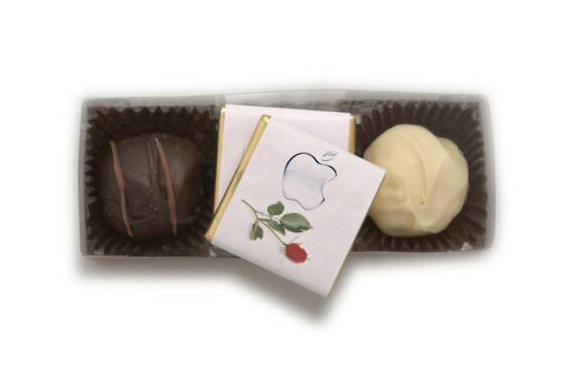
Eating just one Belgian truffle can make you “significantly more likely” to desire a Mac than your more self-controlled neighbor, according to a study due to be published in the Journal of Consumer Research.
Professors Juliano Laran (University of Miami) and Chris Janiszewski (University of Florida) conducted a two part study in which one group of participants was given a chocolate truffle, while the other group was required to abstain. In part one of the study, the researchers found, not surprisingly, the group of truffle eaters was more likely than their pleasure-restricted peers to to unleash a “what the hell” syndrome, and revealed a desire for additional treats such as pizza, ice cream and potato chips, while their abstaining counterparts found it easier to resist temptation.
Part two of the study again had people eat or resist a chocolate truffle and asked them to indicate how much they desired several products that are symbols of status [for example] an Apple computer… “People who ate the truffle desired the status products significantly more than those who had to resist the truffle,” write Laran and Janiszewski.
The answer to Apple’s flat Mac sales, then, would appear to be free truffles for every visitor to an Apple Retail Store. Someone get an advance abstract of Behavioral Consistency and Inconsistency in the Resolution of Goal Conflict to Cupertino, stat!
Not literally, mind. From the delightful Peter Serafinowicz Show Christmas Special, uploaded to YouTube this evening. The demonstration of the comma is amazing, but you wouldn’t believe what it takes to make a semi-colon.
Apple doesn’t sell its own iPhone 3G mobile devices on its web store, but you can now get both new and refurbished 3G models online through AT&T. Following last week’s quiet launch of on-line sales for new 3Gs, AT&T began Tuesday also offering refurbished units at $150 for the 8GB model, while both the black and white 16GB models sell for $250. As with new units, purchase of the refurbished phones requires the buyer to sign a two year service contract with AT&T.
Politics, not platelets, are why Steve Jobs is turning over the Keynote responsibility to Phil Schiller at next month’s Macworld Conference & Expo, according to CNBC correspondent Jim Goldman.
Citing “sources inside the company,” Goldman writes that Jobs’ demurral from the Keynote address for Apple’s last appearance at the venerable trade show in San Francisco is assuredly not a product of any inability on his part to perform for health reasons, but is rather a result of the company’s “trying to separate itself from Macworld for some time.” Amid the growing trend of big companies scaling back participation in traditional trade shows world wide, Apple has also in recent years taken the lead in producing its own product release events, such as the ones that introduced the company’s new iPods this summer and new notebook computers in the fall.
Apple also directly reaches millions of visitors who come weekly to its growing chain of world-wide retail stores, and millions more who receive the company’s carefully designed and controlled messaging through visits to the company’s iTunes stores.
Knowing how the Apple-interested universe’s collective pulse begins to race with every inkling of Jobs’ mortality, it’s no surprise to see Monday’s announcement generate lots of speculation and extra volatility in the movement of the company’s stock price. As Goldman writes, however, the party to be concerned about is not Jobs, and not Apple, but Macworld. For some time now it’s been fashionable to imagine scenarios about Apple in the inevitable post-Jobs era. But will there even be a Macworld in the post-Apple era?
Apple’s decision not to attend Macworld might mean any of the following:
– Yeah, maybe Steve Jobs is really ill. It’s none of our business, though
– Apple no longer wishes to indulge the trade show industry
– Apple would rather present stuff on its own agenda, to its own timetable, when there is stuff ready to present. And if it wishes to hire a big room in which to do so, it will certainly have the money to do that
– Perhaps, given the success of the iPhone, Apple would rather devote its energies to publicising and marketing the iPhone and the App Store
What Apple’s decision not to attend Macworld might NOT mean:
– All of the above
– Any other speculation you read elsewhere today
Meanwhile, keep injecting the rumor sites if that’s what grabs you. New Mac minis! Some kind of netbook! iPhones on skis! Yeah yeah yeah; it’s all just hot air and page impressions until Phil Schiller stands on that stage. And even after that, it’ll mostly be page impressions.
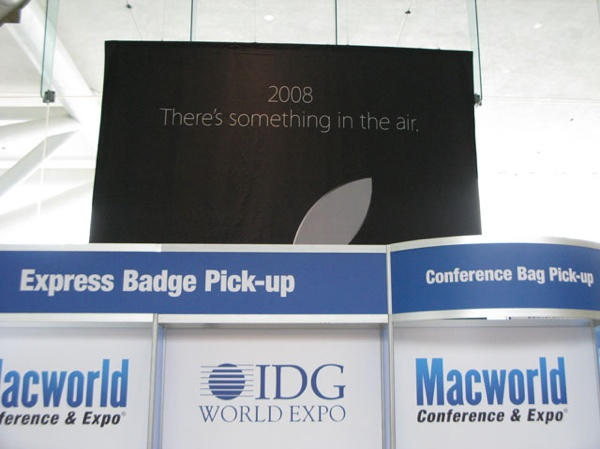
Apple today announced that 2009 will be the last year the company exhibits at Macworld Expo.
Citing the declining efficacy of reaching its audience through participation in trade shows, the company issued a press release indicating Philip Schiller, Apple’s senior vice president of Worldwide Product Marketing, will deliver the opening keynote for this year’s Macworld Conference & Expo. Schiller’s will be Apple’s last keynote at the show, which held its debut event in 1985.
The keynote address will be held at Moscone West on Tuesday, January 6, 2009 at 9:00 a.m. Macworld will be held at San Francisco’s Moscone Center January 5-9, 2009.
With the increasing popularity of Apple’s Retail Stores, which more than 3.5 million people visit every week, and the Apple.com website, the company is able to directly reach more than a hundred million customers around the world in ways a trade show could never hope to.
Apple has been steadily scaling back on trade shows in recent years, including NAB, Macworld New York, Macworld Tokyo and Apple Expo in Paris.
Nearly 70 percent of companies say they will permit employees to use Macs in the workplace – double the number just 8 months ago, a survey found.
Macs “could very well represent a viable alternative to PCs” in companies, Laura DiDio, principal analyst of the Boston-based Information Technology Intelligence Corporation.
A survey of businesses found the top reason was the “consumerization of IT,” followed by the increased availability of Windows applications through Boot Camp and other virtualization.
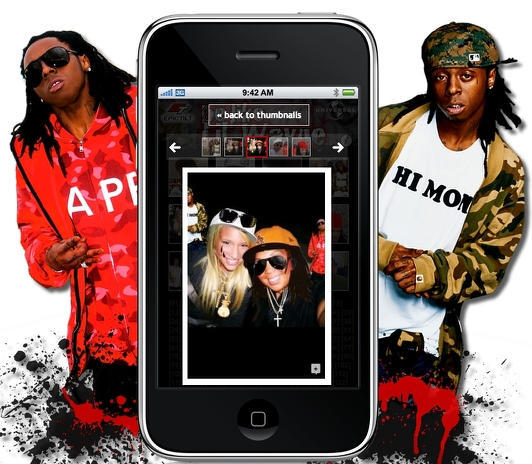
Rapper Lil’ Wayne recently launched an iPhone, iPod touch app designed to give fans a taste of what it’s like to be him.
Well, what it means to look a little like 25-year-old Dwayne Carter, or to paraphrase the old cosmetics slogan: “You, only blinger.”
The app developed by Lil’ Wayne and his record company Universal Music, comes from epictilt, the makers of iPhone app ESPN Cameraman.
The Lil’ Wayne app adds gold jewelry, his trademark teardrop tats and oversized hats to your pics. If you’re unsure you want to pop $0.99 for it on iTunes, you can check out a photo gallery here. The app allows fans to check out other Wayne-ified photos and buy his music.
One guarantee: you get to look fierce but avoid Lil Wayne’s real-life arrests with corresponding mug shots.
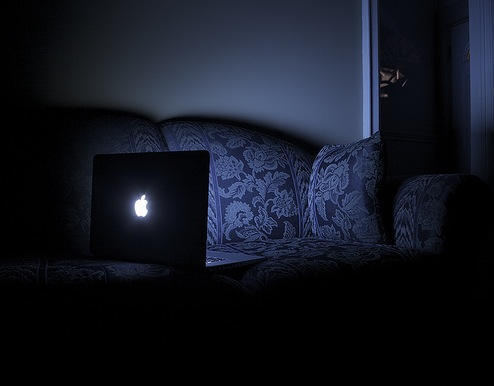
This post is entirely about MacBooks on sofas. Or couches. Or settees. Or whatever it is you call them in your house. In our house, they are sofas. Anyway. Here are some more pictures of MacBooks on sofas. If you have your own pictures of MacBooks on sofas to contribute, please do let us know in the comments.
Steven’s picture is by far the best, the most MacBook-plus-sofary picture we’ve seen. But there are more…
Amazon MP3, the DRM-free digital music store, is far from a rival to Apple’s iTunes, claims a Tuesday report. The MP3 arm of online retail giant Amazon.com has only 5 percent to 10 percent of the market, compared to more than 70 percent for iTunes, according to All Things Digital.
The report’s estimate cited an unnamed label executive.
The one year-old MP3 store “has failed miserably” as a rival to iTunes, Peter Kafka wrote. Amazon earned $39 million on $82 million in sales – the bulk going to Universal Music Group, the report suggested.
The faltering economy has caught up with Mac desktop sales. Sales of Apple desktop computers fell 38 percent in November, according to retail research firm NPD.
The figure compares to a 15 percent drop in U.S. sales of Windows desktop PCs and a 20 percent domestic cut for overall desktop sales during the past month.
Mac U.S. sales were flat in November, falling 1 percent as PC sales grew 2 percent, according to NPD. The numbers appear to reflect a consumer spending tightening and Apple’s reluctance to shift from premium prices.
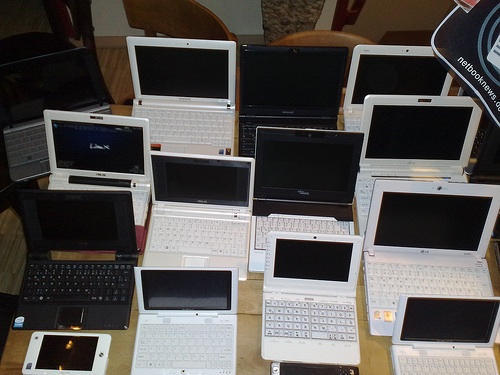
Apple will unveil two netbooks at the upcoming Macworld Expo in response to the gloomy economy, an analyst predicted Tuesday. The devices would likely follow the path of iPhones’ dependence on the App Store and iTunes.
Ezra Gottheil, analyst with Technology Business Research Inc., believe Apple will introduce two low-priced computers at the January tradeshow, according to Computerworld Tuesday. The crumbling economy and growing consumer interest in netbooks is cited as spurring expected decision.
“It looks like netbooks are real, and getting a certain amount of traction,” the analyst told the publication. The netbook category grew 160 percent during the third quarter, DisplayResearch announced last week. Apple was described as the “lone exception” to computer makers entering the segment.
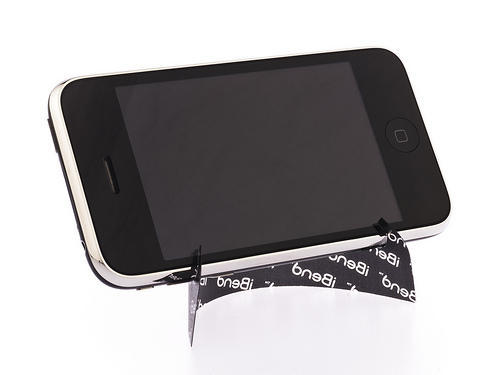
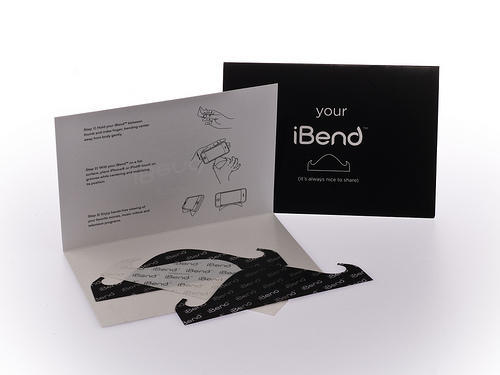
iBend marketing materials call it “the thinnest stand for the iPhone and iPod Touch.”
$5 gets you what appears to be two pieces of plastic or maybe laminated card stock (the website doesn’t say) cut in such a way they could be mistaken for “Snidely Whiplash”-style fake mustaches, but that, when “bent” just so, will hold your device in place on any flat surface so you can look at it (and the video or slideshow you’re watching on it) without having to hold it in your hand. The iBend is thin enough to fit in your wallet, pocket or purse.
iBend is patent-pending and manufactured in California.
Apple released the 10.5.6 update to Leopard on Monday with a feature that makes it impossible to jailbreak and/or unlock an iPhone or iPod Touch using PwnageTool or QuickPwn, according to a report at iPhoneAlley.
Blogger Erica Sadun explains in more detail that engineers at Apple propagated to all 10.5.6 loaded Mac systems USB kexts (kernel extensions) that prevent a Mac from recognizing an iPhone or iPod in Device Firmware Update mode, a high level communication protocol used for firmware restores among other things.
The battle between Cupertino and a dedicated band of Apple users who believe the company’s mobile platform should be opened for general use and development outside the limitations of the AppStore has been going on since the original iPhone was unlocked weeks after its initial release in June 2007. Subsequent updates to the mobile firmware have ben decoded within days of their release.
Many, though not all users who jailbreak/unlock their iPhones do so to enable them to operate on cellular telephone networks other than AT&T, the exclusive authorized service provider in the US. Others see the advantage of an unlocked phone that can run software developed for it that has not otherwise been approved by Apple for sale and distribution in the iTunes AppStore.
Sadun confirmed with sources inside Apple that the current roadblock to unlocking efforts was deliberate and both she and iPhoneAlley suggested those wanting to operate jailbroken iPhones and iPod Touches ought to wait to install the 10.5.6 update on their Macs until developers working to maintain the open mobile platform have devised a workaround.
One possible avenue around the DFU mode restriction has been suggested by Phone developer Steven Troughton-Smith, who told Sadun the problem relates to devices plugged directly to Macs. He relates that DFU mode can be used with a unit connected via a hub and can be pwned as normal, even with the 10.5.6 update.
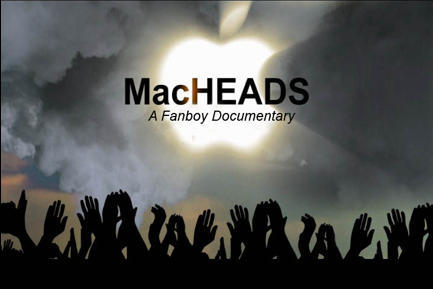
Chimp 65 Productions announced Monday the premiere of its documentary film “MacHEADS The Movie” at the 2009 Macworld Conference & Expo. The attendees-only special screening is scheduled for Wednesday, January 7, in room 131 of the North Hall of San Francisco’s Moscone Center.
MacHEADS is an in-depth examination of the cultural phenomenon of Apple fandom, using events from Steve Jobs’s historic Keynote addresses, the iPhone’s first release in NYC, and other historic moments in recent Apple history to explore the loyalty of Apple followers and their obsession. The film also combines visual evidence from archives of early Macworld Expos.
“Two years after shooting the first reel at Macworld 2007, we’ve come full circle with this special premiere at the leading event of the Mac community,” says producer Ron Shely. “Macworld Expo & Conference 2009 is truly the natural place for telling the story of Apple and its followers. We are thrilled to screen the movie at the Moscone Center a place of tradition and innovation.”
Director Kobi Shely added, “We wanted to answer the core questions: ‘How was a community formed around a brand, and how did this phenomenon contribute to Apple’s success? During the film-making process, it became obvious that there is a community and there is Apple. Although they correlate, in many ways they are separated.”
The film features several key Mac personalities in the company-community ecosystem, including one-time Apple Chief Evangelist Guy Kawasaki; Apple’s first official employee Daniel Kottke; and a special guest appearance by Apple co-founder Steve Wozniak. Authors including Adam Engst, who created the first Apple newsletter, Tidbits and Chicago Sun-Times tech columnist Andy Ihnatko are also featured in the film.
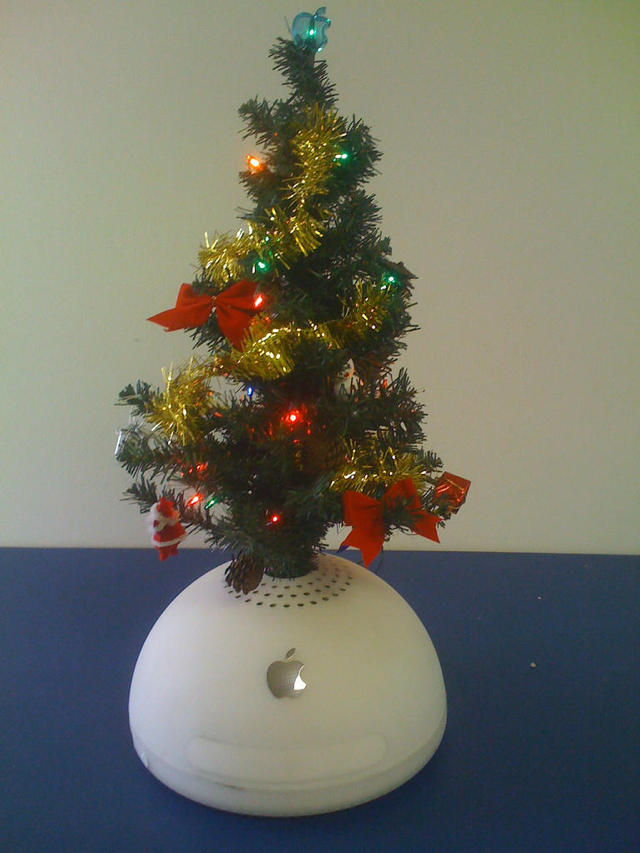
MacMedics get into the Christmas spirit with this little desktop tree, featuring a Bondi Blue Apple tree topper and a snazzy base made from a decommissioned G4 iMac.
Seasons’ greetings from Dana Stibolt and his band of jolly Mac elves, who operate Apple Authorized Resellers and Apple Authorized Service Providers in three locations serving the Baltimore-Annapolis, Washington, and Philadelphia markets.
Rogue Amoeba Software added to its lineup of innovative audio software titles Monday with the release of Radioshift Touch, software that lets users listen to internet radio anywhere on their iPhone or iPod Touch.
Powered by RadioTime, an internet radio catalog with thousands of stations from around the world in its database, Radioshift allows users to browse by genre, search by keyword and view listings for thousands of specific radio programs as well.
The app leverages iPhone firmware’s GPS capabilities to serve up local stations based on the user’s location and uses a feature called “SmartStream” to point to the most bandwidth-friendly stations, depending on the connection. Users can access Internet radio via, WiFi, EDGE or 3G.
Radioshift Touch is available at the iTunes AppStore for $9.99.
Given the host of free and low cost music programs available on the AppStore, including the ever-popular Pandora, and ClearChannel’s iHeartRadio, it will be interesting to track the success of Radioshift, with its relatively expensive price tag. Paul Kafasis, lead developer at Rogue Amoeba, has a sterling reputation for developing useful, high quality audio software for the Mac, so we invite Cult readers who try Radioshift to let us know what you think.
We recently wrote about iBreviary, an iPhone and iPod Touch app that gives the morning prayer, evening prayer and night prayer or complines for the day.
The Italian priest who had the brainwave for the app, Don Paolo Padrini, informed us that the 1.2 version of the prayer app, which he says has the blessing of the Vatican, is now available in Spanish, French, English and Latin (for those, like the Pope, who want a return to pre-Second Vatican Council days) and a version that follows the Ambrosian Rite, for the five million Catholics or so in the Milan area.
iBreviary costs $0.99 on iTunes and now also comes with a how-to page to help those unfamiliar with daily prayer rituals. The original Italian-language version was gratis, Father Padrini says the price of the app is a contribution for the developers.
Don Padrini also says an app is in the works for Facebook called that “Praybook” that will let groups use the Breviary via social network.
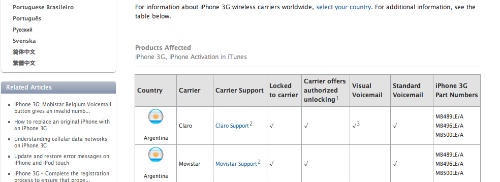
In a nod to reality, Apple Monday began listing worldwide carriers offering ‘unlocked’ iPhones. Just a year ago, Apple CEO Steve Jobs described the struggle between hackers and Cupertino as a “cat-and-mouse game.”
Now the Apple Website includes “Carrier offers authorized unlocking” on a support page.
Nearly 40 of the 105 countries listed offer unlocked iPhones. However, some handsets are unlocked through just one carrier.
Singer Katy Perry made her fame with pop try-bianism, but her heart is in a long-distance love with a boy. Perry is a Mac user who credits iChat with keeping up the relationship:
“Her current love is Travis McCoy, singer for the indie hip-hop band Gym Class Heroes, whom she met two years ago when they were recording in the same studio complex in New York, although he remained on the East Coast while she went back to L.A.
This summer they were together for 10 weeks during traveling music festival the Warped Tour,but “I [last] saw him three, four weeks ago,” says Katy wistfully. “It’s definitely difficult. I was really lonely for a couple of weeks, but that’s the name of the game. To me, iChat is the most beautiful technology invented, ever!”
Wonder if she iChatted a girl, just to try it, would the experience be as beautiful?