What it is: Think social media is a kick in the pants? Big twitter and Facebook fan, are you? Well, you may want to consider upping your game with Foursquare, a newish social media app/game for iPhone and iPod Touch.
Foursquare feeds the social, yet competitive spirit in users, who leverage the location-aware functionality of Apple’s mobile devices to let friends and others on the network know where they go, what they do and what they dig in 12 major US metropolitan areas (so far).
Why it’s good: The built-in gaming aspect of Foursquare lets users earn points for checking in at different places around the city and giving tips on what makes those places so cool (get the curry duck at Thep Phanom, for example). By hitting different spots and making combinations of recommendations, players can unlock “badges” and become a “Mayor” of their city.
By keeping up with and adding friends, users get to leverage the collective knowledge about a city into lists of cool things they have done and cool things they want to do.
Users can check in by logging on to accounts through a mobile browser, directly from within the app itself or by texting their location from a mobile phone.
Apple lost a patent infringement lawsuit Thursday in Texas, when a jury awarded Opti Inc. of Palo Alto, Calif $19 million in damages. The plaintiffs argued Apple willfully infringed on Opti Inc.’s patent covering a computer operation that enables a “snooping” function designed to help computers more easily retrieve previously accessed data.
The jury in the courtroom of Judge Charles “Chad” Everingham IV of the U.S. District Court for the Eastern District of Texas in Marshall, rejected Apple’s contention that Opti Inc.’s patent should be declared invalid and awarded the verdict as fair and reasonable compensation to Opti for Apple’s willful patent violation, according to the verdict form.
No word a yet on the status of Apple’s intent to appeal the verdict in the case.
The lucky downloader of the billionth app from iTunes (winner of a MacBook Pro, a 32GB iPod Touch, a $10,000 iTunes Gift Card and a Time Capsule wireless hard drive) is reportedly a 13-year-old who hit the jackpot with a free app called “bump.” Apple reached the billion mark with apps in just nine months.
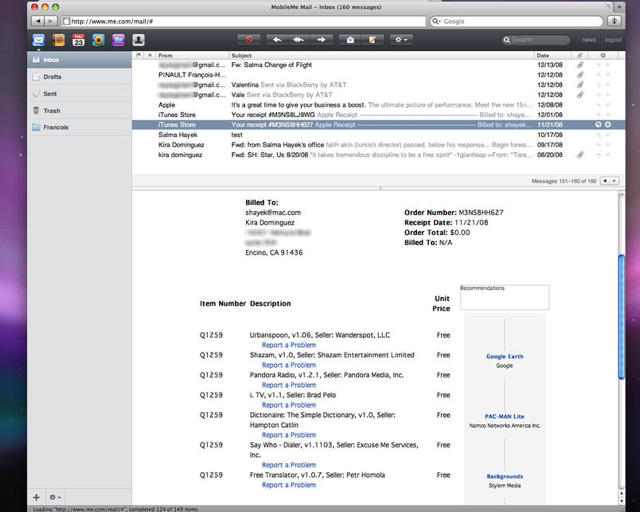
Call it hacking, or just common sense: getting into actress Salma Hayek’s Mobileme account was apparently as easy as knowing her birthday and her favorite starring role.
An anonymous post on imageboard 4chan.org provided MobileMe login details for Hayek:
Go to me.com, forgot password, type [email protected]
Her //snip//
Answer to change password question is: //snip//
Voila : a peek at Hayek’s iPhone apps downloaded from iTunes — including restaurant finder Urbanspoon, Shazam and the Say Who voice recognition dialer — plus emails from uber-magnate husband Francois-Henri Pinault and an invite to America Ferrera’s 25th birthday party.
Wonder if iPhone loving twitterer Ashton Kutcher’s next…
In computer software circles, there’s a lot of discussion about the “10-foot UI,” designed for interactions from across a living room. Now that streaming video has truly come into its own, the space has exploded. Apple’s Front Row is a 10-foot app, as is Boxee.
But if you’re a Mac user, especially a Mac mini owner who keeps it hooked up to an HDTV, there’s only one choice: Plex Media Center, a Mac-only offshoot of the Xbox Media Center software. Basically, Plex pulls all of your content — whether on your hard drive, your network, your Tivo — and blends it with everything on the entire Internet, including Hulu, Pandora, BBC iPlayer, Netflix, and The Daily Show, then wraps it in a stunningly beautiful interface that makes it a snap to navigate all of the world’s video and music with arrow keys are a simple remote control. Better still, it’s an open architecture, and people are adding to it like crazy.
It’s been around as Plex since last July, but many of the best features, like the Netflix plug-in, are recent arriving in the last two weeks. What’s maybe most exciting is that Plex has plug-ins that the original XBMC application lacks. The Mac development community is passionate enough to dramatically improve their offering beyond other versions. Heck, it has its own App Store. And it’s 100 percent free, running on all Intel hardware running Leopard.
This is the media operating system of the future. Now, if they’d just release a companion remote application for iPhone, this thing would really take over the planet.
Were you aware there is an annual conference devoted to the Apple II computer? And that it’s been held for 20 years?
Make plans now to be at Rockhurst University in Kansas City, MO from July 21 – 26 for, yes, the 20th annual KansasFest, a computer hoedown all about Apple’s iconic Apple II computer.
The keynote speaker will be Jason Scott, webmaster of
TEXTFILES.COM, director of “BBS: The Documentary”, and caretaker of Sockington, the cat on Twitter with over 300,000 followers.
KansasFest 2009, the world’s only annual Apple II conference, invites any and all Apple II and Macintosh users, fans, and friends to attend what oganizers call the “summer camp for geeks.” For photos, schedules, presentations from past year’s events, and inquiries, visit the event’s Web site.
It took two days of people complaining, but Apple finally yanked Baby Shaker from the App Store on Wednesday – though the screaming and crying over why it was ever approved in the first place has probably yet to reach a fever pitch.
With nearly umpty-thousand applications now in the App Store and Apple fast approaching a billion downloads, it’s not unreasonable to expect that some things might slip through the cracks.
But, seriously, Baby Shaker?
Think I could slip my Shoot the President app past ’em somehow?
In a gloves-off analysis of Apple’s unexpectedly good earnings report yesterday ($1.2 billion in profits, up 20 percent from 2008), Time attributes the uptick to brand cachet, not the products.
“Apple and RIMM results are an example of why brands matter and why companies are willing to work to develop them by making huge investments which can stretch over decades.”
Writer Douglas McIntyre falls back on a number of generalizations “a lot of people” “a lot of experts” “a lot like the iPhone” “a lot of cheap phones” and then pulls a few punches took a few cheap shots at people who buy Apple products.
“A lot of people think that consumers who buy brand are suckers, the kind people WC Field used to mock in old movies. Samsung builds a smartphone that looks and works a lot like the iPhone. It is called the Instinct and Apple owners think it is junk.”
“A lot of experts claim to know why people buy branded products, but there are probably as many reasons as there are people. All Apple cares about is that their customers have enough money to buy an iPhone, iPod, or Mac. Suckers have money, too.”
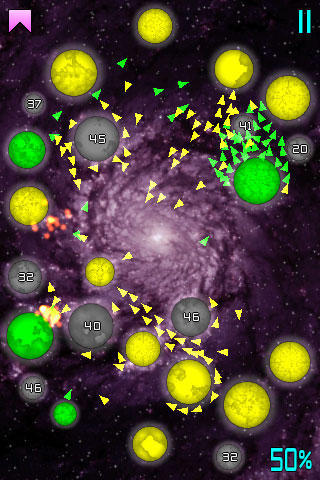
What it is: A real-time Risk, set in space. You conquer planets by sending a percentage of your ships (from one or multiple planets) to attack, and each planet under your control builds more ships to replenish your forces. Strategy lies in securing larger planets, which have faster production, and also determining where to station your forces for protection or counter-attacks in multi-player games.
Why it’s good: Although having similarities with Risk and even games like Civilisation, Galcon is fast. Games can be over in a matter of seconds, thereby making it a perfect pick-up-and-play title. Visually and aurally, it’s great, and a number of single-player modes and levels enable you to ‘train’ yourself in the Galcon ways.
Galcon also has an online mode, enabling you to play ‘live’ against up to three opponents. The gameplay varies slightly from easier single-player games, since you don’t see how many ships are guarding each planet. Therefore, gameplay becomes a combination of Risk, bluff elements of poker (in luring opponents into a false sense of security, or leaving large planets almost bereft of forces, to put more into attack) and a Mexican stand-off, with matches often ending in a frantic arcade-like orgy of destruction.
If being brutally honest, there does appear to be a certain technique to winning multiplayer matches, and a lot of success is down to whether you get a good starting position in the randomly defined maps. However, given the cost of the application, and the sheer fun to be had (in both multiplayer and single-player modes), it’s a definite favorite, and we urge you to check it out.
Where to get it: Galcon’s available on the App Store, and is at the time of writing on sale for $2.99. There’s also a free lite version with the ‘Classic’ mission. More information about the game, along with forums and sign-up for the online mode, can be found on the Galcon website.
Regardless of how much Steve Ballmer is cackling about Apple’s problems from charging a premium, the company’s performance suggests that the House That Steve Built is extremely well-adapted to thriving in the current recession.
Over the past three months, Apple enjoyed its best-ever non-holiday quarter. $8.16 billion in revenue, up 9 percent from last year. Profits of $1.2 billion, up 20 percent from a year ago. Apple beat consensus estimates by about 24 cents per share.
Mac sales did slow down a bit, but iPod sales were up 3 percent and iPhone sales an astounding 123 percent. The company is delivering results like no one else right now. The fact that the analysts were so pessimistic (they predicted a drop in revenue and profit) should elevate the price further.
Remember — this is the first quarter without Steve Jobs in charge since his cancer treatments five years ago, and Apple did better than ever before. And we’re six to ten weeks from a new version of the iPhone. Apple is sitting pretty, and no one can touch them right now.
The Better Business Bureau is warning Facebook users to read the fine print when responding to ads.
A recent BBB press release stated that an estimated $1.3 billion will be spent on social networking advertising this year. The large print on ads featured on social networking sites, like Facebook and Myspace, do not always tell the entire story.
The warning about MacBook Air scams is a hoot:
Also common on Facebook are ads to get a free MacBook Air claiming that the company is seeking laptop testers. The ads lead to an incentive marketing program at https://www.colormyrewards.com/ where participants must sign up for various products and services in order to earn their free laptop.
The Fine Print: Customers must complete two options from each of the three tiers, Top, Prime and Premium before receiving their “free” MacBook. Example offers listed in the Top and Prime tiers include signing up for credit cards or trial offers for subscription services such as for vitamin supplements or DVD rental services. In some cases, the participant will need to pay for shipping, and if they aren’t vigilant about canceling the trial offers they signed up for, they’ll begin being billed every month.
Examples of the Premium offers listed on the Web site that must be met in order to get the MacBook are much more expensive and include paying as much as $1,500 for furniture or purchasing a travel package with a minimum value of $899.00 per person.
BBB Warns: Incentive programs can be extremely costly in the long run and the fine print shows that the customer might have to pay a significant amount of money in order to get their “Free” items. It is also a red flag that Apple does not even make MacBook Air in purple, red, pink, or green. (Emphasis mine.)
And as flickr user 4braham noted (image used with a CC license) the Mac in the scam pic isn’t a MacBook Air. Sheesh!
What gadgets and software applications do you use on a day-to-day basis?
Steve Wozniak: I have such a crowded life and crowded schedule. When people send me a link with a gadget, I’ll look at it and buy it if it looks interesting, but I don’t have time to check out everything I’d like to.
I do have a Nixie Tube watch… The biggest benefit in my life comes from my Segway, which I use everywhere I am. If I’m going to San Antonio, for example, I’ll load it in the car and just go everywhere with it. The other crucial thing is my Verizon wireless card, which I have to have because hotel Wi-Fi is just so unreliable.
What are you using to manage your email?
Steve Wozniak: Eudora….The reason I do is, it has an incredible feature that every single mail client should have.
Any feature in the menu list, any action there, can be added as a button. I changed it so I have a vertical menu bar, so I can have tons and tons of pre-made buttons saved right where I want them up top, and I learn where those place are. You can script actions to the buttons, too, so I can quickly copy messages to my assistants. There are scripts I wrote for joke lists so I can forward a message, remove the brackets and formatting, and make sure all the original attachments are included, to a pre-defined “joke” group. Apple’s Mail app just isn’t scriptable enough to really handle my mail buttons.
Some of the buttons will re-direct mail with quote marks, or not. I’ve got another script that will actually customize a mail forward, like my own version of mail merge. So even if something’s going out to 400 people, I can set it to single out certain people and take away all the forwarding markings, so it looks like I singled out someone to send them mail. Which is, I hope, a nice little moment for them.
The near-term economic horizon appears to be surprisingly bright in the Apple/Mac universe, according to a survey released Tuesday by MacTech Magazine.
Despite recent dismal numbers from many sectors of the economy, 90% of respondents in “the Apple market ecosystem” polled by surveyors from MacTech believe 2009 will be “almost as good as or better than 2008”; 62.8% reported feeling good or great when asked about the Apple/Mac segment.
“The MacTech team decided to survey those in the market after seeing two significant trends starkly contrasting the general U.S. economic news,” said Neil Ticktin, Editor-in-Chief/Publisher, MacTech Magazine. “It’s been easy to get wrapped up in the bad news of the U.S. economy, but the reality is that for the Mac and Apple markets, things are strong and expected to get stronger.”
MacTech’s own advertising results and forecasts appear to support Ticktin’s optimism, with the magazine seeing a 13% increase in ad revenues 1Q09 over 1Q08.
A news editor from another well-known technology-focused magazine told Cult of Mac Tuesday, “after an abysmal holiday season, ad sales for the June issue look to be the best EVER!” MacTech’s Ticktin added “our staff has heard from many MacTech advertisers how well they are doing despite the economy.”
The sunny outlook from Apple-land certainly contrasts with anecdotal sentiment Cult of Mac gathered Tuesday night at an AdTech after-party in San Francisco, where several attendees reported a very down-beat vibe from the bellwether digital advertising conference.
Yahoo also reported Tuesday plans to cut 5% of its workforce in the wake of a nearly 80% drop in profits in the first quarter of 2009, and media guru Shelley Palmer said at the post-AdTech gathering in San Francisco he gives the economy 10 months to show its hand as far worse than anyone believes it is today.
If you’ve ever wondered why some developers can’t stand Apple, perhaps Marco Arment can help.
Arment makes useful websites in New York, according to his bio. He’s the lead developer of Tumblr, the Web 2.0 sharing sensation, and creator of the very popular iPhone application Instapaper, which allows users to save web pages on their devices for reading later.
Arment penned a revealing blog post Monday that serves to highlight the frustration even established developers must endure in navigating the uncharted, fickle waters of Apple’s approval process for third-party iPhone and iPod Touch applications.
After submitting an update to Instapaper that included the mobile phone icon shown in the screen capture above, Arment was informed his update could not be accepted because it ran afoul of SDK guidelines that prevent “use [of] the Apple Logo or any other Apple-owned graphic symbol, logo, or icon … except pursuant to an express written trademark license from Apple.”
A friend of Arment’s had designed the icon and offered it to him for use with Instapaper.
Arment concedes the App Store is “an amazing deal for independent developers” but laments the fact that “problems seem so arbitrary, avoidable, and developer-hostile.”
In the end, the frustrated developer must resolve to “make a different icon from scratch that doesn’t contain any depictions of any Apple products,” with Arment asking, “can I use arrows, or does that violate the arrow key on Apple’s keyboards?”
And the bottom line, something with which even Apple is undoubtedly familiar, is that a developer in Arment’s position is forced to resubmit, wait another 7 -14 days, hope to be accepted, and lose a few weeks of the increased sales that the new version will generate, all the while chalking it up to “another annoying cost of doing business on the App Store that [you] can’t do a thing about.”
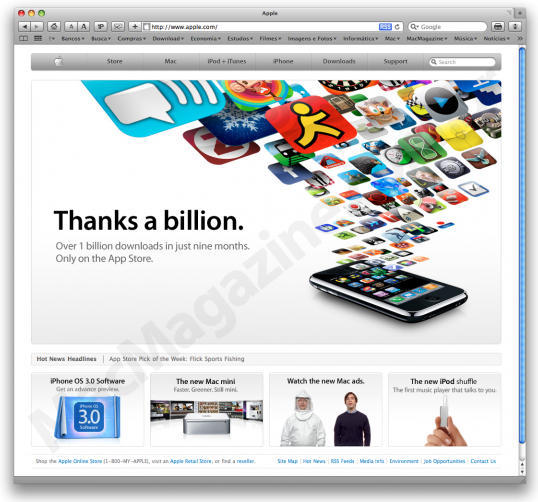
Who knows when the happy moment will come, but when it does, Apple is ready to trumpet the news that a billion apps have been downloaded from the iTunes AppStore.
So says the Brazilian website Mac Magazine, anyway.
A reader, identified only as JOSZé claims to have discovered a counter embedded in Apple’s website that, when advanced to the number 1,000,000,000 will return the page you see above.
As the editors at Mac Magazine said, “sorry to spoil the surprise.”
Thanks to Rafael for the tip!
UPDATE: Rafael, from Mac Magazine, tells Cult of Mac the secret to revealing the waiting “Thanks a Billion” page lies in changing the time and date on your Mac to something in advance of the date you might expect the magic number to be reached. A recent check of the App Store’s counter says more than 990,000,000 apps have been downloaded as of this writing.
Thinking further about the new Mac ads — and how if I were considering buying a Mac over a PC they wouldn’t sway me — I came across this post about an accidental switch & bait that turned one PC person, political-science professor Harry Farrell, into a Mac user:
“I was working in my office, when a work-study knocked on my door with a brand new MacBook Pro, which he told me had been sent over from my school’s technology program. I was nonplussed, and told him that he must be wrong, that I hadn’t ordered one etc…
So I finally acquiesced, on the grounds of gift-horses, and the wisdom of not inquiring too closely into the dental conditions thereof, and unpacked it. Two hours later, I was completely hooked –œ more rational and altogether nicer than my Windows box, while much smoother than my Ubuntu installation. I would have wanted to take it home and marry it, if I wasn’t married already. Three hours later, I discovered it had been a mistake, and that it was in fact intended for a colleague with a vaguely similar name… And I had to give it back.”
iPhone 3.0 firmware, expected to be released in June, may provide native voice activation and voice-enabled services previously available only with third-party applications, according to emerging reports.
Code-named Jibbler, according to sources cited by Ars Technica Monday, the new services appear to be an enhancement to the iPhone’s SpringBoard application, a Finder-esque app that acts as a launcher and will support the newly announced 3.0 Spotlight search.
While there is thus far no indication whether any of these voice features would be tied to new hardware, also expected this summer, or if new features will be compatible with existing iPhone hardware, the implications for voice-controlled dialing, which other popular mobile phones have had for some time, and additional hands-free functionality position the iPhone to remain atop its class of touch screen smartphones for some time to come.
I get asked a lot why I prefer Macs to PCs. Sometimes it’s from a Windows fan trying to pick a fight, sometimes it’s from a platform agnostic who’s interested why I care enough to choose. But the intent is the same — what makes you so passionate?
And after citing obvious reasons like the elegance of Apple’s hardware and software design or the way everything just works out of the box, I almost inevitably bring up something that seems to dull to get excited about: OS upgrades. Not that they happen, but that it’s always easy for me to know which edition of OS X to buy, and I never feel like Apple is needlessly squeezing pennies out of me by charging more for the features that make it worthwhile to upgrade. Leopard was Leopard. Snow Leopard will be Snow Leopard. Easy.
This is the opposite of the Windows experience, in which there will be seven (!) versions of Windows 7 to choose from, some of which are hopelessly crippled. The worst of these is Windows Starter, designed just for Netbooks.
We all know that the vast majority of personal computers run Windows, with a significant but smaller number using Linux and Mac OS X, and then teeny slices using other operating systems like Solaris and Amiga OS. What might not be so obvious is that Microsoft has become equally dominant in the new Netbook market, with Windows XP or Vista shipping on 95 percent of the tiny lappies compared to just five percent for Linux.
And Microsoft, sitting on top of a dominant market position in netbooks, is quickly formulating a plan to actively screw over their potential customers. In the fall (if they’re lucky) MS will roll out Windows 7, which, from my testing of it, is a lot like Vista without all of the most glaring problems. Alongside Windows 7 will be a version custom-designed for netbooks called “Windows 7 Starter,” which will, I swear to you, only be allowed to run three simultaneous applications and won’t feature the same UI as more expensive flavors of the OS. Those features are present — you’ll just need to pay Microsoft for an upgrade code to access them. So forget about running Word, Firefox, iTunes, and Outlook at the same time if you’re on Windows Starter.
Here’s why this is a brain-dead strategy. The only reason to get a Windows netbook is to run Windows applications. If you’re limited to only three apps at a time, it’s actually saner to use Cloud apps in a Web browser. And if you’re going to do that, it makes more sense to just go with Linux or another alternative. Starter is intended to make people want to buy the nicer versions of Windows 7. I think it’s net effect is more likely to be that people seriously consider alternatives.
And that’s why Apple’s dedication to making OS X available in just normal and server versions is one of the best decisions Steve Jobs has ever made. Apple has ignored the netbook market up until now, but it’s safe to say if Apple did release a netbook, it would be a premium offering at the high-end of the market and run a full version of Mac OS X. That’s just how Apple rolls.
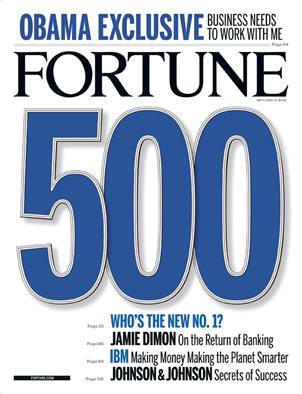
Apple is back in Fortune magazine’s elite Fortune 100 list for the first time since 1994, according to new rankings released in the magazine’s issue dated May 4 but made available this week online.
Thanks in part to the declining performance of companies previously ranked ahead of it, Apple jumped 32 spots above its 2008 ranking, to rejoin the list of the 100 largest US corporations for the first time since Steve Jobs returned to lead the company in 1997.
Among Apple’s largest U.S. competitors, Hewlett-Packard (HPQ) came in at No. 9, Dell (DELL) at No. 33 and Microsoft (MSFT) at No. 35. Apple (AAPL) placed at No. 71 on revenues that grew 35.3% to $32.479 billion in 2008.
Apple’s iPod Touch and, to a lesser extent, the iPhone are increasingly the U.S. military’s handheld device of choice for deployment on the battlefield, according to a recent report in Newsweek.
Traditionally, the military might issue electronic handheld devices, made at great expense specially for the battlefield, with the latest software. But today’s “networked warfare” requires each soldier to be linked electronically to other troops as well as to weapons systems and intelligence sources, says the report.
Making sense of the reams of data from satellites, drones and ground sensors cries out for a handheld device that is both versatile and easy to use – a requirement Apple’s mobile devices fulfill handily.
Such acceptance of a commercial product for use by the military is nearly unprecedented. Many soldiers, however, own iPods and iPhones for personal use and it’s logical their versatility might come to the attention of military strategists seeking methods for fighting the new kinds of counterinsurgency warfare the US has confronted in the post-9/11 era.
Apple’s gadgets have proved surprisingly fit for the task, according to the report.
Software developers and the U.S. Department of Defense are now developing military software for iPods that enable soldiers to display aerial video from drones and have teleconferences with intelligence agents halfway across the globe. Snipers in Iraq and Afghanistan now use a “ballistics calculator” called BulletFlight, made by the Florida firm Knight’s Armament for the iPod Touch and iPhone. Army researchers are developing applications to turn an iPod into a remote control for a bomb-disposal robot (tilting the iPod steers the robot). In Sudan, American military observers are using iPods to learn the appropriate etiquette for interacting with tribal leaders.
As Lt. Col. Jim Ross, director of the Army’s intelligence, electronic warfare and sensors operations in Fort Monmouth, New Jersey says, when it comes to soldiers’ battlefield communications, an iPod “may be all that they need.”
Apple has chosen Foxconn Electronics as its main manufacturing partner for a ten inch touchscreen netbook to be released later this year, according to renewed rumors emanating from the Asian press Monday.
The Chinese language news site Commercial Times, quoting sources within the supply chain, reported Hon Hai Precision Industry, also known as Foxconn, secured a deal to manufacture Apple’s next portable gadget, designed to compete in the growing market for WiFi enabled devices that connect easily to the Internet.
The persistent rumors of Apple’s imminent introduction of a device to fill the gap between its popular iPhone/iPod Touch and full-fledged notebook computer lines fly in the face of previous statements from Steve Jobs vowing Apple has no interest in what its CEO considers the low-end of the computer market.
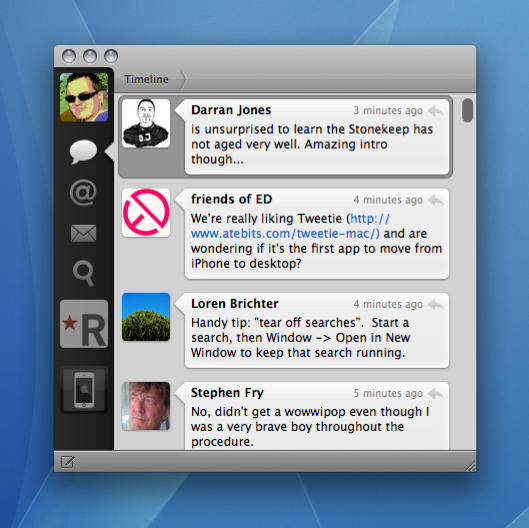
The Mac’s not exactly drowning in great Twitter clients, and especially not in multi-account ones. (EventBox kinda rocks as a social networks aggregation tool, but it supports only one Twitter account.) Oddly, the App Store has a whole bunch of such apps, the best of which is Tweetie.
Occasionally, cut-down versions of apps make their way from the desktop to mobile, but Tweetie’s taken the opposite journey, starting out on iPhone and arriving on the desktop a few hours ago.
First impressions are that the competition has just been largely obliterated in one fell swoop (or at least given a severely tweaked nose). Tweetie’s UI is mostly gorgeous, the app is utterly stable, and it’s also very usable. There are some issues relating to the interface: the inability to scroll via page up/down (although Space/Command+Space does the same job), overly large icons to the left, the too-small ‘new tweet’ button and the entire lack of a refresh button. Also, there aren’t any saved searches at present. However, despite these shortcomings (which, for me, are niggles rather than deal-breakers), it still to my mind betters the likes of Blogo and Twitterific, and is likely to take up a permanent place in my Applications folder.
Check the app out for yourself via the unlimited, ad-supported demo, available from atebits. You can also register for $14.95 until May 4, whereupon the price goes up by five bucks.
Cult of Mac Twitter feeds
For those who’d like to follow Cult of Mac and its contributors on Twitter, check out the following feeds:
– Cult of Mac updates: @cultofmac
– Leander: @lkahney
– Me (Craig): @craiggrannell and @iphonetiny (for mini iPhone app reviews)
– Lonnie: @lonnielazar
– Pete: @morepete