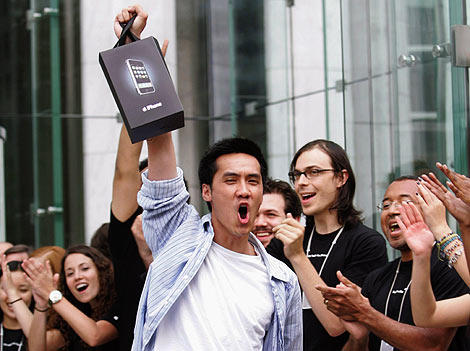
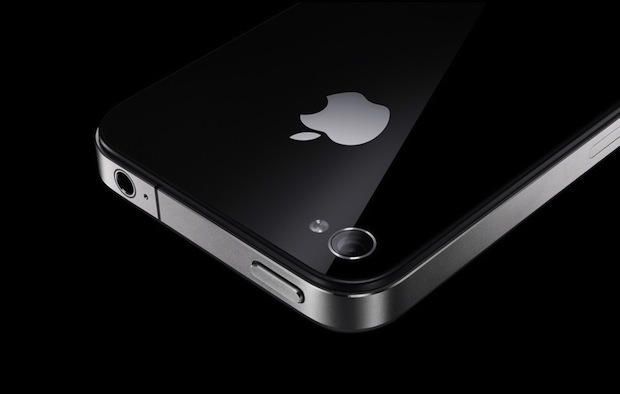
The iPhone 4 was selling like the proverbial hotcakes during the first days the iconic handset was available to consumers, one analyst told investors Monday. Indeed, on June 24, when the new phone went on sale, 60 percent of Apple Stores and all participating retailers had no stock left by the end of the day.
“We believe initial weekend volumes were 1 million plus,” Deutsche Bank analyst Chris Whitmore wrote Monday. “But shipments could have been dramatically higher if there was more supply,” he added. Apple announced Monday it sold more than 1.7 million iPhone 3 units between Thursday and the end of Saturday, June 26.
As they are wont to do, the guys over at iSuppli have ripped apart their pretty new iPhone 4s, done some math and figured out how much it cost to make.
What’s the damage to Apple? The 16GB iPhone 4 costs $187.51 to put together in hardware costs alone, with the fancy new Retina Display costing $28.50 per unit, the A4 CPU costing $10.75 and the new gyroscope only coming in at around $2.60./
Needless to say, there’s a lot more money spent on every iPhone 4, including marketing, design and manufacturing, so this isn’t a complete view of how much profit Apple is looking at per device, but I still always find this stuff fascinating, like taking my dental records down to a pawn shop and seeing how much I could get for my fillings.
Steve Jobs just can’t seem to make up his mind. Just a few days after he tersely told a customer that people experiencing rampant reception issues with their iPhone 4 that people were “holding it wrong,” Steve Jobs has written to another Apple customer, saying “There is no reception issue [with the iPhone 4]. Stay tuned.”
Isn’t that a bit of a contradiction? Even if a forthcoming iOS 4.0.1 update does fix the reception issues, that still implies there wasan issue. Plus, why do we need to hold it in a specific way if there’s no issue whatsoever?
More interestingly, what are we “staying tuned” for if there’s no issue with the iPhone 4’s reception at all? A placebo? If you want one of those to work, Steve, you’re not supposed to tell the patient.
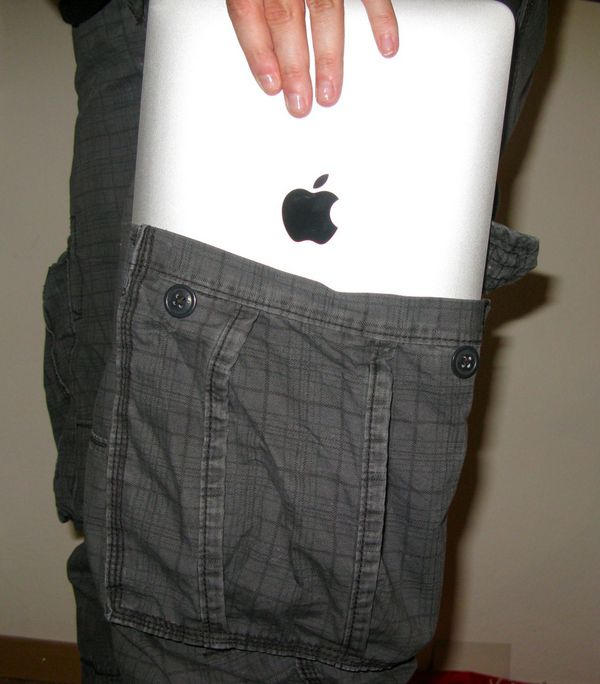
Cult of Mac reader Angela says all of this dedicated clothing design for the iPad is superfluous: “If you think iPad’s an overpriced iPhone/iPod touch that won’t fit in your pocket, you’re wearing the wrong pants.”
Here she is, wearing what she describes as a “fairly normal pair of pants (well, they look big on me, but they’d look normal on a guy) that fit an iPad into a side pocket.”
What do you think — time to put the cargo back into those cargo pants or not?
More than 1.7 million iPhone 4s were sold from Thursday, June 24 through Saturday, June 26, Apple announced Monday. CEO Steve Jobs called the new iPhone “the most successful product launch in Apple’s history.”
Jobs also apologized for the long lines some people encountered while waiting to purchase the device. “We apologize to those customers who were turned away because we did not have enough supply,” he said by statement.
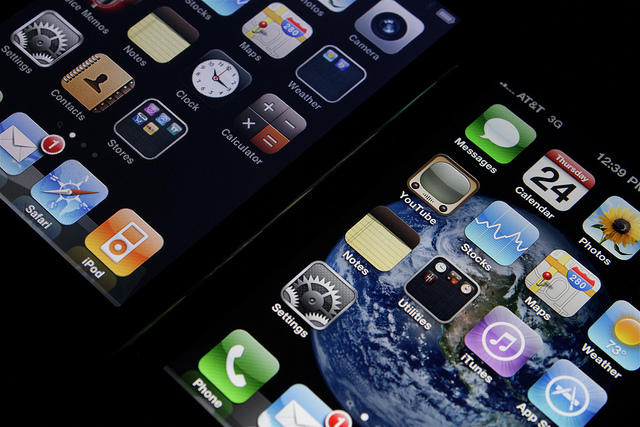
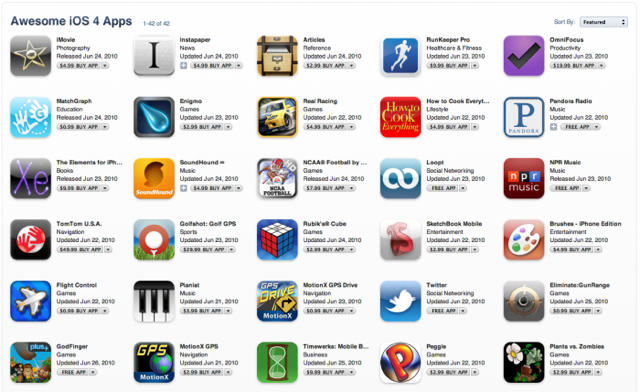
Apple’s taken to list making with their latest addition to the App Store, Awesome iOS 4 Apps. It seems a strange and disparate bunch of apps to highlight, and while many of these are awesome apps indeed, the vast majority of these apps don’t take particular advantage of iOS 4 except through Apple’s new built-in save stating option. Still, it’s always interesting to see which apps in particular Apple has their eyes on.
In order to demonstrate “Two of mankind’s greatest inventions, together at last, “iPad owner Jesse Rosten create this fantastic little video which is as much a paean to Apple’s tablet as it is to that wonderful element, Velcro. In fact, the video’s so good that Apple themselves have chosen to highlight it on the official iPad webpage… although you’d think they’d be less cavalier about people strapping their expensive tablet computers onto objects like a wall or motorcycle.
The mouse has once again darted around the cat. Just a few days after the official release of the iPhone 4, userland has once again managed to find its way around Apple’s updated security measures to jailbreak the handset and get root access to the device.
Don’t expect to do this yourself for now: because the exploit uses remnants of Apple’s own code, it can’t be released to the public just yet, and it’s possible the forthcoming iOS 4.0.1 update might put a kibosh on this particular jailbreaking strategy.
But if you’ve got dreams of high-res Cydia apps dancing in your head, be patient and keep waiting for Dev Team Christmas.
Jonathan Mann once wrote a tune about Paul Krugman that went wildly viral and landed him on the Rachel Maddow Show. Now he’s written one about Steve Jobs and it remains to be seen where this one might take him, but it’s at least a pretty good song by our reckoning: “he’s the best at what he does though I hardly can define/what it is and what he has and that kinda blows my mind.”
Mann is a busy, creative guy who’s led a very interesting and adventurous life so far, which you can hear more about on his YouTube site. He has been writing a song and making a video a day since January 1, 2009 and while he admits he wants to be a star, he also cops to simply “trying to make my way through life.”
In addition to Steve Jobs’ Head (song #541), he recently posted song number #543, Let’s Get Along, which he shot and edited on his new iPhone 4. A dedicated Apple fan, Mann also uses a Mac Pro and a Macbook Pro to record his material.
How come no one ever uses Windows gear to write songs about Steve Ballmer or Bill Gates?
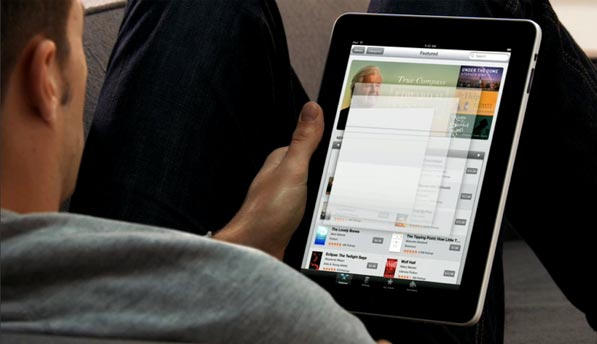
The category of computing represented by the iPad has gone by many names: tablets, slates, oversized iPod touches. But not one of them has really stuck. Partially, it’s because we haven’t had a hit until this year. Unsurprisingly, people are now calling them iPads, and the competitors “iPad-killers”. That’s because people are far more attracted to a product success than they are to a form-factor or technical specifications. It’s worth remembering that virtually no one ever talked about the emerging class of graphical user interface computers in the 1980s. They talked about Macs, and then they talked about Windows. No one is particularly happy with the name “tablet” because it doesn’t actually capture anything interesting about the device except for its size and shape.
My colleague and collaborator from Jump, Conrad Wai, has an interesting hypothesis about what might stick as a name: “kneetop.” Conrad notes at Something Ventured that every computer ever used by consumers has ultimately been defined by where you use it, from the desktop to the oft-ill-advised “laptop.” Heck, even “mobile phones”. And that might need to happen here for the tablet category to take off.
Desktop, laptop, and mobile all speak to where you use it. But what about tablet? That’s a form factor — and we don’t call a laptop a “hinged screen with keyboard.” The tablet doesn’t yet have a context of use baked in. What’s the use scenario? Where are you going to use it? How are you going to position it relative to your body? Until we resolve these questions, tablets, pads, slates — whatever — will just be a cool technology. It’s something app developers and would-be iPad slayers should keep in mind as they develop their products.
…
To be honest, I think things will turn out a bit differently. My take is that “tablets” as a term will hang around, but that they’ll usher in the era of “casual computing.” Put another way, to be successful, tablets will have to be a transition point when we stop thinking about “using a computer” when we grab one. To me, that’s what people have in mind when they talk of having several tablets just lying around.
So what say you, iPad owners? Is it all about resting it on your knees while you browse? Or do you have a better name?
Well, that didn’t take long. Within days of the iPhone 4’s public launch savvy entrepreneurs are already jumping on the device’s video chat capability to expand their offerings — and opportunities — in the sexual services industry.
With promises of a free iPhone 4 and a “very competitive salary” to women who want to participate, an online interactive pornography firm in New York has an ad up on Craigslist with a job description including “talk to potential clients and chat with them and perform various acts as desired by clients.”
The firm is requesting information and pictures – and hopes to launch before 9/1/2010.
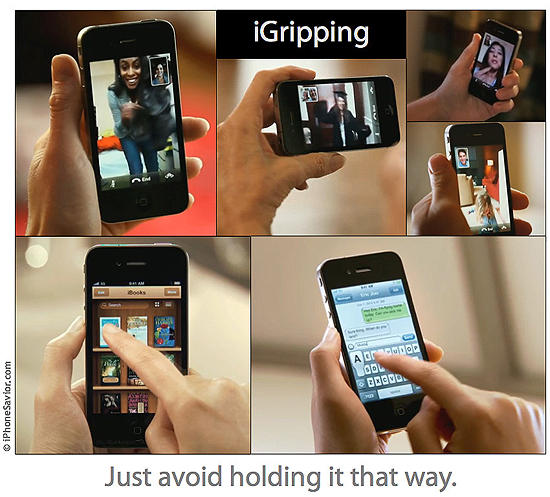
The New Paradigm - iGripping (Image: iPhoneSavior)
User Interface Watch: Apple’s march towards hands free, thought controlled computing continued this past week with the widely misunderstood iPhone 4 “Death Grip” episode. Perceived and quickly lambasted as a design flaw, Apple is stategically taking high levels of flak as they quietly persue their true longterm goal.
[Tags: ANALYSIS, HUMOR, SATIRE]
Steve Jobs has always been a minimalist, be it product design, the breadth of his wardrobe, or succinct email replies. This minimalism also applies to the ways in which we interact with our computers.
Early computers required both hands and all fingers to operate, utlilizing bulky keyboards. This mimicked the way humans had conveyed information since the invention of the typewriter, but was clearly just a technology to be milked for all it was worth, then cast aside.
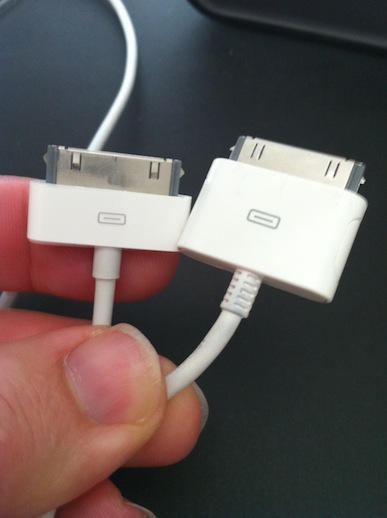
I wasn’t able to pre-order an iPhone 4 for delivery and ended up standing in the reserve line for one here in Houston instead. However, I was able to pre-order some accessories: a black iPhone 4 Bumper case and a pack of white Universal Dock Adapters. I installed the Bumper and that is when I started to have problems with some cable accessories. I also have an example of not having black Universal Dock Adapters when Apple is shipping black iPhones and not white ones. I thought come on Apple how about some black Universal Dock Adapters — is that to much to ask?!?!?
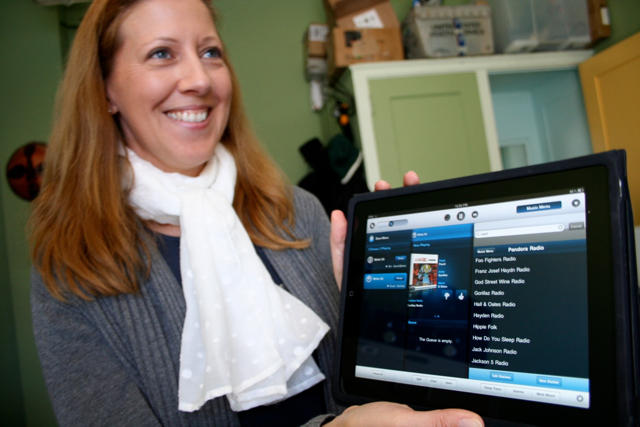
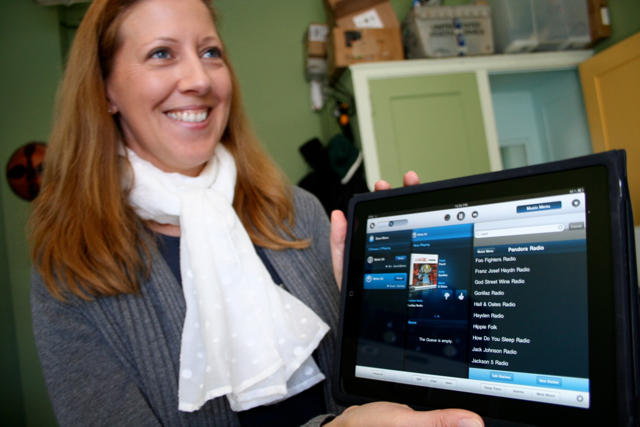
Sonos product manager Joni Hoadley shows off the company's upcoming iPad app.
I just got a sneak peek at Sonos’ upcoming iPad app — and it looks awesome.
Sonos sells wireless music players that make it easy to get multi-room audio around your house. Plug in a player in each room and stream music to each one (or the same music to all of them). Sonos’ products have won kudos for painless setup, ease of use, relative low-cost (you can spend a lot more) and innovation — this is the home stereo of the future.
Sonos is about to take it to the next level with a fantastic iPad app that makes digital music very easy — especially listening to online music services. Using the iPad as a big Wi-Fi remote control, you can play music from your iTunes library, thousands of online radio stations, satellite radio subscriptions, or online music services like Pandora, Rhapsody and Last.fm (and soon the fantastic Mog.com).
I was gutted to find this morning that my brand new iPhone 4 didn’t work with my beloved TomTom Car Kit — the best automotive cradle/charger for the iPhone, bar none.
The iPhone 4 fits in the cradle OK, but it doesn’t charge. Discovering this filled me with disappointment. I love the TomTom Car Kit (which costs $100 but is well worth it). It holds the iPhone just where I want it for navigation and music. It charges the iPhone, and boosts the GPS signal when using TomTom’s excellent navigation app. And it doesn’t move, even if I clumsily bash on the iPhone’s screen with my big sausage fingers.
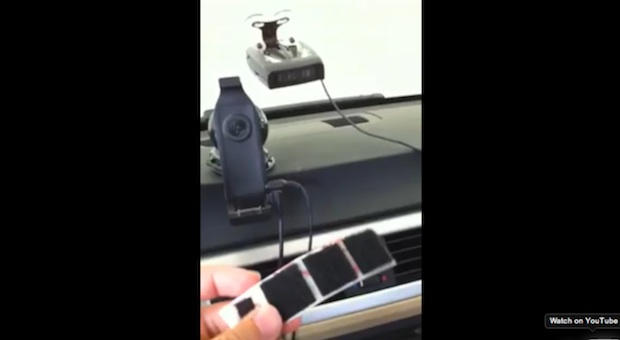
So I’m delighted there’s a simple and inexpensive fix for the charging issue — a small strip of velcro.
As Engadget tipster Ben Peacock Martin Alaniz discovered, you cut a small strip of velcro (the soft side) and stick it to the back of the Car Kit cradle, just behind the dock connector.
There is no need to attach anything to the iPhone itself. The velcro acts as a cushion holds the moving part of the cradle flat, pushing the Car Kit’s electrical contacts against the iPhone’s. Simple and cheap.
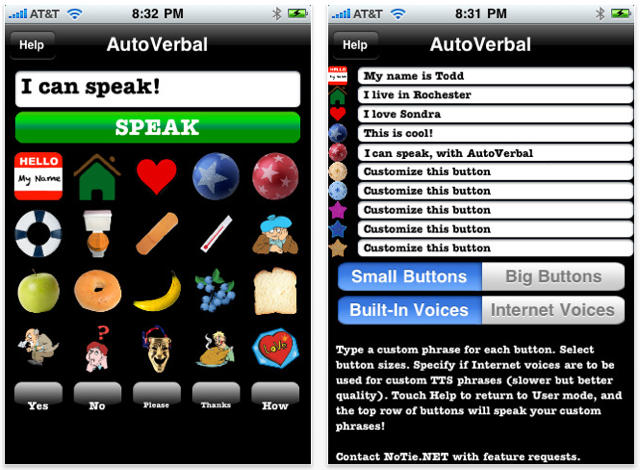
What it is:Auto Verbal Pro (iTunes link) is handy, if not quite full-featured augmentative and alternative communication (AAC) software that gives non-verbal people an inexpensive tool to communicate using an iPhone, iPod Touch or iPad.
Why it’s cool: Other high-end AAC solutions such as Proloquo2go (iTunes link) cost well upwards of $100 while Auto Verbal Pro hit the iTunes store a couple of weeks ago at 99¢. The introductory price won’t last long but even when NoTie Software kicks its offering up to $30 it will still be a bargain for the help it can bring to people with autism or other conditions that make it difficult for them to communicate verbally.
With over 100 pre-programmed icons in its intuitive interface, Auto Verbal Pro makes it easy for a non-verbal person to say basic phrases such as “I am tired,” or “I am OK,” and things such as numbers, days of the week, shapes, colors, food items, animals and so on. There are 10 icons which can be custom programmed to utter more complex phrases, such as “This software is the bomb, isn’t it?” and a text entry field in which any phrase can be typed and played through the device speakers. Users can choose between large and small buttons, which can be very useful to the visually impaired or fat-fingered, and between male or female sounding computerized voices in low-fi or hi-fi quality.
While great strides have been made in recent years developing software to speak for us, Auto Verbal Pro showcases some of the limitations that persist. The built-in low-fi voicings are certainly intelligible but lack any kind of nuance or expressiveness. Hi-fi voicings are even more intelligible and slightly more expressive, but they require WiFi Internet access in order to work, since the files live on NoTie’s servers. When a custom or typed phrase is called on to use a hi-fi voice, the software connects to NoTie and plays back the sounds using QuickTime, which results in clunky, irritating delays. Where no Internet access is available, the program defaults to the low-fi voicing.
All and all, this is useful and potentially even quite amusing software; with good reason it quickly jumped into the Top 5 Paid Medical apps on the iTunes App Store.
Where to get it:Auto Verbal Pro (currently English-only, but with French, Spanish, and German versions planned) is available on the App Store for a limited time at 99¢, after which its price will jump to $30. It’s well worth investing a dollar now to see if it’s something that could be useful to you or someone you care about.
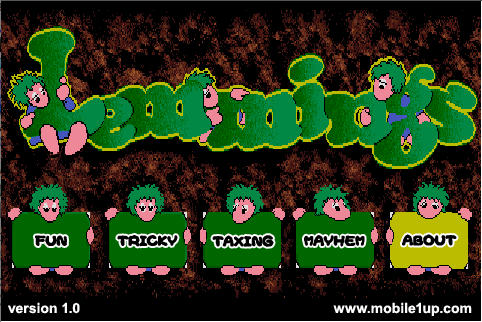
Touch Arcade have reported today that game developers, Mobile 1UP, have “bitten the bullet” and announced in the Touch Arcade forums that they are porting Lemmings to the iPhone & iPod Touch. All 120 levels of the original game will feature, and what’s more, it will be a free download.
If you’re unfamiliar with Lemmings, it’s a 20-year-old puzzle game that was originally developed by DMA Design, now Rockstar North, and published by Psygnosis. The aim of the game is to guide a group of Lemmings through different landscapes by assigning them individual skills, in order to get a certain number of them through to the exit.
Lemmings first appeared on the Commodore Amiga and was one of the most popular games of its time. Since then it’s been ported to a wide variety of game systems, most recently to the PSP and PlayStation 3 consoles.
If you’d like to keep track of Mobile 1UP’s progress on the iPhone & iPod Touch port, you can follow their live blog throughout the whole process.
Mobile 1UP have stated that Lemmings will be submitted to the App Store as soon as it’s ready – stay tuned for a review when it’s released!
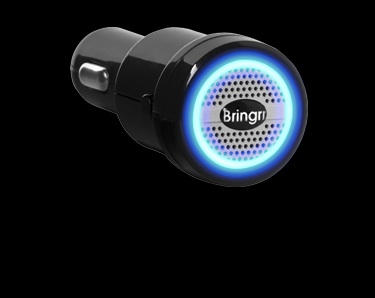
This new gadget is called a “Bringrr,” but we think that’s only because “Hey, Don’t Leave The Prototype in a Bar Next Time, Dumbass Device” wouldn’t fit on the box:
Pair the little Bluetooth-equipped plug with a phone, pop it into a car’s cigarette-lighter port, and it’ll have a conniption (alarm, flashing lights) if the car is started without the phone in close proximity.
We end the week with another batch of App Store freebies, including “PocketFish,” a fish simulator for the iPhone or iPod touch. Also in today’s spotlight: a 1.83GHz Core 2 Duo MacBook for $500. Finally, we all know the iPad is pretty sweet, so why not let everyone know it, as well, with a hard case that appears like a jumbo candy bar?
Along the way, we’ll check out new iPhone and iPad software, along with other gear. As always, details on these and many other items are available at CoM’s “Daily Deals” page right after the jump.
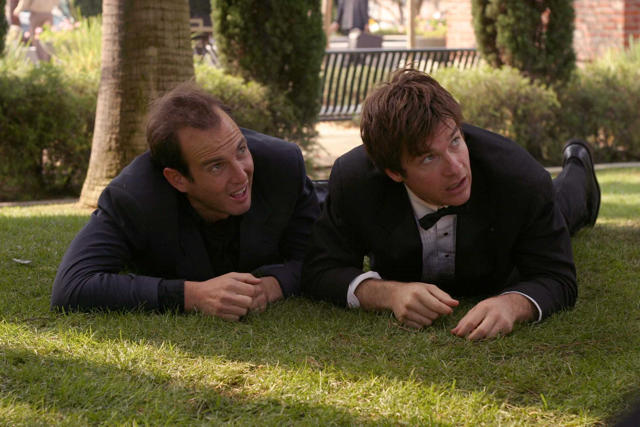
Being the star of the best comedy series of all time has its perks: recognized waiting in line like some sort of pleb by an Apple Store employee, actor Jason Bateman was pulled from the line and ushered into the Apple Store to get his iPhone 4 ahead of the less famous people waiting in line in front of him.
Usually, we’d be incensed at the privileged treatment celebrities get, but in Michael Bluth’s case, I think we can make an exception.
Edit: This post was originally accompanied by a photo of Jason Bateman being spoken to by an Apple store employee while waiting in line for his iPhone 4, which we picked up from the celebrity gossip blog WWTDD. If you want to see Jason Bateman looking bored and sitting on the ground in a long line while an Apple Store Genius with his underpants exposed talks to him, you should go over and see the pictures there.
As consumers worldwide flock to purchase the iPhone 4, China Unicom is still talking with Apple about bringing the latest iPhone and the already-released iPad tablet to the giant Asian marketplace, according to a Friday report. As happened with the China launch of the iPhone 3G and iPhone 3GS, the carrier could start out already behind the flood of gray market competitors.
According to the Wall Street Journal, China Unicom faces a repeat of previous iPhone launches, when it introduced the handsets without Wi-Fi and priced higher than those bought in other nearby countries. Although the government has officially lifted the ban on outside Wi-Fi versions, it’s unknown whether the carrier can cut its $730 price tag on the iPhone to a level that would spur massive sales.
My 27-inch iMac’s display is so big and gorgeous that ever since I got it, my 50-inch living room plasma has been getting a lot less burn-in. The 2560 x 1440 iMac display is just so choice: just about everything looks better on it.
Unfortunately, up until now, there hasn’t been an easy way to hook your iMac up to an HDMI source, which means there’s no good solution for watching a Blu-Ray movie or playing an Xbox 360 game on your iMac.
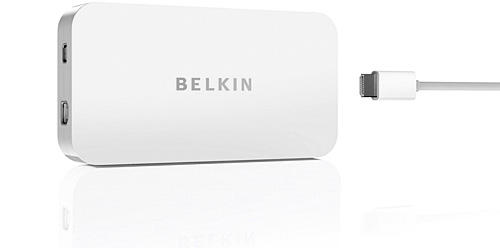
Belkin’s AV360 Converter is a simple bridge that acts as an HDMI-to-miniDisplayPort converter. It requires a free USB 2.0 port to keep powered, but otherwise you can pipe in any HDMI signal to your iMac or MacBook without any further fuss.
There’s a couple big downers here, though. The first is the price: $150 is a lot of money to spend on something like this. The second downer, though, is that while the AV360 Converter will accept a 1080p signal, it will downsample it to 720p on your Mac… pretty disappointing if you’re trying to finally watch your Blu-Ray copy of Planet Earth on the 27-inch iMac’s gorgeous display.
The AV360 Converter is available for order now directly from Belkin
As iPhone fans soak up the latest information about the handset’s features and abilities, Apple CEO Steve Jobs and other leaders of the Cupertino, Calif. company likely are more mindful of something else: the high rate of iPhone owners who are upgrading to the latest model. While only 38 percent of purchasers of the original iPhone upgraded to the iPhone 3G in 2008, more than three out of four iPhone 4 purchases Thursday were from current iPhone owners.
“Apple is effectively building a recurring revenue stream from a growing base of iPhone users that upgrade to the newest version every year or two,” Piper Jaffray analyst Gene Munster told investors Friday. Oppenheimer analyst Yair Reiner found a similar response in his survey of first-day iPhone 4 buyers. He found 76 percent of purchases were upgrades which took place 14.7 months after buying the previous Apple handset. Buyers “were inspired by desire rather than need,” Yair noted Friday.
"You call that a strut? This is how we strut in Russia!"
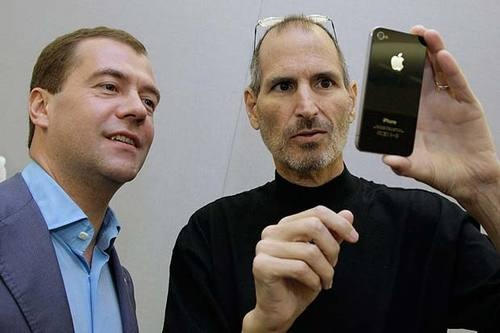
It is with some regret that we close the comment thread on the open caption contest for the historic meeting of Steve Jobs and Russian president Dimitry Medvedev: you guys are killing us.
Winner “nudge” who concocted the above simple but effective headline wins an trio of cool promo codes: iAnnotate iPad app, Soduku 2 and Hangman RSS for iPhone.
Special mentions to Jeremey Laflamme, Kevin Kestler, Julie and Alfredo for the laughs.
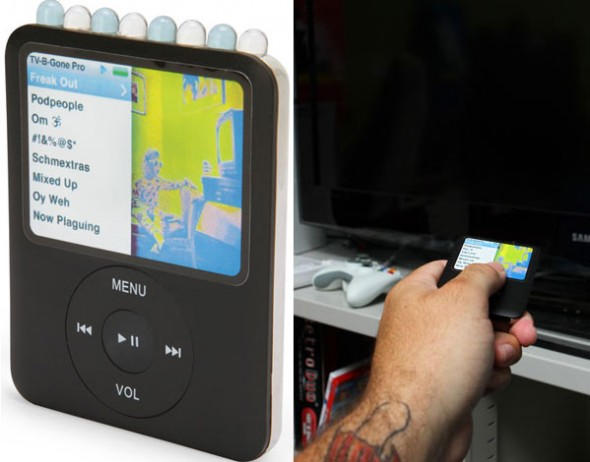
TV-B-Gone is a small, portable device that allows you to remotely turn off televisions, and consequently it’s easily one of the most irritating, selfish and pretentious gadgets on Earth. Now it looks like an iPod.