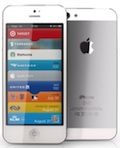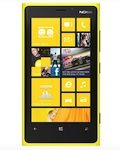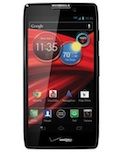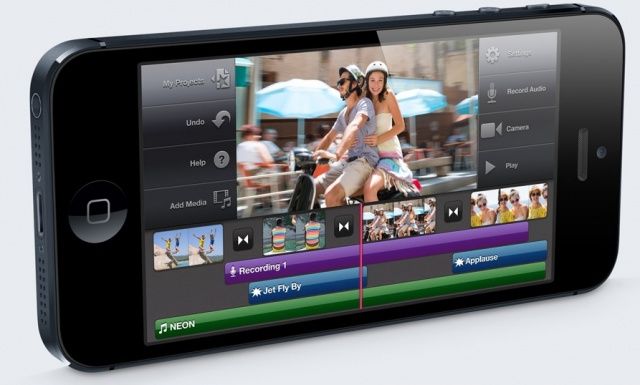
Today, Apple made official the eagerly-awaited latest version of the world’s most popular smartphone, the iPhone 5. Apple has historically been a trendsetter when it comes to building smartphones, using cutting-edge technology and top-of-the-line materials, but over the past few months, the competition — Samsung, Motorola, Nokia and HTC — have started catching up.
So, spec-by-spec, how does the iPhone 5 stack up? We have compared the specs of the iPhone 5 with the iPhone 4S, Nokia Lumia 820, Nokia Lumia 920, Motorola DROID RAZR HD, Motorola DROID RAZR MAXX HD, Motorola DROID RAZR M, Samsung Galaxy SIII and the HTC One X. To see how the iPhone 5 fares, check out the comprehensive table below.
Please scroll the table left and right to see all of its contents
iPhone 4S
iPhone 5
Nokia Lumia 820
Nokia Lumia 920
Motorola DROID RAZR HD
Motorola DROID RAZR MAXX HD
Motorola DROID RAZR M
Samsung Galaxy SIII
HTC One X
Operating System
iOS 5/6
iOS 6
Windows Phone 8
Windows Phone 8
Android 4.0.4 Ice Cream Sandwich
Android 4.0.3 Ice Cream Sandwitch
Display
3.5-inch Retina display (960×640)
4-inch Retina display (1136×640)
4.3-inch AMOLED display (800×480)
4.5-inch PureMotion HD+ display (1280×768)
4.7-inch Super AMOLED display (1280×720)
4.3-inch Super AMOLED display (540×960)
4.8-inch Super AMOLED display (1280×720)
4.7-inch Super LCD 2 display (1280×720)
PPI
326
326
217
332
312
312
256
306
312
Processor
800MHz dual-core A5
1.2GHz dual-core A6*
1.5GHz dual-core Snapdragon S4
1.5GHz dual-core
1.5GHz dual-core
1.5GHz dual-core
1.5GHz dual-core Snapdragon S4
1.5 GHz quad-core ARM Cortex-A9
RAM
512MB
1GB*
1GB
1GB
1GB
1GB
1GB
1GB-2GB
1GB
Storage
16GB, 32GB, 64GB
16GB, 32GB, 64GB
8GB + microSD slot
32GB
12GB + microSD slot
32GB + microSD slot
8GB + microSD slot
16GB, 32GB, 64GB
32GB
Camera(s)
8MP (rear) with f2.4 + VGA (front)
8MP (rear) with f2.4 + 1.3MP (front)
8MP PureView (rear) + VGA (front)
8.7MP PureView (rear) + 1.3MP (front)
8MP (rear) + 1.3MP (front)
8MP (rear) + 1.9MP (front)
8MP (rear) + 1.3MP (front)
Video
1080p
1080p
1080p
1080p
1080p
1080p
1080p
1080p
1080p
Wireless
UMTS, HSDPA, HSUPA, GSM, CDMA
UMTS, HSDPA, HSUPA, GSM, CDMA, LTE
GSM, WCDMA, LTE
GSM, WCDMA, LTE
HSDPA, GSM, LTE
HSDPA, GSM, CDMA, LTE
UMTS, HSDPA, HSUPA, GSM, CDMA, LTE
UMTS, HSPA, HSPA+, GSM
Bluetooth
Bluetooth 4.0
Bluetooth 4.0
Bluetooth 3.1
Bluetooth 3.1
Bluetooth 4.0
Bluetooth 4.0
Bluetooth 4.0
Bluetooth 4.0
Bluetooth 4.0
Wi-Fi
802.11b/g/n
802.11 b/g/n
802.11a/b/g/n
802.11a/b/g/n
802.11a/b/g/n
802.11a/b/g/n
802.11a/b/g/n
802.11a/b/g/n
802.11a/b/g/n
Dimensions
115.2 x 58.6 x 9.3 mm
123.83 x 58.57 x 7.6 mm
123.8 x 68.5 x 9.9 mm
130.3 x 70.8 x 10.7 mm
131.9 x 67.9 x 8.4 mm
131.9 x 67.9 x 9.3 mm
131.9 x 67.9 x 8.4 mm
136.6 x 70.6 x 8.6 mm
134.4 x 69.9 x 8.9 mm
Weight
140 g
112 g
160 g
185 g
146 g
157 g
146 g
133 g
130 g
Battery
1,432 mAh, 3.7V
1,440 mAh, 3.8V
1,650 mAh
2,000 mAh
2,530 mAh
3,300 mAh
2,000 mAh
2,100 mAh, 3.8V
1,800 mAh
Please scroll the table left and right to see all of its contents
Editor’s Note: Specs with an asterisk are suppositions right now. We will update when we have exact specifications.
John Brownlee is a writer for Fast Company, and a contributing writer here at CoM. He has also written for Wired, Playboy, Boing Boing, Popular Mechanics, VentureBeat, and Gizmodo. He lives in Boston with his wife and two parakeets. You can follow him here on Twitter.

Subscribe to the Newsletter
Our daily roundup of Apple news, reviews and how-tos. Plus the best Apple tweets, fun polls and inspiring Steve Jobs bons mots. Our readers say: "Love what you do" -- Christi Cardenas. "Absolutely love the content!" -- Harshita Arora. "Genuinely one of the highlights of my inbox" -- Lee Barnett.
Next time you make a comparison table, make it so that it expands fully in a new tab or pop-out. Its really annoying and inefficient trying to compare that many products / features when you have to scroll each time.
true
Next time you make a comparison table, make it so that it expands fully in a new tab or pop-out. Its really annoying and inefficient trying to compare that many products / features when you have to scroll each time.
It would be nice to find out which competitors are over clocking slower chips to these faster speeds and the problems associated with it. Many of these Android phones are overclocked chips.
Sooooo…..this means the iPhone, the new iPhone 5, the latest and greatest, is an iPhone that has finally caught up to the specs of many other competitors, some of which have been on the market for a while already.
I’ve enjoyed my iPhone 4, but the 4S and this have been such small upgrades, twice in a row, that I’m loosing my enthusiasm.
Everybody complains instead of just looking at the damn list. Guys, it’s not hard, just scroll the list over. It’s possible on an iPhone, an iPad, and probably other Android devices too. Just shut up and bask in what Apple just did today.
As we’ve seen many times before, bigger/better specs do not necessarily make a better user experience. Windows computer specs can make standard Mac specs look tame but will produce a much less satisfying experience to use due to the OS and the overall workability and reliability. Apple has always had this in spades.
Instead of using Retina Display in the comparison how about the dpi comparison that will provide a better comparison for users to see. As for the GS3 processor, you should reflect Dual Core S4 (US) and Quad Core Exynos for Non US Models.
Now Apple has fragmentation in the iP5 LTE variants, 3 models for across the globe so you really can’t have a uniform LTE model yet. Seriously how long will that take 5 years for the chip companies to get their act together.
Most of the categories in the chart are just features that the manufacturers pile onto the phone by purchasing specific off the shelf components rom a supplier. Thickness and weight however (and the proprietary processor chip) reflect real design and development heavy lifting. That’s real engineering and problem solving that goes on there, it’s not a matter of merely buying off the shelf parts and slapping them together with as little airspace as possible. And guess who beats everyone else on those categories.
18 responses to “The iPhone 5: How It Stacks Up Against The Competition [Chart]”
Next time you make a comparison table, make it so that it expands fully in a new tab or pop-out. Its really annoying and inefficient trying to compare that many products / features when you have to scroll each time.
true
Bravo on this chart!! I’ll be sure to read it on another site that makes it readable.
Correction: iPhone 5 sports 802.11 a/b/g/n. You skimped out on the ‘a’
I’m happy with my 4S. Will wait for 5S to upgrade.
why is the chart like this!! it makes me NOT wanna read it!
FYI – You have the wrong processor listed under the Galaxy S3. It’s powered by a Quad-core Exynos processor.
That’s on the overseas versions only. ALL US versions have dual core.
It would be nice to find out which competitors are over clocking slower chips to these faster speeds and the problems associated with it. Many of these Android phones are overclocked chips.
Sooooo…..this means the iPhone, the new iPhone 5, the latest and greatest, is an iPhone that has finally caught up to the specs of many other competitors, some of which have been on the market for a while already.
I’ve enjoyed my iPhone 4, but the 4S and this have been such small upgrades, twice in a row, that I’m loosing my enthusiasm.
Everybody complains instead of just looking at the damn list. Guys, it’s not hard, just scroll the list over. It’s possible on an iPhone, an iPad, and probably other Android devices too. Just shut up and bask in what Apple just did today.
As we’ve seen many times before, bigger/better specs do not necessarily make a better user experience. Windows computer specs can make standard Mac specs look tame but will produce a much less satisfying experience to use due to the OS and the overall workability and reliability. Apple has always had this in spades.
Instead of using Retina Display in the comparison how about the dpi comparison that will provide a better comparison for users to see. As for the GS3 processor, you should reflect Dual Core S4 (US) and Quad Core Exynos for Non US Models.
Now Apple has fragmentation in the iP5 LTE variants, 3 models for across the globe so you really can’t have a uniform LTE model yet. Seriously how long will that take 5 years for the chip companies to get their act together.
Most of the categories in the chart are just features that the manufacturers pile onto the phone by purchasing specific off the shelf components rom a supplier. Thickness and weight however (and the proprietary processor chip) reflect real design and development heavy lifting. That’s real engineering and problem solving that goes on there, it’s not a matter of merely buying off the shelf parts and slapping them together with as little airspace as possible. And guess who beats everyone else on those categories.
the table works great on a rMBP, is the side scrolling the issue? Or do people dislike have to scroll in the first place?
the iphone 5 has a/b/g/n wireless network not just b/g/n