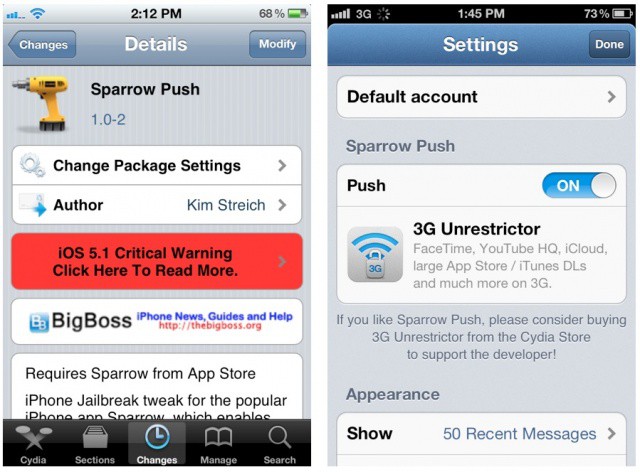
Sparrow Push brings badge notifications to the iPhone's newest email app.
A new jailbreak tweak adds push notifications to the popular iPhone email app called Sparrow. We’ve already shown you a roundabout way to get push for Sparrow with the Boxcar app on a non-jailbroken iPhone, but you can now easily enable notifications with a Cydia tweak called Sparrow Push.
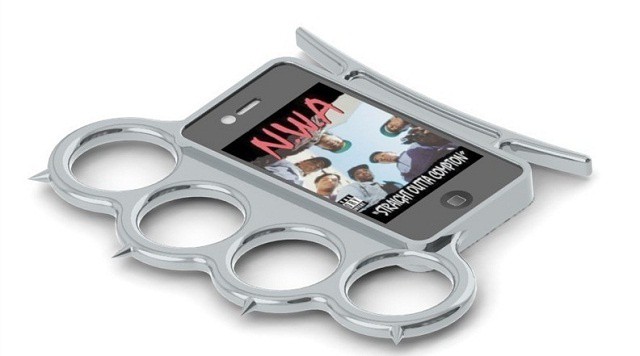
Nothing comes between me and my iPhone thanks to the iKnucks case
This brass knuckles iPhone case isn’t straight out of Compton, it IS Compton. Meet the iKnucks – the iPhone case that doubles as a set of vicious brass knuckles. What better way to protect yourself from muggers than slipping this mean puppy around your fingers and throwing some haymakers?
Mike Daisey performing his one-man show, "The Agony and the Ecstasy of Steve Jobs"
Mike Daisey, the man behind the hugely popular show that highlights Apple’s manufacturing environment at Foxconn, has received heavy media criticism since This American Life revealed that he had lied and given inaccurate information about his trip to China. Daisey continues to perform his show at theaters in the United States, and he says he still stands by his work.
Would this fry cook be better off investing in Apple stock?
When asked today why it was going to begin paying out an ongoing quarterly dividend of $2.65 per share to stockholders, one reason Apple cited for the new plan was that it wanted to “generate income” for its investors, and consequently attract investors for whom a dividend was an investment necessity.
It got us thinking. Apple says it wants to generate income for its shareholders, but $2.65 per quarter per share is a pretty small amount. How much stock would you need to own to even earn minimum wage from dividend payments?
The answer might surprise you, and will surely put into perspective the size of the investments Apple is hoping to attract.
Comixology is in the process of updating its hugely popular comic book reader for the iPad to take advantage of the third-generation tablet’s Retina display. The next update to Comics is expected to hit the App Store soon, bringing with it high-resolution comics that look “mind-blowing”
Thou Shalt Have No Other Tech Gods Before You But Me
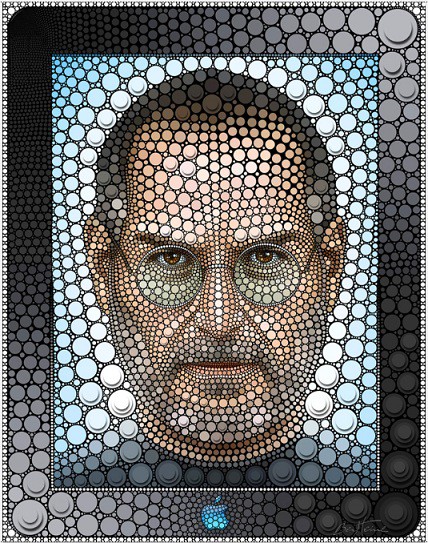
Alright, maybe to you this amazing “Digital Circlism” portrait is pretty freaking awesome, but it gives me the willies. There’s something weird about having Steve Jobs blast me with his death stare in a mosaic-esque picture. Like he’s God or something. Maybe he is. Regardless of whether it’s creepy or straight up bomb diggity, we think think this portrait of Steve Jobs is actually pretty rad.
Its creator, Ben Heine, has created a series of portraits like this one using a technique he calls Digital Circlism. It’s a synthesis of Pop Art and Pointillism that uses digital tools and flat circles to recreate celebrity portraits.
Underage workers, health hazards and debilitating overtime are findings echoed by sociologist Dr. Boy Lüthje, who has spent the last decade researching labor conditions at China’s contract manufacturers where U.S. tech giants including Apple, Dell and HP make the electronic devices that populate our homes.
(You can read Cult of Mac’s exclusive interview with him here.)
Along with a team of researchers, he’s the author of a forthcoming academic work titled From Silicon Valley to Shenzen. The data here, Lüthje notes, is from late 2009 (before the wave of suicides hit Foxconn) but the general conditions remain largely unaltered. When it hits shelves, the book will include updated comments on Foxconn and Apple, he says.
Publisher Rowman & Littlefield granted Cult of Mac permission to publish an excerpt from Chapter 4, which similarities between electronics assembly plants in Mexico, China and Eastern Europe.
Adapted from CC-licensed photo by Mrbill on Flicker.
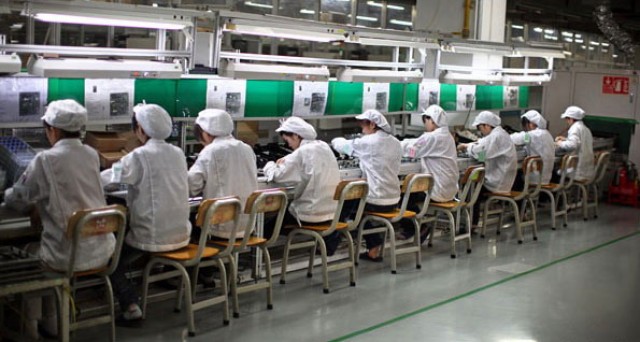
If you own an iPhone, laptop, Kindle, Android device, electric toothbrush, baby monitor or GPS navigator, it was probably put together by a worker in a Chinese factory.
Although Apple is currently juggling the PR hot-potato over working conditions at Foxconn plants in China, a situation made more murky by the factual takedown of Mike Daisey’s monologue, dozens of other global companies make their must-have electronics there.
For a wider perspective, Cult of Mac tracked down one of the world’s leading experts on modern labor in Asia.
NetZero launches freemium contract-free 4G service
NetZero made a name for itself in the late nineties by offering free ad-supported dialup Internet access before turning to a low-cost model (still available for dialup and and basic DSL). NetZero is returning to its free/freemium roots with today’s announcement of a contract-free 4G service. The service offers several tiers of data use with the first one being free beyond purchasing a 4G device.
While intriguing, the free service tier definitely illustrates the “you get what you pay for” addage. Some of the other tiers are attractive, but there are some downsides and, quite frankly, a Verizon 4G iPad may be a much smarter investment in the long run.
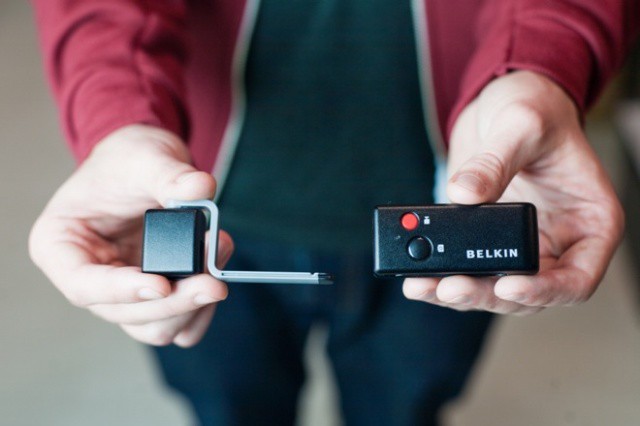
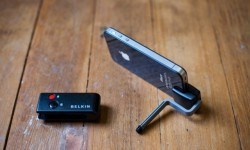
I start to feel twinges of separation anxiety when I get more than a few meters away from my iPad, so I can’t really imagine why anybody would want to use a remote shutter release for their iPhone that can trigger the camera from up to 30 feet away. But here it is, for you braves souls who can manage to cut the iApron stings: the iPhone Shutter Remote, from Photojojo and Belkin.
Apple’s not exactly the kind of company that boasts lightly. That’s not to say they don’t boast a lot — they’re probably the most bragging of all the companies in tech, and for damn good reason — but every boast is weighted against genuine success, not numbers fudging.
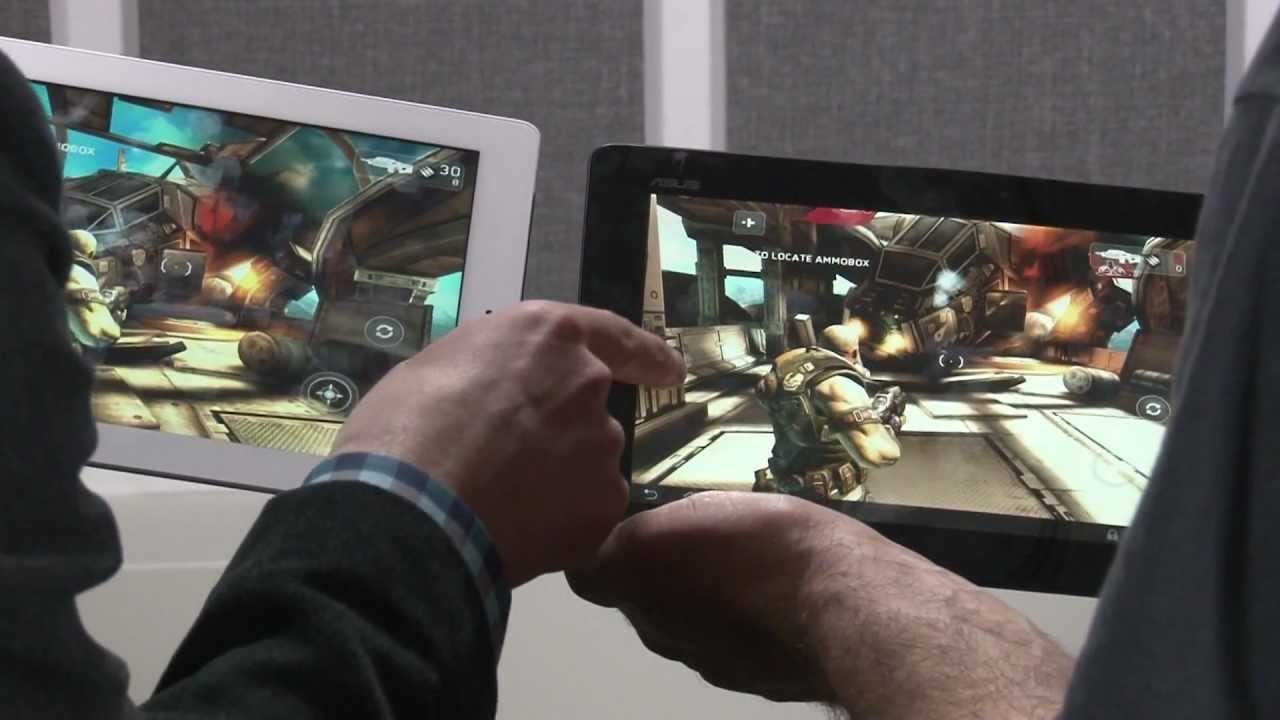
So when Apple debuted the new iPad a couple weeks ago and claimed that their tablet — powered by a dual-core CPU and quad-core graphics — outperformed the quad-core CPU and 12-core graphics of the NVIDIA Tegra 3 SoC, a lot of people arched their eyebrows. NVIDIA raised a stink, saying it couldn’t possibly be true. But we quietly suspected that Apple would be proven right.
So guess which is faster in independent benchmarks?
The new iPad can run on AT&T's 4G LTE network in select areas of the United States.
Following this morning’s comment from Apple CEO Tim Cook that the company is absolutely “thrilled” with its launch weekend sales for the new iPad, AT&T has confirmed record single-day sales and activations for the new tablet.
Apple’s new iPad packs a number of new features that the Cupertino company has been quick to boast about since its unveiling, but there is one that it’s yet to mention: Take the tablet to bed on a cold winter’s night and after half an hour’s reading you’ve got yourself a nice warm slab of aluminum to cuddle up to you.
Unlike its predecessor, the new iPad seems to be suffering from some overheating issues during prolonged periods of use. And it’s causing a number of early adopters to become pretty concerned.
The China Labor Bulletin (CLB) has spoken out after an episode of This American Life, which highlights the poor working conditions at one Chinese factory, was retracted last week, making it clear that this does not clear Foxconn’s name. “The press and stock investors will continue to watch how Foxconn treats its workers,” the CLB made clear.
iPad ban during takeoff/landing being reconsidered
Anyone who’s ever flown is familiar with the “please turn off all electronic devices” speech that flight attendants give after closing the airplane door and again shortly before landing. The ban on electronic devices of all kinds exists out of fear that devices might interfere with the planes navigation and other systems, even if the device doesn’t include any sort of radio antenna.
The ban on electronic devices has come under fire recently as the F.A.A. has been certifying the use of iPads in the cockpit during all phases of flight (including takeoff and landing) by various commercial airlines as a replacement for hefty “flight bags” of paper manuals and charts.
In a move that will music to the ears of Words With Friends addict Alec Baldwin, the agency is looking at allowing the use of electronic devices by passengers during takeoff and landing
Old computers never really die, they just get passed on to grandkids and collectors. Likewise old computer users never die, they just don’t get out as much as they used to. The internet is an unfriendly place for 8 bit processors and dialup modems.
To help relive old memories and make new ones, several festivals dedicated to computers with no commercial value make the rounds each year. This year for our vintage geek pleasures: the perennial Apple II bash called KansasFest, and the Vintage Computer Festival East.
Activision Product Director Noah Heller talked with T3 a bit about their Call of Duty Elite app and its natural progression from smartphone to tablet.
“We’re working on the tablet app right now, I can’t tell you much about it but what I can tell you is that it will be a truly native, customised application for the tablet, it’s not just a simple port.”
Bringing COD Elite to the tablet has many advantages to the smartphone counterpart as it allows Activision to take advantage of the additional screen space. What additional features will be added to the tablet app remain a mystery but there’s been talks about possibly adding live Heat Maps among other things.
Apple wasn’t willing to go on record with the new iPad’s initial launch figures just yet, but when quizzed about it during the Q&A session of today’s announcement of an official dividend and stock repurchase plan, Tim Cook did let slip a bit about how well the new iPad had done.
Confirming a press release from just ten minutes earlier, Apple CEO Tim Cook has confirmed that Cupertino will use its vast hoard of cash to initiate a quarterly dividend payment to current shareholders, as well as buy back almost $10 billion in stock to help avoid dilution of employee equity.
The conference call announced for 9 a.m. this morning hasn’t even happened yet, and Apple’s already announced what they are doing with the cash: initiating a $10 billion share repurchase plan, as well as issue dividends and make strategic investments. All told, they expect to spend $45 billion over the next three years.
We’ll give you more details when the call starts, but for now, here’s the press release.
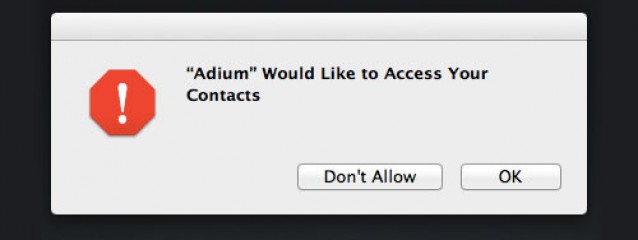
We finally have control over our contacts in Mountain Lion.
In addition to the new features we detailed earlier today, Apple’s second OS X Mountain Lion beta adds a nifty security feature that will prevent third-party applications from accessing your contacts without your permission.
Who ever thought that Instagram would be a source for product leaks? But it looks like the iOS-only photo-sharing service has inadvertently outed the successor to the Lumix GF3 — the GF5.
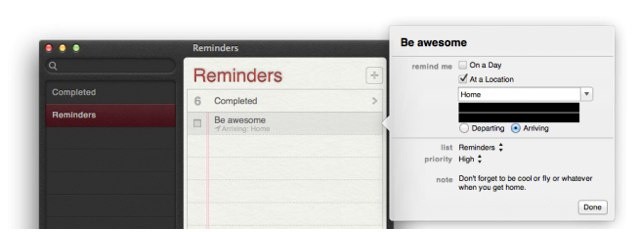
A location-based reminder in Mountain Lion beta 2.
Following the release of Apple’s second Mountain Lion beta late last week, registered developers have been stumbling across a number of new features that weren’t present in the first beta. These include Twitter notifications, “iCloud Tabs,” and location-based reminders.
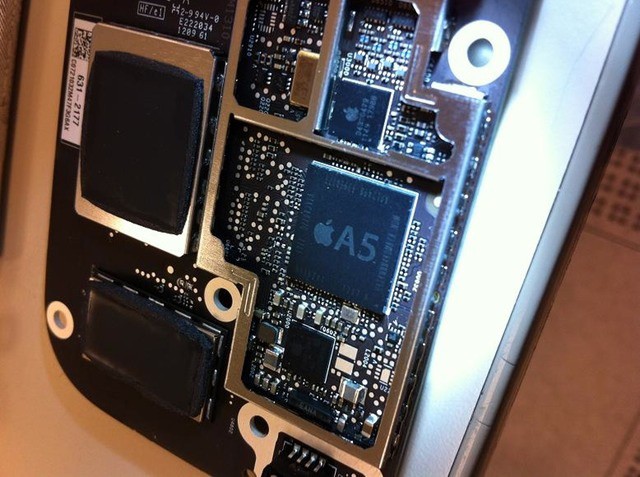
This is what we like to see: Geeks ripping open their own gear and posting the photos to prove it
The new Apple TV has been opened up to reveal the same old 8GB of storage, along with 512MB RAM — double that of the previous generation Apple TV. XBMC forum member aicjofs got bored one day and decided to rip open his own Apple TV to see what was inside — a nerd after our own hearts.
Apple has issued a press release announcing a conference call it will be holding tomorrow morning to discuss the “outcome of the Company’s discussions concerning its cash balance.” In case you didn’t know, Apple is sitting on nearly $100 billion in cash, making it the most valuable company in the world.
The call will be hosted by Apple CEO Tim Cook and the company’s CFO, Peter Oppenheimer, on March 19th at 6:00 A.M. PDT/9:00 A.M. EDT. Could AAPL shareholders finally receive dividends?