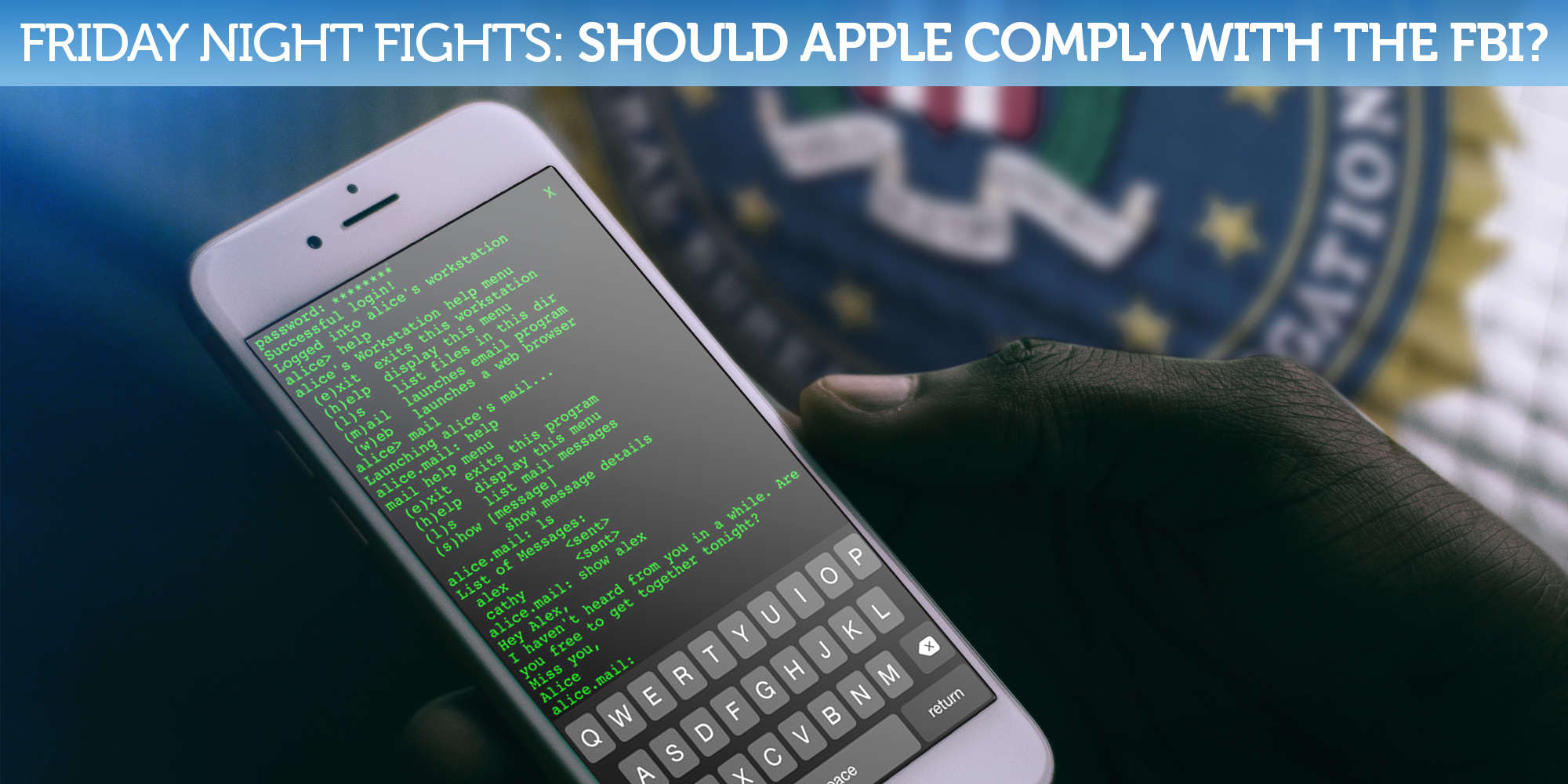
Apple’s fight against the FBI continues to dominate headlines, with the company standing firm to protect its beliefs and the privacy of its users. But should it really be doing more to help law enforcement agencies?
 No one who uses Apple products wants it to compromise the security of iOS by creating dangerous backdoors, but should it be working to find a safer solution that would provide the FBI with information when it’s needed?
Join us in this week’s Friday Night Fight between Cult of Android and Cult of Mac as we battle it out over this hot topic — and be sure to weigh in at the end with your opinion!
 Luke Dormehl (Writer, Cult of Mac): After a couple of weeks away, it’s great to be back, Killian. Nothing like a battle of wits (or, well, whatever the equivalent is among Android users) to finish off the first week back at the grindstone in top fashion!
So clearly the FBI’s battle with Apple regarding creating a backdoor in iOS is the biggest subject of the week — and may well turn out to be the biggest tech story of the year and Tim Cook’s ultimate legacy at Apple.
It’s a complicated issue, but ultimately Apple’s fighting on the side of the angels here. It’s not just about the specifics of this one case: I don’t think a single person reading this is likely to support terrorism and want the FBI to be compromised in serving justice in this instance. The problem is about the precedent it would set if Apple helps break its own encryption.
We’ve never reached an inflection point like this before, and Apple’s strong stance in favor of end-to-end encryption is a battle about the future of technology. If Apple is forced to compromise its principles here, which the vast majority of its users are behind, it could have seismic repercussions.
But I understand you, to coin an Apple tagline, think different. How so?
 Killian Bell (Writer, Cult of Android): I know this is an incredibly controversial topic, so let’s get one thing straight: I completely agree that the FBI’s request is unreasonable. Apple should not create custom firmware to bypass passcode locks that has the potential to be exploited, not only by governments and law enforcement agencies, but also by malicious hackers.
But I do believe the company must find another solution that would allow it to provide the FBI and other authorities with access to user data in a secure manner under exceptional circumstances.
I’ve emphasized those three words because I want to make it clear that I do not support snooping. I am against a Big Brother state. I don’t want the police sifting through my holiday snaps and private conversations without good reason just because they can. But if they do have a legitimate reason, I think Apple should make it easier — not harder — for them to do so.
The information stored on iOS devices owned by criminals and terrorists has the potential to save lives. Blocking access to data that could foil terrorist attacks — just to prevent someone from seeing our personal information — is unethical, and it poses a risk to our security.
If a guy living in my town was a suspected terrorist, and the police had good reason to believe he was planning to carry out an attack, I’d want them to have access to all the data they need to prevent that. And I don’t think anyone who’s against terrorism wouldn’t want the same.
Law enforcement agencies aren’t interesting in accessing your data unless they have genuine reasons to do so. They don’t have the time or the resources to spy on us all for no reason. And if you’ve given them a reason to believe you’re a terrorist — and a threat to innocent people — then you don’t deserve privacy.
I think Tim Cook is right to fight against backdoors in Apple’s software. They are risky, and they should not exist. But Apple is capable of creating a safe alternative, and it should.
Photo: Olly Browning/Pixabay
Luke: Ugh. Honestly, Killian, I expected better of you! There are so many problems with what you’re saying here.
The first one is obviously a case of precedents being set. Once Apple is made to help unlock one iPhone as part of an investigation, it’s far easier for the argument to be made that they should the next time a similar case comes up. And the idea of “exceptional circumstances” as you put it can be eroded easily. What are those circumstances? It would be an easier argument to make if you said something like “We’ll only ever unlock the phone of one person if not doing it guarantees the death of innocent people,” but surely you can see how that quickly enters a gray area?
Secondly, once a backdoor has been added, it can be exploited by people other than the good guys — and that is if we’re assuming the government always constitute the good guys.
Finally, and most significantly, how much evidence do we have that the trade-off is worth it in terms of security vs. privacy? You may have other examples, but all I see when I look at how much good Section 215 of the Patriot Act did — which opened the door to the massive amounts of government snooping we face today — is how little it actually achieved in terms of avoiding acts of terrorism.
I do, unfortunately, believe that at some point Apple may capitulate to government demands, but I think there’s nothing we should be prouder of than that a giant company like Apple is actually acting in the interests of its users — and not helping turn this into a Big Brother society after fear-mongering words like “terrorism” are thrown around.
The FBI has been raging about Apple’s end-to-end encryption since the moment Apple introduced it, and I think most people can see that this case just represents a chance for it to finally try and leverage Apple to create the backdoor it’s always wanted.
Killian: Luke, you’ve totally missed my argument here.
I just stated pretty clearly that I am against backdoors, and that Apple shouldn’t unlock this iPhone in the manner being requested by the FBI. Again, it’s incredibly dangerous to create firmware that bypasses passcode locks, and I think Apple is right to fight that. It’s commendable that the company is standing up for what it believes in.
But why shouldn’t there be a better solution? Why can’t Apple — and other companies — say, “okay, we’ll give you the data you need, but you’ll have to send the iPhone to us and we’ll extract it.” That would negate the need for a backdoor that could be exploited, and it would ensure the FBI and other agencies only get the data they require.
It’s hard to tell whether mobile phone data has been successful in fighting terrorism, because it’s not easy to find the evidence; governments and law enforcement agencies aren’t keen to disclose things like that. But this data certainly can’t be unhelpful.
Just because one report says it hasn’t helped the FBI, it doesn’t mean cellphone data hasn’t prevented terrorist attacks and other crimes in other countries. And let’s not forget it’s not just about terrorism; this data could also stop other organized crimes, take pedophiles off our streets, and more. The more information intelligence agencies have to play with, the more effective they’re going to be at protecting the innocent.

Photo: Jim Merithew/Cult of Mac
Luke: But I’m asking whether that’s actually the case — or whether it’s an unforgivably high cost for people giving up their privacy. Because that’s certainly what it feels like.
The problem with your argument is that you want to have your cake and eat it: you don’t want to live in a Big Brother society, but next thing you’re saying is that the more information governments get their hands on (and you interestingly used the phrase “to play with”), the safer we all are. I don’t want to accuse you of scaremongering, but…
So what’s the “better” solution you have? And how does that help in a specific case like this where the FBI is clear about what it wants Apple to do — and it’s not to create a magical “better” solution at some unspecified point in the future.
Killian: Well, I don’t agree that there can’t be a middle ground that helps law enforcers capture criminals while maintaining the privacy of the innocent. And you keep accusing me of “scaremongering,” but I think it’s totally acceptable to be concerned about terrorism and organized crime. I’m not saying we should live in fear of it every day, but we shouldn’t be turning a blind eye to it, either. If we can make changes that help make the world a safer place, let’s do it.
I’ve already suggested one solution. I’m not saying it’s a perfect one — there are obviously downsides to that and hurdles to overcome — but it’s not my job to come up with a solution. As you mentioned earlier, there is a concern that Apple will be forced to give in later, and the government gets its own way. But if we can find a better process in the meantime, that may not need to happen.
On that note, I think it’s time you and I passed this one over to the readers. How do you feel about this? Is there a middle ground between backdoors and encryption? Should Apple and other companies find a better solution that help the FBI and others? Let us know down in the comments.

Killian Bell is a freelance writer based in the U.K. He has an interest in all things tech and also covers Android over at CultofAndroid.com. You can follow him on Twitter via @killianbell.

8 responses to “Our Android guy says Apple should help the FBI [Friday Night Fight]”
Absolutely NOT
“Our Android guy says Apple should help the FBI [Friday Night Fight]”
Respectfully, I strongly disagree with Killian on the notion of “under exceptional circumstances.” This is not just a slippery slope, it is more akin to stepping off right into the abyss. Besides, a terrorist attack on San Bernardino is not an “exceptional circumstance.” Trying to locate a nuclear bomb that’s about to explode, prevented only by access to an iPhone, •might• be exceptional, but for that to happen there would have been •exceptional• failures in every government security agency in the first place. To think an iPhone can keep America safe from terrorism is the reasoning of paranoids, and/or incompetents.
Interestingly, a lot of people, including presidential candidates, squawk about how the •government• should have done more to prevent the San Bernardino killings, as if that were even remotely possible. Yet the FBI—a principal government security agency, no less—feels it must have the contents of an iPhone to keep us “safe” from future attacks? Ridiculous. Likely the same people who vociferously complain that Hillary Clinton jeopardized national security by her use of a private email server (of which there as not been one reported example), have absolutely •no• concern that potentially gaining access to tens of millions of Apple devices could be devastating for personal freedom in America and other free nations around the world. But ask •one• of these flag-wavers to leave their unlocked iPhone on a park bench or a table at Starbucks and walk away, and see just how fast they value national security over personal security.
Tim Cook is doing the correct thing by refusing to compromise users’ data, and I feel certain he would go to jail rather than comply with this dangerous precedent.
I’m not sure what Killian is arguing here. The current security model for iOS (and Android) is to encrypt storage using a combination of data, including a key that (presumably) only the user knows. There are safeguards in place protecting the weakest link in that chain: the passcode. Creating a way to remove those safeguards breaks the model and is a backdoor.
The android guy talks BS. If Apple can in any way retrieve the data, then so can anyone else. That’s the whole point. You’re “suggestion” isn’t viable. There isn’t middle ground. Encryption is binary. Its either yes or its no. Its not yes, maybe, no.
I’m an Android user, for the most part I use Nexus only devices, currently my daily is a Nexus 6. But at the same time I use Mac OS X as my desktop machine, I have to completely disagree, there should be no backdoors what so ever. This is a gateway to bigger issues down the road. Whats next backdoors on Filevault or a backdoor for Android. No thanks!! Luckily for some of us we know how to code and understand what is at stake here. For example if for lets say there is an exploit for OpenSSH and a patch for it has been released but Apple still hasn’t released the official patch I can simply brew install and link the binary over. We all know we can on an Android device root our devices and install whatever rom we want along with modify certain binaries and configurations, hence the XDA community. All in all I’m glad to be an Android user, for the simple fact that I can create and lock down my smartphone with a large array of vectors. Thank god for F-Droid and the Guardian Project, besides I store everything critical on a Sansdisk Wireless flashdrive….lets see how long it takes to brute force an alpha-numeric 24 character password…
Your argument “… thank god some of us know know how to code…” is tantamount to the argument: I’m holding the gun, so I’m the stronger guy here and I say what’s what.
As a society as a whole, we have to come up with a way of dealing with one another and of dealing with the bad apples among us. That is the issue here. And there are people out there that want to do harm. That’s a fact. So we as a society have to come up with a way of dealing with them.
One of the ways we came up with was, to have democratically elected governments and democratically designed and implemented legal systems. Legal systems that are basically just balancing the interests of the many with the interests of the individual. And that’s all it is: a balancing act.
In the case of accessing information based on a court order we have to assume that the courts are working legitimized by and for the people, so we have to comply with them or else that whole system doesn’t make any sense.
If, of course, someone lives under the premise: it’s me against the rest of the world and majorities don’t mean anything to me because they force me to change my way of life in order for society as a whole to get ahead, then to that person my whole argument above doesn’t make sense. I understand that.
But people have to understand the balancing act of being an individual with rights but also with responsibilities towards the other individuals out there.
And that’s why we have political institutions and formed governments, because otherwise it’s the rule of force. I can’t believe that anyone would really want to aspire to that form of society.
Harkening back to the first Apple Super Bowl commercial, Apple is still on mission not to make 2016, or any year, like “1984”
Ok, Killian…make an unencrypted copy of all data that resides in your phone and publish it, unencrypted and unmodified/uncensored, to the web for us all to look at and analyse. A week after you do that, you come back and tell us you want there to be a way for anybody, even Apple itself, to get into your phone.