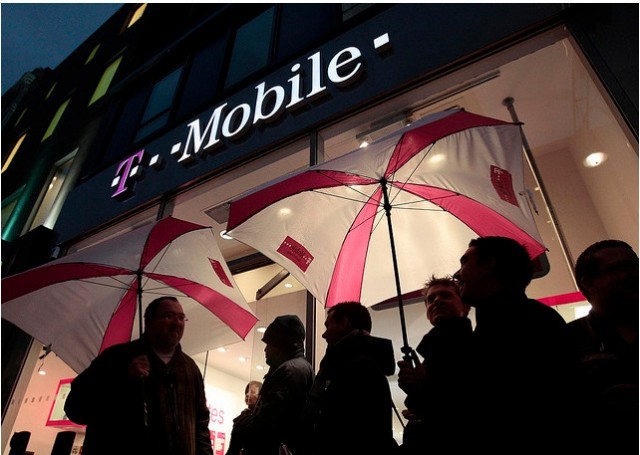
Yesterday we told you about AT&T’s decision to back out of its proposed $39 billion merger with T-Mobile. After facing heated scrutiny and antitrust concerns from both the Federal Communications Commission and Department of Justice, AT&T couldn’t take the heat any longer.
As part of the deal falling through, AT&T has agreed to pay T-Mobile $3 billion in cash for breakup fees. The money combined with the two carriers’ spectrum and roaming deal makes T-Mobile the only winner of the failed merger.
Deutsche Telekom, T-Mobile’s parent company, has worked out a deal with AT&T that gives T-Mobile USA several new perks. On top of the cash (which isn’t really that significant at this scale) T-Mobile also receives spectrum licenses from AT&T in 128 US markets and a 7-year roaming agreement with AT&T that expands T-Mobile’s potential customer base by 50 million subscribers.
The merger wasn’t approved for obvious reasons: no one wants to give AT&T more power than it already has, and the more competition there is in the US carrier space the better. While T-Mobile is the least-powerful ‘big’ player left, the GSM carrier still has a fighting chance.
Macworld reports that AT&T will give T-Mobile Advanced Wireless Services (AWS) spectrum in 12 of the top 20 US cities, including San Francisco, Boston, Atlanta, Washington, Los Angeles, Dallas, and Seattle. The two carriers’ 7-year roaming agreement will give T-Mobile 3G access to many parts of the country that it couldn’t previously reach, increasing the network’s reach by 50 million customers to 280 million.
AT&T, Verizon, and Sprint all offer the iPhone, so T-Mobile is the only major carrier left out in the cold. Many have speculated that the iPhone 4S would be announced on T-Mobile, and the merger with AT&T could very well be the reason that Apple decided to not partner with T-Mobile in 2011. Why partner with a carrier that’s about to be bought by another carrier you’re already in bed with?
Now that T-Mobile’s fate as an independent carrier is assured, is it possible that we will see a T-Mobile iPhone in 2012? Something like the iPhone may be what T-Mobile needs to become relevant again. Then again, it could already be too late.
12 responses to “Only Winner Of Failed AT&T Merger Is T-Mobile”
Monopoly is only good for fool!
” … The merger wasn’t approved for obvious reasons: no one wants to give AT&T more power than it already has, and the more competition there is in the US carrier space the better.
… “
???
Only Winner Of Failed AT&T Merger Is T-Mobile???
Does that mean we can now get T-Mo service in places where AT&T has coverage and T-Mo does not (like parts of the Poconos)?
To me it appears as if T-Mobile is the biggest loser here. I’m not sure at all that their future as independent provider is assured.
Other winners: cell phone customers everywhere, and I think it makes CLEAR spectrum worth more so they may also be more viable.
AT&T gained nothing and lost a lot! How are they not the biggest losers? T-Mobile gets $3 billion and great spectrum and roaming agreements, all for free. They’re much better off than they were before the merger started.
Sure, they have $3b more, but they’re still losing money and customers and they’re still in danger.
Also, in order to see who’s the biggest loser of the cancelled merger, you mustn’t compare them to their pre-merger self, but to the status they’d be in after a successful merger. Compared to that, AT&T may have lost, but T-Mobile even more so.
Deutsche Telekom, is the only winner. The money goes to them, not the T-Mobile USA Subsidiary. Deutsche Telekom put T-Mobile USA up for sale because they don’t wish to do business in the US anymore. Sprint bid but didn’t have the money. Verizon wasn’t interested. AT&T had the winning bid.
The end result is that most of the money will probably go to Deutsche Telekom shareholders and T-Mobile will be sold piecemeal to regional and second-tier carriers. The marketplace will still lose a carrier and the landscape will be exactly like it would be after the proposed merger. Consumers are not winners, T-Mobile USA is not a winner. Deutsche Telekom is the sole winner. Especially since Sprint just spent the $30 Billion they bid on T-Mobile on iPhones.
AT&T gains free roaming on the entire T-Mobile Spectrum. The money doesn’t go to T-Mobile USA but their parent company.
Doubtful. If they don’t have towers in the area, they won’t have sales and support for it either. However if you buy a T-Mobile phone in an area they cover, you can roam to the Poconos and continue using it once the roaming agreements are in effect.
I doubt that T-Mobile is going anywhere, it is one of the only profitable companies that Deutsche Telecom owns, it’s also one of the few profitable US carriers (that’s why it was a target for an acquisition in the first place).
Also regardless of which entity of Deutsche Telecom is getting the $3B (it’s one company anyway), T-Mobile is the only one that can get the spectrum and roaming agreements.
Having said that, a spinoff or a different buyout (Dish, Google, Comcast …) may not totally be out of the question. Either way T-Mobile will likely stay and continue to grow in my opinion.
It looks to me like some T-Mobile executives should be having a nice holiday this year. Whoever had the cajones at T-Mobile to stick their neck out on a deal like this and then come out with $3 billion and additional spectrum in exchange *for basically nothing* deserves to be rewarded. ESPECIALLY if they’re getting it from AT&T!
Does this spectrum license mean the iPhone will finally take advantage of the 3G and 4G speeds while still using T-Mobile service?

