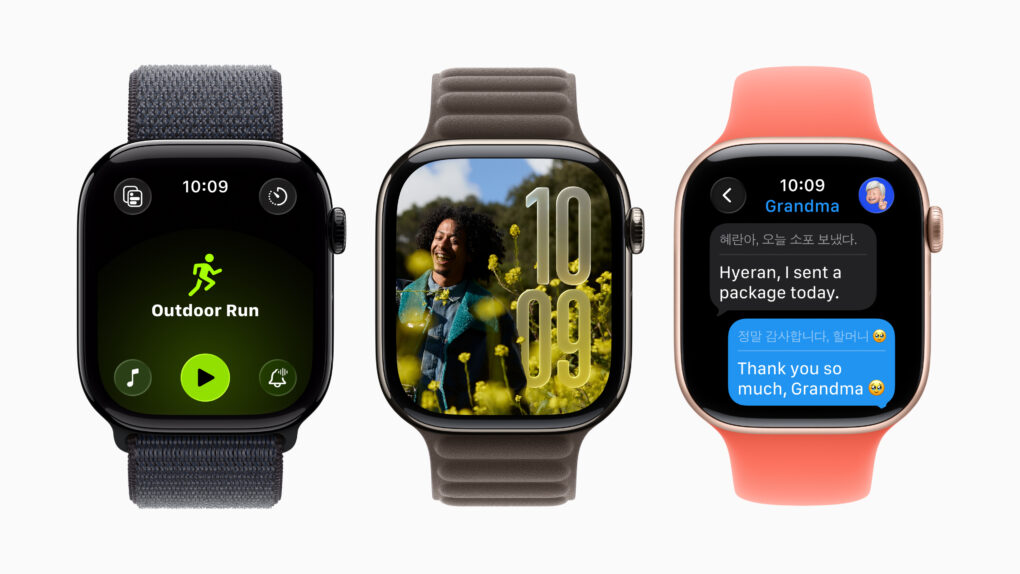
The display in your Apple Watch may already seem pretty great, but a new type of screen technology in development could make models in the next year or two even better by running for longer on a single charge, according to a new report.
Next-gen OLED Apple Watch displays
LG Display currently works on a high-mobility oxide (HMO) thin-film transistor (TFT) backplane technology for use in its sixth-generation small and medium-size OLED production lines, according to a new report from The Elec. And Apple weighs HMO as a potential next-generation, low-power successor to low-temperature polycrystalline oxide (LTPO) TFT technology. That’s the backplane tech currently powering features like always-on displays and variable refresh rates in recent iPhone and Apple Watch models.
Making the switch to HMO could lead to better power efficiency and, therefore, longer battery life in your next Apple Watch.
Why does HMO matter?
To understand some of the specifics of why this matters, a quick primer on display backplanes helps. A TFT backplane is the layer of transistors beneath an OLED screen that controls how current flows to each pixel. The efficiency of this layer has a direct bearing on how much power the display consumes.
Unlike LTPS and LTPO, oxide TFTs skip manufacturing steps such as laser crystallization and ion implantation. That gives them a natural advantage for low-power operation. Widely used LTPO blends the strengths of both LTPS and oxide technologies. But HMO pushes further by fully capitalizing on oxide’s inherent advantages of reduced power draw and lower production costs, according to the report.
The electron mobility challenge
The catch with oxide TFT technology has historically been performance. Conventional oxide TFTs have struggled to keep up with high-resolution and high-refresh-rate OLED applications because of comparatively low electron mobility. That’s a measure of how freely electrons travel through the transistor material under an electric field. Next-gen OLED tech could significantly increase it.
LG Display appears to tackle the challenge with a manufacturing method already familiar in display production. The company uses sputtering, a thin-film deposition technique already widely established in oxide processes. It makes integration with current production infrastructure comparatively straightforward.
Samsung Display, by contrast, reportedly pursues atomic layer deposition (ALD) on its Gen-8.6 line. That’s a slower but more precisely controlled approach to building up the transistor layer.
Apple Watch serves as a testing ground
Industry observers expect OLED panels for devices such as the Apple Watch to be the first application for LG Display’s HMO technology, with one source noting that LG Display is anticipated to begin supplying the technology for smartwatches next year.
That would follow an established pattern. According to one industry source, Apple has historically validated new backplane technologies with LG Display for smartwatches first, then broadened the development scope to both Samsung Display and LG Display as the technology moves toward mobile devices. In other words, the Apple Watch frequently serves as a proving ground before new display advances reach the iPhone.
Apple’s preference for sourcing from multiple suppliers limits reliance on any single vendor and strengthens its negotiating position. And it also supports the case for LG Display bringing HMO to market via the Watch first.
Not a done deal
Despite the promising outlook, meaningful hurdles remain. LG Display still needs to confirm HMO’s suitability for mass production on its Gen-6 lines, with electron mobility, process temperature, uniformity, reliability and yield all representing critical open questions. The final product lineup and commercialization schedule remain tentative, with actual adoption depending on customer timelines and the results of equipment validation.
It’s also worth noting that the 2027 Apple Watch lineup isn’t expected to bring a major visual overhaul. A significant redesign is reportedly unlikely before 2028. But a display backplane upgrade wouldn’t necessarily show up in the mirror anyway. The payoff would show up on the battery indicator instead.

David Snow, an expert on Apple hardware and software, writes on a variety of technological and cultural topics for Cult of Mac. They include Apple news, technology buying guides, and features about computer setups and Apple TV shows and movies.
With 30 years of experience covering technology and other subjects, he has written and edited for numerous print and online publications, including CMP Media, TechTV.com, CNET, Wired News, Red Herring magazine, Law.com, The National Law Journal and Law Technology News magazine. Among other roles, he served as executive editor of the Law.com network of websites and editorial director, technology, for ALM Media.
Snow graduated with a B.A. from Syracuse University with majors in magazine journalism and psychology. While there, he worked as a reporter for The Daily Orange newspaper and associate editor of Equal Time magazine.
Founder of the blog At the Waterline, he can be reached on X (formerly Twitter) via @atthewaterline and on Mastodon via @dsnow.