The Mac Studio, Apple’s top-of-the-line desktop, delivers extraordinary CPU and GPU performance in a surprisingly compact enclosure — but many users simply cannot add as much RAM as they need.
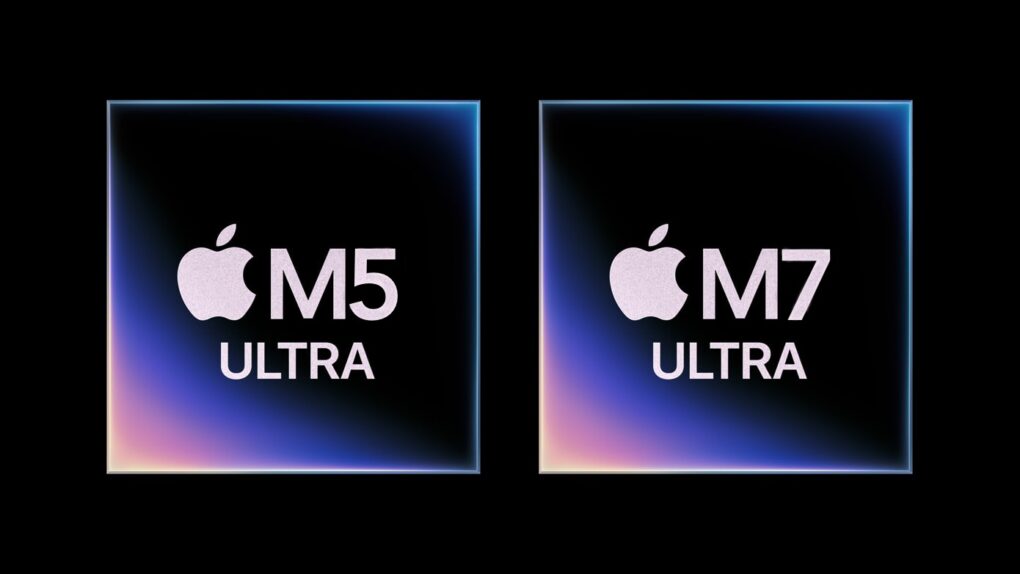
However, change is apparently on the way. Apple is reportedly developing an M5 Ultra chip that supports more unified memory than the current version. And the subsequent M7 Ultra chip will be even better — it will supposedly handle as much as three times more RAM. That’s a dramatic leap beyond the best of today’s Macs.
Mac Studio performance is limited by 512GB unified memory ceiling
After the death of the Mac Pro earlier this year, the Mac Studio became Apple’s highest-performance computer, built for professionals who need far more computing power than any MacBook. It’s designed for demanding workloads such as video production, 3D rendering, software development, music production and artificial intelligence.
The current Mac Studio version available in retail tops out at 96GB of RAM. There used to be versions with 128GB and even 512GB available from Apple, but those got discontinued amidst the recent huge rise in memory prices that’s been dubbed “RAMageddon.” (These models remain at select third-party enterprise distributors, though.)
Unfortunately, even a ceiling of 512GB proves increasingly challenging for professionals working on their largest projects these days. While it is certainly generous for software development and even 8K video production, it can quickly become a bottleneck for users training AI models, rendering feature-length visual effects, running massive engineering simulations or editing enormous scientific datasets.
Bring on the Apple M5 Ultra and M7 Ultra
The latest premium version of the Mac Studio runs on an M3 Ultra processor. The desktop and processor launched together in 2025. The rest of Apple’s computers are already on the M5 family, and an M5 Ultra is reportedly in development.
The chip has not yet been announced, but could come with as many as 36 CPU cores, up to 80 GPU cores and support for as much as 768GB of unified memory.
Looking further ahead, 2028 will bring the release of the M7 Ultra, according to an unconfirmed report from Bloomberg‘s Mark Gurman published Sunday. And it could handle a whopping 1.5TB of unified memory.
Either is certainly an improvement over the 512GB ceiling in the M3 Ultra.
Why RAM matters so much
For many professional workflows, running out of RAM is far more of a hindrance than having a slightly slower processor. Once an application fills physical memory, macOS begins swapping data to the SSD. Even Apple’s extremely fast storage chips are thousands of times slower than unified memory, causing processing to slow dramatically.
No one needs to explain this to creative professionals. Film studios routinely work with hundreds of layers of visual effects, massive RAW video files or complex 3D scenes containing billions of polygons.
And science researchers often analyze datasets taking up hundreds of gigabytes. Software developers compiling enormous codebases may run dozens of virtual machines, containers and simulators simultaneously. In each case, sufficient available memory often determines whether the workload runs efficiently.
And now artificial intelligence has made the problem even worse. Large language models consume enormous amounts of memory. Developers increasingly judge a workstation not by how many CPU cores it has, but by how large a model it can keep entirely in RAM. Every additional gigabyte allows larger models and more complex workloads to run locally instead of relying on cloud servers.
It’s an Apple silicon problem
Long-time Mac users might be aware that Apple once had a solution to this problem. The 2019 Intel-based Mac Pro supported up to 1.5TB of conventional RAM. But when the company transitioned to M-series processors in 2020, that level of expandability disappeared.
Apple silicon uses unified memory built directly into the processor package. That design dramatically increases bandwidth because the CPU, GPU and Neural Engine all access the same memory pool without copying data back and forth. The tradeoff is that memory capacity is fixed at purchase and can’t be upgraded later.
Even worse, no M-series processor released so far can handle more than 512GB of RAM. (Top-of-the-line Intel Xeon processors could take up to 1.5TB, even in 2019.) That limitation leaves some of Apple’s most demanding users without a true workstation-class desktop.
Pros should pin their hopes on Apple M5 Ultra and M7 Ultraz
The latest rumors point to the next Mac Studio arriving around October 2026 with the M5 Ultra inside and its potential for 768GB of unified memory — along with an M5 Max option for those who don’t need quite so much power.
A version of the Mac desktop with the M7 Ultra is expected in 2028, as noted. But whether Apple actually ships a 1.5TB configuration remains uncertain. Much will depend on the price of RAM, and it is extremely high now. If RAMageddon isn’t over by 2028, a Mac with 1.5TB of RAM could likely carry a truly eye-watering price tag.

Ed Hardy has been writing full-time about tech for 26 years, and using it for much longer than that. His intro to Apple was a Macintosh SE/30 (which he still has), but now he uses a 13-inch iPad Pro as his primary computer.
That’s because he’s a “tablet first” type of guy. Rather than use a Macbook, he connects a keyboard case to the iPad. And instead of a desktop Mac, he connects his tablet to a 27-inch display and full-size keyboard. (So don’t try to tell him that everyone has to use a Mac to be productive.)
Before coming to Cult of Mac, Ed wrote for NotebookReview, TabletPCReview and Brighthand, as well as other sites.


2 responses to “How Apple could fix a major Mac Studio memory problem”
The 96GB “ceiling” is not the machine’s maximum supported RAM configuration. There are Studios in the wild with 128GB, 192GB, 256GB and even 512GB machines.
Thank you for the reminder, Matt! Geez, what was I thinking? I updated the article.