New data shows how Apple’s iPhone bucks a US smartphone sales slump. Apple grew U.S. iPhone sales by 1.3% year-over-year in the first quarter of 2026, even as the broader American smartphone market contracted sharply, according to a new report.
For iPhone owners and fans of the Apple ecosystem, the numbers paint a picture of a brand that continues to tighten its grip on the U.S. market despite a challenging environment for the industry as a whole.
iPhone bucks US smartphone sales slump: The numbers at a glance
While Apple edged up 1.3 percent, the overall U.S. smartphone market fell 5.7 percent year-over-year during Q1 2026, according to a new market report from Counterpoint Research. Android fared considerably worse, with sales dropping 14.4 percent. Apple’s market share grew 4% year-over-year as a result, underscoring just how wide the gap between iPhone and the competition has become.
Perhaps the most striking statistic concerns performance at the carrier level. iPhone now accounts for 75% of all smartphone sales at the three major U.S. carriers — AT&T, Verizon, and T-Mobile. Android devices make up the remaining 25%. Apple gained share at all three carriers during the quarter, while Android saw declines across the board.
What drove Apple’s outperformance
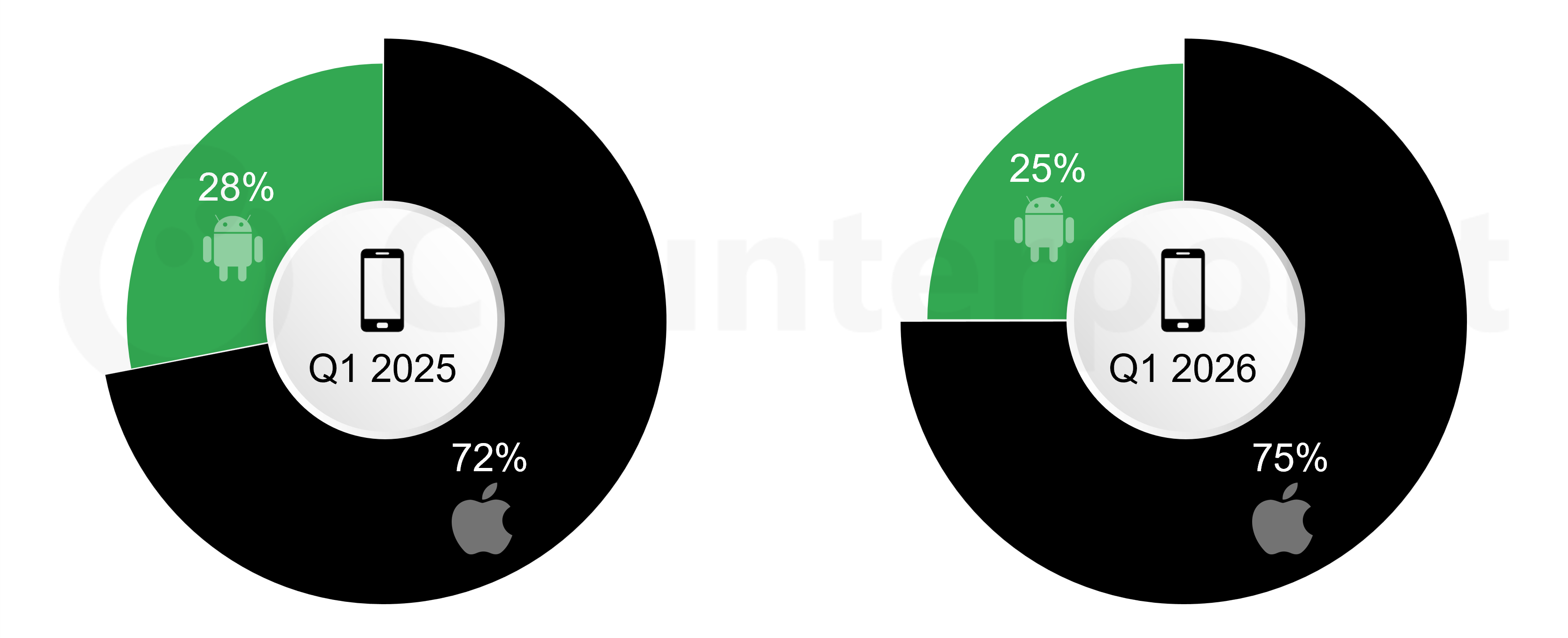
Photo: CounterPoint Research
A few factors help explain how Apple managed to grow sales while the market around it softened. The iPhone 17 lineup has been a standout performer. During Apple’s earnings call at the end of April, CEO Tim Cook described the iPhone 17 family as the most popular lineup in Apple’s history, adding that IDC data confirmed Apple gained market share in the quarter.
Cook also noted that iPhone demand was so strong it actually outstripped supply, with the company experiencing constraints tied to production of the A19 and A19 Pro chips at TSMC — itself stretched thin by soaring demand for AI server chips.
The timing of Samsung’s Galaxy S26 launch also played a role. Counterpoint Research noted that the Galaxy S26 series arrived in March. That’s later than typical, which gave Apple a longer runway of largely uncontested premium sales in the quarter.
iPhone 17e has also proved strategically important. Apple kept pricing steady on the more affordable model while even increasing storage. That gave cost-conscious buyers a compelling option at a time when rival smartphone makers — squeezed by thinner hardware margins — have been forced to raise prices.
Counterpoint’s analysts noted the significance of this approach, suggesting that if Apple can avoid meaningful price increases and continue to outspend rivals on promotional activity, Android manufacturers will find it difficult to keep pace.
What this means for iPhone users
For existing iPhone users, the data is a sign that Apple’s ecosystem is becoming only more dominant in the U.S. A 75% carrier sales share is a remarkable figure. It reflects not just the appeal of the hardware but also the stickiness of services, iMessage, AirDrop, and the broader Apple platform.
Looking ahead, there are some headwinds (a popular term on Apple earnings calls) to keep an eye on. Cook acknowledged that memory shortages and rising costs are expected to have a more significant impact on Apple later in 2026. The company anticipates “significantly higher” memory costs. We’ll have to watch how Apple chooses to respond — whether by absorbing those costs, adjusting pricing or finding other efficiencies. Cook declined to offer specifics on the call.
iPhone bucks US smartphone sales slump: The bigger picture
Q1 2026 reinforces a pattern that has been building for years: Apple is not just winning the premium segment in the US, it increasingly is the US smartphone market. With Android’s 14.4% sales decline, the gap is widening rather than narrowing.
For iPhone users, that dominance translates to continued investment in the platform, deeper carrier relationships, and — at least for now — a company that has managed to hold the line on pricing while competitors struggle.
The full Counterpoint Research report is available at counterpointresearch.com.

David Snow, an expert on Apple hardware and software, writes on a variety of technological and cultural topics for Cult of Mac. They include Apple news, technology buying guides, and features about computer setups and Apple TV shows and movies.
With 30 years of experience covering technology and other subjects, he has written and edited for numerous print and online publications, including CMP Media, TechTV.com, CNET, Wired News, Red Herring magazine, Law.com, The National Law Journal and Law Technology News magazine. Among other roles, he served as executive editor of the Law.com network of websites and editorial director, technology, for ALM Media.
Snow graduated with a B.A. from Syracuse University with majors in magazine journalism and psychology. While there, he worked as a reporter for The Daily Orange newspaper and associate editor of Equal Time magazine.
Founder of the blog At the Waterline, he can be reached on X (formerly Twitter) via @atthewaterline and on Mastodon via @dsnow.