
The Safari browser turns 20 years old today, and I remember excitedly firing it up for the first time.
When Steve Jobs introduced Safari at Macworld 2003, he described the brand-new browser as a speed demon and way easier to use than competitors.
“Buckle up,” he said with a smile. “We have done our own browser and it’s hot … it’s sweet.”
A few weeks later, I deleted it in disgust. Safari wasn’t sweet. It sucked!
Safari web browser turns 20
Safari did have a nice clean interface. It had a simple bookmarks bar and a prominent search box with Google built in.
But for several years, Safari was nigh-unusable.
It promised great things — primarily speed and not being Internet Explorer, the default browser on Macs at the time (thanks to a deal Jobs struck with Microsoft’s Bill Gates).
Everyone hated Internet Explorer, which was bloated, ugly and slow. When unveiling Safari, Jobs promised it would be the fastest browser on the Mac platform. (Watch Jobs introduce Safari during the Macworld keynote.)
Fast but buggy
And Apple’s new web browser was pretty snappy. But unfortunately, Safari was buggy as all heck. It crashed all the time. Worse, early versions of Safari didn’t have the ability to remember open tabs — a basic requirement these days. So when it crashed, it took all your tabs with it.
I hated Safari so much at the time, I wrote a screed about it for Wired.com: “Who in Their Right Mind Would Run Safari on Windows?”
Safari was 4 years old then, and Apple had just released a version for Windows. I detested it so much, I wondered why any sane Windows user would download it.
I was using Firefox at the time, a free alternative to both Safari and Internet Explorer that was far superior. It was fast, stable and supported plugins, of which there were plenty.
Luckily, Safari improved over time
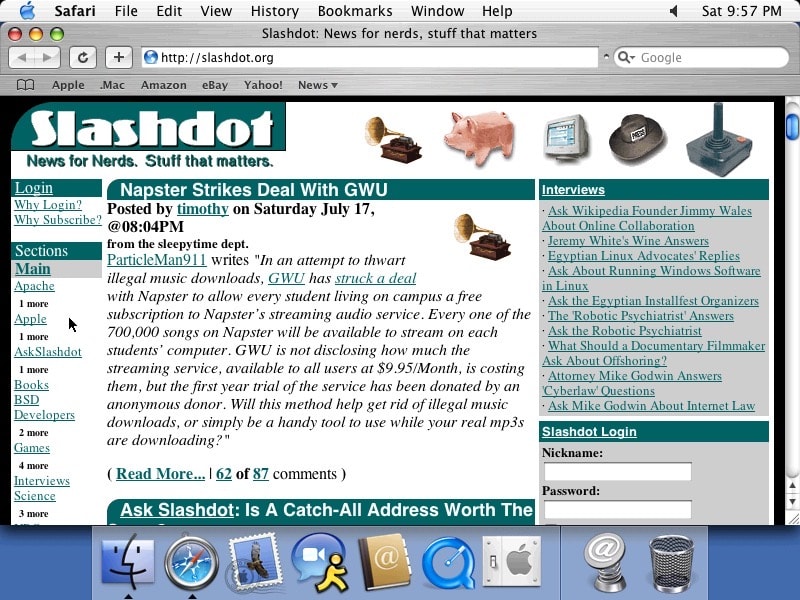
Screenshot: Nathan/toastytech.com
In the ensuing years, Safari has improved by leaps and bounds, both on Mac and iOS.
It’s now my default browser on both platforms, and it has happily kept pace with competing browsers. It’s now the third-most-popular browser in the world, with a 9% share. Safari is fast, secure, feature-rich and works with plenty of useful plugins. Plus, a thriving open-source community is devoted to the upkeep of WebKit, the HTML rendering engine behind Apple’s browser.
Like a lot of Apple projects and products, Safari started out sucking but got immeasurably better over time. Safari is like Apple Maps, which took a beating on release but is now arguably the best map service out there.
So Steve Jobs was right after all. Safari is sweet — 20 years after it launched!

Leander Kahney is the editor and publisher of Cult of Mac. Leander is a longtime technology reporter and the author of six acclaimed books about Apple, including two New York Times bestsellers: Jony Ive: The Genius Behind Apple’s Greatest Products and Inside Steve’s Brain, a biography of Steve Jobs.
Leander has written for Wired magazine, Scientific American, The Guardian, The Observer, The San Francisco Chronicle, MacWeek and many other publications.

