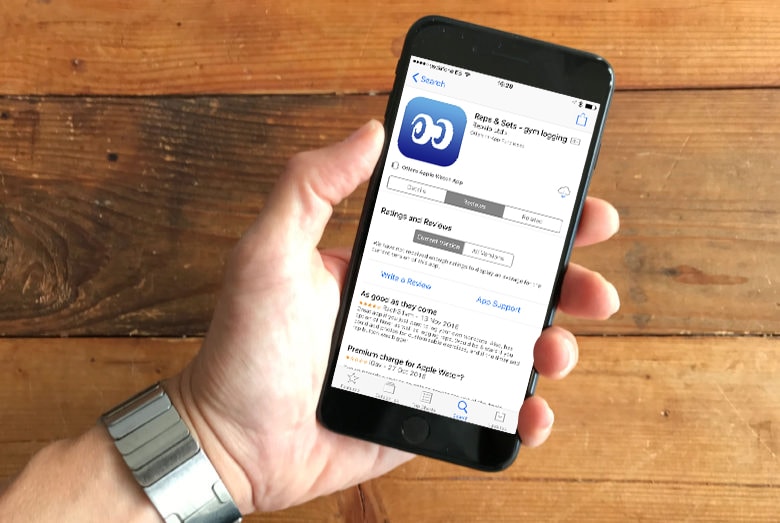
I’m not so thin-skinned that I can’t handle the occasional criticism. But there’s something about App Store reviews that really bugs me.
Like most indie developers, I put blood, sweat and tears into my app, Reps & Sets, which I develop with my partner. It’s our baby, and we love and cherish it. So when some random dude posts an inaccurate one-star review, I’ll be honest: It hurts. That’s why I’m so excited that Apple will be giving developers the chance to reply to reviews in iOS 10.3.
Nobody loves a critic
This week, Hollywood director and producer Brett Ratner took issue with movie review site Rotten Tomatoes, arguing that its aggregated scores effectively killed serious film criticism and are harmful to movie production.
I may not be a hot-shot movie director, but in my humble way as an app developer, I kinda know how he feels. It’s painful to see your app distilled down to an aggregated star rating on the App Store.
A Rotten Tomatoes rating can make or break a movie, and the same is true of App Store ratings for apps. They matter. Big time. After all, who’s going to use a one-star app?
App users are a necessary evil
Every app developer needs users. Without them, your app is pointless: It becomes one of those zombie apps that lurks deep within the gloomy, cobweb-ridden recesses of the App Store, waiting for its inevitable cull next time Phil Schiller decides to zap some cruft.
The whole point of being a developer is to delight users, so they’ll pony up some hard-earned cash for more of your sweet app goodness. And yet it can be hard to feel the love.
Users sometimes seem like a necessary evil. They grumble about the frequency of updates; they threaten to stop using your app altogether unless you add that one special feature they crave; and they post mean reviews on the App Store to punish you, even though they continue to use your app every day.
The irony of punishing the developers of your favorite apps with a negative review is that it is likely to have the opposite effect from what you intended. Bad reviews are bad for business. With less money coming in, it is less likely a developer can afford to fix bugs, or add support for iOS updates — let alone add new features.
Negative reviews are a real buzzkill. Users may think they are delivering a feisty pep talk, but in reality, one-star reviews are more likely to sap the motivation of indie developers. Many indie devs work on their apps in their spare time as a hobby, and only earn peanuts from the App Store.
Developers no longer must bite their tongues
Up until iOS 10.3, which is currently in beta, Apple expected app developers to act like saints — stoically enduring the slings and arrows of disgruntled users without any chance to answer back. That can be more than a little infuriating.
If a reviewer just doesn’t like the basic premise of our weightlifting app, or the way we designed it, that’s fair enough. Everyone is entitled to their opinion, and there’s not much to say in terms of a reply.
But if a negative review is based upon “alternative facts” like our app doesn’t support HealthKit (it does), or it only works with kilograms (it doesn’t), that proves really frustrating. These reviews sit on your app page for all to see, with no opportunity to set the record straight.
Fortunately, with the imminent release of iOS 10.3, Apple is giving developers a chance to respond to their critics. I won’t be staying up all night to correct everyone who is wrong on the Internet. But at least I’ll be able to highlight features that a reviewer may have overlooked, or even promise a fix now and then.
No good deed goes unpunished
Recently, we switched our app to a freemium model. Previously we’d charged a one-off up-front payment of $1.99. By switching to free with an optional in-app subscription for premium features, we hoped to reach a wider audience and establish an ongoing revenue source to help pay for new features.
Things did not quite work out that way. Instead, we got lots of negative reviews. Previously our app enjoyed a healthy four-star rating, but the free version got only two stars. It’s exactly the same app — the only difference is that we made it free. (Plus we added new features for premium users).
Why would an app that enjoyed good reviews get punished for becoming free? Probably because, when the app cost $1.99, you had to buy it before you could post a review. Now anyone can review the app without paying a cent.
When you pay for an app, you tend to read the description on the App Store carefully, and consider whether the app is likely to meet your needs. But when it’s free, you can just download it and find out if it’s what you want. That’s all very well and good, but it’s hardly fair to leave a one-star review if the app turns out to not do what you were expecting.
Punishment for making our app free? Just goes to show that no good deed goes unpunished.
Thumbs down for star ratings
Gaining the ability to reply to reviews sounds promising, but there’s another way Apple could help developers fight back against the tyranny of App Store trolls.
After all, there’s not much you can say to a one-star rating where the user does not explain why they felt your app deserved such harsh punishment. That’s the whole problem with star ratings.
In theory, reviewers should carefully weigh exactly how good an app is, relative to all the others they’ve tried, then place it on a scale of one to five based on its relative merits.
In practice, most users only bother to rate a review if they feel strongly about it — if it sucks or it rocks. So most star ratings tend to be one star or five star. As John Gruber pointed out this week, that’s why YouTube scrapped star ratings in favor of a simple thumbs-up or thumbs-down, and why Netflix is planning to follow suit.
Apple should do something similar.
I’m happy to admit that my app is not perfect. Perhaps it doesn’t deserve a five-star rating. But I know for sure that it doesn’t deserve a one-star rating, either. The truth lies somewhere in the middle. But since the two-, three- and four-star buttons seem to almost never get used by reviewers, I think it’s about time Cupertino came up with something better.
Maybe a metric based upon app usage patterns would be more appropriate and truthful. If a user launches an app every day and uses it for several minutes, or even hours, that surely tells you more than a battle between five-star and one-star reviewers.
Fortunately, some of our users rock
If all this grumbling sounds a bit ungrateful, let me say for the record that we have some awesome users. Especially our beta testers, who put a huge amount of time and effort into helping us make our app better.
Their feedback is not always praise, but it is always constructive and polite. Some of our testers have made great suggestions on how we could market our app more effectively, and even introduced us to potential business partners.
Users like this make it all worthwhile, and give us the encouragement we need to keep investing time in the app.
No failure, only feedback
Ultimately, whether you are a top Hollywood movie director or a humble indie app developer, everyone needs feedback. We can all get too close to our work sometimes, and need some external input to help us raise our game. Behind every great athlete, there’s a great coach. And behind every great app, there are great users providing insightful feedback.
What really counts is how feedback is delivered. The way in which Apple designs the user feedback systems in the App Store has a huge impact on the quality of feedback developers receive. The changes Apple is introducing in iOS 10.3 are an important step in the right direction, and I hope that Apple continues to focus on this area. It will result in better apps, which is a win-win for developers and users alike.

Graham Bower is a designer, writer, fitness geek, and long-time Apple user. He is the co-host of Apple Core, a podcast about the history of Apple, and the developer of Reps & Sets, a fitness app for iPhone, iPad, and Apple Watch. Connect with Graham on Bluesky or at www.grahambower.com.

23 responses to “I can’t wait to reply to App Store reviews in iOS 10.3”
Give me a break, if your app sucks, free or 1.99 wont matter. Let me tell you and all the developers something. Greed will get you nothing but 1 stars. Make a game thats free and charge people real money in order to continue playing and you will rightfully be considered nothing but a greedy developer who deserves their one star reviews. Boo hoo, cry me a river.
Oh FFS he’s just explained how his ratings dropped through freeloaders such as yourself! How about YOU build a free app? Can you do that? Or can you only take, take, take and moan?
I was paid 104000 dollars last year by doing an internet based work moreover I was able to do it by working in my own time for quite a few hours on a regular basis. I tried job opportunity I came across on the net and also I am delighted that I was manage to make such good money. It is actually newbie-friendly and I am so grateful that I discovered out regarding it. Look out for what I do… http://ru.vu/bDrJl
Did you actually read and comprehend Undivided’s post? I did, and nowhere did I see them saying apps should be free. The comment was about freemium subscription apps. Seems to me Undivided was perfectly happy to pay for apps. However the idea of charging money to continue using the app beyond a certain time is what’s at issue here. Especially if said app USED to be a paid app, now leaving original paid users high and dry.
The developer of iCab got it right by grandfathering existing users before going for in app purchases.
The princely sum of $1.99 as a one-off payment only goes so far, and can’t fund app developers to keep making updates in perpetuity. By going the route we did, we were able to provide our “original paid users” with ongoing support and iOS compatibility updates, enabling them to continue to enjoy the features they had paid for. They were not left “high and dry”. Quite the opposite. Those updates the “original paid users” are receiving are in fact being funded by the new premium subscribers.
The one-off payment is because a faulty App Store pricing policy. If one could charge for updates, this would be different. But at the same time, how can big apps like Camera+ and Pixelmator make ends meet? I know Camera+ have a couple of filter packs for sale in the app, but Pixelmator bases their revenue solely on the one-off payment.
Agreed – it would be a big help if developers could charge for updates. Pixelmator is more expensive (especially the Mac version) so I guess that helps. But also, they are very popular and that helps too – as long as their user-base keeps growing, the one-off payment model is sustainable. But it’s telling that even the likes of Adobe and Microsoft have now switched to subscription.
I was paid 104000 dollars last 12 months by doing an internet based job and I was able to do it by working in my own time for several hours during the day. I tried work opportunity I found out on the internet and also I am delighted that I was in a position to earn such decent cash. It is really newbie-friendly and therefore I’m so grateful that I discovered out regarding it. Check out exactly what I do… http://ipt.pw/vhH7x5
Im pretty against the subscription model for software, as long as its not depending on running costs for back-ends, but with the current revenue model, there is not any viable models other than subscription.
The company I work for, found its niche in developing internal apps for entrerprises, and that really pays the bills. The indie dev has a real struggle, unless they get a really big user base.
The model Overcast has gone for, is also pretty exciting. I really love that Marco booted the closed source libraries, and went for selling his own ads.
Yeah – I don’t like software subscriptions either. We held out for ages, but in the end we concluded we had to give it a try.
Spot on 42. I am perfectly content in paying for apps. Charging money to continue game play is the issue and should be a model that gors the way of the dinosaurs.
Wow…talk about missing the point entirely.
Trolling much?
Misreading much?
LOL….so you troll my comment. How about you allow others their opinion. Or are you so childish that a differing opinion really upsets you?
Reviews are (a) a necessary evil; (b) here to stay; and (c) all of the above.
I think by now most people know how to sift through reviews and parse the good ones (well written, explain their points) and bad ones (snarky, complain but don’t explain). I agree with the author that the star rating can make or break though. The app store resets star ratings/reviews for each upgrade and also gives the option for seeing all ratings since the apps inception, or “most recent” to see the trend. To me this seems like a good idea – see how the upgrade is doing before deciding to use it, without the clutter of reviews from years ago when the app may not have been as well designed.
I was paid 104000 dollars past 12 months by doing an internet job and I was able to do it by working in my own time for several hours each day. I tried job opportunity I found on the net and therefore I am thrilled that I was succeed to earn such good money. It’s actually newbie-friendly and therefore I am so pleased that I found out regarding it. Read through exactly what I do… http://ru.vu/b13PO
All great points. How do you feel about Apple hiding reviews every time you do an app update? This is Apple punishing app developers for improving their apps and fixing bugs. It is also Apple discouraging users from leaving reviews since they will know they will be hidden in the near future. By all means show the version of the app that was reviewed but don’t hide them! It is hard enough getting users to leave reviews so hiding them helps no one. Yes you can click show all reviews but let’s face it. No one bothers with that. They just tap on an app and see no reviews and move on.
I completely agree. It doesn’t make sense to wipe away reviews for every update. I wonder if it makes sense for the App Store to distinguish between minor and major updates.
I see your point about free apps and think your thumbs up/down idea is a good solution. I hope going forward you will at least allow a trial period for your apps. As a user in the prime marketing target group, I will not pay for (or even consider) apps costing more than 9.99, apps with reoccurring monthly charges or apps that I can not try first to see if it meets my needs. However, I am willing to pay yearly to keep the apps I buy and love up to date.
We made our app freemium precisely so that users could try before they buy. Also, we use Apple’s one month free trial feature, so users can try out the premium service too.
I have a lot of sympathy with this article and what the developer says. However, there’s one aspect that I don’t particularly agree with, and that’s the “No good deed goes unpunished” section.
Thing is, switching from paid to freemium is portrayed as a good thing. But is it, really? And who is it good for? The users or the developers?
I’ve just had a look at the home page for this app, and it looks really good. I should say that I am NOT a gym user myself, and am never likely to be one, so the app actually holds no appeal for me at all… but if it were something I wanted, I’d definitely check it out as its website makes it look interesting and really nicely designed.
Now, if I’d bought this app at $1.99, which is apparently what it cost, doubtless I’d think I’d got a fantastic deal. It’s a trivial amount of money for an app that’s likely to be lastingly useful, and as such it could have been one of the real bargains I’d found on the App Store.
But if, having bought the app, it suddenly went free and expected me to pay for a subscription (even if, as a paid user, it gave me some perk or other in compensation), that wouldn’t be terribly welcome. My reactions would probably be:
(a) I’ve wasted the $1.99; if only I’d waited a while, I wouldn’t have had to pay it.
(b) The developers are now on a quest to find ways of extracting money from me on a regular basis. The app that I paid $1.99 for, for open-ended use without further fees, has now turned into an app that requires me to pay $12 (or whatever it may be…) a year for, in an ongoing manner.
So, the premise that going freemium is a ‘good deed’ isn’t really true, is it? It means that, instead of paying $2 once, users will be paying $1 per month ‘forever’, which is hardly a bargain in the same class.
Please don’t flame me for pointing this out. I’m just outlining what a typical reaction will be from an average user, and why the move generated a lot of negative feedback.
I’m not actually condoning this ‘cheapskate view’ myself. I understand that a lot of developers on the App Store don’t make much money from sales of their apps, and there’s a very good chance that one-off payments of $1.99 purchase-once apps simply won’t cover the development costs, let alone let the developers bask in luxury. I imagine that, for an app like this one, a $1-per-month subscription is actually extremely good value, if the app is something you use all the time.
But the point is just that users have long ago cottoned on to the fact that “free” doesn’t mean “free” any more. “Free” these days generally means “we’re going to screw you out of as much money as we can possibly get away with through in-app purchases and ongoing subscriptions”. A $1-per-month subscription to something sounds (and indeed is) trivial… but if you find yourself subscribing to lots of apps (and software on the desktop, as subscriptions are the unwelcome new software sales model…), it all adds up.
So I’m not arguing against what this developer has done. I fully understand and sympathise with the move to freemium in this case. But at the same time, I can also see why users haven’t liked it, and why it’s generated bad reviews. It’s made all the worse by the fact that the app was once not free, because the move to a free (but with hidden in-app purchases) model feels like a broken promise to all the people who’ve paid for the app already. If the app had been free with an in-app subscription from the outset then this problem wouldn’t have arisen, I suspect – or would have been much less severe.
I think this is a good illustration of the dangers of switching to freemium. Developers want to see it as doing their users a favour, but in most case it isn’t. In most cases, what it equates to is the developers finding ways of persuading their users to pay more (and quite possibly very substantially more) than they’d have paid otherwise with the one-off up-front payment.
As I say, I’m not actually arguing against this. It’s not wrong in principle, and clearly developers need to live too. But I do think that the freemium model is also abused and pretty heavily exploited by certain game-makers, which is another reason why so many people hate it so much.
As for doing users a favour by going freemium… well, there’s only one situation in which I really agree with that as a general principle, and that’s when it’s done in order to create a ‘demo mode’. If you’re a game developer (say; it’s the most likely scenario) and your game app used to cost $1.99, then you change it to be Free with restrictions, and allow the full version to be unlocked for $1.99… well, that equates to the same thing in the end, but it gives your users the ability to try out the game first, so THAT’s doing your users a favour by going free.
On the other hand, I wouldn’t particularly recommend that either. A price of $1.99 is so low that a lot of people will just pay it to get your app, if they think they’ll like it. But if they can download it for free first, then there’s a much higher chance that they won’t decide to pay for it, so the idea of going free backfires on the developer again. Overall, that’s another argument against Freemium!
I think the moral of the story is: if you’re going to issue a Freemium app, make it free from the start. Any attempt to change a paid app to a free one is likely to backfire.
And freemium isn’t a bad idea in principle, but in reality it’s become so widespread, and is so widely abused (or at the very least annoying), that developer should approach it with GREAT CARE.
I think you make some good points here, and this is, in part, why we got negative reviews with the freemium switch. But equally I think those negative reviews missed some very important points:
1. Users who previously purchased our app continue to have access to all the features they paid for without having to pay a cent extra. The subscription service is only for *additional* features added after we switched to the freemium model, like our new watch app.
2. When I say “good deed” – I don’t mean for our existing users. It is a good deed for the *new* users who are getting something for free that used to cost money. The bad reviews appear to come from causal free downloads – not existing users of the app.
3. When you buy an app, there is no guarantee you’ll be able to use it forever. Consider all the apps that are about to stop working when Apple scraps support for 32bit apps in iOS 11. Ongoing development is required to keep apps compatible with new versions of iOS – and that costs money. You can’t blame app developers for this – or even Apple. It’s just progress :)
4. The premium subscriber option (it is just an option, not required) benefits all users – including non-subscribers, since the ongoing revenue from this will fund future updates to keep both the free and paid versions compatible with updates to iOS.
5. The only other option I can see would have been to create a new and separate “Reps & Sets Pro” app. This way, the old app could have retained the one-off up-front payment model. But over time the old app would have become out of date because our development efforts would naturally focus on the new subscriber app. So we genuinely made this decision because we thought it was in the best interests of all our users – including the existing ones.
No one likes it when they pay for something that subsequently becomes free. It drives me mad when I buy some cool new Apple kit, only for them to release something better and cheaper a few months later. But that’s life. I know Apple has to do this stuff to stay competitive, and as an Apple user I benefit from that over time. The same is true with indie app developers.