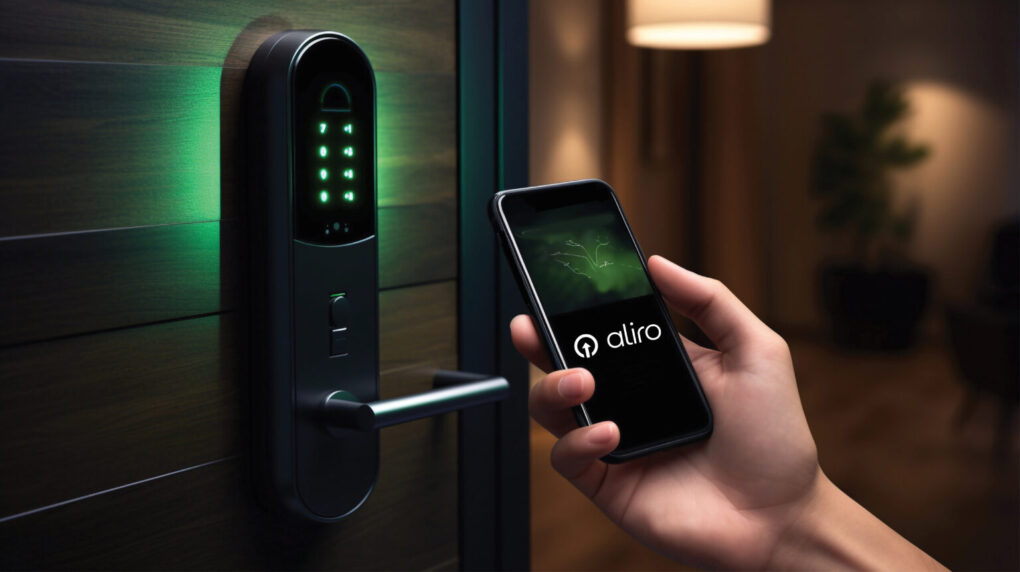
The new Aliro 1.0 communication protocol and credential standard could fundamentally change how iPhone users interact with smart locks, the Connectivity Standards Alliance said Thursday upon release of the specification. And it will affect usage not just at home, but in places like offices, hotels, colleges and apartment buildings.
Why the Aliro smart lock standard matters
For years, smart lock adoption has been slowed by fragmentation. Different locks required different apps, different platforms and different workarounds. Aliro aims to fix that by establishing a single interoperability standard. It lets any compatible lock work directly with the digital wallets already on your phone, the Connectivity Standards Alliance said in a press release.
Apple is one of the founding members of the effort, alongside Google and Samsung. That means Aliro-enabled locks will be addable to Apple Wallet, much like how transit cards or hotel keys work today — no third-party app required.
Hands-free unlocking and more
For Apple users specifically, the standard has immediate practical implications. Aliro supports Near Field Communication (NFC) for tap-to-unlock, Bluetooth Low Energy for user-initiated access at longer range and Ultra-Wideband (UWB) for hands-free authentication. UWB is the same technology already powering Precision Finding in AirTags and hands-free unlocking in supported vehicles via CarKey. So the underlying infrastructure on Apple’s side is already well established.
The specification also works in areas without network coverage. That includes underground parking garages and elevators. That addresses one of the more common real-world failure points for connected lock systems.
Who’s on board
More than 220 companies are members of the CSA initiative. Among those expected to achieve Aliro 1.0 certification first are Apple, Allegion, Aqara, Google, HID, Kastle, Kwikset, Last Lock, Nordic Semiconductor, Nuki Home Solutions, NXP Semiconductors, Qorvo, Samsung and STMicroelectronics — a list that covers major lock manufacturers, chip makers and platform leaders.
For consumers, that breadth of support suggests Aliro-certified locks should begin appearing across a wide range of price points and form factors relatively quickly.
Security and privacy built in
Aliro uses asymmetric cryptography to secure interactions between devices and readers. That means the credentials on your iPhone are protected without exposing your personal data to the lock hardware itself.
The framework is designed to respect user privacy while maintaining strong authentication.
Aliro smart lock standard: What’s coming next
CSA describes Aliro 1.0 as a living standard rather than a finished product. Secure key sharing — the ability to grant temporary or permanent access to others — sits among the features already planned for future updates. And backward compatibility makes sure existing certified hardware will also work.
For Apple users who have already embraced Home Key on supported locks, Aliro represents a significant expansion of that experience across a far wider ecosystem of hardware and venues.

David Snow, an expert on Apple hardware and software, writes on a variety of technological and cultural topics for Cult of Mac. They include Apple news, technology buying guides, and features about computer setups and Apple TV shows and movies.
With 30 years of experience covering technology and other subjects, he has written and edited for numerous print and online publications, including CMP Media, TechTV.com, CNET, Wired News, Red Herring magazine, Law.com, The National Law Journal and Law Technology News magazine. Among other roles, he served as executive editor of the Law.com network of websites and editorial director, technology, for ALM Media.
Snow graduated with a B.A. from Syracuse University with majors in magazine journalism and psychology. While there, he worked as a reporter for The Daily Orange newspaper and associate editor of Equal Time magazine.
Founder of the blog At the Waterline, he can be reached on X (formerly Twitter) via @atthewaterline and on Mastodon via @dsnow.

2 responses to “New standard makes more smart locks work seamlessly with iPhone”
Sorry to point this out: in your second sentence above you should use “affect” NOT “effect.”
Typo fixed. Thanks!