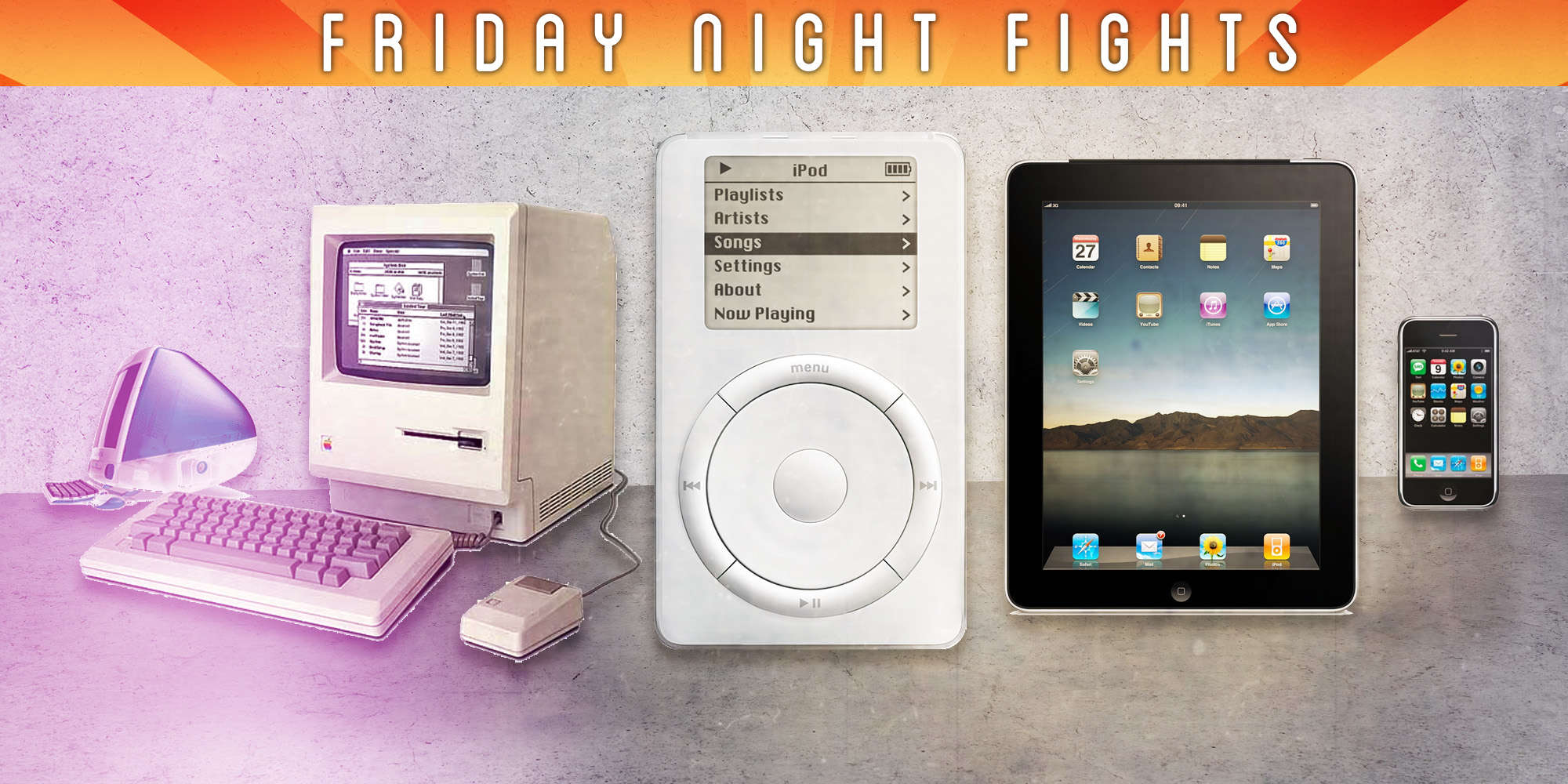
Apple impressed us all with its Q1 2017 earnings earlier this week. Is it the start of something spectacular?
 iPhone sales beat expectations, and though things may look bad for the iPad business, there’s strong demand for Apple Watch, the Mac lineup is raking in more than ever, and services will be big enough to be its own Fortune 100 company by the end of the year.
Is Apple headed for another boom period? Or does it need more than just the iPhone 8 in 2017 to keep up this trend? Join us in this week’s Friday Night Fight as we battle it out over Apple’s year ahead.
 Luke Dormehl: Apple’s earnings call this week was as good as people could have realistically expected. It was the company’s most profitable quarter in history, and given that Apple topped the apparently “peak iPhone” numbers from last year, that’s got to be pretty exciting, right?
By any stretch of the imagination, these are great results for the company — buoyed by increasing numbers in Apple’s Services division and elsewhere. But what we’re arguing today is whether this is the start of another high growth “golden age” for Apple, and I just don’t see the evidence that it is.
Every day I write a “Today in Apple history” post for Cult of Mac, showing what happened on that particular day in a previous year. Recently, for example, I wrote about Apple’s January 12, 2005 earnings report, which came at around the mid-point in Steve Jobs’ tenure as Apple CEO. During the quarter being reported on there, the company managed a massive 75 percent increase on what it had done that same quarter one year earlier.
The iPod, Apple’s hottest product at the time, was up 525 percent from the preceding three months — and there were already plenty of reports that Apple was planning a possible iPhone. Alongside that, Apple was showing huge growth in its other divisions, thanks to products like the gorgeous iBook G4 and iMac G5, while the iTunes Store couldn’t have been any hotter!
Today, it doesn’t seem like that. Yes, Apple’s managing to increase iPhone sales, but there’s no doubt that growth is slowing down. It also has yet to release sales figures for the Apple Watch, while iPad sales continue to plummet. And just about everything else — the Macs, Apple TV, Apple’s focus on producing original Netflix and Amazon Prime-style content — feels like an afterthought. And there’s no sense that that is going to change.
I don’t think Apple’s going to collapse any time soon. Production of iPhones in India will undoubtedly help save a bit of money, market share will gradually increase, and the iPhone 8 looks to be big — but the days of crazy mid-2000s growth are over. And I just don’t see them coming back. Do you?
 Killian Bell: Slowing iPhone growth isn’t entirely Apple’s fault. Sure, recent upgrades haven’t been overly exciting, but the smartphone market has become incredibly saturated in recent years, and no company is seeing substantial growth — especially not in the U.S.
But the iPhone 8 will be huge. Not only will it be a significant upgrade, but it’s coming at just the right time. The number of people switching from Android to iPhone has never been greater, and according to recent data from Consumer Research Intelligence Partners, iPhone fans are ready to upgrade.
Just 19 percent of the iPhone install base in the U.S. upgraded to iPhone 7 or iPhone 7 Plus last year. That means that a whopping 81 percent will have an iPhone that’s at least two years old when the iPhone 8 makes its debut in September. That’s plenty of room for growth.
And of course, iPhone 8 won’t be the only thing up Apple’s sleeve in 2017. No, Apple won’t take off like it did in the mid-2000s again — that just doesn’t happen with a company as big as Apple. But its last earnings results weren’t just an anomaly; it’s only going to get better this year.
Luke: So, just to be clear, you’re conceding that Apple isn’t going to have another boom period like it did a decade ago? Like a lot of what we’ve seen under Tim Cook’s leadership of Apple, I think we’ll see slight incremental increases in earnings, although it seems pretty clear that Apple’s not in a position to make up for any decline in iPhone sales.
Do you really think Apple’s Services division can do that? Would you acknowledge that it’s ignored several product categories to its detriment?
Killian: I think it would be silly to say Apple’s going to blow up again like it did in the mid-2000s. It’s a heck of a lot easier to have a “boom period” when you’re small; not so much for the world’s most valuable company. Having said that, you never know what’s around the corner with Apple.
It could surprise us with something completely new this year, and yes, I do believe Services will continue to play an increasingly important role. I also believe there’s lots more Apple could do with Services; there’s more room to grow than there is in the smartphone and tablet businesses.
What do you think Apple has been ignoring? And what do you think it could have done with those products to make them more successful?
Luke: I think Apple has scaled back its ambitions with the Apple Watch, while other promising areas — including Apple TV, the Beats radio station, HomeKit, and most noticeably the Mac division — have been ignored and allowed to fall by the wayside. Look at it this way: in the mid-2000s, Apple was more than willing to cannibalize its hit iPod division to make way for the iPhone. Could you ever imagine Apple today making that kind of bold step?
Sure, iPhone sales did well this quarter (although Apple’s holiday quarter is always its biggest of the year), but it’s incredibly reliant on iPhone sales. If those fall, there isn’t another product waiting in the wings to pick up the slack. You’re also right about Apple’s comparative size a decade ago, but there were numerous times during Jobs’ reign that we thought Apple couldn’t get any bigger — and it managed to.
Killian: If tablets had taken off in a big way, and we all gave up our computers for them, we could argue Apple cannibalized its Mac business for the iPad. It just so happens that it’s yet to find a product as revolutionary as the iPhone; I don’t think it was anything to do with guts.
Apple is just responding the market like every other company. Why plough resources into products that are never going to be as big spectacular sellers. Apple TV and HomeKit will never be truly big businesses.
The tech industry is very different today; it’s not as easy to create groundbreaking new products. Can you name a single product category that’s in desperate need of an overhaul — like music players were in 2001 and smartphones in 2007? One that could rake in as much as iPhone?
Luke: You legitimately don’t think that smart homes or television are mass-market products? That’s insane!
Killian: Of course I do, but Apple isn’t developing a television. And like I’ve said many times in these Friday Night Fights, Apple TV will never do it all. No single set-top box will because there will always be channels and services that require other devices. It’s totally different to a smartphone or a computer because Apple doesn’t have complete control; content providers do.
As far smart homes, it’s still too early. Very few people are making their homes smart.
Luke: Legislation around the world is changing to make it mandatory to have smart devices installed in new-builds. It also perfectly fits into Apple’s ecosystem business model, but HomeKit has been roundly ignored — with the exception of a courtesy namecheck by Tim Cook on the earnings call. And, no, Apple’s not making a television, but the idea that providing an entertainment system, whether that be on the content or hardware front, is somehow a niche area is baffling to me.
Killian: New builds are a small percentage of the homes available today. And no legislation is going to force home makers to kit out new properties with smart devices. The vast majority of people don’t buy smart devices for their homes today. It’s as simple as that. They’re not as necessary as computers or smartphones.
I’m not saying TV is a niche area. I’m saying there’s not a single home entertainment device dominates the market. It’s just as saturated as the smartphone business, except unlike smartphones, you can’t get a single device that does it all. Most people need a box for cable, and another to stream shows from services like Netflix. Apple TV will never be able to give us everything, and even it if did, it would likely only support a small number of markets.
Luke: Well, let’s wrap this up with a question to you then: Do you think Apple simply can’t have another massive boom period again or does it just have have the wrong people in charge right now? Or, as you were originally arguing, is everything fine and just getting better?
Killian: I don’t think there’s a leadership problem. I do believe Apple can grow even greater, but I don’t think it has anything in the pipeline just yet that’s going to cause another “boom.” As I’ve said, however, I don’t think that’s entirely Apple’s fault; I just don’t think it has been able to identify a market that’s ripe for an overhaul.
I do think Apple is doing a great job at the moment, and with iPhone 8 and other products around the corner, I think it’s only going to get better.
Let’s find out what the readers think now. Join the debate down in the comments!
Friday Night Fights is a series of weekly death matches between two no-mercy brawlers who will fight to the death — or at least agree to disagree — about which is better: Apple or Google, iOS or Android?

Killian Bell is a freelance writer based in the U.K. He has an interest in all things tech and also covers Android over at CultofAndroid.com. You can follow him on Twitter via @killianbell.

6 responses to “Is Apple headed for another boom period? [Friday Night Fights]”
The iPhone appeared when it did because the technology had just become available to build them and use them. The first iPhone didn’t even have 3G. It had a camera but no video capability.
To find another blockbuster product you’d have to find a product that is similarly held back by technology. Perhaps the Watch fits this description. It just became possible to build the Apple Watch. It may be a few years till it really takes off as more medical sensors are built in.
One problem for any new device is that the iPhone absorbs new products. The iPhone is now your point and shoot camera. It’s a game console. It’s a small tablet. It’s your GPS navigator. Instead of making a new device Apple is much more likely to add it as a part of the iPhone. Maybe in a year or two we’ll see some sort of augmented reality device. Most likely it will be an accessory to the iPhone.
Apple now has incredible momentum just because of the number of phones they sell in tens of thousands of outlets around the world.
Apple is a little constrained in that any new feature to be built into the hardware must be capable of being manufactured at the level of 100 million per quarter.
TVs are updated slowly, about once in 8 years. Automotive may be a good area for Apple, though I suspect that this too will be an area of slow growth.
Home automation is probably a good area for Apple. It seems to in the very early stages.
At least for the next couple of years Apple looks to be in a very solid position. Revenue and profits are great. Competition is weak, and there are new products in the pipeline. There seems little chance of a groundbreaking new product like the iPhone, but there seems little chance that anything can put a dent in iPhone sales (in the near future).
I got paid 104,000 thousand dollars in last 12 months by freelancing online and I manage to earn that much by working in my own time for several hours each day. I was following a money making opportunity I was introduced by this website i found online and I am excited that i was able to make so much money. It’s really newbie friendly and I am just so grateful that i discovered this. Here’s what I did… REGULAR74.COM
I’ve earned 104,000 bucks last year by working from my home and I did that by working part-time for 3+ hours daily. I’m using a business model I was introduced by this company i found on-line and I am so thrilled that i was able to make such great money. It’s really beginner-friendly and I’m so grateful that I found out about it. Here is what i did… STATICTAB.COM/5rq2qty
It appears that the current results are based on this being a 14 week quarter, instead of the usual 13. That is where the boost comes from, rather than a turnaround.
The internet sleuth has figured it out! Screw all those Harvard MBAs who spend their entire life focusing on the market. They obviously overlooked this detail. 14 > 13! Oh my god. Call The NY Times! We have a breaking story! Even AAPL beat their own 14 week guidance and the market’s collective expectations. The market must’ve overlooked this obvious piece of public record!!!
I doubt calling any of the mainstream press would do any good. Only the likes of John Gruber and Jeff Johnson picked up that 14 weeks was not mentioned anywhere in the Apple press release. Apple mislead the market with their press release and thats fraud.
A little bird tells me that the BBC and the Guardian have a bunch of complaints to deal with due to them not reading the investor call transcript. I’m betting most of the worlds newspapers and websites didn’t either. Thats a lot of retractions to make.
This one is going to be. *Embarrassing*
Oh and I’m not a hater. I’m a long time Mac User back to 2001 (even the Mac Cube!). I want Apple to survive their downturn and continue to make good computers. I dont want it to implode like Nokia and Blackberry did.