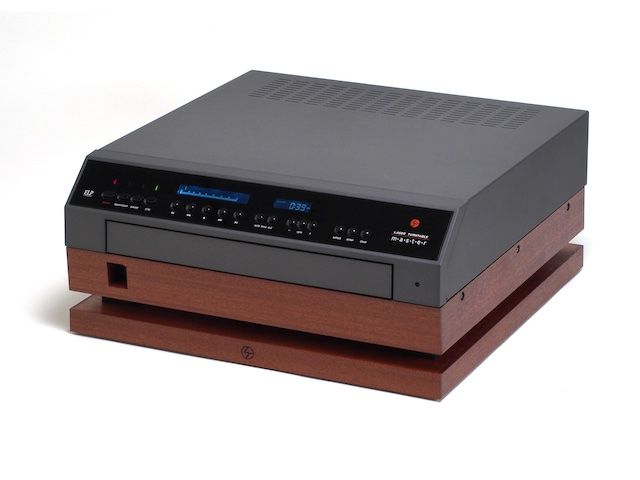
If you’ve got an extra $14,000 to $18,500 sitting around, you might consider grabbing yourself one of these bad boys from Japanese manufacturer ELP.
The ELP Laser Turntable promises the best in fidelity when playing your precious vinyl records because it uses a laser, not a needle, to decode the music that’s been cut into your LPs.
This, says the company, allows the audio device to read information deep in the grooves of all your old and new records, something a needle alone can’t do. An added bonus is that a laser will never scrape your record like a needle does.
“Audio information read by the laser is 10 microns below the shoulder,” says the ELP website. “Therefore, the laser is picking up audio information which never been touched or possibly damaged by a needle. It plays the virgin audio information on the groove without any digitization.”
So, basically, you’re buying a big CD player. Wow.
There are three models of the ELP Laser turntables, with the low- and mid-range versions running $14,000 and $17,000, respectively. These will play 7-, 10- and 12-inch records. The high-end model supports 8-, 9- and 11-inch records as well. The higher-end models also support 78 RPM speeds, a must if you’re an audiophile record collector of older discs.
The laser only reads from black vinyl records, unfortunately, since lasers are made of light, and transparent or colored discs tend to let light pass through.
However, using a non-needle to listen to old or damaged recordings might be just the ticket. Plus, the laser tech lets you skip tracks, go forward and backward, and shuffle your music off a vinyl disc the same way your CD player does. Only this one costs way more and takes up a ton more space. Hmmm.
There’s more detail at the ELP website, so if you’re seriously into audio geekery, give it a look.
For me, these are seriously interesting to look at, but not to touch. I wouldn’t want to have to buy one.

Rob LeFebvre is an Anchorage, Alaska-based writer and editor who has contributed to various tech, gaming and iOS sites, including 148Apps, Creative Screenwriting, Shelf-Awareness, VentureBeat, and Paste Magazine. Feel free to find Rob on Twitter @roblef, and send him a cookie once in a while; he’ll really appreciate it.


11 responses to “$14,000 turntable won’t wear out your vinyl. What a deal.”
Are you using Pay!pal address ?Because you can generate an additional 950 dollars /a week in your revenue freelancing over the internet for 5 hours a day…CHECK IT OUT HERE–>
What a brilliant piece of technology. I can’t wait to see the prices go down in a few years.
These have been around since the 90’s. I haven’t had a chance to use one, but from what I hear, they’re pretty “meh” for the price. Not to mention taking away most of the enjoyable parts of playing vinyl.
Of course, you can only play the LP once, because the laser melts the vinyl as it reads the audio groove.
What I’m wondering is wether the laser picks up audio info I don’t want, i.e., scratches and flaws.
I was a Rep for a company called Finial from 1984 to 1986. It was a beautiful piece of engineering but I only saw it work a couple of times out of 3 or 4 CES presentations.
The laser tracked the grooves deeper than a stylus and avoided any previous stylus damage but could also pick up lots of trash down there. Before every (attempt at a) demonstration the vinyl got a good cleaning with a Nitty Gritty machine.
When it worked it sounded amazing. With the total lack of mass, the laser read very high frequencies and tracked the loudest bass with no problem.
I think they could have gotten it right eventually but there was a little silver disc that was really starting to kill LP sales around that time.
Interesting tech, but totally defeats the point of analog playback. If the data is being read by a laser, there’s gotta be some conversion happening, and with that the same audio losses that a occur with a cd.
Not necessarily, especially if it isn’t converting the motion from the grooves into a digital signal. Even with a normal phono cartridge there is a conversion from the groove vibrations to electrical energy. (and then back to motion again at the loudspeaker). Any conversion of energy will introduce some distortion.
You can get them for $9000 on eBay. The article refers to the more expensive model which also plays 78 RPM records.
A cheaper alternative to the ELP is the DS Audio DS-W1 phono cartridge, which doesn’t use moving coils or magnets. It uses LASERs to sense the stylus position. The sound is recovered using analog signal processing technology.
Interesting idea, but it still uses a stylus to read the vibrations in the groove and therefore will still not read the deep, untouched area of the groove, and it still has mass, unlike photons (although that may be arguable according to my astronomy professor).
It can still wear and damage the recording, like any other physical stylus. But I would love to have one for a few days to try it out.