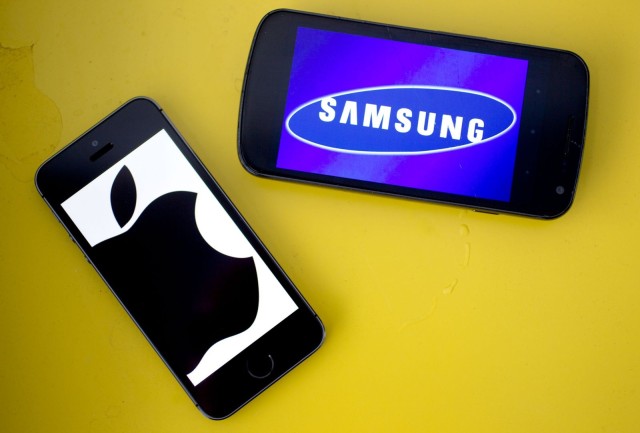
U.S. Supreme Court justices appear to be confused over how much Apple’s patented iPhone design should worth.
Lawyers for Apple and Samsung faced off this morning at the nation’s highest court. The two sides argued whether breaking a design patent should be worth most of a product’s profits, or if the thousands of other patents that go into a smartphone should be viewed as equally valuable to the contribution of profits.
Billions of dollars and the future of patent law is at stake in the case that hinges on a law written in 1887. But the justices didn’t give much indication which side they’ll take.
[contextly_auto_sidebar]
The iPhone and the Beetle
“If I were a juror, I wouldn’t know what to do,” Justice Anthony Kennedy said, according to CNET.
Justice Kennedy brought up the iconic design of the Volkswagon Beetle as a comparison, saying it seems unfair not to give more profit to someone whose infringed design is so important to the overall product. Justice Alito countered that the car is made up of thousands of other important parts. The judge noted that no one would have bought it if it had horrible gas mileage and a high price tag.
“The thing that makes the product distinctive might not cost very much,” said Justice Kagan.
Apple’s never-ending legal war
Samsung and Apple have been fighting their long-lasting legal battle in different courts across the globe for nearly five years. Apple accused Samsung of stealing the design of the iPhone as well as some of its software features.
Last year a court ordered Samsung to pay Apple $399 million for intentionally infringing on the iPhone-makers patents. Samsung is hoping the U.S. Supreme court will rule in its favor and reduce the amount it owes. The South Korea based company says it makes “no sense” to give a patent holder the entire profits from a device that infringes narrow design patents.
“Awarding all of the profits for a single patent devalues the contributions of the hundreds of thousands of other patents in a smartphone,” a Samsung spokesperson said. “We are hopeful that the Supreme Court will give a sensible and fair reading to the design patent statute. That would be a win for businesses and consumers alike.”
Some of the top tech companies in Silicon Valley have come to Samsung’s defense in the patent battle. Facebook, Google, HP, Dell and Ebay urged the Supreme court to take up the case claiming the nearly 130 year old design law is outdated and stifles innovation.
Apple’s lawyers argued that letting Samsung off easy is what actually ruins innovation because the company that comes up with new ideas doesn’t get rewarded.
“We firmly believe that strong design patent protection spurs creativity and innovation,” said Noreen Krall, Apple’s chief litigation officer. “And that’s why we’ve defended ourselves against those who steal our ideas. Eleven times now, Samsung has been found guilty of intentionally and blatantly copying the iPhone. Every court at every level has agreed. We think that’s wrong and that it poses chilling risks to the future of design innovation.”
The Supreme Court is expected to make a ruling by June of next year.

Buster Hein is a freelance writer who lives in Phoenix, Arizona. Twitter: @bst3r.


6 responses to “Apple vs Samsung patent battle has U.S. Supreme Court confused”
The problem with this is that for ever after…. in theory if all of the 10’s of 1000’s of patent holders suddenly decided to sue a device maker on patents, how are they going to divide remaining profits, when there is none after the all or nothing patent win of the first lawsuit???? Today’s technologically advanced world with the SCOTUS deciding to support Apple’s point of view will be opening up a whole new can of worms. That could come back around on Apple and eating them up. There will be a free for all and patent trolls will rule over the true innovators. Including Apple!!! …….it’ll be the equivalent of Gang Bangers killing each other off instead of doing anything constructive and Attorneys Will Rule Business with their hands in EVERYBODY’S POCKETS!!!
The design patient is, of course, important for a product where the design is distinctive and a major selling point. The Beetle example is an excellent one – people bought the Beetle because it was unique first, and utility second. Design is important because of the distinction. With a Ford Taurus, nobody cares if GM makes a car that looks the same – you’re buying because of Price (and utility).
Design is everything for Apple, and not of consequence to Samsung (or to Google for that matter). So of course it’s not important to Samsung, but heaven help you if you violate one of their technical patients! To Samsung, Design is a means to an end. To Apple, technical patients are a means to an end.
So, the question is – whose worth should we award? If we rule in favor of Samsung and award a lesser value, you’re effectively saying Design isn’t important to product identification and marketability and that anyone should be free to rip off anyone else’s design. If we rule in favor of Apple, you’re effectively saying that Design trumps technical patients.
The other question is: Do we make Samsung an example (and, hopefully, discourage other companies from making the same choices to blatantly steal other people’s designs)?
Apple works hard to make a distinctive design – and it’s a part of all of their products and who they are. All of Apple’s products (with an occasional exception) fit in a design philosophy with each other. Few other companies have such a consistent design throughout their product lines. Sony used to, Dell kind of does, Samsung (today) is getting there, but nobody (in the tech world) is close to Apple in this regard. So when somebody rips off of one of Apple’s designs and makes their product (be it a laptop, software, or phone) look like an Apple product, they’re effectively stealing Apple’s product’s identity.
When it comes down to it, from Apple’s Point of View, it’s Identity Theft.
Design patent is a joke. I love Apple but I hope they lose. IP law has gotten so incredibly out of hand.
The whole point is simple: If I come up with an idea, produce a product and register a patent on it, the concept, design, look and feel and the function of the product are mine. I put the time into research and development, testing and manufacture of something new. If anyone wants to use those ideas in their own products, they need to license them from me. This rewards me for the innovation. This is a really simple concept and it has worked well for decades.
Samsung wants to confuse the issue. They are really saying “We want the right to use other people’s ideas and research without paying for it.” Samsung has a history of violating patents, then dragging out court cases for years, meanwhile making millions of dollars on others ideas.
The idea that patent law stifles innovation is ridiculous. Without patents, there is no way for an innovator to protect his/her hard work in creating something new. Samsung is arguing for the right to copy others ideas with impunity. Without the ability to patent and protect innovations, there is little incentive to innovate.
So only M&Ms should be allowed to sell circular, sugar coated chocolate. Only Samsung should be allowed to sell curved HDTVs. Only Reynold’s should have ever been allowed to make foil sheets for household usage. Less competitive/monopoly pricing doesn’t make the economy work more efficiently. It’s just another form of rent seeking and makes the cost of goods to consumers more expensive. The market works. Get out of its way.
You are misguided.
This isn’t about whether a patent is or isn’t valid it’s about the proportionate amount that should be paid.
As an example if say Samsung did violate an Apple phone patent then Apple would expect ALL 100% of the profits? But what if there is another company that has a patent infringement then how do they also get 100% of the profits?
If the infringed patent is worth perhaps 100 dollars of a 500 dollar product how can they be expected to pay more than its worth?