
 On June 20, 1994, Apple launched its short-lived eWorld service. Why is eWorld so significant? Because it represented Apple’s first deep dive into being a provider of internet services — several years before Steve Jobs returned to the company and embraced the importance of going online.
Part messaging service, part news aggregator — and all with Apple’s customary premium prices — eWorld was ahead of its time.
The impetus behind eWorld was a proto-social network, called AppleLink, linking Apple with its various dealers and support centers. In the early 1990s, when John Sculley was still steering the ship at Apple, the decision was made to turn this idea into a more consumer-facing service.
Years before Apple launched iTunes, iCloud and its various internet-based services, Apple acquired a data center in the Bay Area — which it brought from the banking giant Citigroup. It also came to a licensing agreement with America Online (AOL), who built the basic technology eWorld was based upon.
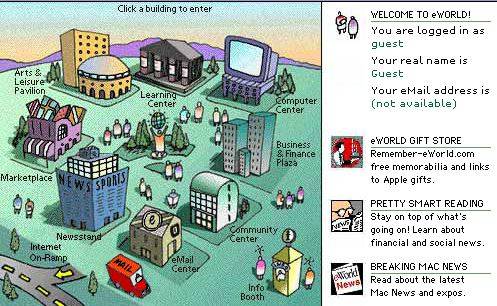
Photo: Apple
Typically for Apple, the idea was for eWorld to be a “walled garden” so that Apple could control the user experience its customers received. Today, of course, Apple’s moderated, walled garden approach to its App Store makes it something of a rarity compared to alternative models demonstrated by the likes of Android. In the 1990s, however, it was not a big departure from the norm; AOL, Prodigy and CompuServe were all attempting to do similar things — no-one quite sure yet what it was that the internet would turn into.
eWorld didn’t just contain material written by Apple, though. A bit like the iOS News app, it served as a (very early) aggregator of news and entertainment from other services, all filtered through a familiar Apple interface.
Looking at eWorld today, the big surprise for a lot of people will be how cartoonish it looks. The notion of turning the internet (or, at least, a version of it) into a Sim City-style settlement, with different buildings representing different services, seems very unnecessary — and non-workable — to users here in 2016. It makes sense, though, when you consider that what it was doing was narrativizing an abstract idea, in much the same way that the graphical user interface “borrowed” the metaphor of the desktop to explain computing concepts to a new audience. Full web-browsing support didn’t arrive until 1995.
The other massive shock for modern audiences will be how expensive the whole thing was. In a world where internet is increasingly ubiquitous and low-cost, two off-peak hours with eWorld’s dial-up service cost $8.95, while hourly costs beyond this (or during the day) set people back $4.95.
Sadly, while Apple is today superb at gauging the right moment to leap on new technologies, in the 1990s its ability to do so was somewhat diminished. eWorld only ever picked up 147,000 users, and it eventually died in 1996 — with remaining customers migrating over to AOL.
You can get a more detailed, Flash-based demo of how eWorld operated by clicking here.

Luke Dormehl is a U.K.-based journalist and author, with a background working in documentary film for Channel 4 and the BBC. He is the author of The Apple Revolution and The Formula: How Algorithms Solve All Our Problems … and Create More, both published by Penguin/Random House. His tech writing has also appeared in Wired, Fast Company, Techmeme and other publications.

3 responses to “Today in Apple history: eWorld opens its virtual doors”
I am earning close to 6000-8000 bucks /a month from freelancing at home. Anyone looking to work simple online work for 2-5 h every day from your home and get decent paycheck for doing it… Then this opportunity is for you… FAVE.CO/20SSeWe
I remember it well. This was in the era before the return of Jobs, when Apple was fumbling around for a way to build relevance on the Internet. Using AOL’s tools, they made a serious effort. Unfortunately, AOL’s practice of mailing out thousands upon thousands of setup CDs (when having a CD ROM was cool and everybody wanted disks to stuff in it. I must have received 35 of those CDs. Frankly it was just as bad an idea as the Pippin – an underpowered also-ran that was the result of bad leadership and wishful thinking at Apple – a rather lame version of Apple’s ivory tower approach to telling people what they should like.
The traffic on eWorld was very low. I remember the night they closed it down. There were a few comments about the state of online chatrooms, etc., then the half dozen who chose to comment that night went away. I was the last one to comment, saying something about the tumbleweeds rolling down the abandoned streets. Not much to brag about. It should never have launched in the first place.
The only way that AOL survived was by making sweeping changes based on consumer studies. It is nothing like what it was and I’m rather surprised that it is still rolling along.
BTW – the prices were not high. That was pretty much the going rate back then. You had to be there. (I remember downloading an OS 7 update once. It took 9 hours – back then being the owner of a 28.8 modem was where most of us were and it was very cool to be doing anything on the Internet at all.)
i also was one of 179K people and i liked experience of eWorld. it defenitely felt like a real comunity, mac oriented one at that! thinking back i think i was spending at least $30+ a month for eWorld subscription and phone bill. now that’s what i pay for my mobile contract~ ^^;;