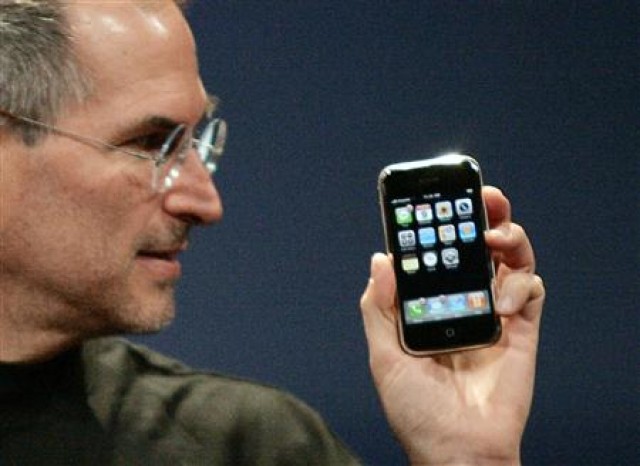
Living in a world where the iPhone dominates, and rivals don’t so much compete by doing things differently as by offering cut-rate versions of the same core technology, it can be easy to forget how much of a disruption Apple’s handset actually caused when Steve Jobs unveiled it in 2007.
A new book chronicling the rise and fall of BlackBerry tells the story from the perspective of the one-time king of (semi-)smartphones. And the reaction was every bit as full of shock, awe, anger and denial as you might expect.
Because iPhone and BlackBerry don’t have to compete for customers, right? Right?
You can check out a longer excerpt of the book here and pre-order it here (it comes out tomorrow), but the below passage really sums up what must have been a pretty shockingly bad day for BlackBerry’s founder and vice-chairman Mike Lazaridis:
Lazaridis was home on his treadmill when he saw the televised report about Apple Inc.’s newest product. Research In Motion’s founder soon forgot about exercise that day in January 2007. There was Steve Jobs on a San Francisco stage waving a small glass object, downloading music, videos and maps from the Internet onto a device he called the iPhone.
“How did they do that?” Mr. Lazaridis wondered. His curiosity turned to disbelief when Stanley Sigman, the chief executive of Cingular Wireless joined Mr. Jobs to announce a multiyear contract with Apple to sell iPhones. What was Cingular’s parent AT&T Inc. thinking? “It’s going to collapse the network,” Mr. Lazaridis thought.
The next day Mr. Lazaridis grabbed his co-CEO Jim Balsillie at the office and pulled him in front of a computer.
“Jim, I want you to watch this,” he said, pointing to a webcast of the iPhone unveiling. “They put a full Web browser on that thing. The carriers aren’t letting us put a full browser on our products.”
Mr. Balsillie’s first thought was RIM was losing AT&T as a customer. “Apple’s got a better deal,” Mr. Balsillie said. “We were never allowed that. The U.S. market is going to be tougher.”
“These guys are really, really good,” Mr. Lazaridis replied. “This is different.”
“It’s OK—we’ll be fine,” Mr. Balsillie responded.
RIM’s chiefs didn’t give much additional thought to Apple’s iPhone for months. “It wasn’t a threat to RIM’s core business,” says Mr. Lazaridis’s top lieutenant, Larry Conlee. “It wasn’t secure. It had rapid battery drain and a lousy [digital] keyboard.”
Of course, BlackBerry wasn’t the only company to write off the iPhone as an impressive-but-expensive toy which wouldn’t have too much of an impact on serious handset makers. The most famous is Steve Ballmer’s hysterical laughing at Apple’s $500 phone, which is likely to go down in history along with comments about how The Titanic was an unsinkable ship.
But few companies have suffered as much of a drop as BlackBerry as a result of Apple entering the smartphone business. As the blurb of Losing the Signal: The Untold Story Behind the Extraordinary Rise and Spectacular Fall of BlackBerry points out, in 2009 BlackBerry controlled half of the smartphone market. Today that number is less than one percent.
And with Apple reaching new heights while BlackBerry haemorrhages customers, that figure doesn’t look like it’s turning around any time soon.
Source: WSJ

Luke Dormehl is a U.K.-based journalist and author, with a background working in documentary film for Channel 4 and the BBC. He is the author of The Apple Revolution and The Formula: How Algorithms Solve All Our Problems … and Create More, both published by Penguin/Random House. His tech writing has also appeared in Wired, Fast Company, Techmeme and other publications.

18 responses to “‘How did they do that?’ New book reveals BlackBerry’s response to original iPhone”
Quote – “The next day Mr. Lazaridis grabbed his co-CEO Jim Balsillie at the office and pulled him in front of a computer.“…Jim, I want you to watch this,” he said, pointing to a webcast of the iPhone unveiling.”
Says a lot too = that Balsillie even the next day didn’t know about the iPhone or a new competitor that was all over the main stream & business news.
THAT”S how clueless these two were and still are.
Agreed!!
And how incredibly dismissive were they of tech companies in general?! They should’ve had their people in the first row ready to report anything interesting that Apple may’ve announced, phone related or not. But my guess is RIM thought of themselves as a “phone company” not a “tech company” and that’s where they went wrong.
Gross misjudgment aside it also shows how lackadaisical they were in their approach to technology and where it was headed. They were perfectly comfortable in their position and like Microsoft never envisioned anyone being able to build a better mousetrap.
The bad news for both companies is that they don’t get a do-over. The ship has sailed and they weren’t on it.
Conversely Apple can’t afford to rest on their success but I don’t believe they’re the same kind of company as they’re more than willing to disrupt their own tech in favor of the better idea.
Yes. And Microsoft and BB certainly watched the ship leave. And even when it was gone, not one these companies had any idea how to attack Apple. Still don’t. Just read today, Microsoft might be trying to buy BB? Huh? The Microsoft purchase of Nokia was so successful? LOL. The MS Board needs to take control.
As I talk to friends and others – only 2 IMO – Apple and Google have a definitive vision of what THEY want to do as companies everyday and into the future. I think Apple is a better managed and visionary company than Google, but Google is their biggest competitor. With Amazon if you think about it.
But Apple building the hardware and software has a huge advantage. And many years doing that. So an edge up for them, Google loses money on everything but search advertising. And they just keep wanting to be something other than the best search/ad company. Not glamorous enough for these CEO”s it seems.
Microsoft I think is very vulnerable in the immediate future as they still just can’t accept that consumers really don’t like the stuff they sell or build. Now building – Surface. Even Xbox has only been a money loser. MS has always been so jealous of the Apple image and can’t let go. Then it was Google for Microsoft to envy and can’t let go. Billions down the drain. They need to concentrate on their enterprise, huge enterprise customers they have but can lose faster than they know.
And yes, it is very impressive how Apple as a company is willing and even plans the disruption of their products. They really just want to build the best of. It was a very impressive show watching Jobs and now Cook turn this company around. Skillful.
if you search youtube for the Jobs/Gates on stage talk with Mossberg back in I think ’07(?) with hindsight as our history, Jobs knew where he was going and building and Gates was kind of clueless.
If Google went the Apple route and controlled the hardware and software Android would be much better, and competition would get slimmer. Samsung would be forced to do a larger rollout of their own OS Tizen, which would most likely either be a good thing(I think TouchWiz is horrid), or would spell their doom, but I’ve never used Tizen. With the Jobs/Gates interview I think as you said it is obvious Jobs knew the tech future and where he was going to take it, but I feel Gates was on his way out and had switched from company future to global social future as he was on his way out to be a philanthropist.
It’s one thing to want to build hardware and software. It’s another thing to be good at it. Google, based on their track record so far, does not know how to do hardware. I don’t think Page, Brin or Schmidt have the mindset or instinct to run a hardware operation that could challenge Apple, or even Samsung for that matter.
For one thing, their penchant to release products in extended or even perpetual beta indicates that they don’t have the discipline and relentless attention to detail to get it right the first time. And with hardware, unlike software, once the customer buys the device, you don’t have much room for do-overs. If you screw it up that first time around, that customer is lost forever. On top of that, not only will he never purchase any stuff from you, his word of mouth will cause you to lose additional potential customers.
When you think about it Apple is the only company in the industry with award-winning, genre-defining products and the world’s most popular and profitable mobile OS.
It’s a delicate balance that didn’t happen overnight when you consider that everything started with the iPod. As great and genre-defining as the iPhone was it was basically an iPod that could make phone calls and the success of that product was a catalyst to the iPhone’s success.
Doesn’t mean Apple’s infallible but at this point they appear fairly untouchable. There’s no other mobile platform on the planet where you can get the best of Google, Microsoft and even BlackBerry as well as Apple’s wares and product synergy.
Very true, but Google really hasn’t taken the time to really try either. Their track record is less than good, but they also haven’t taken the hardware plunge. They have still relied on other companies to build “Google” devices. Nexus is built by Motorola, while Google owns them I believe Motorola kept their original employees.
I am a Apple user, the only version of Android I ever used that was good was pure Android without a skin. Android could be the greatest software ever made and I would never use it simply because of Google policies of tracking, reading, and selling everything you do to advertisers. I only want competition for innovation sake. I just find it sad that the company that makes Android really has nothing to do with new features, it is Samsung and others with their skins that are fostering change. Google has the resources to truly do what Apple does, but I don’t understand why they won’t.
Every time I see this book brought up in the context of Rim’s reaction to the iPhone, somehow they leave out the main, public one: Rim publicaly said the iPhone was impossible and that Apple’s demo was rigged. How this gets left out every time is very interesting. Now, we read about the officers getting together and going, gosh, AT&T never has a second cup of our coffee…it’s as if this book is intended to overwrite that blatant doofusness with a new, somewhat less doofus history to make the people involved seem more competent…like they could have made an iPhone, but the other reindeer wouldn’t let them.
They had a chokehold on what passed for smartphones then, they had all the power, they were operating as a citizen of the technological corporate world as it was then, as it was set down by Microsoft, and imagining what the iPhone was wasn’t natural to that worldview. They were incapable of comprehending it even after they saw it, and called it an impossible trick, a deception. That is how far a break it was from the world they knew.
The focus that Apple brought was alien to everyone. No one started from the end product in the end user’s hand and imagined the best experience. That’s just not how it was done. The only reason it is more often done, or easier to believe it’s more often done, these days is because Apple somehow jackhammered through the stone fortresses of corporate human cattle ranching in technology with pure consumer enthusiasm. Not Fanboy enthusiasm, general public potential users who didn’t previously have real choices. Following this, opponents, naysayers and copycats…after doing their part in public denouncing the iPhone and damage control, seeing the world shift in a way they would never have expected, began trying to me-too themselves into the public’s attention span again…clumsily…without a real grasp of what Apple had done. Arguing the merits of a touchscreen phone without the elastic scrolling…a touchscreen phone with a physical keyboard…putting out scads of crappy lookalike phones….missing the point(s)….over and over….for years.
It’s like the Empire in Star Wars suddenly realizing the light side of the force was winning, and changing their lightsabers blue to catch up with the joneses.
Great stuff. Please write more often.
Blackberry, Nokia….the mighty have fallen.
I do remember one of the co-CEOs, maybe even both, throwing public hissy fits whenever an interviewer asked them about how they plan to fight back against the iPhone. At one interview, he even ended the interview as soon as the reporter asked the dreaded what-about-iPhone question. When I saw that, I thought that RIM had no chance. The CEO didn’t even want to acknowledge its problems, how could they even begin to solve them?
This is ancient history. It was eight years ago, and it’s been reported many times already elsewhere. Yeah, they were caught flat footed by the iPhone. As one who had the original iPhone, I can tell you that it was terrible, despite Jobs’ dog and pony show. It’s not much better now. I couldn’t wait to get rid of the iPhone and didn’t see another one in the wild for at least a year after I got mine. Now that I’m using BlackBerry 10, I can’t imagine downgrading to an iPhone.
So much BS in a single post. You didn’t see an iPhone in public for a year after its release? Where do you live, Antarctica?
I live in New York, and I didn’t see one for a good year. They were not widely used in 2008. I remember it well.
You’re on drug, right? Cuz you re full of sh.t. Do me a favor, STFU!
“Now that I’m using BlackBerry 10, I can’t imagine downgrading to an iPhone.”
Well good luck with that, pal. You’re in a very exclusive club.
When the original iPhone was first announced, and subsequently released, I was managing a Sprint Store. I remember being in a regional meeting in which we were being read the riot act because our stores weren’t selling as many data plans as we “should have.” I made the comment that it was difficult to get a customer to pay for internet access considering what the internet looked like on the phones at the time (it was shockingly similar to what the internet looked like on computers in the early to mid 90’s). When I asked about full internet browsers on cell phones, every suit from corporate that was attending openly mocked me, said that there will “never be full internet on cell phones, it is absolutely impossible.” This was a couple of months after the announcement of the iPhone. When I commented about Apple’s announcement, they then proceeded to get the entire room to laugh at me.
A couple of months later when the iPhone was released, we were directed to mock AT&T, Apple, and iPhone any time a customer brought it up. We were instructed to point out the price, the unfairness of AT&T having an exclusive contract, the fact that AT&T couldn’t preform repairs (that they had to be done directly through Apple), that AT&T’s insurance wouldn’t cover it, that it was untested, that there was no way the internet would work how they advertised, and that its battery wasn’t removable – and really whatever we could think of. The point was to spit out as many problems (real or not) with the iPhone as we could in as short an amount of time as possible.
In the meantime, BlackBerry didn’t seem to be changing much except the shape of their phone and then calling it new. Virtually all other brands, successfully or not, started to adapt to the new expectation that Apple had set. But BlackBerry didn’t seem to budge. We kept getting promotions from RIM (sell x amount of BB phones, get a gift card).
Denial was the name of the game from Sprint and cell phone companies (especially RIM). The denial was thorough from the first announcement of the iPhone until we finally got notice that Sprint was going to be able to sell the iPhone. Once that happened, what we were being told changed COMPLETELY – the iPhone was essentially treated as the messiah, and RIM became like the annoying neighbor kid that nobody wants around.
It is interesting hearing your account as this sounds like the reason why the control of android has been handed to OEMs and carriers for market access.
When you look at how late Andi was to market using Nokia’s form factor, and how much support it got from carriers and OEMs, I feel like retailers were pressured/bribed to push a poor imitatition.
Late and desperate, Google bent users over and agreed drop devices from support after 18 months to benefit carriers contract cycle and OEMs turnover.
Google get the data they require for selling, OEMs get high device turnover, and carriers lock users to long overpriced contracts where you pay $1,000 for a $400 phone.