The year is 2018. After a long day at work, you pull into your driveway, whip out your iPhone 10 Plus and say, “Siri, I’m home.”
Your garage door opens silently, beckoning you to enter the ultra-connected smart home of the future.
As you walk in, your lights turn on. The wife used to get on you about leaving the lights on, but her nagging feels like a distant memory now. Your thermostat cools everything down to a comfortable 69 degrees. Knowing that you pulled into the driveway two minutes ago, your oven has started preheating itself. You usually fix dinner for yourself on Thursdays, so it’s time for frozen pizza.
Your 55-inch Apple TV turns on in the adjacent living room and says, “Welcome home,” in that all-too-familiar voice. Your camera-equipped doorbell will send you a push notification when your son gets home from band practice, but for now, you’re alone. It’s time to watch the highlights from last night’s game, which you queued up from your iPhone at work earlier in the day.
While the “smart home” is barely more than an industry buzzword these days, new technology from Apple and others is paving the way toward a Jetsons-style future when everything is computerized. Your thermostat. Your refrigerator. Your alarm clock. But for it all to work seamlessly, your thermostat needs a way to talk to your refrigerator.
We’re just now starting to see smart home tech mature out of infancy, thanks largely to the likes of Apple, Google and Samsung laying the groundwork for making every device in your house work together. There’s no clear winning platform yet, but Apple is on its way to having the best ecosystem of anyone. And well-done software, not just hardware, will be the key.
“The first platform to deliver a true ‘killer app’ will be the winner.”
“We are still in the nascent stages of smart home deployment,” Gartner analyst Mark Hung told Cult of Mac. “Before picking a winning platform, we’ll need to first determine what is the must-have value that any of these solutions is purporting to deliver. The first platform to deliver a true ‘killer app’ will be the winner.”
HomeKit, Apple’s smart home framework unveiled at the Worldwide Developers Conference last June, has no app in the traditional sense. It’s even simpler than that: Devices that meet Apple’s specifications will be able to talk to one another on the same Wi-Fi network, and Siri will act as the command interface. Telling Siri something like “home theater mode” could set off a chain of triggers that simultaneously dim a room’s lights and turn on the TV, for example.
While many brands like Honeywell and Phillips were listed as partners when HomeKit was announced, the first certified hardware was just shown off at the International CES in Las Vegas last week. Leading the HomeKit charge is a small Connecticut-based company called iDevices, which, under the leadership of CEO Chris Allen, invested $10 million in developing for HomeKit last November.
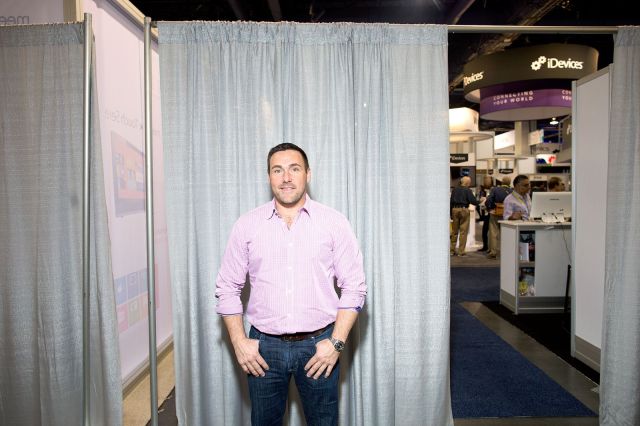
iDevices made a name for itself with the iGrill in 2011, one of the first Apple-approved, app-enabled devices. While a smart thermometer for grilling isn’t exactly a world-changer, it opened the door for a relationship with Apple that Allen, a personal fan of the company, was eager to cultivate.
“Lightning very rarely strikes twice,” Allen told Cult of Mac during an interview in the upstairs meeting area of the iDevices booth at CES. Leaning back in a cushy chair above the bustle of the sprawling show floor, Allen couldn’t seem prouder of iDevices’ new Switch, a HomeKit-enabled wall plug that lets Siri control anything that’s plugged in.
A smart wall plug? So what, right?
It may seem rudimentary now, but the Switch plug represents just the beginning of what the smart home industry will conjure up. Apple wanted a wall plug when it selected iDevices as one of the few partners to work on HomeKit integration early last summer, and the Switch will be available for $50 in the next few months.
The Switch is more than just a remote on-off switch. iDevices is banking on its software putting it in a league above competitors like iHome and Incipio, both of which will offer less-expensive HomeKit wall plugs in coming months.
iDevices has its own app that can create custom schedules and events that chain devices together. So instead of pressing a button on your iPhone to turn on a light bulb, you’re turning on everything connected to a Switch in one room.
iDevices also has its own cloud infrastructure for remotely accessing connected devices when you’re not at home, a feature other companies working on HomeKit integration told Cult of Mac will be possible through the Apple TV.
The Switch wasn’t the only HomeKit product at CES. Schlage’s Sense door lock and Chamberlain’s MyQ garage door opener will work with HomeKit when specs are finalized. A host of other companies, including Google-owned Nest, have expressed interest in supporting HomeKit in the future.
Nest is ‘actively looking into’ HomeKit
“We’re open to integrating with any platform out there,” Nest senior product manager Greg Hu, a former Apple employee, told Cult of Mac. According to Hu, Nest is “actively looking into” HomeKit as well as Samsung’s SmartThings, but no announcements have been made.
The clear advantage of HomeKit is that it doesn’t require any kind of hub in the home beyond an iPhone. iDevices’ Allen is quick to point out that Nest is based on a “hub-and-spoke model,” which he doesn’t believe in. There’s a lot of cool integration happening on the Nest platform (like using Automatic in your car to automatically adjust your thermostat when you’re away), but it all requires Nest’s thermostat or smoke detector to work.
Photo: Jim Merithew/Cult of Mac
The same goes for SmartThings, which sells its own hub for connecting everything from light bulbs to refrigerator. Both SmartThings and Nest are further along in development, with more partners on board, but HomeKit’s iPhone-centric approach will give it an exceptionally wide base at launch.
HomeKit specifications are still not finalized. Companies were hesitant to speak on the record, but several said Apple’s platform isn’t ready for prime time. That’s why all of the HomeKit-compatible products announced at CES don’t have an exact shipping date yet.
As a company that’s already been entrenched in HomeKit for months, iDevices is offering its services to other companies that want to put HomeKit integration on the fast track. The new Schlage Sense door lock and Chamberlain MyQ garage door opener will integrate with the iDevices app, and more brands are expected to join soon.
With no Android support, Allen is betting big on Apple out of the gate to win the home-automation race. HomeKit means that buying a smart home device will be the equivalent of buying an iPhone accessory — it should just work. According to Allen, Apple controlling everything is a good thing because it ensures compatibility and a guaranteed experience for users.
“I think the failure in the marketplace has been that a lot of people have tried to be everything to everybody,” says Allen. “Let the people that do the job really well, like a Schlage, do their job and make a really great lock. If you can create the framework around it like Apple did with the HomeKit protocol, we can create a great iDevices app around that. And that’s where we feel like we can win.”

Alex Heath is a journalist who works for Tech Insider. He’s the former co-host of The CultCast. He has been quoted by the likes of the BBC, KRON 4 News, and books like “ICONIC: A Photographic Tribute to Apple Innovation.” He lives in Lexington, Kentucky. If you want to pitch a story, share a tip, or just get in touch, additional contact information is available on his personal site. Follow him on Twitter.


8 responses to “With HomeKit on horizon, home automation is about to get real”
I’m assuming you would not say, “Siri, I’m home,” as most home automation devices are location aware! They’ll know you’re home so they can start the coffee and warm up the soup without a word.
If this is the future of “smart” homes then I’m disappointed. Having to tell Siri what I want is like telling my kids to go do it. Most cases it would be easier and more convenient if I just went and turned the oven on myself when I needed it.
I don’t need my house to say hello to me. I don’t need my presence sensed in order for my lights to turn on. I use a light switch. I don’t want to have to open up my iPhone to turn a light off. I don’t need to have an app to turn all the lights off for the night. I turn them off whenever I leave the room. I don’t need mood lighting. I don’t want to live under blue or red or orange illumination. What I want are wireless lights that wirelessly recharge. Hang them anywhere. Take them with me. I want a TV that I can hang like a picture frame with no wires. Or that I can project onto a wall (without wires.) Not goggles that isolate me from the family. I do want zoomable binoculars built into my glasses. I do want a Google map overlay built in (Spyglass on acid.) Yet, I will continue to buy a few of everything because I am a gadget addict. Like a meth freak, few of these toys bring me much joy, anymore. But, someday, one of them really will be the next great thing. Like Google Translate.
I’m really tired of having to open the pod bay doors manually. Can’t wait to have that automated.
This article was written as if Homekit is the first and only home automation system (even though it doesn’t actually exist yet). A wifi controlled switch? Really? Haven’t we had that from different companies for years now?
Niche or mainstream market? The Smart Home has been hyped as “the next big thing” for at least 58 YEARS. See The Elusive Smart Home, which has a video of the RCA-Whirlpool Miracle Kitchen, and think of how many of those products you can buy today.
I still have seen no company that “gets it” or knows how to deliver the smart home vision — not Whirlpool and not Apple or Microsoft or Google or Philips or BestBuy. A lot of innovation has occurred in the last 50-some years that is getting us closer to that vision, including smartphones and the Internet of Things, but there are still many marketing barriers that these companies don’t seem to understand.
You had me until “and Siri will act as the command interface.” Siri is reliable for finding out the local weather, sports scores, and that’s about it. When I ask Siri which actor played a particular role, I’m more likely to get a restaurant phone number 700 miles from my current location. If Siri were in charge of controlling my home, I expect she’d kill me within a month.
Working in the field of home automation, I can tell you that most people, present posters included, don’t know the basics about the current state of home automation. There are a handful of controllers, or hubs, that act as the central brain for your home system. They only require ONE app. I don’t know where you people get your information, but each component doesn’t require its own app.
As in their phone hardware technology, apple is WAAAYY behind on home automation. Educate yourself a little and you will see that all of the current controllers already have Android and iOS apps. And no, you won’t need to say “Siri…..” anything. They are already location-enabled, so they already know to open your garage door and turn on the hall lights, etc.