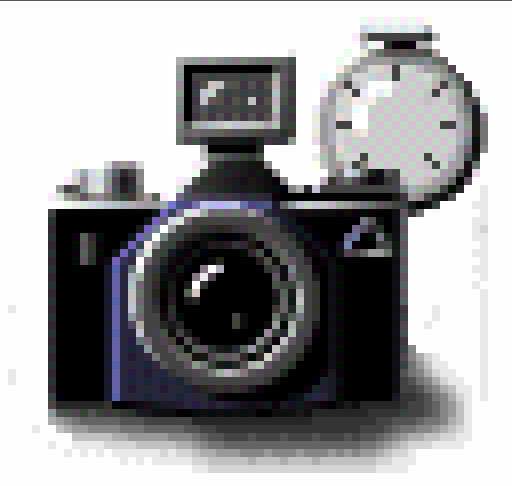
If you’re running Leopard, hit Command + Shift + 4 and then the space bar, and you'll see an icon of a camera that harks back to Steve Jobs's days at NeXT.
The decades-old icon is one of the last visible vestiges of NeXTStep, the old operating system that laid the foundation for OS X in the late ’90s.

The camera icon looks dated, but it’s pretty good by today’s standards. Look at some of the Windows icons from the same period.
The NeXTStep camera can be found in the Resources of the Grab tool (in the Utilities folder) and comes in several different versions with eyes, stopwatches and camera flashes.
Other holdovers from NeXT in Leopard include various system sounds, including Basso, Frog, Funk, Ping, Pop, and Tink, as one commenter notes at Robojamie.net, which first pointed out the camera icon.
And as another commenter says, there’s another old icon in: /System/Library/Frameworks/AppKit.framework/Resources/NSMultipleFiles.tiff
It doesn’t seem to be used anywhere though.
Steve Jobs founded NeXT in 1985 after he was booted from Apple. He had the company build advanced workstations, hoping to drive Apple out of business. But its black magnesium NeXT Cubes were too expensive except for select clients in academia and the CIA. NeXT eventualy dropped the hardware to concentrate on the its state-of-the-art software and operating system, which Apple bought in 1996 as the foundation for the Mac OS.
Apple got a lot from NeXT: Jobs came on as an adviser, and eventually took on the CEO role. A lot of Apple’s top executives came from NeXT and so did lot of its technology. As well as basing OS X on NeXTStep, Apple has built a lot of its online offerings on NeXT’s WebObjects, including its first online store, the iTunes Music Store, its DotMac website and the iPhone App Store.

Leander Kahney is the editor and publisher of Cult of Mac. Leander is a longtime technology reporter and the author of six acclaimed books about Apple, including two New York Times bestsellers: Jony Ive: The Genius Behind Apple’s Greatest Products and Inside Steve’s Brain, a biography of Steve Jobs.
Leander has written for Wired magazine, Scientific American, The Guardian, The Observer, The San Francisco Chronicle, MacWeek and many other publications.