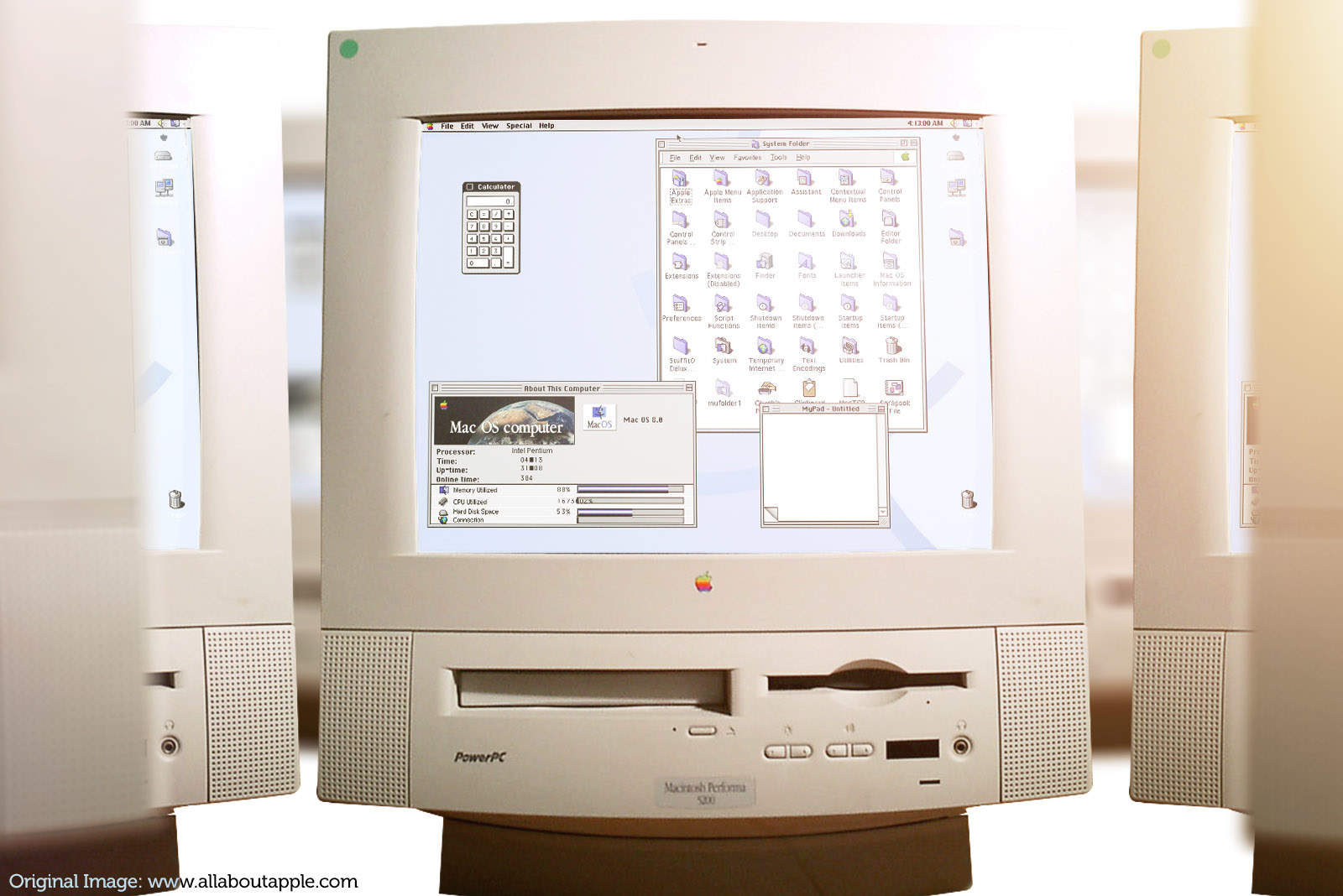
 March 8, 1997: Apple renames the forthcoming Mac OS 7.7 update, calling it “Mac OS 8.” It’s more than just a name change, though: It’s a sneaky sucker punch that ultimately knocks out Mac clones.
Unfortunately for Mac users, the updated operating system does not deliver the total top-to-bottom rewrite promised by Apple’s Project Copland. However, the renaming strategy turns out to be a brilliant (if underhanded) way of getting Apple out of terrible licensing deals.
Mac OS 8 and the attack of the Mac clones
Early 1997 wasn’t a good time to be an Apple watcher. Despite the return of co-founder Steve Jobs, Apple continued losing money hand over fist, suffering through some of its worst financial quarters ever.
One big challenge Apple faced at the time was the existence of clone Macs, which the company originally viewed as a way to save itself from Microsoft’s Windows 95 juggernaut. Starting in December 1994, Apple signed licensing deals with companies like Power Computing and Radius to produce Macintosh-compatible computers.
The goal? Make Mac competitive with Microsoft.
As Apple’s market share fell, long-time rival Microsoft steamed ahead, thanks to its software-licensing strategy. Cupertino execs envisioned clone Macs as a good way to secure Apple’s future.
Unfortunately, it didn’t quite work like that.
Mac OS 8 ends a bad deal for Apple
Apple CFO Fred Anderson worked out that the clone Macs strategy actually cost the company money. The $50 fee Apple received for every clone Mac sold proved far too low. The company failed to even recoup the money lost when a person chose a clone over an actual Mac.
Cupertino could not get out of the disastrous agreement if it kept updating System 7, the Mac OS licensed to clone-makers. However, if Apple released Mac OS 8, it could argue that the deal became null and void.
Apple made the switch, calling the new operating system Mac OS 8. Then Cupertino began negotiating new, more favorable terms with third parties licensing the Mac operating system. However, before Mac OS 8, Apple had been working on Copland OS, an ambitious but ultimately abandoned project that aimed to modernize the Mac operating system.
Mac clone-makers fight back
This inevitably led to consternation from Apple’s licensees. On August 5, 1997, Apple became locked in a standoff with Power Computing after the official launch of Mac OS 8. (You can read more about the feature set of Mac OS 8 here.)
Apple eventually agreed to acquire Power Computing’s customer list and Mac OS license for $10 million and an additional $100 million in AAPL stock. That covered all of Power Computing’s outstanding debts and costs. The clone-maker closed shop for good in early 1998.
Putting an end to Mac clones was one of the first major moves Steve Jobs made as Apple’s new CEO after his 1997 return, along with shutting down the Newton MessagePad division.
System 8 proved a hit in the marketplace, even though it fell short of expectations. Mac fans had to wait for OS X to see a major update, but System 8 marked the start of Apple’s turnaround.

Luke Dormehl is a U.K.-based journalist and author, with a background working in documentary film for Channel 4 and the BBC. He is the author of The Apple Revolution and The Formula: How Algorithms Solve All Our Problems … and Create More, both published by Penguin/Random House. His tech writing has also appeared in Wired, Fast Company, Techmeme and other publications.

5 responses to “Today in Apple history: Apple outwits clone-makers with Mac OS 8”
I remember the clone era. We had a six Power Computing Macs running Pagemaker; they cost a lot less than getting Macs from Apple so it was a no brainer. I still have my sys 8 disk somewhere.
It wasn’t the first time Apple licensed their technology; the Apple ][ Roms were licensed to Laser an ITT for their clones.
Apple’s problem wasn’t only that clones undercut Apple’s hardware those sales and thus profit; but that the market couldn’t be expanded enough to let software be a money maker. There simply wasn’t the hardware readily avaiable to allow companies or DIY to build a bos taht ran Apple’s OS. Apple would have had to go head to head with MS and simply sell the OS to all comers, but absent an inexpensive reference design for the hardware coupled with Apple’s own custom chipsets made making a lot of cheap clones running Apple’s OS nearly impossible. This contrast with the PC world where there were plenty of cheap (relative to a Mac clone) alternatives to run MS’ OS.
I profited 104 thousand bucks in last twelve months by doing an online job at home and I did that by working part-time for several hrs on daily basis. I was following an earning model I found on-line and I am so happy that i earned so much money. It’s very user-friendly and I am just so happy that i found it. Check out what I do… http://weeklybasis10.com
The intended solution to the “inexpensive reference design” was Apple’s CHRP, the Common Hardware Reference Platform. Umax successfully prototyped a design (ERD unit #004 is somewhere in my garage right now), but the whole deal came crashing down, as Luke wrote above, long before we could turn it into a shipping product.
I’m amazed! A surprisingly accurate and complete playback of the end of the clone era! It shouldn’t be such a rarity, but it is. Nicely done, Luke!
I think just two pieces, arguably anecdotal, remain.
The first is that the Umax Computer Corp, makes of the “SuperMac” clones (originally licensed by Radius), did successfully negotiate a Mac OS 8 agreement and shipped its last systems with “SuperMac-ized” Mac OS 8.0 master discs. There was even a Mac OS 8.1 master disc set produced, intended to ship with the ill-fated SuperMac J710, but I don’t believe it ever officially, physically shipped (though several 8.1 supporting files were posted to the UCC web site before the bitter end).
Second, the change of System 7.7 to Mac OS 8 was only one tool Apple used to kneecap the clones. The other was Apple’s refusal to certify any clones with PowerPC G3 processors. UCC got around this by shipping some systems with Newer Tech G3 upgrades in separate boxes, but the only SuperMac machine designed to ship with a G3 built-in, the aforementioned J710, was only certified to contain a PowerPC 604e processor… which, after the advent of the G3, no one wanted to buy. I personally demo’ed the J710 with UCC’s own G3 ZIF design at MacWorld SF in January, 1998, but none of these nice little boxes were ever sold to the public.
By that time, Umax had lost about $65M on the Mac clones venture, so there was simply no point in fighting on.
The “complete” inside story remains today at http://www.kennedybrandt.com/supermac_insider/history/index.html as a free sleep aide.
I remember those horrible years. Putting out a major metropolitan daily with old and obsolescent Macs doing all the graphics through paste-up and sending files to plate-setting by color fax. 13 varieties of old Macs with OS’s running from System 7.1Pro through 7.3.5, finally updating to System 7.6.1 and THEN, almost miraculously, OS8. Quark Xpress was horrible with its sensitivity to each separate OS and individual licensing per station and its reps were notoriously rude, PageMaker barely limping by from one update to another, with separate, expensive add-ons needed for every new feature, taking 5 minutes to complete a drop-cap. We used a specialty newspaper app called Multi-Ad creator, which was fantastic for our purposes, and which was only occasionally problematic with Illustrator and its paths (which showed up as ghosts). We loved Kai’s Tools, but had a license for only one seat, so only one operator at time could use it. And then Adobe cut a deal with Kai Kruse, and his tools disappeared and we had to learn Illustrator all over again.
OS8, 8.1 (which meant that all our non-Power PC Macs were rubbish) and the new G-series put us back on the path again. And Adobe became buddy-buddy with Apple again, and life became easier. Lots of fun in the old, bad days, for sure. And then we came to love and use InDesign, which finally lost its bugs and became the great app it is today.