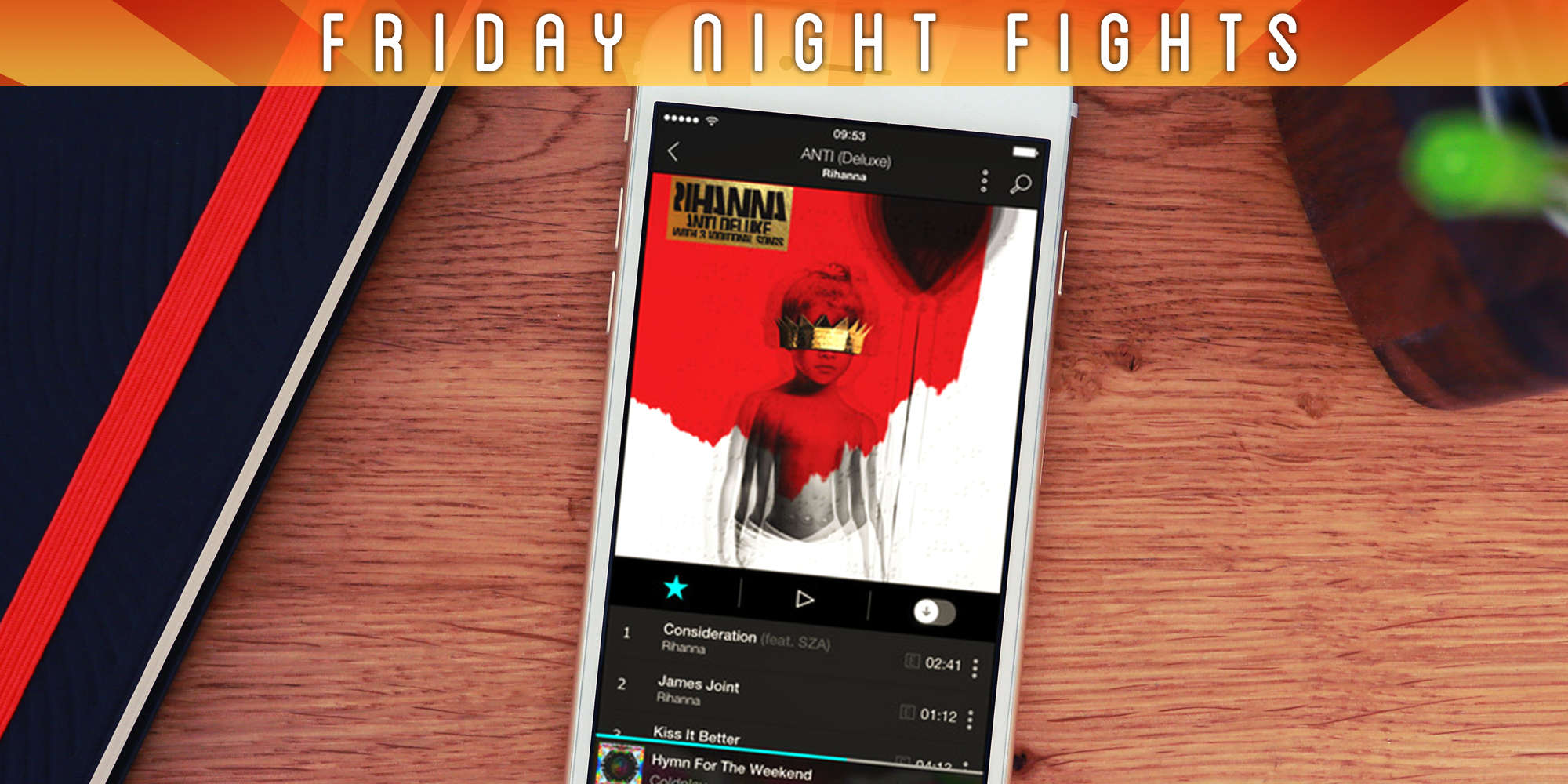
When you have the kind of cash Apple has, the easiest way to take down the competition is to just buy it. That’s exactly what the Cupertino company is planning to do with Apple Music rival Tidal, according to a recent report.
 But would a Tidal takeover be a good move? Would Apple be using its money solely to wipe out a rival, or will Tidal’s talent and connections to the music industry be great for Apple Music?
Join us in this week’s Friday Night Fight as we battle it out over the latest Apple acquisition rumor!
 Killian Bell: I think buying Tidal would be a terrific move for Apple. Sure, Spotify is by far the biggest music streaming service, with more than twice as many paying subscribers as Apple Music, but I think it’s Tidal — with its close ties to the music industry and strong backing from so many major artists — that actually poses the biggest threat in the future.
What’s more, Apple Music and Tidal share a lot of things in common. They’re both focused on supporting artists. They both have support from plenty of famous faces. And they both offer some incredible exclusives that are worth subscribing for. In comparison, rivals like Spotify and Deezer are, dare I say it, a little boring.
Spotify may be big now, then, but that’s only because it’s been around the longest. Once Apple Music has had its kinks ironed out, and no one’s complaining about it being so unfriendly, I don’t think it will be at all difficult to persuade music lovers to switch. But Tidal has enough to lure them the other way — and gobbling the company up is the easiest way Apple can put a stop to that.
 Luke Dormehl: A lot of what you say makes perfect sense Killian, but I’m going to have to disagree — and not just because it’s the format of Friday Night Fights. Could Apple buy Tidal? Well, of course it could. Apple could buy any tech company it wanted to and still have Scrooge McDuck-style money vaults left over.
Should it? Certainly it makes sense in the classic acqui-hire way tech companies typically operate: gobbling up competitors to take them out of the game. But Tidal doesn’t really offer a threat to Apple, and as far as I can see it doesn’t have any particular technological advantage that Apple would gain by buying it.
The only “advantage” Tidal ever really had was the fact that it was committed to making more money for artists. Now that’s a fair enough goal, but the idea of it as some scrappy artist-run endeavor pretty much vanishes the moment it’s absorbed into the Apple Borg. And what does Apple get out of it? The image of being the big company that swooped in and bought out an artist collective, and possibly more of the same culture clash teething problems it suffered when it bought Beats.
A lot of people are still questioning whether Beats was a wise investment for Apple, and Tidal makes even less sense — since it doesn’t have close to the same name recognition, core talent (hasn’t it switched CEOs about three times in the past year?), or the hardware division that made Beats at least make a bit more sense as a purchase. Again, Apple could buy Tidal without breaking a sweat. But should it? I just don’t think that buying out all the competition has ever been Apple’s mandate.
Killian: Well, in this case, I don’t think it’s necessarily about what Tidal can do for Apple. I think it’s about stopping Tidal in its tracks before it can become a big problem. No, that’s not normally why Apple acquires companies, but Apple doesn’t normally struggle to get a product off the ground like it is with Apple Music — though it hasn’t been that slow.
The way I look at it is this: If you’re an Apple Music subscriber already, there’s no great reason to switch to the likes of Spotify or Deezer. However, there are reasons to switch to Tidal, like its backing from your favorite artists and exclusive albums from Rihanna, Kanye West, and others. Apple takes on all of that if it takes Tidal off the map.
The other thing Tidal has is high-resolution audio. The company has reached a deal to use Meridian to use its MQA format, which allows high-res audio to be condensed into a file that’s a fraction of the size of a FLAC track. That makes it ideal for streaming services.
So I don’t agree that Tidal has nothing to offer. It might not have the talent other Apple acquisitions have had, but for the sake of Apple Music, the world is a better place without Tidal in it.
Luke: I guess I just don’t see it. Don’t get me wrong: I’m not opposed to Apple acquiring companies with a degree of name recognition (even thought Tidal certainly doesn’t have the positive buzz that Beats did among a certain audience.) I just don’t see what Tidal adds. It may have an agreement to use tech that allow high-res audio to be compressed, but does it own patents that would stop Apple doing a similar thing? And, if not, what’s to stop Apple from licensing the tech itself — or acquiring the company which owns it so as to stop others from licensing it? I just don’t think Tidal has anything that Apple hasn’t already got access to.
If the company flops, and Apple Music continues its ascent, artists are going to want to attach themselves to the Apple bandwagon just as they’ve been doing for years. Sure, you get the odd artist like Bon Iver’s frontman complaining about the service, but the general impression you get when you hear artists interviewed about Apple Music is that it’s a much better deal than the free streaming companies like Spotify. It’s more sustainable in the long run and it offers an unparalleled opportunity to reach users. Some artists may be loyal to Tidal, but does that loyalty contractually transfer to Apple if Tidal is bought and shut down? And if Tidal’s a sinking ship, why not just wait and pick up the valuable pieces later on?
Nothing about this screams “must buy” to me.
Killian: I don’t think Tidal is a sinking ship. It has had its problems, but it’s not going anywhere any time soon with all the support it has. Jay Z and friends will keep throwing money at it until something sticks — or a company like Apple comes along and snaps it up.
Let’s hand this over to the readers now. Do you think Apple would be crazy to waste its money on Tidal? Or is the acquisition worth it just to take out another Apple Music competitor? Leave your thoughts down in the comments!
Friday Night Fights is a series of weekly death matches between two no-mercy brawlers who will fight to the death — or at least agree to disagree — about which is better: Apple or Google, iOS or Android?

Killian Bell is a freelance writer based in the U.K. He has an interest in all things tech and also covers Android over at CultofAndroid.com. You can follow him on Twitter via @killianbell.

10 responses to “Why Apple should buy Tidal (and why it shouldn’t) [Friday Night Fights]”
Tidal can’t keep CEO’s, they’ve gone through 3 in about a year, they’ve been laying people off and they are/were getting sued over not paying royalties. A big NO NO. I don’t think JayZ really knows what to do since he’s not exactly a business person when it comes to actually running a company. He just likes marketing himself to suckers for his BS, and the others that are with him aren’t exactly business experts either when it comes to running a tech company as they are more into marketing themselves, which isn’t really needed for a streaming service. I think Tidal has been losing money from the start, just like Spotify and if they can’t find a suitor like Apple, then they might eventually have to shut their doors. Spotify has more subscribers, but they lose more money. So, no one is making a profit, but a company like Apple doesn’t rely on their streaming services for profits, as they make their profits from hardware sales of iPhones, iPads, and computers. The problem is that these streaming service companies simply can’t charge enough to become profitable, hence why Spotify has to always get more money, etc. I think Apple buying Tidal is a good thing if they keep MQA/Lossless and help drive that as the new Hi Res standard for streaming. It will help light a fire under BMG and Sony to spit out MQA content since Warner is already signed on, and having a major player like Apple behind it, will help MQA’s efforts as a high quality Lossless streaming for those that don’t mind paying more for a premium sound quality. As always, the masses aren’t going to go with a premium streaming services, but those that are into high quality audio, typically don’t mind paying more and I think Apple SHOULD offer several tiers of pricing. One for advertising based free, one for Lossy paid subscription and a one for Hi Res audio. If you look at Apple’s Store, they do sell some rather expensive audio products as they offer the Devialet Phantom speakers which are $2000+ each. It wouldn’t surprise me if more higher end audio products get sold through Apple as a way to sell product since Apple is a big content supplier. I actually thought Apple should have purchased Tidal instead of Beats. It would have saved them more money and they could have had Lossless right from the start and still offered a less expensive Lossy version. Since Apple’s getting rid of the 3.5mm jack, there is going to be a big push in Lightning (or maybe USB-C) headphones with built in DACs coming to the market which would make it more plausible to offer a Hi Res Streaming to those that pay a little more for DAC headphone that’s of higher quality.
Yeah, Apple should buy Tidal because the whole Beats Music purchase was such a winner, right?
Tidal has nothing that Apple needs. The market isn’t clamoring for streaming lossless music encoded at sampling rates that allow reproduction of bat sonar. In fact, 99% of the public couldn’t tell the difference between 256kbps AAC and 24bit/192KHz lossless audio — regardless of the quality of the DAC, headphones, or speakers. That Tidal remains in financial trouble only reinforces my point.
I have made blind tests with lots of people and the majority can spot lossless from 320kbps quite easily. The problem is that people think that music should sound like crap because the kids today have never seen a CD.
I compared Tidal vs Spotify vs iTunes comparisons and Lossless is very easy to pick out, plus it’s over the course of listening to music for the long term as Lossy just gets annoying and I can’t listen to it for extended periods of time.
I personally have most of my catalog ripped from CD to AIFF, so I’m using uncompressed format. But I do have some AAC, some MP3 320kbps, some 24 bit (various sample rates) in AIFF and it’s interesting to hear the differences in sound quality, but I do that listening on a pretty good stereo in my home and I have to make sure I turn off the HVAC because the fan noise is too loud and that gets annoying on it’s own. :-) I have one 24 Bit recording where they pretty much removed the audio compression/limiting and it’s so damn clear compared to even the CD version that I rip to AIFF. I can hear very subtle things that were in the studio that get taken out in the CD version. It’s VERY noticeable to me. I sometimes freak out when I listen to certain passages on how much clarity, 3 dimension realism for some of the 24 Bit versions I got from HD Tracks. I am looking forward to MQA encoded content, and I’m hoping that the music players get the software codecs so i can still use my existing DAC since I don’t really want to have to buy a new DAC just to listen to MQA content, but we are still in waiting mode. I just hope it’s worth the wait and whether Apple gets on board with MQA (with or without buying Tidal) is another story. If they do, then I might be VERY interested in signing up for Apple Music, but right now, I don’t use any streaming service because I listen to my pre-existing catalog and that’s sufficient since I have a large catalog of recordings and very little new content comes out that’s worth buying or even listening to. The whole exclusive marketing crap they are doing is of no interest since I don’t listen to Drake, or these others clowns that put out exclusive content.
No offense intended, but your tests do not align with the results from peer-reviewed studies such as one presented at the 127th Audio Engineering Society convention entitled “Subjective Evaluation of MP3 Compression for Different Musical Genres.” It was conducted by researchers at CIRMMT & McGill University.
The causes of false positives in blind-testing can be the result of unintentional cues being given by the person ‘flipping the switches’, much like a poker player may exhibit a “tell” when he has a good hand, explaining why the gold standard for such studies is double-blind ABX. I’ve seen cases where the two sources are not perfectly level-matched or where there is a delay such that the user is discerning that one source is “ahead” of the other. I’ve even seen cases where the sources were not going through the same audio chain, with differing A/D converters and analog electronics prior to feeding the preamp or audio switch.
I’m not saying that it’s impossible to create artificial signals that might allow a listener to discern such differences, but tests using music have had results like the AES presentation cited above.
That aside, no listener benefits from MQA’s ability to encode 384kHz sampling rate on audio. That’s literally capable of recording frequencies close to double the highest frequencies that bats can hear.
Well, that’s what MQA is all about. It’s to bring better than standard lossless with a lower bandwidth requirement. The thing about MQA is you have to have the codec, which if they licensed from Meridian, they could stick the MQA codec in the software so any decent DAC could play it back. The executives at Warner Music have done their own listening tests of MQA and they have decided to bring their catalog to MQA. Now, MQA is VERY new and there isn’t much content right now, but over time, there will be more. MQA is a new codec that allows for even closer to the original master than 24/192 with smaller file sizes and you don’t get pre or post ringing problems that’s associated with other compression formats. Now, do the masses care? NO, probably not, but there is a group of people that do care and are willing to pay more $ for streaming Lossless and eventually with MQA which might lower the bandwidth requirements. Essentially MQA enables as close to the original master by with much lower bandwidth for streaming it.
The noise floor is lower and there are essentially no artifacts. So if you have a decent playback system, in a quiet environment and you have spent time learning what to listen for, there is supposed to be a quite noticeable difference, but you’re right in the masses not caring, but that’s why it would be wise for Apple to offer 2 different tiered pricing, one for Lossy playback, and one for Lossless/MQA playback. Some people CAN tell the difference between Lossy and Lossless, ESPECIALLY with recordings of acoustic instruments that have no audio compression, limiting that’s done during the mastering process. If you listen to modern music that’s mostly synthesized, lots of distortion, audio compression, limiting, and a lot of signal processing, it doesn’t matter as much, but for those that listen to classical, acoustic jazz or just really well recorded acoustic instruments and voice, you want a higher quality sound and it’s more noticeable to hear differences.
All streaming services are in financial trouble. Heck, even Apple’s streaming music service probably is losing money, but they bundle that portion of their business into “services” which also includes AppleCare (which is 100% profit) and app store purchases and then that gets bundled into the rest of Apple’s business, so whatever losses Apple Music has gets buried into the rest of their business model, but they can absorb those losses a LOT longer than Spotify and Tidal. I think ultimately, they will both get sold off or go out of business, it’s just a matter of time.
Tidal has over 4 Million people and there are more that would want Lossless streaming. I would want it, but I want to wait until MQA is adopted more widely because some of what I listen to is with Sony and BMG, along with Warner. MQA is just really new, and it’s getting a lot of attention amongst the “audiophile’ crowd as they are figuring out what it’s all about, but so far, I’ve heard a lot of positive things about it, and Warner Music has signed on to converting their catalog, which is usually a good sign.
The whole aspect of whether or not these companies can be profitable has to do with how much they charge per month, I think the Lossy crowd should probably be charging more like $15/mo, while the Lossless crowd should be charging more like $25/mo. Obviously, the people that would want Lossless have more money to spend since they can afford higher end stereo systems, so paying the higher monthly fee isn’t the issue, it’s all about can they get the content and many of them are just used to vinyl and collecting content rather than streaming it, but as time goes on, more and more are adopting streaming services and more and more are waiting for MQA content to emerge.
Streaming is still relatively new, and it takes a while for people to adopt it. As far as Lossy vs Lossless, yeah, at this point in time the average person doesn’t give a crap since the recordings the average person listens to is synthesized, heavily processed and distorted guitars,etc. so it’s not as critical, but don’t dismiss the fact that there is a segment of the population that doesn’t listen to that music, they listen to and enjoy acoustic recordings with little to no artificial crap during the recording, mixing, and mastering process and for those people, the audible difference between Lossy and Lossless IS noticeable. And yes, there are more and more listening tests conducted which are proving that there is a noticeable difference between Lossy and Lossless/HiRes recordings.
I’ve been into high end audio since the 1980s. I’ve seen all kinds of claims about the audibility of everything from green paint at the edge of CDs to little pointy feet under amplifiers. I’ve conducted tests where self-proclaimed audiophiles swore that they heard degradation from a piece of signal processing equipment — except that it was never in-circuit, I just muted the output for a fraction of a second to simulate switching signal paths. So I don’t buy into the claims of improved sound until someone demonstrates it with properly designed and conducted, peer-reviewed tests.
You wrote: “Well, that’s what MQA is all about.””
What MQA is all about is generating revenue for Meridian, music publishers, and streaming services. The same company that sold you an LP of an album in the 1970s, an “audiophile pressing” of the same album in the 1980s, a CD version in the 1990s, and a “remastered” CD version with “bonus tracks” a few years later, would be happy to sell it to you again as an MQA release.
While I realize that Meridian continues to deny this, MQA is also a Trojan Horse with a belly full of DRM.
From the CES 2015 Q&A on MQA (note my ***HIGHLIGHTING*** in the passage):
___________________
1. The MQA syntax supports a hierarchy of authentication keys using strong encryption. The encryption protects the encoding/decoding instructions, various metadata and verification of both lossless digital transmission from studio to decoder and ‘beyond digital lossless’, it authenticates the analogue-to-analogue path — which is a major step forward in sound quality.
2. At the lowest level the keys verify that the stream is genuinely MQA. This is important for the full benefit of Authentication to be realised and we hope that facility will ignite new and enriched ways for artists to communicate with fans and for listeners to appreciate ‘the real thing’. MQA is neither a DRM nor conditional-access system; listeners can still enjoy the music without a decoder in a variety of legacy playback scenarios, ***IN ACTUAL CD QUALITY***. However the keys protect the ecosystem.
___________________
Translation: It’s just like HDCP for video, where the source drops back to 480P quality if it doesn’t find HDCP at the other end. With MQA, it drops back to 16/44.1.
You wrote: “It’s to bring better than standard lossless with a lower bandwidth requirement. … The noise floor is lower and there are essentially no artifacts.”
A 24 bit sampling depth provides a theoretical noise floor of at least 144dB. That’s orders of magnitude better than the performance of any analog electronics — even from a theoretical standpoint due to Johnson noise.
According to an analysis by John Siau, VP and Director of Engineering at Benchmark Media Systems (makers of the highly acclaimed Benchmark DACs), “MQA is NOT Lossless…the original 24-bit signal is never recovered. MQA does not losslessly preserve the original 24-bit signal. For this reason MQA is not truly a lossless system. At best, the MQA system losslessly conveys 17-bits at 96 kHz.”
I urge you to enter “Is MQA DOA?” into Google and hit the “I’m feeling lucky” button to be taken directly to the article (I can’t seem to post links here without my post going into endless purgatory).
You wrote: “So if you have a decent playback system, in a quiet environment and you have spent time learning what to listen for, there is supposed to be a quite noticeable difference…”
Demand proof. Because Paul McGowan, of PS Audio, didn’t find that to be the case, writing “Expectations were high since we’ve heard how much better the MQA file should sound, better than even the original! I’ve seen pictures on the MQA website of people crying after listening – so much better the process is supposed to be. Imagine my surprise when it was worse than the original.”
You wrote: “which also includes AppleCare (which is 100% profit)…”
Huh? When I had issues as a developer, one of their engineers spent more than 45 minutes with me on the phone, even pulling OS source code to investigate the problem I’d seen. And it was done at no charge against AppleCare for a used Mac Pro that I bought. How was that “100% profit” for Apple?
You wrote: “And yes, there are more and more listening tests conducted which are proving that there is a noticeable difference between Lossy and Lossless/HiRes recordings.”
That’s rather vague. I don’t think that anyone would say that there is no audible difference between 128kbps MP3 and 24/96 lossless. But how about 320kbps VBR MP3 from a respected codec like LAME? Or 256kbps AAC encoding? I’ve cited a peer-reviewed study presented to the AES. Do you have similar peer-reviewed, double-blind studies that showed different results?
Well, there are a few things Tidal has, that Apple wants badly. And it’s there exclusive artist. Hell, it’s one of the biggest reasons Apple started Apple Music in the first place. It was actually going to be one of Apples biggest advantages over Spotify. This was the year that Tidal really flexed its muscle. Tidal just had one of the absolute biggest exclusives of the freaking year. Beyonces Lemonade Album/Art Movie. One of the absolute biggest albums of the year, and Apple didn’t even get a tiny piece of the exclusive love. I think this is one of the main reasons Apple is considering this purchase. The same happened with Kany West Life of Pablo Album, & Rhinnahs new Album. Remember…. When Beyoncé released her last huge release, it was an Apple iTunes exclusive, for a long period, and Apple even had a Beyoncé iTunes takeover on the first week of its release. Tidal may not have as many users as Spotify & Apple music, but there strategy is genius, and puts them in a powerful position. If anything can persuade people to pay $9.99 a month to listen to music, it’s huge Artist exclusives. Hints the talks there having with Apple right now.
Larry, most of what I’ve seen is Tidal getting exclusive albums, not artists. And they’ve done that through large payments and dilution of ownership by giving artists stock in the company. As of the end of March, there were 20 “artist-owners” at Tidal.
Those exclusive albums are leading to piracy from people who choose not to subscribe to yet another streaming service. Kanye West’s fans were very critical of his decision to initially release his album The Life of Pablo as a Tidal streaming exclusive. And the album had been pirated over half a million times as of February 17, 2016 according to the website Torrent Freak. Kanye West later made his album available for streaming on competing services.
Beyonce’s Lemonade album is no longer exclusive to Tidal. She’s now made it available through Pandora. Apparently she didn’t feel the need to be exclusive and faithful to her husband’s company.
MQA is just another lossy, but proprietary, audio codec. Why would Apple want to buy into that when they could design their own HD audio codec (in fact, they’ve probably already done so and have it waiting in the wings) and give much better assurances about future support? My guess is that the acquisition is purely about increasing market share/position (and that’s okay!).