Filed Under: FutureWatch
What I’m going to say will likely disturb some folks, particularly in light of the fact that iTunes just became the #1 music retailer in the world this month. But work with me a little.
The online music revolution has not occurred, yet.
That’s it. No wild speculation, or tin-foil hat accusations, (and yet your characteristic sensationalism remains –ed)
That is the whole of the thing. While other industries have seen often dramatic effects on their business as a result of the internet, the music business is much like it was when my dad had a music store 20 years ago. Consumers still shop, they buy records, or singles they’re interested in. In short, online music has not been changed by the internet (save for the piracy aspect), it remains the same “Buy and Consume” metaphor it has always been.
In the spirit of disrupting future software patents by publishing prior art, after the break we’ll discuss in detail exactly how Apple could change all that.
Way back in the dark-days when the internet was just FTP and DARPA net, when the World-Wide-Web was just some cool photos from NASA, I had occasion to discuss with an analyst from the Central Intelligence Agency, on the subject of the proliferation of networks, and information exchange, and how that might effect his core business (distilling information into actionable intelligence).
What he said was”¦ well we’re not going to talk a lot about everything he said, because there were all kinds of words in there that I didn’t understand”¦ but ONE thing he said that really, really stuck with me to this day was:
“With these new systems [the internet], we’re not going to be able to control information anymore. But we’ll be able to do something just as good. We’ll be able to know what information someone has access to. And knowing what your opposition knows is just as valuable as what he knows.”
Now that was some serious spy-gobbly-guck, and this cat really talked that way. What he was trying to say was (for example), simply knowing that the Chinese have the plans for the MK23 Mascot-Shoulder-Fired-Tee-Shirt-Launcher (what did you think they were going to do during the half-time at the Olympics?), is as valuable as having the plans for the MK23 MSFTSL itself.
I mention this because that’s a revolutionary thought.
You don’t think so?

Back in those days there was a company Lexis-Nexis (there still is) and they controlled information search. They had the data, if you wanted to search it you have to pay (and you still do).
Now a days, there is this little company that thinks that simply KNOWING what you’re searching for, and KNOWING your results is as valuable as all of the data they’ve indexed.
Or lets put it in terms of our present thesis: “KNOWING that someone has a particular song on their iPod, is just as valuable as the song itself.” Take THAT RIAA!
I say that lightly, but I am deadly serious here. If we were to couple in information like, frequency and times played, personal rating, how long they’ve had the song, and how that play has increased or diminished over time, you’ve got information that is Significantly More Valuable than the song itself.
If someone is willing to pay Google twenty cents just because you searched for The Doors, what do you suppose detailed information about your listening habits about The Doors might be worth?
This extends WELLLLLLLL beyond music searches. We have this thing called BI Analytics, it’s what Amazon or Netflix uses to make product recommendations for you. You suppose that if the analytic software worked out that folks who still listen to The Doors are more 500 times likely to buy organic fair trade coffee than Beyonce fans, that information might be worth 99 cents to someone to let you download ‘Love me two Times‘?
I want to be crystal clear: I am not talking AT ALL about ad supported music, Forget that. I’m not listening to “Buy gold, it’s great, so great we’re buying ads to try and sell it“ advertisements on my iPod, forget it. That’s not revolutionary, that’s not even evolutionary, we have that already, it’s called The Radio.
What I’m talking about is a browser that integrates with iTunes to anonymously provide information to ad-syndicates that work with various portals and sites which can be used to trigger topical advertising that might actually be of interest to me. For you visual thinkers, this:
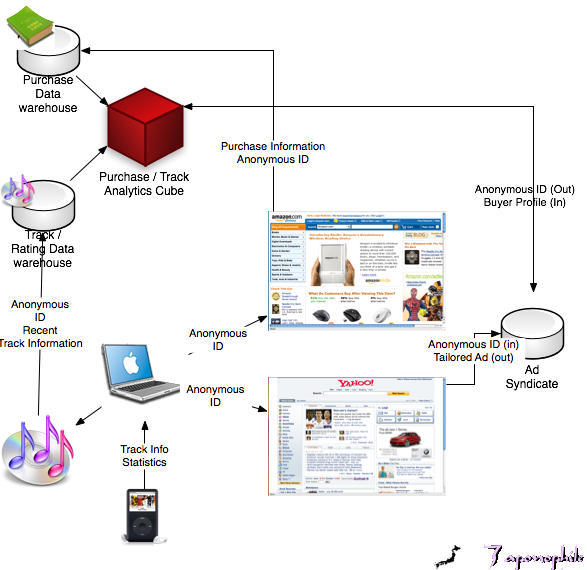
I’m used to seeing ads on these sites anyway, from my perspective as a consumer it’s the status quo. It might even be more accurate; as my taste in music is a whole lot better indicator of what I like and what I might buy than what I happen to be searching for.
Thats revolutionary. There’s only one company in the world that could pull it off, that has the library, the audience, the browser and the pull in the industry to make it happen.
Meet the New Boss, Same as the Old Boss:
Apple.
————————–
Credits: I don’t usually do this, but this post was inspired by Nick Carr, the ideas were all mine, but he has an almost magical talent for getting me to think of things differently. If you don’t currently read: Rough Type, you should.

Leigh McMullen leads the Advisory Services & Strategy practices for the professional services arm of one of the Big-Five firms. He has written several books that would cure any insomnia you might have, and is an avid Mac junkie.