Our old friend Farhad Manjoo has an insightful piece on Slate explaining why he hopes Apple’s tablet will be like a toaster.
Farhad hopes the tablet will have an iPhone-like operating system (as we’ve mentioned here before) that offers a somewhat restricted, locked down computing experience like the iPhone. That is, he hopes Apple has removed all the complexity of using and maintaining a traditional personal computer.
“The most revolutionary thing about Apple’s phone wasn’t its sleek case or the multitouch gestures, but the artful way in which it hid nearly every bit of complexity behind a display of easy-to-understand icons. The iPhone contains no visible “directory structure.” Your music is not in a particular place on your phone; it’s just on your phone, and you get to it by launching the music player. Other than charging it, the iPhone requires no maintenance. Backups and OS upgrades occur automatically, and because all programs are approved by Apple (and because even third-party programmers aren’t given deep access to the phone), you never have to worry about malware. And look how easy it is to install a program: Choose one from the store, press “Install,” and type in your password to authorize the purchase—and that’s it. The iPhone doesn’t ask you where you want to put the new program, or how you’d like to launch it, and whether you’d like it to be the default program for doing a particular kind of task. It just puts up a little icon on the screen. To run the program, click the icon. To do something else, hit the home button.”
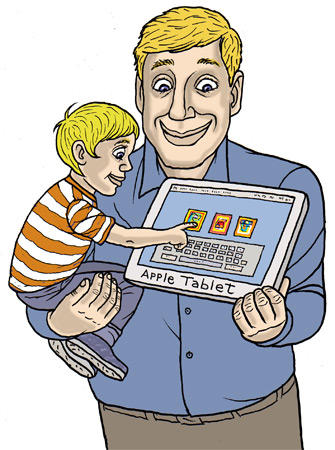
I think Farhad has put his finger on the most important feature of the tablet. It’s not designed for nerds, like traditional PCs (even the Mac) but for ordinary consumers who have no interest whatsoever in learning how to use a computer.
If you can get your noodle around it, it’s an astonishing thought. Steve Jobs is attempting to reinvent computing again, but to do it right this time.
The tablet will usher in a new era of consumer-level computing that will be utterly different to computing in the past. Instead of mice and keyboards, there’ll be a new generation of software designed for fingers and voice. It’ll be a lot easier to use (see all those videos of toddlers using iPhones), and a lot easier to maintain. Thanks to Apple’s controls over app installation, it’ll be largely free of the viruses, driver issues and tech-support headaches of traditional PCs. Of course, we’ll sacrifice some freedom to tinker for all this — but who cares? (Our own Leigh McMullen for one. See his “My Tablet Won’t be Running any Silly Phone OS.”)
No wonder Steve Jobs is so excited about the tablet. All the way back to the Apple II in the late 1970s, his earliest ambition was always to make computers accessible to mere mortals — to make the computers “for the rest of us.” It’s the realization of his earliest dreams.

Leander Kahney is the editor and publisher of Cult of Mac.
Leander is a longtime technology reporter and the author of six acclaimed books about Apple, including two New York Times bestsellers: Jony Ive: The Genius Behind Apple’s Greatest Products and Inside Steve’s Brain, a biography of Steve Jobs.
He’s also written a top-selling biography of Apple CEO Tim Cook and authored Cult of Mac and Cult of iPod, which both won prestigious design awards. Most recently, he was co-author of Cult of Mac, 2nd Edition.
Leander has been reporting about Apple and technology for nearly 30 years.
Before founding Cult of Mac as an independent publication, Leander was news editor at Wired.com, where he was responsible for the day-to-day running of the Wired.com website. He headed up a team of six section editors, a dozen reporters and a large pool of freelancers. Together the team produced a daily digest of stories about the impact of science and technology, and won several awards, including several Webby Awards, 2X Knight-Batten Awards for Innovation in Journalism and the 2010 MIN (Magazine Industry Newsletter) award for best blog, among others.
Before being promoted to news editor, Leander was Wired.com’s senior reporter, primarily covering Apple. During that time, Leander published a ton of scoops, including the first in-depth report about the development of the iPod. Leander attended almost every keynote speech and special product launch presented by Steve Jobs, including the historic launches of the iPhone and iPad. He also reported from almost every Macworld Expo in the late ’90s and early ‘2000s, including, sadly, the last shows in Boston, San Francisco and Tokyo. His reporting for Wired.com formed the basis of the first Cult of Mac book, and subsequently this website.
Before joining Wired, Leander was a senior reporter at the legendary MacWeek, the storied and long-running weekly that documented Apple and its community in the 1980s and ’90s.
Leander has written for Wired magazine (including the Issue 16.04 cover story about Steve Jobs’ leadership at Apple, entitled Evil/Genius), Scientific American, The Guardian, The Observer, The San Francisco Chronicle and many other publications.
Leander has a postgrad diploma in artificial intelligence from the University of Aberdeen, and a BSc (Hons) in experimental psychology from the University of Sussex.
He has a diploma in journalism from the UK’s National Council for the Training of Journalists.
Leander lives in San Francisco, California, and is married with four children. He’s an avid biker and has ridden in many long-distance bike events, including California’s legendary Death Ride.
You can find out more about Leander on LinkedIn and Facebook. You can follow him on X at @lkahney or Instagram.

